Photo: Maksim Goncharenok / Pexels
The diets react (see scores below)
Common Ingredients
- potatoes
- bacon
- onion
- eggs
- milk
- salt
- pepper
- sour cream
Specific recipes may vary.
Incompatible with 10 of 11 diets
Diet Ratings
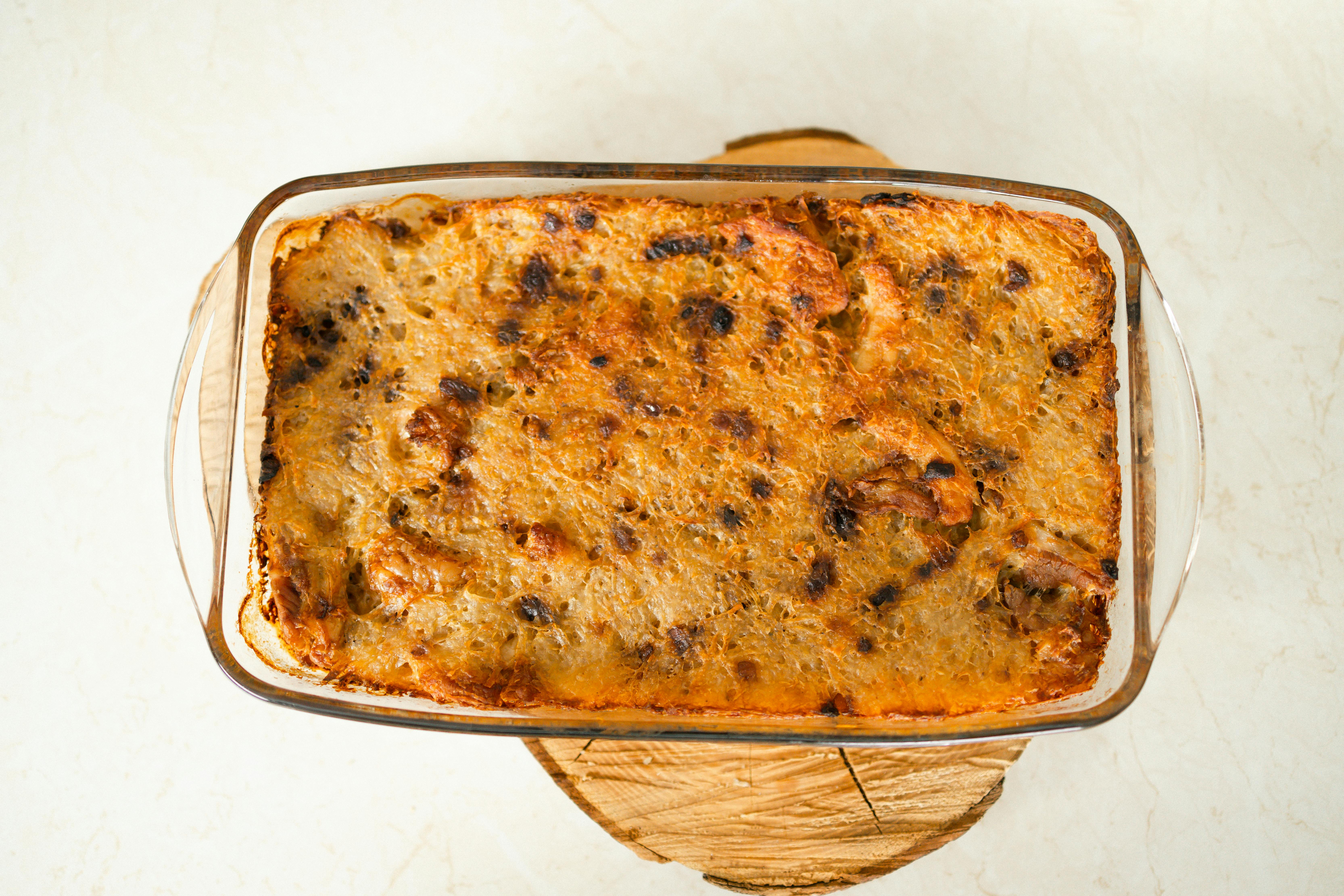
Kugelis is a traditional Lithuanian potato pudding where potatoes are the primary and dominant ingredient. Potatoes are extremely high in net carbs — a single medium potato contains roughly 30-35g of net carbs, and this dish uses a large quantity of them as its base. A standard serving of kugelis would easily deliver 40-60g+ of net carbs, blowing past the entire daily keto limit in one side dish. While the bacon, eggs, and sour cream are keto-friendly components, they are minor by weight and cannot offset the massive carbohydrate load from the potato base. Milk also adds modest additional carbs. This dish is fundamentally incompatible with ketosis regardless of portion size.
Kugelis is a traditional Lithuanian potato pudding that contains multiple animal-derived ingredients. Bacon (pork), eggs, milk, and sour cream are all animal products that are categorically excluded from a vegan diet. This dish is fundamentally incompatible with veganism in its traditional form. While a vegan version could theoretically be constructed using plant-based substitutes (vegan bacon, flax eggs, plant milk, and vegan sour cream), the dish as described with these ingredients cannot be considered vegan.
Kugelis is a traditional Lithuanian potato pudding that contains multiple non-paleo ingredients. Milk and sour cream are dairy products excluded from the paleo diet. Salt is an additive excluded under paleo rules. Bacon is typically a processed meat with added salt, nitrates, and preservatives, making it non-compliant. White potatoes are themselves debated or discouraged in stricter paleo frameworks. Even setting aside the potato debate, the combination of dairy (milk, sour cream), processed meat (bacon), and added salt makes this dish clearly non-paleo. Eggs and onions are the only fully compliant ingredients. The dish as a whole fails paleo standards due to multiple core violations.
Kugelis is a traditional Lithuanian potato pudding that conflicts significantly with Mediterranean diet principles. The dish is anchored by bacon as a key flavoring ingredient — a processed red meat high in saturated fat and sodium — which should be limited to rare occasions. It also relies on dairy (milk, sour cream) and lacks olive oil entirely, using no Mediterranean-aligned fat sources. Potatoes and eggs are acceptable components, but the overall profile is dominated by processed meat and saturated fat. The dish contains no vegetables, legumes, whole grains, or other plant-forward elements that characterize Mediterranean eating. As a non-Mediterranean, heavy Northern European comfort dish, it directly contradicts the diet's core emphasis on plant diversity, olive oil, and minimal processed/cured meats.
Kugelis is a Lithuanian potato pudding that is fundamentally plant-based. Potatoes are the dominant ingredient and the structural base of the dish, making it categorically incompatible with the carnivore diet. While the dish does contain some animal-derived ingredients (bacon, eggs, milk, sour cream), these are minor additions to what is essentially a potato casserole. Plant foods — potatoes and onions — form the overwhelming majority of this dish by volume and macronutrient content. No reframing or modification can make this dish carnivore-compatible without essentially creating an entirely different recipe. Pepper is also excluded on strict carnivore.
Kugelis contains two excluded ingredients: milk (dairy) and sour cream (dairy). Both are explicitly prohibited on the Whole30 program. Additionally, bacon as commonly prepared contains added sugar, making it a further concern. The dish is a traditional Lithuanian potato pudding that relies on dairy as a core structural component, not merely a garnish, so it cannot easily be made compliant while remaining recognizable as the same dish.
Kugelis is a traditional Lithuanian potato pudding that contains two significant high-FODMAP ingredients that cannot be avoided: onion and milk. Onion is one of the highest-fructan foods tested by Monash University and is a major trigger even in small amounts — there is no safe serving size during elimination. Milk contains lactose, which is a disaccharide FODMAP; the quantity typically used in kugelis (often half a cup or more per dish) contributes meaningful lactose per serving. Potatoes are low-FODMAP at standard servings (up to 1 medium potato). Bacon and eggs are low-FODMAP. Sour cream contains some lactose but is lower in lactose than milk due to fermentation — at small amounts it may be tolerable, but combined with milk it adds to the lactose load. Salt and pepper are FODMAP-free. The combination of onion (unavoidable fructans) and milk (lactose) makes this dish high-FODMAP during the elimination phase regardless of portion size, as onion cannot simply be reduced to a 'safe' threshold.
Kugelis is a Lithuanian potato pudding/casserole that is problematic for DASH diet adherence on multiple fronts. Bacon is a high-sodium, high-saturated-fat processed red meat that DASH explicitly limits. Sour cream is full-fat dairy, which DASH discourages in favor of low-fat or fat-free options. The combination of bacon, salt, and sour cream creates a dish with significant sodium and saturated fat content. While potatoes, onion, and eggs provide some nutritional value (potassium, fiber, protein), the overall profile is dominated by DASH-unfriendly ingredients. The dish is also calorie-dense with limited fiber relative to its volume. As traditionally prepared, this dish conflicts with core DASH principles around sodium limits (<2,300mg/day is difficult to meet with bacon as a primary ingredient), saturated fat limits, and the emphasis on low-fat dairy.
Kugelis is a traditional Lithuanian potato pudding that is fundamentally incompatible with Zone Diet principles. The primary ingredient is potatoes, which Dr. Sears explicitly categorizes as a high-glycemic, 'unfavorable' carbohydrate to be avoided — potatoes cause rapid insulin spikes and are specifically called out in Zone literature alongside corn, white rice, and white bread. The dish is carbohydrate-dominant with no meaningful lean protein (bacon provides mostly saturated fat, not substantial lean protein), creating a macronutrient ratio that is the opposite of the 40/30/30 Zone target — likely closer to 60-70% carbohydrates, 15-20% fat from saturated sources (bacon, sour cream), and minimal protein. The fat profile is poor for Zone: bacon contributes saturated fat and the dish lacks monounsaturated fats. Sour cream adds additional saturated fat. There is no practical way to portion-control this dish into Zone compliance without essentially not eating it, as the problematic element (potatoes) is the structural base of the entire preparation, not an incidental ingredient. This is one of the clearest 'avoid' cases in Zone methodology.
Kugelis is a traditional Lithuanian potato pudding with a mixed anti-inflammatory profile. Potatoes themselves contain antioxidants (vitamin C, potassium, resistant starch when cooled) and are not inherently inflammatory, though they are high-glycemic when prepared as a dense baked dish. Onions contribute quercetin, a notable anti-inflammatory flavonoid. Eggs provide some beneficial nutrients including choline and selenium. However, bacon is a processed meat high in saturated fat and sodium, and is a well-established pro-inflammatory ingredient. Sour cream adds saturated fat from full-fat dairy, which falls in the 'limit' category. Milk is relatively neutral. The dish is heavy in refined starch with a significant glycemic load, which can promote inflammation when consumed regularly. The overall caloric density and saturated fat content from bacon and sour cream bring the dish down from neutral to mildly concerning, though the presence of anti-inflammatory vegetables (onion) and eggs prevents it from being a strict 'avoid.' This is best treated as an occasional dish rather than a dietary staple.
Kugelis is a traditional Lithuanian potato pudding made by baking grated potatoes with bacon, eggs, milk, and sour cream. It is fundamentally incompatible with GLP-1 dietary priorities. The dish is anchored by starchy, low-fiber refined potato mass with minimal protein density — the eggs and milk contribute modest protein but are diluted across a large carbohydrate base. Bacon adds significant saturated fat and is on the avoid list for GLP-1 patients. Sour cream contributes additional saturated fat with negligible nutritional upside. The high fat content (bacon drippings often render into the bake) directly worsens GLP-1 side effects including nausea, bloating, and reflux. The dish is heavy, dense, and slow to digest — exactly the profile that GLP-1's slowed gastric emptying makes problematic. Caloric density is high relative to protein and fiber delivered. There is no meaningful fiber from the listed ingredients. As a side dish it also competes with space that should be used for protein-forward foods in an already reduced appetite context.
*See how scores were generated at our methodology page.
Nutritional profile
Six traits that cut across every diet.
Fiber & Plants
How much whole-plant food and fiber it delivers.
Healthy Fats
The quality of its fats (unsaturated, omega-3).
Whole / Unprocessed
How close it is to its natural, unprocessed form.
Gut Gentle
How easy it is on digestion (low FODMAP, few irritants).
Low Glycemic
How little it spikes your blood sugar.
Protein Density
How much protein it packs per calorie.
Controversy Index
Higher controversy = more disagreement between diets.
Diet-Specific Tips
 Anti-Inflammatory — 4/10
View tips
- Bacon is a processed meat high in saturated fat and sodium — pro-inflammatory
- Sour cream adds full-fat dairy saturated fat, in the 'limit' category
- High glycemic load from dense potato base can promote inflammatory response
- Onions contribute quercetin and other anti-inflammatory flavonoids
- Eggs provide choline and selenium with a mixed but not strongly pro-inflammatory profile
- No omega-3 sources, herbs, or anti-inflammatory spices present
- Appropriate as an occasional dish; problematic as a regular dietary feature