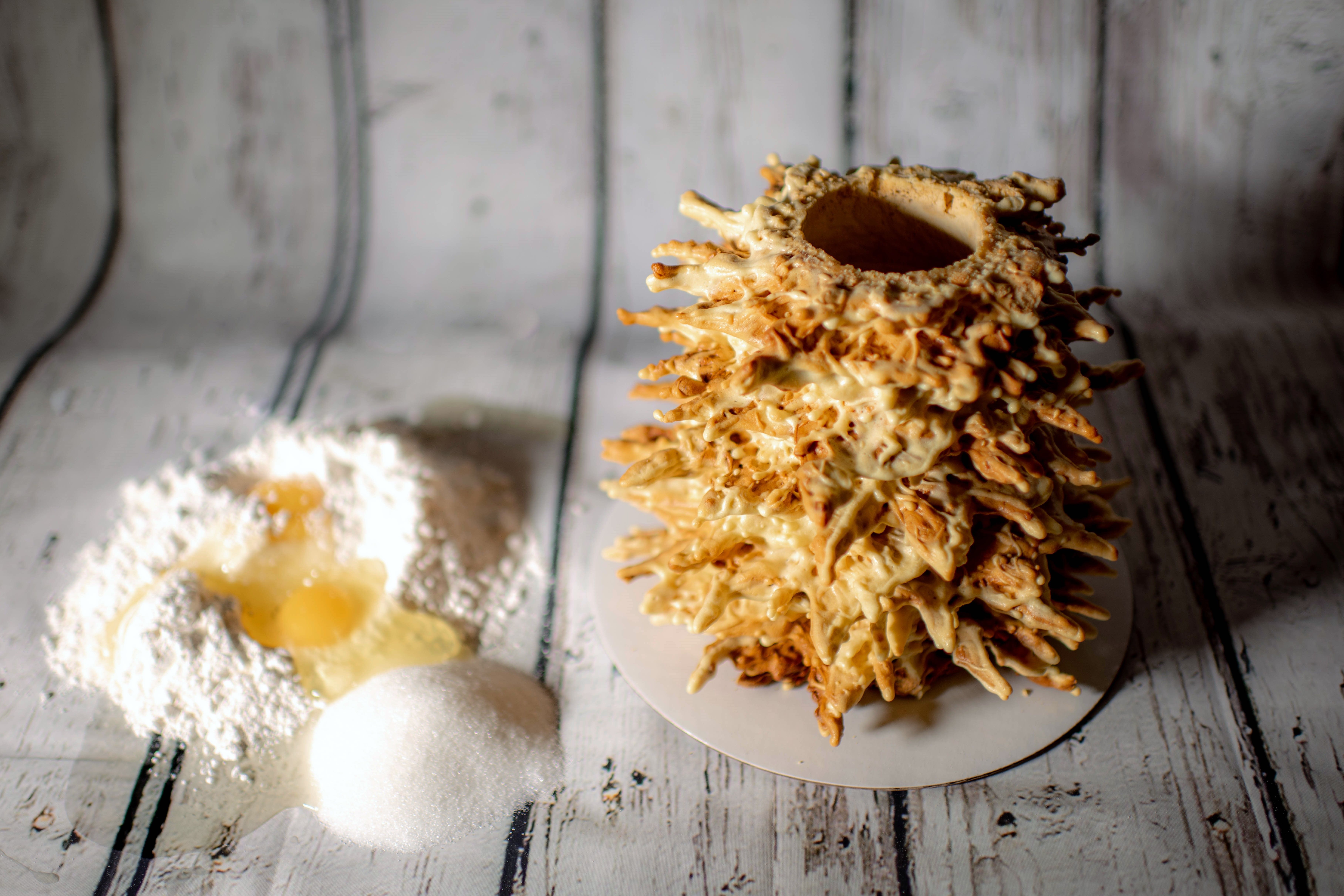
Photo: @ Prestige by Nature / Pexels
The diets react (see scores below)
Common Ingredients
- eggs
- butter
- flour
- sugar
- sour cream
- vanilla
- salt
Specific recipes may vary.
Incompatible with 10 of 11 diets
Diet Ratings
Sakotis is a traditional Lithuanian spit cake made primarily from flour and sugar, which are both strictly incompatible with ketogenic eating. Flour is a high-carb grain product, and sugar is a direct keto disqualifier. Despite the presence of keto-friendly ingredients like eggs, butter, and sour cream, the flour and sugar dominate the carbohydrate profile, making a standard serving contain far too many net carbs to maintain ketosis. This is fundamentally a grain-and-sugar-based dessert cake and cannot be made keto-compatible without completely replacing its two primary structural ingredients.
Sakotis is a traditional Lithuanian tree cake that contains multiple animal-derived ingredients, making it entirely incompatible with a vegan diet. The recipe includes eggs (animal product), butter (dairy), and sour cream (dairy) as core structural and flavoring components. These are not incidental trace ingredients but fundamental to the dish's texture, richness, and identity. There is no plant-based version of Sakotis that could be called traditional; the animal products are integral to the recipe.
Sakotis is a traditional Lithuanian spit cake that contains multiple non-paleo ingredients. Flour (wheat) is a grain and a clear paleo violation. Butter and sour cream are dairy products excluded from paleo. Sugar is a refined sweetener explicitly excluded. Salt is also added. While eggs are paleo-approved and vanilla is generally acceptable, the majority of this dish's structure depends on grains, dairy, and refined sugar, making it fundamentally incompatible with the paleo diet.
Sakotis is a traditional Lithuanian tree cake made primarily from butter, sugar, flour, and sour cream — ingredients that directly contradict Mediterranean diet principles. Butter replaces olive oil as the primary fat, contributing significant saturated fat. Refined flour and sugar are both discouraged as refined/processed carbohydrates. Sour cream adds further saturated dairy fat. While eggs are acceptable in moderation on the Mediterranean diet, they are not the dominant nutritional concern here. This dish is a non-Mediterranean confection with no plant-forward, whole-grain, or olive oil components.
Sakotis is a traditional Lithuanian tree cake that is fundamentally incompatible with the carnivore diet. While it does contain eggs, butter, and sour cream (animal-derived ingredients), the dish is primarily defined by flour and sugar — both strictly prohibited plant-derived, processed carbohydrates. Vanilla is a plant-derived flavoring also excluded on carnivore. The flour makes this a grain-based baked good, which is one of the clearest violations of carnivore principles. The presence of some animal ingredients does not redeem a dish that is structurally a carbohydrate-based confection.
Sakotis is a Lithuanian tree cake containing multiple Whole30-excluded ingredients: butter (dairy, not ghee), flour (grain), sugar (added sugar), and sour cream (dairy). Even if these were substituted with compliant alternatives, the dish would still violate Whole30's rule against recreating baked goods and junk food equivalents — it is fundamentally a cake/pastry. Multiple disqualifying factors make this a clear avoid.
Sakotis is a traditional Lithuanian tree cake made by layering batter on a rotating spit. Its core ingredients include regular wheat flour and sour cream, both of which are high-FODMAP in standard serving sizes. Wheat flour is high in fructans — a key FODMAP — and is problematic even in small amounts typical of a slice or snack portion. Sour cream contains lactose and is high-FODMAP at standard servings (>2 tablespoons per Monash). Eggs, butter, sugar, vanilla, and salt are all low-FODMAP. However, the combination of wheat flour and sour cream makes this dish unsuitable during the elimination phase at any realistic serving size. Even a small piece of Sakotis would contain meaningful amounts of fructans from the flour and lactose from the sour cream.
Monash University has not specifically tested Sakotis, so exact FODMAP thresholds per serving are unknown. Some clinical FODMAP practitioners might note that if a very small portion (e.g., a thin slice) were consumed, total fructan and lactose load could theoretically stay below threshold — but this is impractical for a snack context and most elimination-phase dietitians would advise avoidance due to the wheat flour base.
Sakotis is a traditional Lithuanian tree cake made primarily from butter, sugar, eggs, sour cream, and refined flour — a combination that is fundamentally incompatible with DASH diet principles. It is high in saturated fat (butter and full-fat sour cream), high in added sugar, made with refined rather than whole grain flour, and provides no meaningful potassium, magnesium, fiber, or other DASH-emphasized nutrients. DASH guidelines explicitly limit saturated fat, sweets, and refined carbohydrates. While eggs and a small amount of salt are not disqualifying on their own, the overall nutritional profile of this dessert/snack is characteristic of foods the DASH plan discourages. This is a celebratory confection, not a everyday food, but even in small portions it delivers the wrong macronutrient profile for DASH adherence.
Sakotis is a traditional Lithuanian tree cake made primarily from butter, sugar, flour, eggs, and sour cream — essentially a rich dessert cake. From a Zone Diet perspective, this is deeply problematic across all three macronutrient categories. The carbohydrate base is white flour combined with significant added sugar, both high-glycemic and nutritionally empty — exactly what Zone classifies as 'unfavorable' or outright problematic. The fat profile is dominated by saturated fat from butter and sour cream, with no meaningful monounsaturated fat contribution. While eggs do provide some protein, the protein-to-carb-to-fat ratio is wildly skewed away from the 40/30/30 Zone target — this dish is high in both refined carbs and saturated fat simultaneously, with inadequate lean protein relative to those macros. There is no realistic portioning strategy that brings a serving of Sakotis into Zone balance without consuming a trivially small amount that provides no practical satiety or meal value. As a snack, it fails even more acutely — Zone snacks are meant to be mini-meals maintaining the 40/30/30 ratio and anti-inflammatory profile. Sakotis is processed, sugar-laden, saturated-fat-heavy, and glycemically spiking. It scores a 2 rather than a 1 only because eggs contribute some legitimate Zone protein.
Sakotis is a traditional Lithuanian tree cake made primarily from eggs, butter, flour, sugar, and sour cream. From an anti-inflammatory perspective, this dish presents a challenging profile. The dominant ingredients are pro-inflammatory or neutral at best: butter and sour cream contribute saturated fat; refined flour and sugar drive glycemic load and can elevate inflammatory markers like CRP; and vanilla and salt contribute negligible anti-inflammatory benefit. Eggs provide some choline and selenium (mildly beneficial), but also arachidonic acid. There are no omega-3-rich ingredients, no colorful vegetables or fruits, no polyphenols or antioxidants of note, and no anti-inflammatory spices beyond a trace of vanilla. This is essentially a rich pastry — a celebration food — and sits firmly in the 'limit' category. It is not an 'avoid' at the highest level because it lacks trans fats, HFCS, or artificial additives, but its combination of saturated fat, refined carbohydrates, and added sugar makes it a poor choice for an anti-inflammatory eating pattern when consumed regularly. Occasional consumption is unlikely to cause significant harm for generally healthy individuals.
Some anti-inflammatory perspectives (e.g., Dr. Weil's broader dietary philosophy) emphasize overall dietary patterns over individual foods, and would not categorically condemn a traditional celebration dish eaten rarely. However, stricter anti-inflammatory protocols and autoimmune-focused frameworks (AIP, functional medicine) would flag the refined flour, added sugar, and saturated fat as actively pro-inflammatory, potentially scoring this lower.
Sakotis is a traditional Lithuanian tree cake made primarily from butter, eggs, sugar, flour, and sour cream. While eggs provide some protein, the dish is dominated by saturated fat (butter, sour cream) and refined sugar, making it a high-calorie, low-nutrient-density dessert/snack. The large amount of butter and sour cream significantly increases saturated fat content, which worsens GLP-1 side effects such as nausea, bloating, and reflux. The high sugar and refined flour content offer empty calories with minimal fiber. The fat-to-protein ratio is unfavorable — eggs contribute protein but are far outnumbered nutritionally by the butter and sugar. For GLP-1 patients eating significantly reduced portions, this food provides very little nutritional return per calorie and actively conflicts with priority #1 (protein density), priority #2 (fiber), priority #3 (low fat), and priority #6 (nutrient density per calorie).
*See how scores were generated at our methodology page.
Nutritional profile
Six traits that cut across every diet.
Fiber & Plants
How much whole-plant food and fiber it delivers.
Healthy Fats
The quality of its fats (unsaturated, omega-3).
Whole / Unprocessed
How close it is to its natural, unprocessed form.
Gut Gentle
How easy it is on digestion (low FODMAP, few irritants).
Low Glycemic
How little it spikes your blood sugar.
Protein Density
How much protein it packs per calorie.
Controversy Index
Higher controversy = more disagreement between diets.
Diet-Specific Tips
 Anti-Inflammatory — 5/10
View tips
- High refined flour content — refined carbohydrates spike blood glucose and promote inflammatory signaling
- Added sugar — a well-established driver of inflammatory markers including CRP and IL-6
- Butter and sour cream — saturated fat sources flagged for moderation or limitation in anti-inflammatory protocols
- Eggs — mixed profile; some anti-inflammatory benefit (choline, selenium) offset by arachidonic acid concerns
- No anti-inflammatory ingredients present — no omega-3s, no polyphenols, no antioxidant-rich produce or spices
- No trans fats or artificial additives — distinguishes this from a hard 'avoid' rating
- Occasional/celebratory use context — less concerning than daily consumption