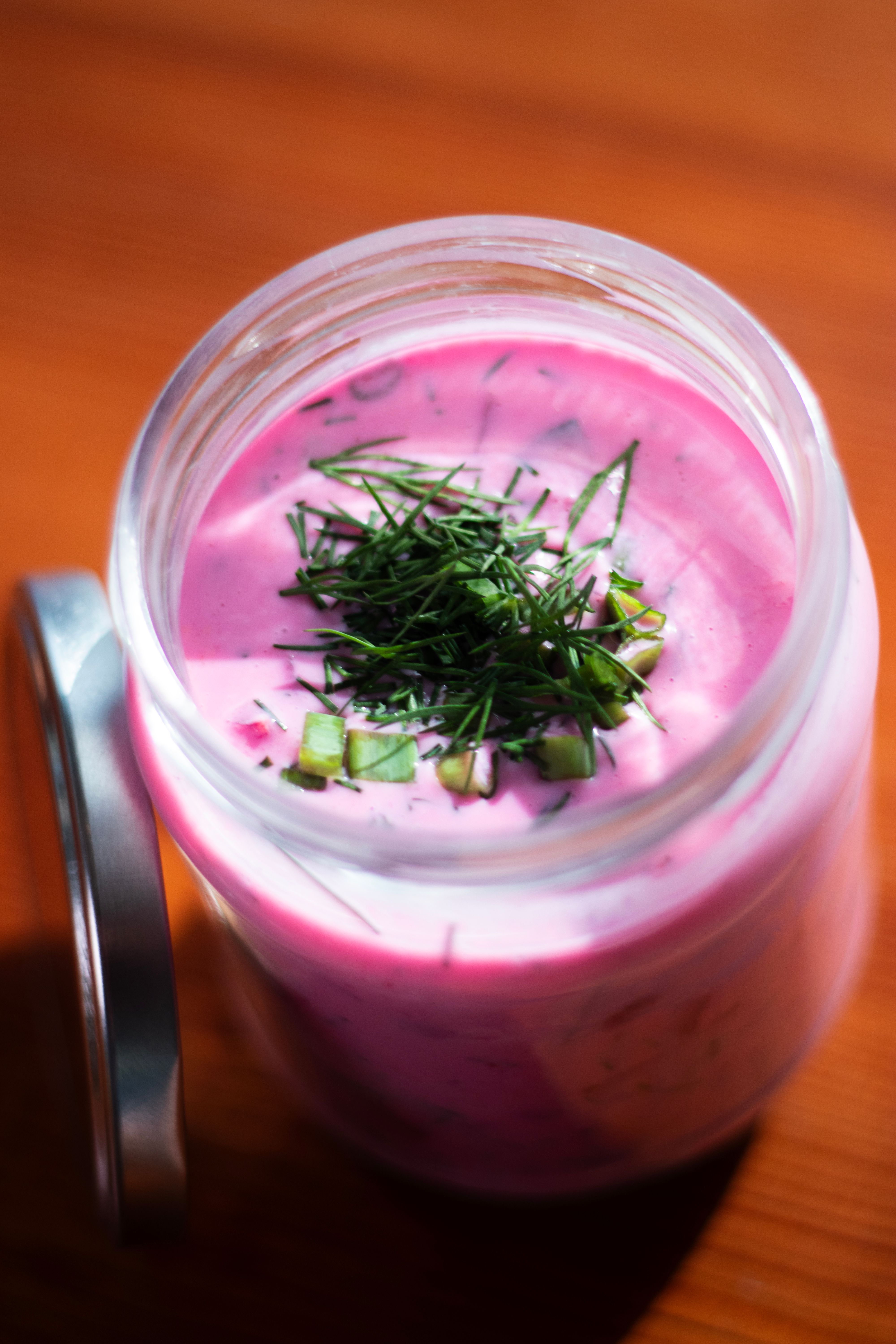
Photo: Reinis Brūzītis / Pexels
Lithuanian
Saltibarsciai
The diets react (see scores below)
Common Ingredients
- beets
- kefir
- cucumbers
- eggs
- dill
- green onions
- potatoes
- salt
Specific recipes may vary.
Incompatible with 6 of 11 diets
Diet Ratings
Saltibarsciai (Lithuanian cold beet soup) is fundamentally incompatible with ketogenic eating. The dish contains two major high-carb ingredients: beets and potatoes. Beets contain roughly 7-8g net carbs per 100g and are high in natural sugars, while potatoes are a starchy vegetable averaging 15-17g net carbs per 100g — both are explicitly excluded from keto. Together, a standard serving of this soup would easily push 30-50g of net carbs from these two ingredients alone, making ketosis impossible. The kefir adds modest carbs (~4g/100ml) from lactose. The remaining ingredients (cucumbers, eggs, dill, green onions) are keto-friendly, but they cannot redeem this dish given the dominant high-carb components.
Saltibarsciai (Lithuanian cold beet soup) contains two clear animal-derived ingredients: kefir, a fermented dairy product made from cow's or goat's milk, and eggs. Both are explicitly excluded under vegan dietary rules. The remaining ingredients — beets, cucumbers, dill, green onions, potatoes, and salt — are all plant-based, but the presence of dairy and eggs makes the dish non-vegan. A vegan adaptation is possible by substituting kefir with a plant-based yogurt or fermented non-dairy milk and omitting the eggs.
Saltibarsciai (Lithuanian cold beet soup) contains multiple non-paleo ingredients that make it incompatible with the diet. Kefir is a fermented dairy product, which is excluded under paleo rules regardless of fermentation. Salt is explicitly excluded as an additive. Potatoes are a debated ingredient. The combination of these violations — especially kefir and salt — results in a clear 'avoid' verdict. The paleo-compliant ingredients (beets, cucumbers, eggs, dill, green onions) are solid, but they cannot offset the disqualifying components.
Some modern paleo practitioners, particularly those following the Primal Blueprint (Mark Sisson) or Perfect Health Diet framework, may permit white potatoes as a 'safe starch' and tolerate fermented dairy like kefir for its probiotic benefits, arguing fermentation reduces problematic compounds. However, even under these lenient frameworks, added salt remains a point of contention, and kefir is not broadly accepted in mainstream paleo circles.
Saltibarsciai (cold beet soup) is a nutrient-rich, vegetable-forward dish centered on beets, cucumbers, dill, and green onions — all strongly aligned with Mediterranean principles. Eggs are a moderate-consumption food in the Mediterranean diet, acceptable in small amounts daily or a few times per week. The main concern is kefir, a fermented dairy product, which is not a traditional Mediterranean staple but is a whole, minimally processed food with probiotic benefits. Potatoes are a starchy vegetable; acceptable but less emphasized than legumes or whole grains. Overall, this is a whole-food, plant-dominant dish with moderate dairy and eggs — fitting a 'caution' rating due to the dairy base rather than any highly processed or red meat ingredients.
Some Mediterranean diet researchers, particularly those focused on traditional regional variations (e.g., Greek or Turkish cuisines), do incorporate fermented dairy like yogurt regularly, and kefir could be viewed similarly as a beneficial fermented food. Under this interpretation, the dish's vegetable richness and whole-food profile could push it toward an 'approve' rating, especially given the absence of red meat, added sugars, or refined grains.
Saltibarsciai (Lithuanian cold beet soup) is almost entirely plant-based and is fundamentally incompatible with the carnivore diet. The dish is built on beets as the primary base, kefir as the liquid, and is loaded with cucumbers, dill, green onions, and potatoes — all strictly excluded plant foods. While eggs are present and kefir is an animal-derived dairy product, they are minor supporting ingredients in what is overwhelmingly a plant-based dish. Even setting aside the plant ingredients, the dish's structure, purpose, and flavor profile are entirely plant-driven. No meaningful carnivore adaptation is possible without completely reconstructing the recipe into something unrecognizable.
Saltibarsciai (Lithuanian cold beet soup) contains kefir, which is a dairy product. Dairy is explicitly excluded from the Whole30 program. All other ingredients—beets, cucumbers, eggs, dill, green onions, potatoes, and salt—are individually Whole30-compliant, but the kefir makes this dish non-compliant as traditionally prepared. The dish cannot be served in its authentic form on Whole30.
Saltibarsciai (Lithuanian cold beet soup) contains several ingredients that require careful portion management on the low-FODMAP elimination diet. The key problematic ingredients are: (1) Kefir — a fermented dairy product high in lactose, making it high-FODMAP at standard serving sizes used in this soup. While fermentation reduces some lactose, kefir retains significant lactose and is not considered low-FODMAP by Monash. (2) Beets — Monash rates canned/cooked beets as high-FODMAP above 2 slices (roughly 20g), and beet soup typically uses substantially more per serving, making this a likely FODMAP concern. (3) Green onions (scallions) — the green tops are low-FODMAP, but if the white bulb portions are included, they contribute fructans. (4) Potatoes — generally low-FODMAP at a standard serving (~1 medium potato). (5) Cucumbers, dill, eggs, and salt are all low-FODMAP with no concerns. The combination of kefir (high lactose) and beets (high at typical soup quantities) makes this dish problematic during the strict elimination phase. A modified version using lactose-free kefir and strictly portioned beets could potentially be made low-FODMAP, but the traditional preparation is not safe for elimination.
Monash University rates kefir as high-FODMAP due to lactose, but some FODMAP practitioners note that kefir's fermentation significantly reduces lactose and a small portion may be tolerated — however, this is not officially supported during elimination. Similarly, beets are borderline; at very small quantities (20g) they are low-FODMAP, but clinical practitioners generally advise avoiding beet-based dishes during elimination since realistic soup servings far exceed this threshold.
Saltibarsciai (Lithuanian cold beet soup) is built on largely DASH-friendly ingredients: beets are rich in potassium and nitrates, cucumbers and dill are low-calorie vegetables, green onions add flavor without sodium, and eggs provide lean protein. However, kefir is the base and its DASH compatibility depends on fat content — traditional kefir is often full-fat, whereas DASH specifies low-fat or fat-free dairy. Potatoes are a starchy vegetable acceptable in moderation on DASH. The primary concern is salt: the dish is named 'saltibarsciai' partly reflecting its briny character, and home/restaurant preparations often add significant salt to the beet base. If made with low-fat kefir and minimal added salt, this soup could score as high as 7-8 (approve territory), but as commonly prepared with full-fat kefir and standard salting, a caution rating is appropriate. Eggs in moderation are now broadly accepted on DASH, though some conservative cardiologists note cholesterol concerns with whole eggs.
NIH DASH guidelines specify low-fat dairy and historically cautioned against whole egg consumption due to dietary cholesterol. However, updated clinical interpretations increasingly accept full-fat fermented dairy (like kefir) given emerging evidence that fermented dairy may not adversely affect cardiovascular outcomes, and the 2020-2025 Dietary Guidelines removed the 300mg/day cholesterol cap, leading many DASH-oriented clinicians to permit eggs in moderation — potentially pushing this dish toward an 'approve' verdict if salt is controlled.
Saltibarsciai (Lithuanian cold beet soup) presents a mixed Zone Diet profile. The base of kefir provides lean protein and beneficial probiotics, eggs add good lean protein, and cucumbers, dill, and green onions are excellent low-glycemic Zone-favorable vegetables. However, the dish has two significant Zone concerns: (1) Beets are a moderately high-glycemic vegetable that Sears classifies as 'unfavorable' due to their higher sugar content and glycemic load. (2) Potatoes are explicitly called out in Zone literature as a high-glycemic carbohydrate to avoid, similar to white rice and bread. The potatoes are often served on the side or mixed in, and they meaningfully elevate the glycemic index of the overall dish. The protein contribution from eggs and kefir is reasonable and could anchor a Zone block structure, but the carbohydrate quality skews unfavorable due to the beet-potato combination. With careful portioning — reducing or eliminating the potatoes and limiting beet quantity — the dish could be restructured into a Zone-compatible meal, but as traditionally prepared it does not naturally hit Zone ratios with favorable carb sources.
Some Zone practitioners would argue that beets in modest portions are acceptable as a 'caution' carbohydrate rather than an outright unfavorable one, given their polyphenol and anti-inflammatory benefits that align with Sears' later writings emphasizing omega-3s and polyphenols. Without potatoes, this soup could be rated more favorably (score 6-7), as kefir + eggs + low-GI vegetables is a reasonably Zone-friendly combination. The verdict depends heavily on whether potatoes are included and in what quantity.
Saltibarsciai (Lithuanian cold beet soup) has a genuinely mixed anti-inflammatory profile. On the positive side: beets are rich in betalains, nitrates, and antioxidants with documented anti-inflammatory effects; cucumbers provide hydration and modest antioxidants; dill and green onions offer polyphenols and quercetin; eggs supply choline and selenium (anti-inflammatory micronutrients). Kefir is a fermented dairy product containing beneficial probiotics that support gut health and may reduce systemic inflammation, though it is low-fat dairy which places it in the 'moderate' category. Potatoes are a neutral-to-mildly-beneficial starch with some antioxidants (especially in the skin) but a higher glycemic load than ideal. The dish is low in omega-3s, contains no emphasized anti-inflammatory fats (no olive oil, fatty fish, nuts/seeds), and the kefir introduces a dairy component that warrants mild caution. Overall, this is a vegetable-forward, whole-food dish with meaningful anti-inflammatory ingredients and no major pro-inflammatory components — solidly in the 'moderate/caution' range leaning toward acceptable.
Dr. Weil's framework and mainstream anti-inflammatory nutrition would likely view this dish favorably given its beet-forward, whole-food composition and fermented dairy (kefir) for gut support. However, AIP (Autoimmune Protocol) practitioners would flag eggs and potentially nightshade-adjacent high-starch potatoes, and some stricter anti-inflammatory frameworks caution against all dairy even fermented, making this less suitable for autoimmune-focused individuals.
Saltibarsciai (Lithuanian cold beet soup) is a moderately GLP-1-friendly dish with meaningful strengths and some notable limitations. On the positive side, kefir provides probiotics and moderate protein, eggs add quality protein and nutrient density, beets and cucumbers contribute fiber and high water content supporting hydration, and dill and green onions add micronutrients with negligible caloric cost. The cold, light nature of the soup makes it easy to digest and appropriate for small portions. However, the protein content per serving is relatively modest — a typical bowl may deliver only 8–12g protein depending on egg quantity, falling short of the 15–30g per meal target without supplementation. Potatoes add starchy carbohydrates with limited fiber relative to their glycemic load, and while not harmful, they displace more nutrient-dense options in a small-appetite context. Kefir, being a dairy product, may trigger mild GI sensitivity in some GLP-1 patients who develop temporary lactose intolerance. Overall this is a light, relatively clean dish that works best as part of a meal supplemented with additional protein, or on days when GI side effects call for something gentle and easy to digest.
Some GLP-1-focused RDs would rate this more favorably, emphasizing the probiotic benefit of kefir for gut health (relevant given GLP-1-related GI side effects) and the high water content supporting hydration in patients with reduced thirst sensation. Others would flag the potato content and low protein density more critically, recommending the dish be modified — extra eggs, reduced potato — before it qualifies as a reliable GLP-1 meal.
*See how scores were generated at our methodology page.
Nutritional profile
Six traits that cut across every diet.
Fiber & Plants
How much whole-plant food and fiber it delivers.
Healthy Fats
The quality of its fats (unsaturated, omega-3).
Whole / Unprocessed
How close it is to its natural, unprocessed form.
Gut Gentle
How easy it is on digestion (low FODMAP, few irritants).
Low Glycemic
How little it spikes your blood sugar.
Protein Density
How much protein it packs per calorie.
Controversy Index
Higher controversy = more disagreement between diets.
Diet-Specific Tips
 Mediterranean — 6/10
View tips
- High vegetable content (beets, cucumbers, dill, green onions) strongly aligns with Mediterranean principles
- Kefir is fermented dairy — not a Mediterranean staple but a whole, minimally processed food
- Eggs as primary protein are acceptable in moderation per Mediterranean guidelines
- Potatoes are a whole food but less preferred than legumes or whole grains
- No red meat, added sugars, or refined/processed ingredients
- Dish is cold, unprocessed, and minimally cooked — preserving nutritional value
 DASH — 6/10
View tips
- Beets are rich in potassium and dietary nitrates, strongly aligned with DASH
- Kefir base is full-fat as traditionally prepared — DASH specifies low-fat or fat-free dairy
- Low-fat kefir substitution would significantly improve DASH compatibility
- Salt content is a concern; 'salt' is a listed ingredient and seasoning level can be high
- Cucumbers, dill, and green onions are DASH-positive low-sodium vegetables
- Eggs are acceptable in moderation under current DASH-aligned dietary guidance
- Potatoes are a starchy vegetable acceptable in controlled portions on DASH
- Overall vegetable diversity and potassium load are DASH-positive
 Zone — 5/10
View tips
- Potatoes are a high-glycemic carbohydrate explicitly discouraged in Zone Diet — major negative
- Beets are classified as 'unfavorable' Zone carbohydrates due to moderate-high glycemic index
- Kefir provides lean protein and probiotics, a Zone-friendly base
- Eggs are an excellent lean Zone protein source
- Cucumbers, dill, and green onions are favorable low-glycemic Zone vegetables
- Dish is low in fat — needs added monounsaturated fat (e.g., olive oil drizzle) to hit 30% fat target
- Overall carbohydrate quality is compromised by beet+potato combination in traditional preparation
 Anti-Inflammatory — 6/10
View tips
- Beets are high in betalains and nitrates with strong anti-inflammatory and antioxidant evidence
- Kefir is fermented dairy — probiotics support gut health and reduce systemic inflammation, but dairy is 'moderate' in anti-inflammatory frameworks
- Eggs are in the 'moderate' category — mixed evidence on arachidonic acid vs. beneficial micronutrients
- Dill and green onions provide quercetin and polyphenols
- Cucumbers are hydrating and mildly anti-inflammatory
- Potatoes add glycemic load — neutral to mildly concerning depending on portion
- No omega-3-rich fats, olive oil, or strongly anti-inflammatory spices like turmeric or ginger present
- Whole-food, minimally processed dish with no seed oils, refined sugar, or additives
 GLP-1 Friendly — 5/10
View tips
- Moderate protein from eggs and kefir — likely 8–12g per serving, below the 15–30g per meal target
- Kefir provides probiotics potentially beneficial for GLP-1-related GI side effects
- Beets and cucumbers contribute fiber and high water content supporting hydration
- Potatoes add starchy carbohydrates with moderate glycemic impact and limited fiber density
- Light, cold, easy-to-digest format well-suited to slowed gastric emptying
- Dairy base (kefir) may trigger mild lactose sensitivity in some GLP-1 patients
- Low fat overall — no fried components, no heavy cream or saturated fat sources
- Portion-friendly as a light soup but requires protein supplementation to meet meal targets