Photo: Domenico Scaglione / Pexels
Lithuanian
Skilandis
The diets react (see scores below)
Common Ingredients
- pork
- pork fat
- garlic
- salt
- black pepper
- saltpeter
- casing
Specific recipes may vary.
Incompatible with 7 of 11 diets
Diet Ratings
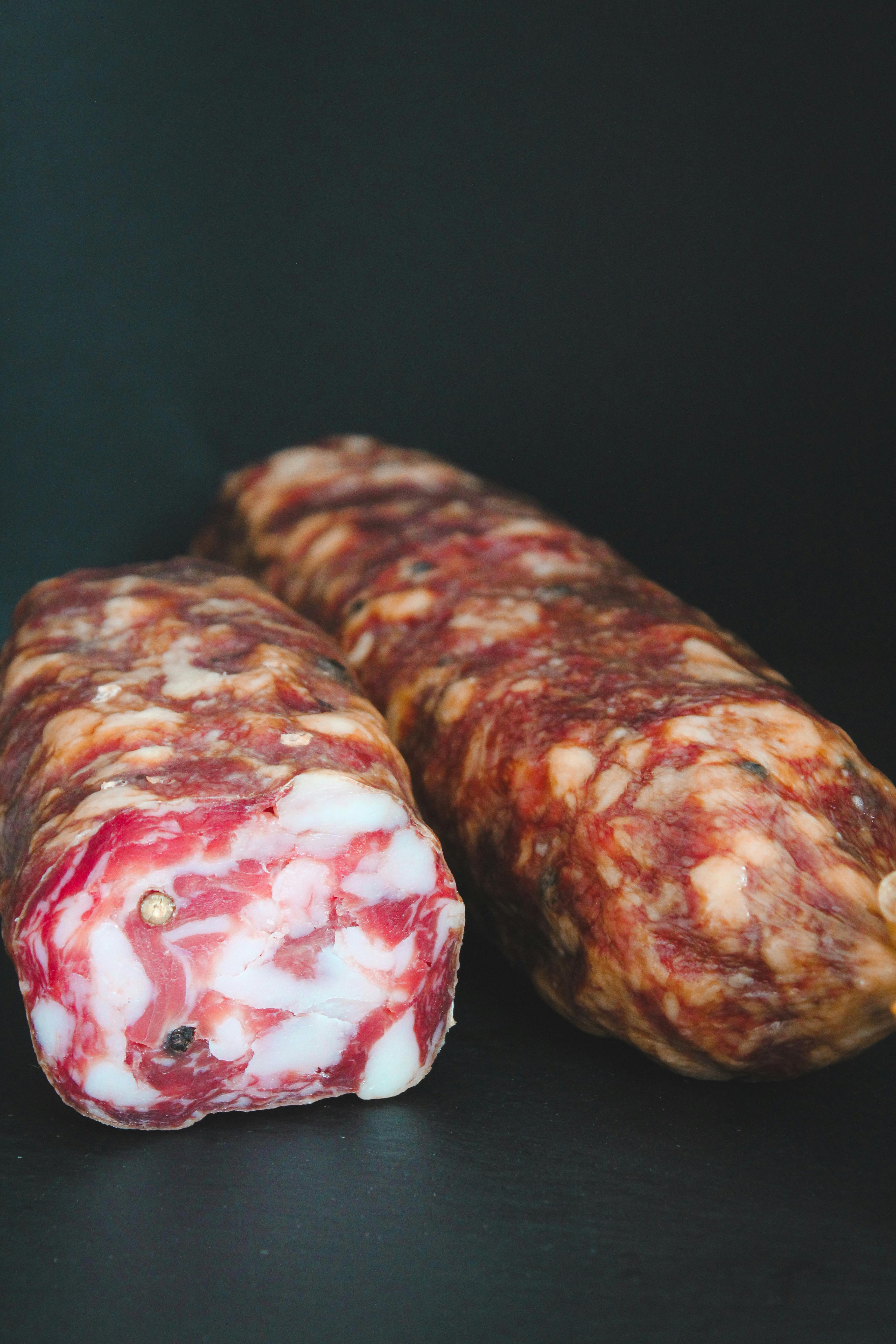
Skilandis is a traditional Lithuanian smoked and cured sausage made from coarsely ground pork and pork fat stuffed into a pig's stomach or bladder casing. Its macronutrient profile is overwhelmingly fat and protein with virtually zero net carbs — the garlic and spices contribute negligible amounts. The high fat content from pork fat aligns perfectly with ketogenic macros. Curing with salt and saltpeter (potassium nitrate) is standard charcuterie practice and does not affect carb content. This is essentially a whole-food, unprocessed cured meat that is an ideal keto snack.
Some strict keto practitioners flag cured meats containing nitrates/saltpeter due to concerns about processed meat additives and potential inflammatory effects, preferring uncured meats; however, this is a minority position focused on food quality rather than ketosis itself.
Skilandis is a traditional Lithuanian smoked and dried sausage made entirely from animal products. The primary ingredients — pork meat, pork fat, and animal casing — are all directly derived from pigs, making this completely incompatible with a vegan diet. There is no ambiguity here; every core component of this dish is an animal product.
Skilandis is a traditional Lithuanian smoked and fermented sausage that contains several non-paleo ingredients. While pork, pork fat, garlic, and black pepper are paleo-compliant, the dish includes added salt (explicitly excluded in paleo rules), saltpeter (potassium nitrate — a chemical preservative/additive not available to Paleolithic humans and explicitly excluded), and natural casing (generally acceptable). More fundamentally, Skilandis is a processed meat product — cured, fermented, and smoked — which falls into the 'processed meats' category like bacon and salami that paleo explicitly avoids. The combination of added salt, saltpeter preservative, and the heavily processed nature of the food makes this a clear avoid under paleo guidelines.
Skilandis is a traditional Lithuanian smoked and cured pork sausage made primarily from fatty pork and pork fat, preserved with salt and saltpeter (nitrates). This dish directly contradicts Mediterranean diet principles on multiple levels: it is red meat (pork) which should be limited to only a few times per month, it is heavily processed through curing and smoking, it contains high levels of saturated fat from pork fat, and it uses nitrate-based preservatives. The Mediterranean diet strongly discourages processed meats regardless of origin, as they are associated with the health risks the diet aims to mitigate. There is no redemptive Mediterranean-aligned component in this dish.
Skilandis is a traditional Lithuanian smoked and dried pork sausage made primarily from pork and pork fat — both carnivore-approved animal products. The salt is acceptable. However, the inclusion of garlic and black pepper introduces plant-derived spices, which are excluded on a strict carnivore diet. Saltpeter (potassium nitrate) is a curing agent that is technically mineral-derived but is a processed additive debated among carnivore practitioners. The natural casing (typically pork intestine) is fully carnivore-compatible. The spices are the primary sticking point for strict adherents, though many carnivore practitioners tolerate small amounts of spices used in cured meats without significant concern.
Strict carnivore adherents following protocols like the Lion Diet or Baker's meat-only approach would exclude Skilandis due to the garlic and black pepper, which are plant compounds that technically violate the all-animal-products rule. Purists argue that even trace plant ingredients in processed meats undermine the elimination purpose of the diet.
Skilandis is a traditional Lithuanian smoked and cured sausage made from pork, pork fat, garlic, salt, black pepper, saltpeter (potassium nitrate), and natural casing. The listed ingredients are individually Whole30-compatible: pork and pork fat are allowed meats, garlic and black pepper are allowed spices, salt is explicitly permitted, and saltpeter (potassium nitrate) is a curing agent that does not fall into any excluded category. Natural casings are compliant. However, as a processed cured meat product, Skilandis warrants caution for several reasons: (1) commercial or restaurant versions may contain unlisted additives, sugars, or sulfites not shown here; (2) the Whole30 program generally discourages reliance on processed and cured meats as staple foods; and (3) label-reading is essential if purchasing commercially rather than making it at home. If prepared at home with only the listed ingredients, it is technically compliant.
Official Whole30 guidelines technically permit cured meats with no excluded additives, but Melissa Urban and the broader Whole30 community caution against leaning on processed meats as a dietary staple, arguing it may undermine the program's goal of resetting food habits. Some practitioners would encourage whole cuts of pork over cured sausage products.
Skilandis is a traditional Lithuanian smoked and dried sausage made with pork, pork fat, and — critically — garlic as a key flavoring ingredient. Garlic is one of the highest-FODMAP foods per Monash University, rich in fructans, and must be strictly avoided during the elimination phase. Even small amounts of garlic in a standard serving of this sausage are enough to trigger symptoms in fructan-sensitive individuals. Pork itself and pork fat are low-FODMAP, as are salt, black pepper (in normal seasoning quantities), saltpeter, and natural casing. However, because garlic is an integral ingredient embedded throughout the meat mixture — not merely a surface flavoring that could be removed — the entire dish must be rated as high-FODMAP and avoided during elimination.
Skilandis is a traditional Lithuanian cured/smoked sausage made from coarsely ground pork and pork fat stuffed into a stomach or bladder casing. It is directly analogous to other cured processed meats (salami, soppressata, dried sausage) that DASH guidelines explicitly discourage. The combination of high pork fat content (significant saturated fat), heavy salting for preservation, and saltpeter (potassium nitrate/sodium nitrate used as a curing agent) results in very high sodium and saturated fat levels — both of which DASH strictly limits. Processed/cured red meats are among the foods most clearly identified by NIH/NHLBI DASH guidelines as incompatible with the dietary pattern. There is no preparation variation that would make this product DASH-compatible, as curing and high fat content are intrinsic to the dish.
Skilandis is a traditional Lithuanian cold-smoked and dried pork sausage made from coarsely ground pork and pork fat stuffed into a stomach or bladder casing. Its primary issues from a Zone perspective are its high saturated fat content (due to significant added pork fat) and its highly processed, cured nature. Zone Diet protein sources are meant to be lean, and Skilandis falls well outside that category. That said, as a protein-dense cured meat, it can technically fill a protein block — similar to how salami or pepperoni can be used in Zone in very small quantities. The high fat content means it simultaneously fills fat blocks, but those are saturated fats rather than the preferred monounsaturated fats. It contains no carbohydrates, so it must always be paired with low-glycemic carb sources to approach Zone balance. As a snack, a small portion could contribute protein and fat blocks together, but the saturated fat profile and processed/cured nature (with saltpeter/nitrates) place it squarely in 'unfavorable' Zone territory. It is not categorically impossible to use, but it requires very careful portioning and thoughtful meal construction to approach Zone ratios.
Skilandis is a traditional Lithuanian smoked and cured pork sausage made primarily from fatty pork and pork fat, placing it firmly in pro-inflammatory territory from an anti-inflammatory diet perspective. The dish is high in saturated fat from both lean pork and added pork fat, which is associated with increased inflammatory markers such as CRP and IL-6. It contains saltpeter (potassium nitrate), a curing salt that produces nitrosamines during processing and digestion — compounds linked to oxidative stress and inflammation. As a cured, processed meat product, Skilandis falls into the category that anti-inflammatory frameworks consistently flag as problematic: processed red meat with added preservatives. The sodium content is also high, which can contribute to endothelial inflammation. The only redeeming elements are garlic and black pepper, both of which have modest anti-inflammatory properties, but in the quantities used as seasoning they provide negligible benefit relative to the overall inflammatory burden of the dish. Anti-inflammatory diet authorities including Dr. Andrew Weil's pyramid explicitly limit red meat and processed meats, and the WHO's classification of processed meats as Group 1 carcinogens further supports avoiding regular consumption.
Skilandis is a traditional Lithuanian dry-cured smoked sausage made from coarsely ground pork and pork fat stuffed into a stomach or bladder casing. It is essentially a high-fat, high-sodium cured meat product — categorically similar to salami or fatty sausage. The explicit inclusion of pork fat as a primary ingredient means each serving delivers substantial saturated fat, which directly worsens GLP-1 side effects including nausea, bloating, and reflux due to slowed gastric emptying compounding the digestive load of high-fat food. The curing process also results in very high sodium content, which can contribute to water retention and cardiovascular strain — a concern for the metabolic patient population most commonly using GLP-1 medications. While pork does provide protein, the protein-to-fat ratio in this product is poor compared to lean alternatives. The saltpeter (sodium nitrate) used as a curing agent is characteristic of processed meats, placing skilandis firmly in the ultra-processed, high-fat, high-sodium category that GLP-1 dietary guidance consistently flags as counterproductive. It offers no meaningful fiber, minimal micronutrient density per calorie, and is not portion-friendly in the sense that even small servings carry a high fat and sodium burden.
*See how scores were generated at our methodology page.
Nutritional profile
Six traits that cut across every diet.
Fiber & Plants
How much whole-plant food and fiber it delivers.
Healthy Fats
The quality of its fats (unsaturated, omega-3).
Whole / Unprocessed
How close it is to its natural, unprocessed form.
Gut Gentle
How easy it is on digestion (low FODMAP, few irritants).
Low Glycemic
How little it spikes your blood sugar.
Protein Density
How much protein it packs per calorie.
Controversy Index
Higher controversy = more disagreement between diets.
Diet-Specific Tips
 Keto — 9/10
View tips
- Near-zero net carbs from all ingredients
- Very high fat content from pork fat — ideal for ketogenic macros
- Moderate to high protein from pork — within keto guidelines
- Garlic and spices contribute negligible carbs at curing quantities
- Saltpeter (nitrate) is a curing agent with no carbohydrate impact
- Whole, minimally processed traditional charcuterie — aligns with whole-food keto principles
 Carnivore — 5/10
View tips
- Pork and pork fat are core carnivore-approved animal proteins
- Natural pork casing is fully animal-derived and acceptable
- Garlic and black pepper are plant-derived spices — excluded on strict carnivore
- Saltpeter is a processed curing additive, debated but widely tolerated
- Traditional cured meat format is accepted by most carnivore practitioners with spice tolerance
- No sugar, fillers, or plant oils present
 Whole30 — 5/10
View tips
- Pork and pork fat are Whole30-compliant proteins and fats
- Garlic, black pepper, and salt are all allowed seasonings
- Saltpeter (potassium nitrate) is a curing agent not listed in excluded ingredients
- Natural casing is compliant
- Commercial versions may contain hidden sugars, fillers, or other excluded additives — label reading is essential
- Processed/cured meats are technically allowed but discouraged as dietary staples per Whole30 spirit
 Zone — 4/10
View tips
- High saturated fat content from added pork fat — contrary to Zone's preference for monounsaturated fats
- Fatty, processed cured meat — falls in 'unfavorable' Zone protein category alongside salami and pepperoni
- Zero carbohydrates — must be paired with low-glycemic vegetables or fruits to achieve 40/30/30 ratio
- Nitrate/saltpeter curing agent and heavy processing conflict with Zone's anti-inflammatory principles
- Small portions can technically fill both protein and fat blocks simultaneously, limiting flexibility
- No omega-3 benefit; likely omega-6 heavy depending on pork sourcing