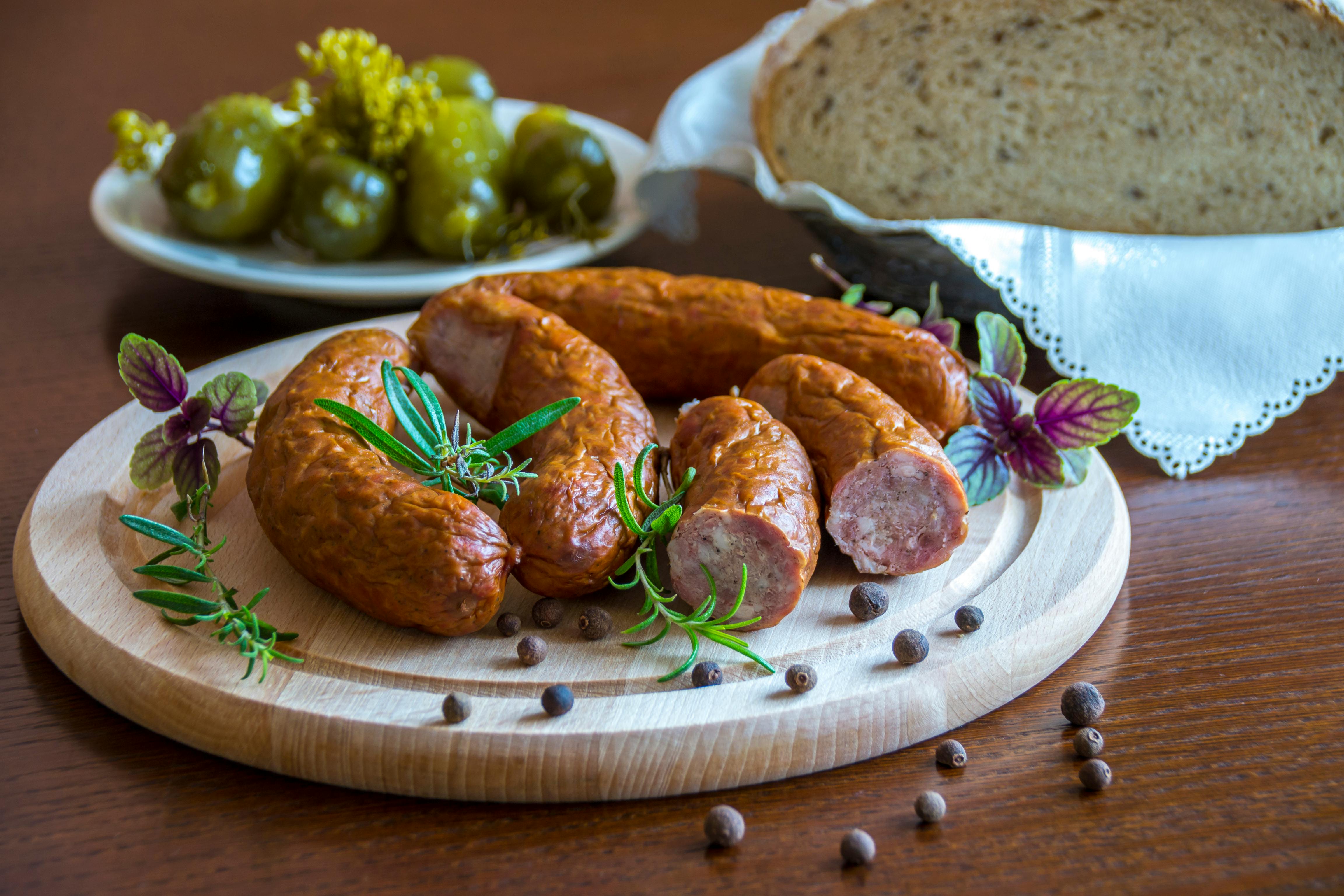
Photo: AS Photography / Pexels
The diets react (see scores below)
Common Ingredients
- potatoes
- bacon
- onion
- pork casings
- milk
- salt
- pepper
- marjoram
Specific recipes may vary.
Incompatible with 11 of 11 diets
Diet Ratings
Vedarai are Lithuanian potato sausages where the primary filling is mashed or grated potatoes stuffed into pork casings. Potatoes are a starchy vegetable with extremely high net carbs — a single medium potato contains roughly 30-35g net carbs, and this dish is predominantly potato by volume. A standard serving would far exceed the daily 20-50g net carb limit for ketosis on its own. While the bacon, onion, and pork casings are keto-friendly components, they are secondary to the potato base, which is the defining ingredient of this dish. The small amount of milk adds negligible additional carbs but does not change the assessment. This dish is fundamentally incompatible with ketogenic dietary goals.
Vedarai is a traditional Lithuanian potato sausage that is fundamentally incompatible with a vegan diet. The dish contains multiple animal products: bacon (pork), pork casings (intestines used as sausage casing), and milk. These are all clearly animal-derived ingredients that violate core vegan principles. There is no ambiguity here — this dish cannot be made vegan without completely reconstructing it with plant-based substitutes.
Vedarai (Lithuanian potato sausage) contains multiple non-paleo ingredients that disqualify it. Milk is dairy and excluded. Salt is an added mineral not permitted under strict paleo rules. Bacon is a processed meat product typically containing added salt, sugar, and preservatives. Pork casings are technically animal-derived and borderline acceptable, but the dish as a whole is fundamentally incompatible with paleo due to dairy, processed meat, and added salt. White potatoes are themselves debated within paleo, but the additional violations make the overall verdict clear. This dish is a traditional processed/stuffed preparation far removed from hunter-gatherer eating patterns.
Vedarai is a Lithuanian potato sausage that fundamentally contradicts Mediterranean diet principles. The dish is dominated by bacon (processed, high in saturated fat and sodium) stuffed into pork casings (processed red meat product), with no olive oil, no legumes, and no meaningful plant-based nutritional contribution beyond starchy potatoes and onion. Bacon is a processed meat that Mediterranean diet guidelines consistently place in the 'avoid' or 'very rarely' category. Pork casings are a processed animal product. The overall fat profile relies on animal fats rather than olive oil. Potatoes and onion are the only Mediterranean-compatible ingredients, but they serve as a minor supporting role in an otherwise meat-heavy, processed dish. This is a Northern European comfort food with no meaningful alignment with Mediterranean dietary traditions.
Vedarai are Lithuanian potato sausages — essentially a plant-based filling (potatoes, onion) stuffed into pork casings with milk and seasonings. While the pork casings and bacon are animal-derived, the dominant ingredients are potatoes and onion, which are plant foods entirely excluded on the carnivore diet. Potatoes are a starchy carbohydrate-heavy vegetable, onion is a plant, and marjoram is a plant-based spice. The dish is fundamentally a potato dumpling/sausage hybrid, not a meat dish. The animal components (casings, bacon, milk) are merely structural or minor flavor additions to what is essentially a potato dish. No carnivore practitioner — whether strict Lion Diet, Baker-style, or Saladino animal-based — would consider this compatible.
Vedarai (Lithuanian potato sausages) contain milk and bacon, both of which are problematic on Whole30. Milk is dairy and is explicitly excluded from the Whole30 program. Bacon, while compliant versions exist (sugar-free, no prohibited additives), is listed generically here and most commercial bacon contains added sugar. Additionally, the dish is stuffed into pork casings, making it a sausage-style preparation — which is fine structurally, but the dairy (milk) is a hard disqualifier with no workaround. The dish cannot be made Whole30-compliant in its traditional form without substituting or removing the milk.
Vedarai (Lithuanian potato sausage) contains two high-FODMAP ingredients that make it unsuitable during the elimination phase. Onion is one of the highest-FODMAP foods tested by Monash University, rich in fructans, and is unsafe at any meaningful serving size. Milk contributes lactose, which is a key FODMAP (disaccharide) — even small amounts used in the filling can contribute meaningfully depending on quantity. Potatoes are low-FODMAP at a standard serving (~1 medium potato), bacon is low-FODMAP, pork casings are low-FODMAP, and the spices (salt, pepper, marjoram) are low-FODMAP. However, onion is a non-negotiable avoid during elimination — it cannot be eaten even in small amounts without triggering symptoms in most FODMAP-sensitive individuals, and it is structurally integral to this dish. The milk component adds a secondary FODMAP concern. This dish cannot be made low-FODMAP without fundamentally altering its traditional recipe by removing onion and substituting lactose-free milk.
Vedarai (Lithuanian potato sausage) is fundamentally incompatible with DASH diet principles. The dish is built around bacon and pork casings — both high-sodium, high-saturated-fat processed pork products that DASH explicitly limits. Bacon is a cured, processed red meat with significant saturated fat and sodium content, falling squarely in the 'avoid' category under DASH. Pork casings add additional sodium and animal fat. The preparation involves stuffing a fatty, salty mixture into sausage casings, making this a heavily processed meat product by nature. Salt is added on top of the already high sodium from the bacon and casings, pushing the sodium load well beyond DASH thresholds. The potatoes, onion, and marjoram are DASH-friendly components, but they are overwhelmed by the problematic ingredients that define this dish's character. This is not a food that can be easily modified to fit DASH guidelines while retaining its identity.
Vedarai (Lithuanian potato sausage) is essentially a high-glycemic, high-saturated-fat dish that poses multiple Zone Diet problems simultaneously. The primary ingredient is potatoes — a high-glycemic carbohydrate that Dr. Sears explicitly lists as an 'unfavorable' carb to avoid. Bacon adds saturated fat without lean protein balance. Pork casings contribute additional saturated fat. The dish lacks any meaningful low-glycemic carbohydrate, any lean protein source, or any monounsaturated fat. The macro ratio is wildly off-Zone: heavily skewed toward high-GI carbs and saturated fat, with minimal quality protein. Even with careful portioning, the fundamental composition cannot be adjusted to approach 40/30/30 without effectively replacing most of the dish. Milk adds minor protein but not enough to rescue the ratio. This is one of the rare cases where the food's base composition makes Zone balancing practically impossible as a dish unit.
Vedarai are Lithuanian potato sausages made by stuffing a mixture of grated potatoes, bacon, onion, and milk into pork casings, then baking or boiling. From an anti-inflammatory standpoint, this dish is problematic on multiple fronts. Bacon is a processed pork product high in saturated fat, sodium, and preservatives (typically nitrates/nitrites), all of which are associated with increased inflammatory markers. Pork casings contribute additional saturated fat. The potato base is largely refined starch with high glycemic load, particularly when prepared in this dense, processed form. Milk adds saturated fat. While the dish does contain some mildly beneficial elements — onion provides quercetin, marjoram offers modest anti-inflammatory polyphenols, and potatoes supply some potassium and vitamin C — these are far outweighed by the pro-inflammatory profile. The combination of processed meat, saturated fat, refined starch, and high sodium content makes this a dish that anti-inflammatory diet frameworks across the board would classify as one to avoid or consume only very rarely.
Vedarai are Lithuanian potato sausages made by stuffing a mixture of grated potatoes, bacon, onion, and milk into pork casings, then boiling or baking and often finishing by pan-frying. The dish is fundamentally incompatible with GLP-1 dietary priorities across nearly every dimension. The primary macronutrient is starchy potato with very little protein — the listed primary protein is 'none,' which reflects the nutritional reality. Bacon adds significant saturated fat with minimal lean protein benefit. The combination of high-fat bacon, fatty pork casings, and starchy potato filling creates a heavy, slow-digesting meal that directly worsens GLP-1 side effects: nausea, bloating, reflux, and gastroparesis-like discomfort are all likely given the slowed gastric emptying these medications cause. Fiber content is minimal — potatoes contribute modest fiber but not enough to meet GLP-1 fiber targets in a realistic serving. Caloric density is high relative to nutritional value, making this a poor use of the reduced appetite window GLP-1 patients have. Fat content from both bacon and casings is high in saturated form. There is no meaningful path to making a standard serving of vedarai GLP-1-appropriate without fundamentally reconstructing the dish.
*See how scores were generated at our methodology page.
Nutritional profile
Six traits that cut across every diet.
Fiber & Plants
How much whole-plant food and fiber it delivers.
Healthy Fats
The quality of its fats (unsaturated, omega-3).
Whole / Unprocessed
How close it is to its natural, unprocessed form.
Gut Gentle
How easy it is on digestion (low FODMAP, few irritants).
Low Glycemic
How little it spikes your blood sugar.
Protein Density
How much protein it packs per calorie.
Controversy Index
Higher controversy = more disagreement between diets.