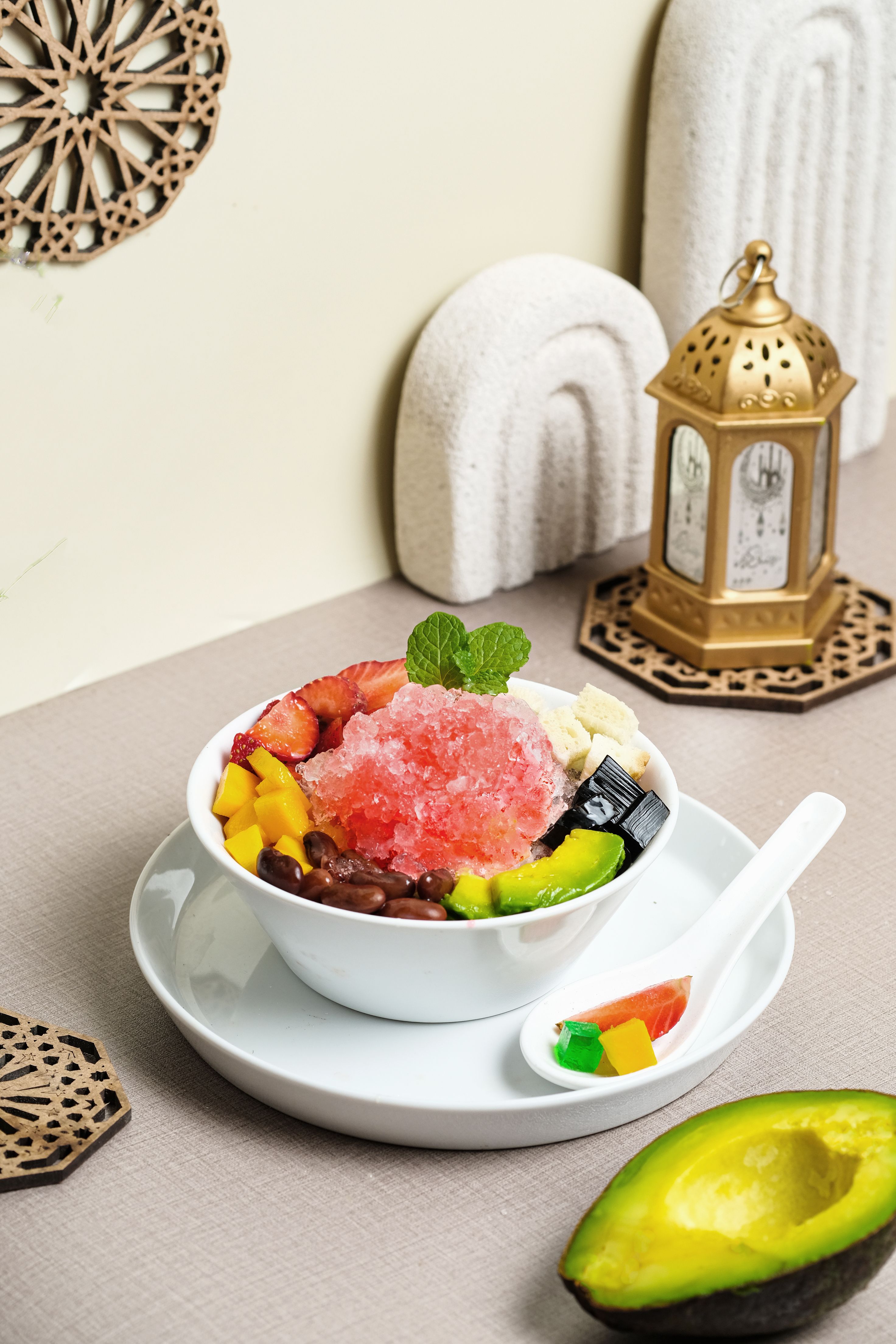
Malaysian
Ais Kacang
The diets react (see scores below)
Common Ingredients
- shaved ice
- red beans
- sweet corn
- grass jelly
- palm sugar syrup
- rose syrup
- condensed milk
- attap seeds
- peanuts
Specific recipes may vary.
Incompatible with 11 of 11 diets
Diet Ratings
Ais Kacang is fundamentally incompatible with a ketogenic diet. Nearly every ingredient is a significant source of carbohydrates or sugar. Red beans and sweet corn are high-carb legumes and starchy vegetables. Palm sugar syrup, rose syrup, and condensed milk are pure sugar or sugar-dense additions that would alone exceed an entire day's keto carb allowance in a single serving. Attap seeds (palm fruit) are also carbohydrate-heavy. The cumulative net carb load of a standard serving likely exceeds 80–120g, which is 2–6 times the maximum daily keto threshold. There are no meaningful fat or protein components to offset this. This dish cannot be meaningfully adapted for keto without replacing virtually every ingredient.
Ais Kacang as traditionally prepared contains condensed milk, which is a dairy product derived from cow's milk. This single ingredient makes the dish non-vegan regardless of the otherwise plant-based components. All other ingredients — shaved ice, red beans, sweet corn, grass jelly, palm sugar syrup, rose syrup, attap seeds (nipah palm fruit), and peanuts — are fully plant-based. The dish can be made vegan by substituting condensed milk with a plant-based alternative such as condensed coconut milk, which is increasingly available and used in vegan-friendly versions of this dessert.
Ais Kacang is fundamentally incompatible with the Paleo diet. Nearly every ingredient violates core Paleo principles: red beans are legumes (explicitly excluded), sweet corn is a grain (excluded), condensed milk is dairy (excluded), rose syrup and palm sugar syrup are refined/processed sweeteners (excluded), and peanuts are legumes (excluded). Grass jelly is a processed product derived from a plant starch, and attap seeds (from palm fruit) while technically from a natural source, are typically processed and packaged with additives. The dish is essentially a dessert built around sugar, legumes, dairy, and grains — representing a near-total conflict with Paleo guidelines. There are no meaningful Paleo-compliant ingredients in this dish beyond the shaved ice itself.
Ais Kacang is a Malaysian shaved ice dessert loaded with added sugars from multiple sources: palm sugar syrup, rose syrup, and condensed milk. While it contains some Mediterranean-friendly ingredients like red beans, sweet corn, peanuts, and grass jelly, the dominant character of this dish is a high-sugar, sweetened confection. Added sugars and sweetened syrups directly contradict Mediterranean diet principles, which call for minimal added sugars and processed sweet foods. Condensed milk adds further saturated fat and sugar. The overall dish is essentially a sugar delivery vehicle, which places it firmly in the 'avoid' category despite the presence of a few whole-food components.
Ais Kacang is entirely plant-derived and contains no animal products whatsoever (condensed milk is the only partial exception, but it is heavily sweetened and processed). The dish is essentially a dessert made of shaved ice topped with red beans, sweet corn, grass jelly, palm sugar syrup, rose syrup, attap seeds, and peanuts — all of which are explicitly excluded on the carnivore diet. Red beans and peanuts are legumes, corn is a grain/starchy plant, grass jelly is plant-derived, palm sugar and rose syrup are sugar-based plant products, and attap seeds come from palm fruit. Even the condensed milk, if considered, is a heavily sweetened dairy product that would be disqualified by its high sugar content. This dish has no redeeming carnivore-compatible components and is antithetical to carnivore principles on virtually every ingredient.
Ais Kacang contains multiple excluded ingredients that make it clearly non-compliant with Whole30. Condensed milk is dairy (excluded). Palm sugar syrup and rose syrup are added sugars (excluded). Red beans are legumes (excluded). Peanuts are legumes (excluded). This dish is essentially a dessert built on a foundation of excluded ingredients — there is virtually nothing compliant about it beyond the shaved ice itself.
Ais Kacang contains multiple high-FODMAP ingredients that make it unsuitable during the elimination phase. Red beans are high in GOS (galacto-oligosaccharides) and are high-FODMAP at typical serving sizes. Sweet corn is moderate-to-high FODMAP above small servings (Monash rates it as high-FODMAP at amounts commonly consumed in a dessert like this). Condensed milk is high in lactose, a key FODMAP disaccharide. Palm sugar syrup may contain excess fructose depending on composition. Attap seeds (nipah palm fruit) have limited Monash testing but are known to contain polyols. Rose syrup typically contains high-fructose corn syrup or sucrose-based sweeteners, which may be problematic in large quantities. Peanuts are low-FODMAP in small servings (~28g), and shaved ice and grass jelly are generally low-FODMAP. However, the combination of red beans, condensed milk, and sweet corn alone makes this dish a high-FODMAP food at any realistic serving size. There is no practical way to consume a standard serving of Ais Kacang within FODMAP limits.
Some clinical FODMAP practitioners may note that individual ingredient quantities matter — if red beans and sweet corn are present only in very small garnish amounts, GOS and fructan load could theoretically be reduced. However, Monash University's elimination phase guidance treats red beans as high-FODMAP at any typical serving, and most Ais Kacang recipes use generous portions of these ingredients, making reduction to safe levels impractical.
Ais Kacang is a Malaysian shaved ice dessert that, while containing some DASH-friendly components (red beans, sweet corn, peanuts), is dominated by high-sugar syrups and condensed milk that make it incompatible with DASH principles. The rose syrup and palm sugar syrup contribute substantial added sugars, and sweetened condensed milk adds both added sugar and saturated fat — all of which DASH explicitly limits. The overall dish functions as a high-sugar confection, similar to other sweetened dessert beverages that DASH guidelines advise against. Red beans and peanuts do provide fiber, magnesium, and plant-based protein, but these positive elements are overwhelmed by the sweet, calorie-dense syrup base. The dessert's sugar load would be inconsistent with DASH's emphasis on limiting sweets and sugary beverages.
NIH DASH guidelines categorically limit added sugars and sweets, placing this dish firmly in the 'avoid' category. However, some DASH-oriented dietitians note that the red beans and peanuts provide genuine nutritional value (fiber, magnesium, potassium), and a modified version with reduced syrup portions, evaporated low-fat milk substituted for condensed milk, and natural fruit toppings could be adapted into an occasional moderate indulgence within strict portion limits.
Ais Kacang is essentially a dessert built almost entirely from high-glycemic, high-sugar components. The base is shaved ice with no nutritional value, drenched in palm sugar syrup and rose syrup — both are concentrated sugar sources that spike blood glucose rapidly, the opposite of Zone principles. Condensed milk adds saturated fat alongside significant sugar. Sweet corn is a high-glycemic vegetable explicitly flagged as unfavorable in Zone methodology. While red beans and peanuts do provide some fiber, protein, and fat, they are present in relatively small quantities within a dish that is overwhelmingly sugar-forward. The macro profile is dramatically skewed: nearly all calories come from simple carbohydrates and sugar syrups, with negligible protein and no meaningful monounsaturated fat contribution. There is no practical way to portion this dish into a Zone-balanced snack — even a small portion delivers an outsized glycemic hit that would disrupt eicosanoid balance, which is central to Dr. Sears' framework. The dish lacks any lean protein block entirely, and the fat present (from condensed milk) is saturated rather than monounsaturated. This is precisely the type of high-glycemic, processed-sugar dessert that Zone categorically discourages.
Ais Kacang is a Malaysian shaved ice dessert whose anti-inflammatory profile is dominated by multiple high-sugar components. Rose syrup is essentially sugar-water with artificial coloring and flavoring. Condensed milk contributes significant added sugar alongside saturated fat. Palm sugar syrup, while marginally less refined than white sugar, is still a concentrated source of simple sugars that drive glycemic spikes and promote inflammatory signaling (elevated AGEs, NF-κB activation). The dish is fundamentally a sugar delivery vehicle. The few redemptive elements — red beans (fiber, polyphenols), peanuts (resveratrol, healthy fats in small quantity), grass jelly (modest antioxidants), sweet corn (some fiber) — are present in small amounts and are thoroughly outweighed by the inflammatory burden of three separate sweeteners plus condensed milk. Attap seeds (nipah palm fruit) are nutritionally neutral. There are no omega-3 sources, no meaningful anti-inflammatory spices, and no significant antioxidant-dense components. The overall sugar load is the primary concern: multiple added sugar sources in a single dish is a hallmark of a pro-inflammatory food pattern.
Ais Kacang is essentially a dessert built around high-sugar syrups and shaved ice, making it a poor fit for GLP-1 patients. The dominant caloric contributors — palm sugar syrup, rose syrup, and condensed milk — deliver a large sugar load with minimal nutritional return. A standard serving can easily contain 40–60g of sugar and 300–400 calories with negligible protein (effectively zero from a dietary standpoint) and very little fiber despite the presence of red beans, sweet corn, and peanuts, which appear in small garnish quantities. The cold, sugary liquid base may feel manageable on a reduced appetite, but the glycemic spike and empty-calorie density are directly counterproductive to the goals of GLP-1 therapy. The red beans and peanuts do offer modest fiber and protein in isolation, but in this dish context they are overwhelmed by the sugar components. There is no meaningful protein source. Hydration value from the shaved ice is nominal given the sugar load. This dish exemplifies the 'empty calorie' profile that GLP-1 dietary guidance specifically cautions against — it consumes valuable appetite capacity without delivering the protein, fiber, or micronutrients patients critically need when eating significantly less overall.
*See how scores were generated at our methodology page.
Nutritional profile
Six traits that cut across every diet.
Fiber & Plants
How much whole-plant food and fiber it delivers.
Healthy Fats
The quality of its fats (unsaturated, omega-3).
Whole / Unprocessed
How close it is to its natural, unprocessed form.
Gut Gentle
How easy it is on digestion (low FODMAP, few irritants).
Low Glycemic
How little it spikes your blood sugar.
Protein Density
How much protein it packs per calorie.
Controversy Index
Higher controversy = more disagreement between diets.