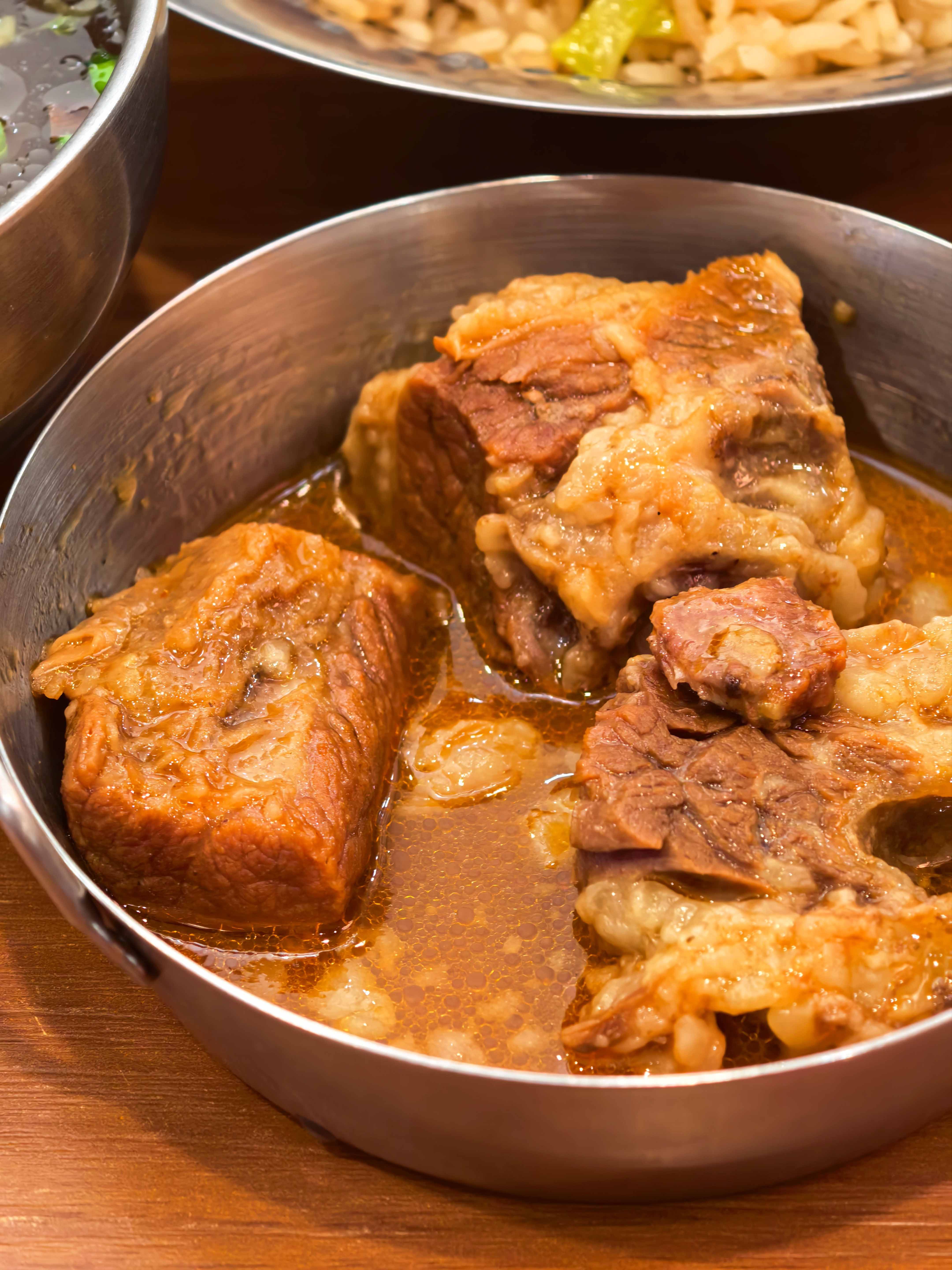
Malaysian
Bak Kut Teh
The diets react (see scores below)
Common Ingredients
- pork ribs
- garlic
- white pepper
- star anise
- cinnamon
- cloves
- dang gui
- goji berries
- dark soy sauce
- tofu puffs
Specific recipes may vary.
Incompatible with 7 of 11 diets
Diet Ratings
Bak Kut Teh is built around pork ribs — an excellent keto protein and fat source — simmered in a spiced broth. Most of the aromatics (garlic, white pepper, star anise, cinnamon, cloves, dang gui) contribute negligible net carbs in typical soup quantities. However, several ingredients raise caution flags: dark soy sauce contains sugar and adds a small but non-trivial carb load; goji berries are relatively high in sugar and carbs even in small amounts; and tofu puffs, while mostly acceptable, absorb broth and can add up in carb content depending on portion. The Malaysian version of Bak Kut Teh also tends to be sweeter and darker than its Singaporean counterpart, often with more soy sauce and sometimes rock sugar added. With ingredient modifications — omitting or minimizing goji berries, swapping dark soy sauce for a low-sodium or coconut aminos alternative, and controlling tofu puff portions — this dish becomes quite keto-friendly. As served traditionally, it sits in the caution zone.
Lazy keto practitioners may approve this outright, arguing that pork ribs dominate the macros and the problematic ingredients (goji berries, dark soy sauce) are used in such small quantities that the dish easily fits within a 50g daily net carb budget. Strict keto adherents, however, would flag any added sugar or sweetened soy sauce as an automatic disqualifier regardless of quantity.
Bak Kut Teh is a pork-based soup where pork ribs are the primary and defining ingredient. Pork is an animal flesh product, which is unambiguously excluded from a vegan diet. No version of this dish with pork ribs can be considered vegan. While the remaining ingredients (garlic, white pepper, star anise, cinnamon, cloves, dang gui, goji berries, dark soy sauce, tofu puffs) are all plant-based, the presence of pork ribs makes the dish entirely incompatible with vegan eating. A vegan adaptation could theoretically be made using only the plant-based components, but the dish as described cannot be approved.
Bak Kut Teh contains two significant non-paleo ingredients that disqualify it: dark soy sauce (a soy/wheat-based fermented condiment — both legume and grain derivatives) and tofu puffs (made from soy, a legume). These are not peripheral garnishes but core components of the dish. The base of pork ribs, garlic, white pepper, star anise, cinnamon, cloves, dang gui, and goji berries would otherwise be largely paleo-compatible, but the soy sauce and tofu puffs are clear violations with high consensus in the paleo community. Dark soy sauce also typically contains added salt, caramel coloring, and preservatives, compounding the issue.
Bak Kut Teh is centered on pork ribs as the primary protein, which is red meat — a food the Mediterranean diet restricts to just a few times per month. The dish has no olive oil, no significant plant-based staples beyond tofu puffs and minor aromatics, and is not aligned with the plant-forward, fish-and-legume emphasis of the Mediterranean pattern. While the spices (garlic, cinnamon, star anise, cloves) and goji berries are individually compatible ingredients, they play only a supporting role. The dark soy sauce adds significant sodium, and the overall dietary profile — a pork-heavy broth dish from a Southeast Asian culinary tradition — fundamentally contradicts Mediterranean diet principles around protein sourcing and fat composition.
Bak Kut Teh is fundamentally incompatible with the carnivore diet despite containing a carnivore-approved base ingredient (pork ribs). The dish is loaded with multiple plant-based additives and non-animal ingredients: white pepper, star anise, cinnamon, and cloves are plant-derived spices; dang gui (angelica root) is a herbal/medicinal plant root; goji berries are a plant fruit; dark soy sauce is a heavily processed legume-derived condiment containing wheat, soy, sugar, and additives; and tofu puffs are processed soy-based plant protein. The pork ribs themselves would be carnivore-approved, but the broth and accompaniments are disqualifying on nearly every front. This is not a dish that can be easily adapted — it would be unrecognizable as Bak Kut Teh without its defining herbal and spiced broth. The tofu puffs and soy sauce alone would be hard avoids for any carnivore practitioner.
Bak Kut Teh as listed contains two clear Whole30-excluded ingredients. First, dark soy sauce is made from soybeans, which are a legume and explicitly excluded from Whole30. Second, tofu puffs are a soy-based product (tofu is made from soybeans), also explicitly excluded. These two ingredients alone disqualify the dish. The remaining ingredients — pork ribs, garlic, white pepper, star anise, cinnamon, cloves, dang gui (angelica root), and goji berries — are all Whole30-compliant herbs, spices, and whole foods. A modified version substituting coconut aminos for dark soy sauce and omitting the tofu puffs could be made compliant, but as described the dish cannot be approved.
Bak Kut Teh contains multiple high-FODMAP ingredients that make it unsuitable during the elimination phase. Garlic is the most significant offender — it is one of the highest-FODMAP foods tested by Monash University, rich in fructans, and is typically used in substantial quantities in this dish both as whole cloves and infused into the broth (unlike garlic-infused oil, a broth preparation extracts water-soluble FODMAPs into the liquid). Tofu puffs (deep-fried tofu) are rated high-FODMAP by Monash at standard servings (~6 pieces) due to GOS content. Goji berries contain excess fructose and polyols (mannitol) and are high-FODMAP at typical serving sizes. Dang gui (angelica root) lacks Monash testing data, introducing further uncertainty. The spices — white pepper, star anise, cinnamon, cloves — are generally low-FODMAP at culinary quantities. Pork ribs are protein-based and FODMAP-free. Dark soy sauce is low-FODMAP in small amounts (~2 tbsp). However, the combination of garlic-infused broth, tofu puffs, and goji berries creates an unavoidably high-FODMAP dish in any standard serving.
Some clinical FODMAP practitioners allow small amounts of tofu puffs (2–3 pieces per Monash's low-FODMAP threshold) and suggest the broth could be made with garlic-infused oil instead of whole garlic, but a traditional Bak Kut Teh as prepared in Malaysian cuisine would not make these substitutions, making avoidance the practical recommendation during elimination.
Bak Kut Teh conflicts with multiple core DASH diet principles. The primary protein is pork ribs, which are red meat with significant saturated fat content — both red meat and saturated fat are explicitly limited in DASH guidelines. Dark soy sauce is a major sodium contributor, with just a tablespoon containing 800–1,000mg sodium, pushing a single bowl of this soup well toward or beyond the DASH daily sodium ceiling of 2,300mg (or 1,500mg for the stricter version). Tofu puffs, while soy-based, are deep-fried and add additional saturated fat. The aromatic spices (garlic, white pepper, star anise, cinnamon, cloves, dang gui, goji berries) are nutritionally benign or mildly beneficial, but they cannot offset the fundamental issues of red meat and very high sodium from the soy-sauce-heavy broth. As a restaurant or traditional preparation, this dish is structurally incompatible with DASH eating patterns.
Bak Kut Teh is a pork rib soup with a complex herbal broth featuring garlic, white pepper, star anise, cinnamon, cloves, dang gui, and goji berries. From a Zone perspective, the dish has several working elements but requires modification. The protein source (pork ribs) is the primary concern — ribs contain significant saturated fat and are not a lean cut, unlike Zone-preferred proteins such as skinless chicken or fish. The herbal spices (garlic, white pepper, star anise, cinnamon, cloves, dang gui) are largely calorie-neutral and actually align well with Sears' anti-inflammatory and polyphenol emphasis. Goji berries add a small glycemic load but are used in minimal quantities. Dark soy sauce adds sodium and a small amount of carbohydrates but is not a major macro disruptor in typical serving amounts. Tofu puffs contribute some plant protein and fat, adding to the fat load of the dish. The overall Zone block balance is off: the meal skews protein-and-fat heavy with insufficient favorable carbohydrates (no low-GI vegetables present), and the fat profile leans toward saturated rather than monounsaturated. To bring this into Zone compliance, one would need to add a side of low-GI vegetables (broccoli, bok choy, spinach), trim visible fat from the ribs, moderate portion size to approximately 3 oz cooked pork, and consider that tofu puffs add fat blocks that need accounting. The dish is workable in Zone with these adjustments but requires careful portioning and supplementation.
Some Zone practitioners and Sears' later anti-inflammatory writings (The Anti-Inflammation Zone, 2005) take a more nuanced view of pork and saturated fat. Sears acknowledges that not all saturated fat is equally harmful and that whole-food sources within a balanced anti-inflammatory diet can be acceptable. The herbal profile of Bak Kut Teh — particularly the polyphenol-rich spices and dang gui — aligns strongly with Sears' later emphasis on polyphenols as Zone Diet enhancers. A strict early-Zone reader (Enter the Zone, 1995) would rate this lower due to the unfavorable fat profile of pork ribs, while a later-Zone reader might score it more favorably given the anti-inflammatory herb profile.
Bak Kut Teh presents a genuinely mixed anti-inflammatory profile. On the positive side, the spice and herb blend is remarkable: white pepper contains piperine (a bioavailability enhancer and anti-inflammatory compound), star anise provides shikimic acid and flavonoids, cinnamon is a well-established anti-inflammatory spice, cloves rank among the highest ORAC antioxidant foods, and dang gui (Angelica sinensis) is a traditional anti-inflammatory botanical with documented effects on inflammatory cytokines. Goji berries contribute zeaxanthin and polysaccharides with antioxidant activity. Garlic contains allicin and organosulfur compounds that reduce CRP and IL-6. Tofu puffs add whole soy protein, which fits squarely within the anti-inflammatory framework. Dark soy sauce adds sodium but contributes some antioxidant activity from fermentation. The significant concern is pork ribs: this is a red meat with meaningful saturated fat content, particularly when bone-in ribs include surrounding fatty tissue. Anti-inflammatory frameworks consistently place red meat in the 'limit' category, and fatty cuts of pork are more problematic than lean cuts. The sodium load from dark soy sauce is also a consideration, as excessive sodium can promote inflammatory pathways. However, this is a broth-based soup — the cooking method is relatively favorable (long simmering rather than high-heat charring), and the ribs are consumed in moderate portions alongside a highly anti-inflammatory herb profile. The net result is a dish that partially offsets its pro-inflammatory protein source with a genuinely impressive anti-inflammatory spice and botanical matrix, landing it firmly in 'caution' territory rather than 'avoid.'
Some anti-inflammatory practitioners, including those aligned with Dr. Weil's broader philosophy, might rate this higher, arguing that the cumulative effect of the spice blend (cinnamon, cloves, star anise, white pepper, dang gui) and garlic significantly mitigates the pork's inflammatory potential — particularly in a traditional medicinal broth preparation where bioactive compounds are extracted into the liquid. Conversely, stricter anti-inflammatory and AIP-adjacent protocols would flag pork ribs more severely as a red/processed meat category concern, pushing this toward a lower 'caution' or light 'avoid,' especially for individuals with autoimmune conditions.
Bak Kut Teh is a pork rib soup with a broth base, which gives it some GLP-1-friendly qualities (high water content, warm and easy to sip in small portions, herbal spices with digestive benefits). However, it has meaningful drawbacks for GLP-1 patients. Pork ribs are a fatty cut of meat — even after slow cooking, the fat content per serving is significant, and fatty meats are a primary driver of GLP-1 side effects including nausea, bloating, and reflux due to slowed gastric emptying. The broth itself may carry rendered fat unless skimmed. Tofu puffs are deep-fried before adding to the soup, adding additional fat and reduced digestibility compared to plain tofu. On the positive side, the soup format supports hydration, the herbal spices (dang gui, white pepper, star anise) may support digestion, goji berries add micronutrients, and the dish is warm and gentle in texture. Protein content from the ribs is real but comes packaged with saturated fat. Dark soy sauce adds sodium, which is worth noting for patients monitoring blood pressure but is not a GLP-1-specific concern. Overall, this is a portion-sensitive dish where a small, broth-heavy serving with fat skimmed and tofu puffs limited could be tolerable, but the standard preparation leans toward caution.
Some GLP-1-focused dietitians would allow pork rib soups in moderation, noting that the soup format slows eating pace, supports hydration, and that fat content can be partially mitigated by skimming the broth and eating the lean meat pulled from the bone rather than gnawing ribs. Others are more cautious, arguing that any fatty pork cut poses an unnecessary side effect risk when leaner protein alternatives are readily available, and that fried tofu puffs add little nutritional justification.
*See how scores were generated at our methodology page.
Nutritional profile
Six traits that cut across every diet.
Fiber & Plants
How much whole-plant food and fiber it delivers.
Healthy Fats
The quality of its fats (unsaturated, omega-3).
Whole / Unprocessed
How close it is to its natural, unprocessed form.
Gut Gentle
How easy it is on digestion (low FODMAP, few irritants).
Low Glycemic
How little it spikes your blood sugar.
Protein Density
How much protein it packs per calorie.
Controversy Index
Higher controversy = more disagreement between diets.
Diet-Specific Tips
 Keto — 5/10
View tips
- Pork ribs are an ideal keto food — high fat, high protein, zero carbs
- Dark soy sauce typically contains sugar and maltose, adding hidden carbs
- Goji berries are sugar-dense and problematic even in small amounts
- Malaysian-style preparation is sweeter than Singaporean, increasing carb risk
- Tofu puffs are borderline acceptable but portion-sensitive
- Spices and aromatics contribute minimal net carbs
- Dish can be made keto-compliant with targeted ingredient substitutions
 Zone — 5/10
View tips
- Pork ribs are a higher-fat, higher-saturated-fat protein — not a Zone-favorable lean protein choice
- Meal lacks favorable low-GI carbohydrates (no vegetables present in the dish)
- Herbal spices (cinnamon, garlic, cloves, white pepper, dang gui) are polyphenol-rich and align with Sears' anti-inflammatory focus
- Tofu puffs add additional fat blocks (primarily unsaturated) and plant protein, complicating block accounting
- Dark soy sauce contributes sodium and minor carbohydrates — manageable but not ideal
- Goji berries contribute small glycemic load but are used sparingly and have antioxidant value
- To Zone-balance this meal: add bok choy or other low-GI vegetables, trim rib fat, moderate protein portion to ~3 oz cooked
 Anti-Inflammatory — 5/10
View tips
- Pork ribs are red meat with notable saturated fat — anti-inflammatory frameworks recommend limiting red meat consumption
- Exceptional anti-inflammatory spice matrix: cloves, cinnamon, star anise, white pepper (piperine), and garlic work synergistically to reduce inflammatory markers
- Dang gui (Angelica sinensis) and goji berries add traditional botanicals with documented anti-inflammatory and antioxidant properties
- Tofu puffs contribute whole soy protein, a positively-rated anti-inflammatory protein source
- Broth-based preparation extracts beneficial phytochemicals from herbs and spices into the liquid
- High sodium content from dark soy sauce is a secondary concern for inflammation at excessive intake levels
- No trans fats, refined carbohydrates, or artificial additives present
 GLP-1 Friendly — 4/10
View tips
- Pork ribs are a high-fat, high-saturated-fat cut — not ideal for GLP-1 patients prone to nausea and reflux
- Tofu puffs are deep-fried, adding fat and reducing digestibility
- Soup format is a positive: supports hydration and gentle eating pace
- Broth may carry significant rendered fat unless actively skimmed
- Herbal spice base (white pepper, star anise, dang gui) is digestion-neutral to mildly supportive
- Protein content is meaningful but comes with saturated fat load
- Small, broth-forward servings with lean meat only are more tolerable than standard rib-heavy portions
- High sodium from dark soy sauce — not GLP-1 specific but worth noting