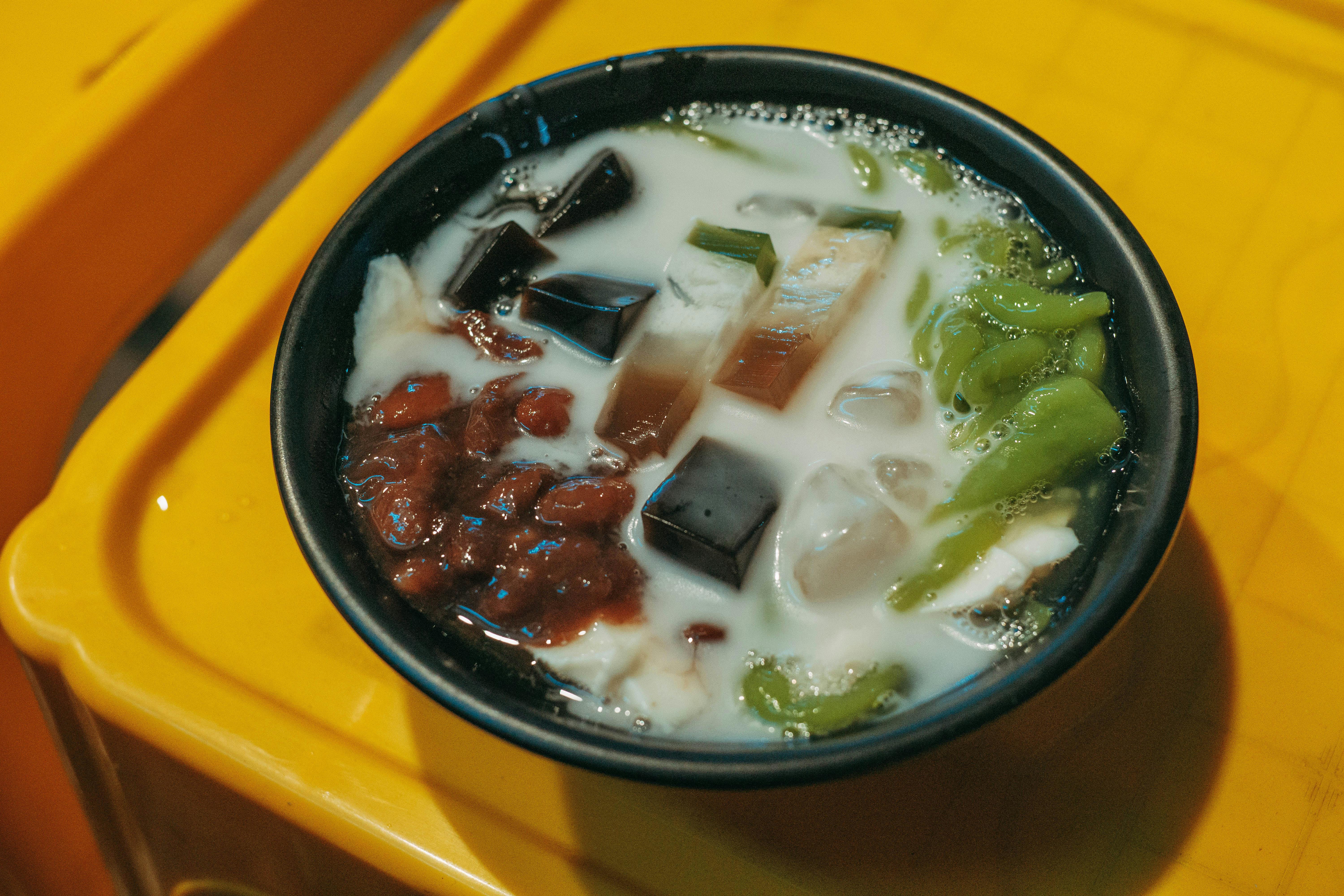
Photo: FOX ^.ᆽ.^= ∫ / Pexels
The diets react (see scores below)
Common Ingredients
- rice flour
- pandan leaves
- coconut milk
- palm sugar
- red beans
- ice
- tapioca starch
- salt
Specific recipes may vary.
Incompatible with 9 of 11 diets
Diet Ratings
Cendol is fundamentally incompatible with a ketogenic diet. The dish is built on multiple high-carbohydrate ingredients: rice flour and tapioca starch form the signature green jelly noodles, palm sugar is a concentrated source of sucrose/glucose used generously as a sweetener, and red beans add substantial starch and carbs. A single standard serving likely delivers 50–80g or more of net carbs, far exceeding the entire daily keto allowance. The coconut milk is the only keto-friendly element, but it cannot offset the carbohydrate load from the remaining ingredients. There is no realistic portion size that would make this dish ketogenic.
Cendol as listed here is composed entirely of plant-based ingredients: rice flour and tapioca starch (plant starches), pandan leaves (a Southeast Asian herb), coconut milk (plant-based), palm sugar (plant-derived), red beans (legume), ice, and salt. No animal products are present in this ingredient list. The dish scores well as it features whole or minimally processed plant foods. The score is slightly tempered rather than a perfect 10 because palm sugar and palm oil products raise ethical concerns within the vegan community due to environmental impact, and coconut milk is moderately processed. The confidence is medium rather than high primarily due to palm sugar — while it is botanically plant-derived, some ethically-oriented vegans raise concerns about palm product harvesting practices and its environmental footprint. Additionally, commercial versions of cendol in Malaysia sometimes include condensed milk or evaporated milk as a topping, which would make those versions non-vegan, but the core listed recipe here contains none.
Some ethical vegans and whole-food plant-based advocates express concern about palm-derived products (including palm sugar) due to deforestation and orangutan habitat destruction, and may choose to avoid this dish on those grounds even though it contains no animal-derived ingredients by strict vegan definition.
Cendol contains multiple ingredients that are firmly excluded from the paleo diet. Rice flour is a grain derivative, strictly off-limits in paleo. Red beans are legumes, another clear paleo exclusion. Tapioca starch, while derived from cassava (a tuber), is a heavily processed, refined starch with virtually no nutritional value — generally discouraged even by moderate paleo practitioners. Added salt is also excluded. While some ingredients are paleo-compatible (pandan leaves, coconut milk, palm sugar as a caution-level natural sweetener), the foundational ingredients — rice flour, red beans, and processed tapioca starch — make this dish incompatible with the paleo diet. There is no meaningful way to adapt Cendol without fundamentally changing the dish.
Cendol is a Southeast Asian dessert that conflicts with Mediterranean diet principles on multiple fronts. Palm sugar is a significant source of added sugar, which the Mediterranean diet minimizes. Coconut milk is high in saturated fat and is not a traditional Mediterranean fat source — olive oil is the canonical fat. The base is refined rice flour and tapioca starch, both refined carbohydrates with minimal fiber or nutritional density. While red beans are a legume aligned with plant-based principles, they are a minor component in a dish dominated by sugar, saturated fat, and refined starches. The overall nutritional profile — high added sugar, high saturated fat, refined grains — places this firmly in the 'avoid' category.
Cendol is entirely plant-based and contains no animal products whatsoever. Every single ingredient — rice flour, pandan leaves, coconut milk, palm sugar, red beans, ice, tapioca starch, and salt — is either plant-derived or non-animal. Rice flour and tapioca starch are grain/starch-based carbohydrates explicitly excluded from carnivore. Pandan leaves are a plant flavoring. Coconut milk is a plant-based fat source. Palm sugar is a high-glycemic sweetener derived from palm trees. Red beans are legumes, one of the most excluded food categories on carnivore. This dish is essentially a high-carbohydrate, high-sugar dessert with zero animal-derived nutrition. It represents the antithesis of the carnivore dietary framework on every level.
Cendol contains multiple Whole30-excluded ingredients. Rice flour is a grain product (grains are excluded), palm sugar is an added sugar (excluded), and red beans are legumes (excluded). The noodle/jelly form of cendol also falls into the 'pasta or noodles' recreation category. Even if individual ingredients like coconut milk, pandan, and salt are compliant, the combination of three major excluded categories makes this dish clearly off-program.
Cendol contains two major high-FODMAP ingredients that make it unsuitable during the elimination phase. Red beans (kidney beans or adzuki beans) are very high in GOS (galacto-oligosaccharides) and are a classic high-FODMAP food to avoid. Palm sugar (gula melaka/gula Jawa) is high in fructose and fructans, and is used in significant quantities in cendol. The remaining ingredients — rice flour noodles, pandan leaves, coconut milk (low-FODMAP at ~60ml), tapioca starch, salt, and ice — are individually low-FODMAP. However, the combination of red beans and palm sugar in standard serving quantities makes this dish clearly high-FODMAP and incompatible with the elimination phase.
Cendol is a Southeast Asian dessert that conflicts with multiple core DASH diet principles. The primary concerns are: (1) Coconut milk is a tropical oil-derived product high in saturated fat, which DASH explicitly limits. (2) Palm sugar is a high-glycemic added sugar, and DASH emphasizes limiting sweets and added sugars. (3) The combination of coconut milk and palm sugar makes this a high-calorie, high-saturated-fat, high-added-sugar dessert with minimal nutritional benefit relative to DASH goals. While red beans offer some fiber, potassium, and protein, they are a minor positive in an otherwise DASH-incompatible dish. The rice flour and tapioca starch base provides refined carbohydrates with little fiber. Salt adds sodium. This dish offers virtually none of the DASH-emphasized nutrients — potassium, calcium, magnesium, fiber — in meaningful amounts relative to its saturated fat and sugar load.
Cendol is a Malaysian sweet dessert drink made primarily from high-glycemic carbohydrates with virtually no lean protein and problematic fat sources. Palm sugar (gula melaka) is the dominant sweetener — a high-glycemic sugar that spikes insulin rapidly, which is exactly what Zone Diet methodology seeks to avoid. Coconut milk contributes significant saturated fat with no accompanying monounsaturated fat benefit. Rice flour noodles and tapioca starch add more high-glycemic, low-fiber carbohydrates. The red beans are the only nutritionally redeeming ingredient, providing some protein and fiber, but they are a minor component in what is fundamentally a sugar-and-fat dessert. There is essentially no lean protein present, making any Zone block balancing impossible without completely reconstructing the dish. The macronutrient ratio is dominated by high-GI carbs and saturated fat — the opposite of the 40/30/30 Zone target. This dish cannot be incorporated into a Zone meal even with careful portioning, because the ratio problem is structural, not just a quantity issue.
Cendol is a sweet Malaysian dessert drink with a mixed inflammatory profile. On the positive side, pandan leaves contain antioxidants and have demonstrated some anti-inflammatory properties in preliminary research. Red beans are a beneficial legume high in fiber, polyphenols, and plant-based protein, all of which support anti-inflammatory goals. However, the dish is dominated by pro-inflammatory concerns. Palm sugar, while less refined than white sugar, is still a significant source of added sugar that can spike blood glucose and promote inflammatory markers like CRP at typical serving amounts. Coconut milk is high in saturated fat (lauric acid), which is debated but generally classified under 'limit' in anti-inflammatory frameworks. Rice flour and tapioca starch are refined, high-glycemic carbohydrates with minimal fiber or micronutrient value. The overall dish is essentially a sugar- and saturated-fat-forward dessert with some mitigating ingredients. It is not a regular-consumption food within an anti-inflammatory diet but is acceptable occasionally, particularly if portion sizes are modest. The red beans and pandan are the only genuinely anti-inflammatory components and do not outweigh the sugar and saturated fat load.
Cendol is a high-sugar, high-saturated-fat dessert drink with virtually no protein and minimal fiber. The base is sweetened coconut milk (high in saturated fat) poured over shaved ice, with palm sugar syrup providing a significant glycemic spike. The rice flour and tapioca starch noodles are refined-carbohydrate fillers with negligible nutritional value. Red beans do contribute some fiber and a small amount of protein, but their positive contribution is overwhelmed by the sugar and saturated fat load of the dish. For GLP-1 patients, this drink hits multiple 'avoid' triggers simultaneously: high sugar (worsens blood sugar instability and provides empty calories), high saturated fat from coconut milk (worsens nausea and GI side effects due to slowed gastric emptying), near-zero protein (critical nutrient completely absent), and cold sugary liquid format that offers no satiety. The reduced appetite window GLP-1 patients have makes this an especially poor nutritional choice — every calorie counts, and these calories deliver almost no protein, minimal fiber, and high fat and sugar.
*See how scores were generated at our methodology page.
Nutritional profile
Six traits that cut across every diet.
Fiber & Plants
How much whole-plant food and fiber it delivers.
Healthy Fats
The quality of its fats (unsaturated, omega-3).
Whole / Unprocessed
How close it is to its natural, unprocessed form.
Gut Gentle
How easy it is on digestion (low FODMAP, few irritants).
Low Glycemic
How little it spikes your blood sugar.
Protein Density
How much protein it packs per calorie.
Controversy Index
Higher controversy = more disagreement between diets.
Diet-Specific Tips
 Vegan — 8/10
View tips
- All listed ingredients are plant-derived — no meat, dairy, or eggs
- Coconut milk is a fully plant-based dairy alternative common in vegan cooking
- Palm sugar is botanically plant-derived but carries ethical concerns for some vegans regarding palm industry environmental impact
- Red beans provide plant protein and fiber, supporting nutritional value
- Pandan leaves and coconut milk are whole/natural plant foods
- Commercial preparations may add condensed or evaporated milk — this listed version does not
- No hidden animal-derived additives such as gelatin or carmine in the ingredient list
 Anti-Inflammatory — 4/10
View tips
- Palm sugar contributes significant added sugar, promoting inflammatory markers at typical serving amounts
- Coconut milk is high in saturated fat, which anti-inflammatory guidelines recommend limiting
- Rice flour and tapioca starch are refined, high-glycemic carbohydrates with minimal anti-inflammatory value
- Red beans provide beneficial fiber, polyphenols, and legume-based nutrition — a genuine anti-inflammatory component
- Pandan leaves contain antioxidants with mild anti-inflammatory properties
- Overall sugar and saturated fat load outweighs the beneficial legume and pandan content