Photo: Ahmad Shakir Shamsulbadri / Pexels
Malaysian
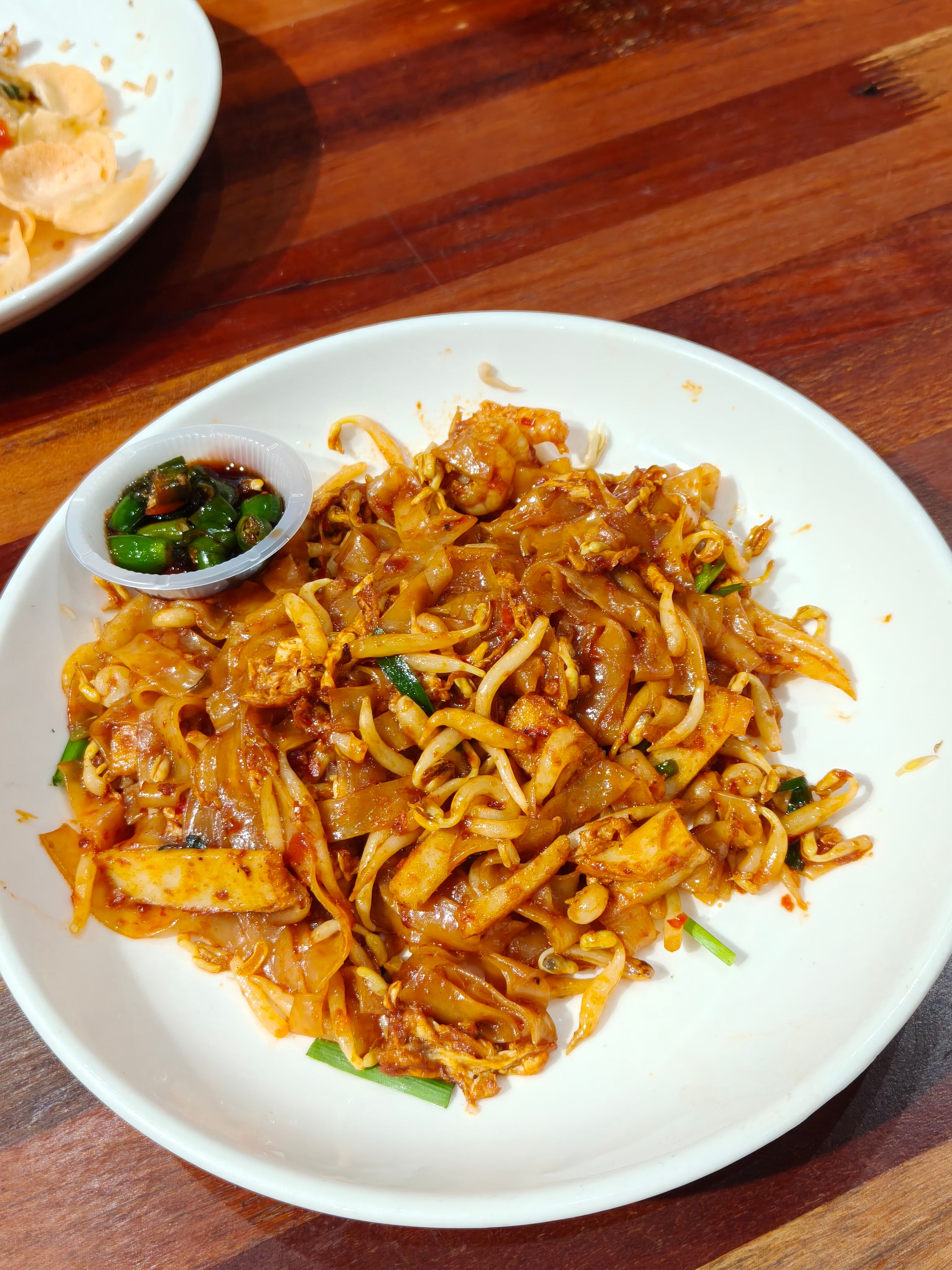
Char Kway Teow
The diets react (see scores below)
Common Ingredients
- flat rice noodles
- shrimp
- cockles
- eggs
- bean sprouts
- chinese chives
- soy sauce
- garlic
- chili paste
- lard
Specific recipes may vary.
Incompatible with 11 of 11 diets
Diet Ratings
Char Kway Teow is fundamentally built around flat rice noodles, which are a high-carb grain-based ingredient and the dominant component of the dish. A standard serving (approximately 300-400g) delivers roughly 50-70g of net carbs from the noodles alone, far exceeding the entire daily keto carb budget. The soy sauce adds minor additional carbs and hidden sugars. While several individual components — shrimp, cockles, eggs, lard, garlic, chives, bean sprouts, and chili paste — are keto-friendly, they cannot offset the massive carbohydrate load from the rice noodles, which are non-negotiable to the dish's identity. This dish is structurally incompatible with ketosis.
Char Kway Teow as described contains multiple animal products that are unambiguously non-vegan. Shrimp and cockles are seafood (animal products), eggs are an animal product explicitly excluded from vegan diets, and lard is rendered pig fat — a direct animal-derived ingredient. This dish fails vegan criteria on at least four separate counts. There is no ambiguity here; this is a classic Malaysian street dish built around animal proteins and animal fats.
Char Kway Teow is fundamentally incompatible with the paleo diet. The dish is built on flat rice noodles, which are a grain-based food — grains are strictly excluded from all paleo frameworks. Soy sauce introduces both soy (a legume) and typically wheat, compounding the violations. Bean sprouts, while derived from mung beans, come from a legume source. Chili paste often contains added sugar, salt, preservatives, or seed oils. While several individual components are paleo-friendly — shrimp, cockles, eggs, garlic, and lard (an approved animal fat) — the foundational ingredients (rice noodles, soy sauce, bean sprouts from legumes) make this dish a clear avoid. There is no meaningful way to adapt this dish and still call it Char Kway Teow.
Char Kway Teow significantly contradicts Mediterranean diet principles on multiple fronts. The dish is cooked in lard (saturated animal fat) rather than olive oil, which directly opposes the core Mediterranean principle of extra virgin olive oil as the primary fat source. The flat rice noodles are refined carbohydrates with no whole grain content. The soy sauce contributes high sodium. While shrimp and cockles are positive Mediterranean-compatible proteins, and bean sprouts, garlic, and chives add some vegetable value, these positives are heavily outweighed by the lard-based cooking fat and refined noodle base. The overall dish profile — high in saturated fat, refined grains, and sodium — places it firmly outside Mediterranean dietary patterns.
Char Kway Teow is fundamentally incompatible with the carnivore diet. The dish is built on a base of flat rice noodles — a grain-based plant food — which alone disqualifies it entirely. Beyond the noodles, it contains multiple additional plant-derived ingredients: bean sprouts (legume sprouts), Chinese chives (vegetable), soy sauce (fermented soy — a legume), garlic (allium vegetable), and chili paste (plant-based condiment). While it does contain carnivore-approved components — shrimp, cockles, eggs, and lard — these are completely overshadowed by the dominant plant and grain content. This dish represents exactly the type of mixed cuisine that carnivore practitioners must avoid in its traditional form. There is no meaningful adaptation possible here without reconstructing the dish entirely.
Char Kway Teow contains multiple Whole30-excluded ingredients. Most critically, flat rice noodles are a grain product (rice is explicitly excluded), and soy sauce contains soy (a legume, excluded) and often wheat (a grain, excluded). These two core components of the dish are fundamentally non-compliant. Additionally, chili paste frequently contains added sugar or other non-compliant additives. Even setting aside the sauce and seasoning issues, the dish is built on rice noodles, which disqualifies it entirely. Furthermore, even if compliant substitutes were used for each ingredient, recreating a noodle dish would fall under Whole30's prohibition on making pasta or noodle-based dishes with compliant ingredients.
Char Kway Teow contains multiple high-FODMAP ingredients that make it unsuitable during the elimination phase. Garlic is one of the highest-FODMAP foods tested by Monash University, containing significant fructans even in tiny amounts. Chinese chives (garlic chives) are also high in fructans. Chili paste typically contains garlic and/or onion as base ingredients, adding further FODMAP load. Cockles have not been well-tested by Monash and their FODMAP status is uncertain. While flat rice noodles, shrimp, eggs, bean sprouts (at small servings), soy sauce (in small amounts), and lard are individually low-FODMAP, the presence of garlic and Chinese chives alone is sufficient to classify this dish as high-FODMAP. This is a traditionally prepared dish where garlic is a core aromatic — it cannot be easily omitted without fundamentally altering the dish.
Char Kway Teow is fundamentally incompatible with DASH diet principles. The dish is cooked in lard, which is high in saturated fat — directly contradicting DASH's explicit limits on saturated fat. Soy sauce contributes very high sodium (a single tablespoon of regular soy sauce contains ~900mg sodium, and this dish typically uses several tablespoons), making it extremely difficult to stay within the DASH 2,300mg/day sodium ceiling, let alone the 1,500mg low-sodium target. The flat rice noodles are refined carbohydrates, not whole grains. Cockles and shrimp add some lean protein value, and bean sprouts, Chinese chives, and garlic are DASH-friendly vegetables, but these positives are heavily outweighed by the lard and soy sauce. This dish as traditionally prepared is a poor fit for DASH across multiple key criteria simultaneously.
Char Kway Teow is fundamentally incompatible with Zone Diet principles as traditionally prepared. The base ingredient — flat rice noodles — is a high-glycemic refined carbohydrate that would dominate the macronutrient profile and spike blood sugar rapidly, exactly what the Zone seeks to avoid. The dish is cooked in lard, a saturated animal fat that is the opposite of the Zone's preferred monounsaturated fats (olive oil, avocado, almonds). The macro ratio is severely skewed: the dish is carbohydrate-heavy (noodles dominate), fat-heavy from lard, and relatively low in protein relative to the overall calorie load. The protein sources — shrimp, cockles, and eggs — are actually Zone-favorable, and bean sprouts and chives add some low-GI vegetable carbs. However, these positive elements are overwhelmed by the structural problems: high-GI noodle base, lard cooking fat, and a macro ratio that would be nearly impossible to bring into 40/30/30 balance without fundamentally deconstructing the dish. This is not a caution-level food that requires careful portioning — the core composition is architecturally misaligned with Zone principles.
Char Kway Teow as traditionally prepared presents a strongly pro-inflammatory profile driven primarily by lard and refined flat rice noodles. Lard is high in saturated fat, which is explicitly limited in anti-inflammatory frameworks. The flat rice noodles are refined carbohydrates with a high glycemic index, promoting insulin spikes and downstream inflammatory signaling (elevated CRP, IL-6). Soy sauce adds significant sodium, and traditional versions are typically wok-fried at very high heat in substantial quantities of lard, compounding the saturated fat load. On the positive side, the dish does contain some genuinely anti-inflammatory components: shrimp provide lean protein and some selenium; garlic has well-documented anti-inflammatory properties (allicin); chili paste contains capsaicin; bean sprouts and Chinese chives offer modest fiber and micronutrients; eggs contribute choline. Cockles (blood cockles) are a reasonable seafood protein source. However, these positives are substantially outweighed by the refined carbohydrate base and the lard-heavy cooking method. The dish could be substantially improved by substituting lard with extra virgin olive oil, using whole grain or lower-GI noodles, and reducing sodium — but as traditionally prepared and ordered, it does not align with anti-inflammatory principles.
Char Kway Teow is a poor fit for GLP-1 patients in its traditional form. The dish is cooked in lard, a saturated animal fat, at very high heat, making it inherently high-fat and greasy — a combination that directly worsens GLP-1 side effects including nausea, bloating, and reflux due to slowed gastric emptying. The base is flat rice noodles, a refined carbohydrate with minimal fiber and low protein density per calorie. While shrimp, cockles, and eggs do contribute some protein, the overall protein-to-calorie ratio is poor when the lard, noodles, and cooking method are factored in. Chili paste may aggravate reflux and nausea in sensitive patients. Bean sprouts and chives add minimal fiber. Soy sauce contributes significant sodium, which can worsen water retention and bloating. The dish also tends to be served in a large, carb-heavy portion that is not small-serving friendly. Virtually every primary concern for GLP-1 patients — high saturated fat, refined carbs, low fiber, GI irritants, large portions — is present here.
*See how scores were generated at our methodology page.
Nutritional profile
Six traits that cut across every diet.
Fiber & Plants
How much whole-plant food and fiber it delivers.
Healthy Fats
The quality of its fats (unsaturated, omega-3).
Whole / Unprocessed
How close it is to its natural, unprocessed form.
Gut Gentle
How easy it is on digestion (low FODMAP, few irritants).
Low Glycemic
How little it spikes your blood sugar.
Protein Density
How much protein it packs per calorie.
Controversy Index
Higher controversy = more disagreement between diets.