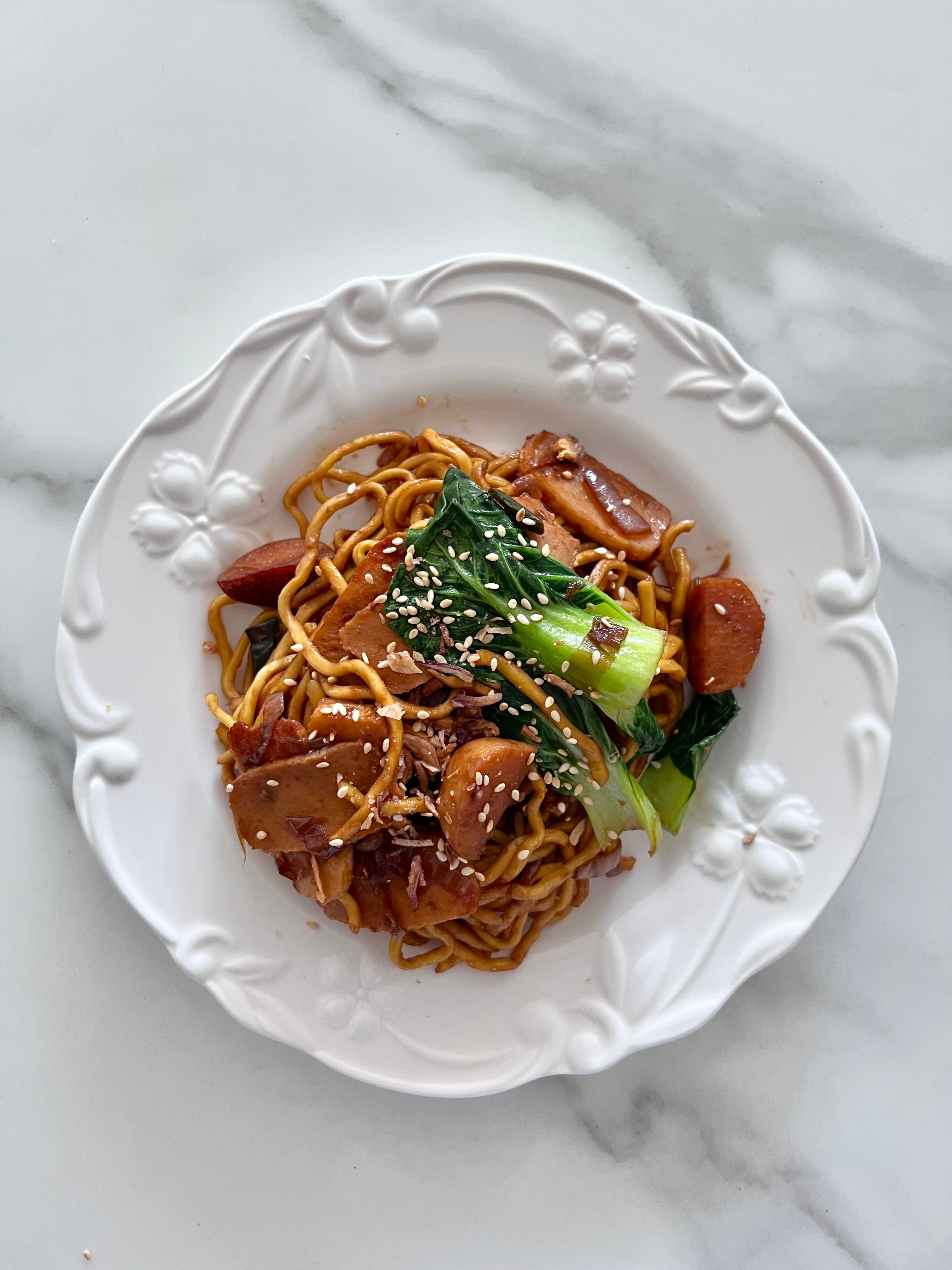
Photo: Anya Dunes / Pexels
Malaysian
Hokkien Mee
The diets react (see scores below)
Common Ingredients
- yellow noodles
- pork belly
- shrimp
- cabbage
- dark soy sauce
- garlic
- fish cake
- lard
- squid
- bean sprouts
Specific recipes may vary.
Incompatible with 10 of 11 diets
Diet Ratings
Hokkien Mee is fundamentally built around yellow noodles, which are wheat-based and carry a very high net carb load — a standard serving (150-200g of noodles) easily delivers 50-70g of net carbs, blowing past the entire daily keto limit in a single dish. While several individual components are keto-friendly (pork belly, shrimp, squid, lard, cabbage, bean sprouts, garlic), the noodles are the structural core of the dish and cannot be reduced to a negligible portion without fundamentally changing it. Dark soy sauce also adds a small amount of sugar and carbs. There is no realistic way to consume a standard serving of Hokkien Mee and maintain ketosis.
Hokkien Mee as prepared here contains multiple animal products and is entirely incompatible with a vegan diet. The dish includes pork belly (mammal meat), shrimp (crustacean), squid (cephalopod mollusk), fish cake (processed fish), and lard (rendered pig fat used for cooking). Every one of these ingredients is a direct animal product or animal-derived ingredient, making this dish unambiguously non-vegan. There are no borderline or contested ingredients here — this is a straightforwardly animal-heavy dish.
Hokkien Mee is fundamentally incompatible with the Paleolithic diet. The dish is built on yellow noodles, which are wheat-based grain noodles — a clear and unambiguous paleo exclusion. Dark soy sauce introduces both soy (a legume) and typically wheat as fermentation ingredients, compounding the violation. Fish cake is a processed food product containing additives, fillers, and often starch. While several ingredients are paleo-friendly in isolation — pork belly, shrimp, squid, cabbage, bean sprouts, garlic, and lard — the foundational components of the dish (noodles, soy sauce, fish cake) make it impossible to classify as anything other than 'avoid.' There are no meaningful modifications that would preserve the dish's identity while making it paleo-compliant.
Hokkien Mee contains multiple elements that strongly contradict Mediterranean diet principles. Pork belly is a fatty red/processed meat that should be limited to a few times per month, while lard is a saturated animal fat that directly opposes the Mediterranean emphasis on extra virgin olive oil as the primary fat. Yellow noodles are refined grain noodles lacking the fiber and nutrients of whole grains. Dark soy sauce contributes high sodium. Although the dish does contain some positive elements — shrimp and squid (seafood), cabbage, bean sprouts, and garlic align with Mediterranean principles — these are outweighed by the problematic core ingredients: pork belly, lard, and refined noodles that together make this dish a poor fit for the Mediterranean dietary pattern.
Hokkien Mee is fundamentally incompatible with the carnivore diet. The dish is built on yellow noodles (wheat-based grain product), which are a core prohibited ingredient. Additionally, it contains cabbage, bean sprouts (plant foods), dark soy sauce (fermented soy — a legume-based condiment with additives and sugar), and garlic (plant). While some ingredients are carnivore-friendly — pork belly, shrimp, squid, lard, and even fish cake (depending on ingredients) — the foundational components of this dish are plant-based carbohydrates and plant-derived condiments. The animal protein components cannot redeem a dish whose structure is built on grains and vegetables. This is not a food that can be modified into a carnivore meal without completely reconstructing it.
Hokkien Mee contains yellow noodles, which are wheat-based egg noodles — a grain product explicitly excluded on Whole30. Additionally, dark soy sauce contains soy (a legume) and wheat (a grain), both of which are banned. Noodles also fall directly under the Whole30's prohibited 'pasta or noodles' category even if compliant ingredients were used. The remaining ingredients — pork belly, shrimp, squid, cabbage, garlic, bean sprouts, lard — are individually Whole30-compatible, but the dish is fundamentally built around excluded ingredients that cannot be substituted while still calling the dish Hokkien Mee. Fish cake may also contain starch binders and sugar depending on the brand.
Hokkien Mee contains multiple high-FODMAP ingredients that make it unsuitable during the elimination phase. Yellow noodles are wheat-based (containing fructans), making them a primary FODMAP concern. Garlic is one of the highest-FODMAP foods known, rich in fructans and a clear 'avoid' in elimination. These two ingredients alone are sufficient to classify this dish as high-FODMAP. The remaining ingredients — pork belly, shrimp, squid, fish cake, lard, bean sprouts, cabbage (in moderate portions), and dark soy sauce — are generally low-FODMAP or low-risk in standard servings. However, the wheat noodles and garlic are non-negotiable problems that cannot be avoided in a traditional Hokkien Mee preparation.
Hokkien Mee is fundamentally incompatible with DASH diet principles due to multiple high-concern ingredients. Pork belly is a fatty red meat high in saturated fat and sodium, directly conflicting with DASH guidelines to limit red meat and saturated fat. Lard (rendered pork fat) is extremely high in saturated fat, which DASH explicitly restricts. Dark soy sauce contributes significant sodium, potentially pushing a single serving well above the DASH daily sodium threshold of 1,500–2,300mg. Refined yellow noodles lack the fiber and nutrients of whole grains emphasized by DASH. While some ingredients like shrimp, squid, cabbage, bean sprouts, and garlic are DASH-compatible, they are outweighed by the problematic core components. Fish cake is a processed food typically high in sodium, adding further concern. The dish as traditionally prepared represents a convergence of high saturated fat (lard, pork belly), high sodium (soy sauce, fish cake, processed ingredients), and refined carbohydrates — three of DASH's primary dietary targets for reduction.
Hokkien Mee presents significant Zone Diet challenges but stops short of a full 'avoid' because it contains lean proteins (shrimp, squid, fish cake) and some favorable vegetables (cabbage, bean sprouts) that partially redeem it. The primary issues are the yellow noodles (high-glycemic refined wheat/egg noodles that dominate the carb block and spike blood sugar rapidly), pork belly (high saturated fat, far from Zone-friendly lean protein), and lard as the cooking fat (saturated fat, directly opposed to Zone's monounsaturated fat preference). Dark soy sauce adds negligible glycemic load but is high in sodium. As served, the macro ratio is heavily skewed: carbs are high-GI from noodles, fat is saturated from lard and pork belly, and while protein is present from multiple sources, the lean proteins are likely outweighed by the fatty pork belly. Achieving a 40/30/30 Zone block ratio from this dish as traditionally prepared is extremely difficult. However, some Zone practitioners might consume a small portion alongside additional vegetables, or reconstruct the dish substituting shirataki or reduced noodle portions, lean pork tenderloin, and olive oil — making this a 'caution' rather than 'avoid.' The dish's core structure (noodle-dominant, lard-cooked, pork-belly-centered) makes it one of the more challenging Malaysian dishes to fit into Zone protocol.
Some Zone practitioners argue that dishes like Hokkien Mee can be portioned into a single carb block worth of noodles with the seafood components (shrimp, squid, fish cake) providing Zone-compatible lean protein, effectively treating the dish as a mixed meal requiring careful selection. Sears' later writings (The Anti-Inflammation Zone) emphasize polyphenol-rich foods and omega-3s over strict glycemic avoidance, and the seafood components do provide some anti-inflammatory benefit. A strict early-Zone reading (Enter the Zone) would rate this closer to 2 due to the unfavorable carb and fat sources.
Hokkien Mee as prepared here is a heavily pro-inflammatory dish by anti-inflammatory standards. The most significant concern is lard, a saturated animal fat that is explicitly discouraged in anti-inflammatory frameworks due to its contribution to elevated inflammatory markers like CRP and IL-6. Pork belly compounds this issue, being one of the fattiest cuts of red/processed meat — a category the anti-inflammatory framework explicitly limits. Refined yellow noodles are a refined carbohydrate with high glycemic load, contributing to insulin spikes and downstream inflammatory signaling. Dark soy sauce, while containing small amounts of antioxidants, is high in sodium and often contains additives. Fish cake is a processed food that typically contains fillers, starch, and sodium. On the positive side, the dish does include some beneficial components: shrimp and squid provide lean protein and some anti-inflammatory minerals (selenium, zinc), garlic is a well-established anti-inflammatory ingredient, cabbage and bean sprouts offer some fiber and polyphenols, and shrimp provides modest omega-3s. However, these positives are substantially outweighed by the use of lard as the primary cooking fat, the refined noodle base, and fatty processed pork as the primary protein. The dish's overall nutritional architecture is fundamentally misaligned with anti-inflammatory eating principles.
Hokkien Mee is a poor fit for GLP-1 patients across nearly every rating dimension. The dish is built on a base of yellow noodles — refined, low-fiber carbohydrates that offer little nutritional value per calorie. Pork belly is one of the fattiest protein cuts available, high in saturated fat, and lard is used as the cooking fat, compounding the saturated fat load significantly. High dietary fat directly worsens GLP-1 side effects including nausea, bloating, and reflux because slowed gastric emptying means fatty foods sit in the stomach for extended periods. While shrimp, squid, and fish cake contribute some protein, their total quantity is typically modest relative to the noodle and pork belly volume, meaning protein density per calorie is low. Bean sprouts and cabbage provide minimal fiber at the quantities used. Dark soy sauce contributes high sodium. The overall dish is calorie-dense, fat-heavy, low in fiber, and difficult to digest — a combination that is particularly problematic on GLP-1 medications. There is no meaningful modification pathway that preserves the character of Hokkien Mee while making it GLP-1 appropriate, since lard and pork belly are core to the dish's identity.
*See how scores were generated at our methodology page.
Nutritional profile
Six traits that cut across every diet.
Fiber & Plants
How much whole-plant food and fiber it delivers.
Healthy Fats
The quality of its fats (unsaturated, omega-3).
Whole / Unprocessed
How close it is to its natural, unprocessed form.
Gut Gentle
How easy it is on digestion (low FODMAP, few irritants).
Low Glycemic
How little it spikes your blood sugar.
Protein Density
How much protein it packs per calorie.
Controversy Index
Higher controversy = more disagreement between diets.
Diet-Specific Tips
 Zone — 5/10
View tips
- Yellow noodles are high-glycemic refined carbohydrates — categorized 'unfavorable' in Zone terminology
- Lard is saturated animal fat, directly opposing Zone's monounsaturated fat preference (olive oil, avocado, almonds)
- Pork belly is high in saturated fat and not a Zone-approved lean protein source
- Shrimp, squid, and fish cake are lean proteins that partially salvage the dish's protein profile
- Cabbage and bean sprouts are favorable low-glycemic Zone vegetables but present in small proportions
- As traditionally served, macro ratio is far from 40/30/30 — carb and saturated fat heavy
- Reconstruction with less noodles, no lard, and lean protein substitution could make it Zone-compatible with effort