Malaysian
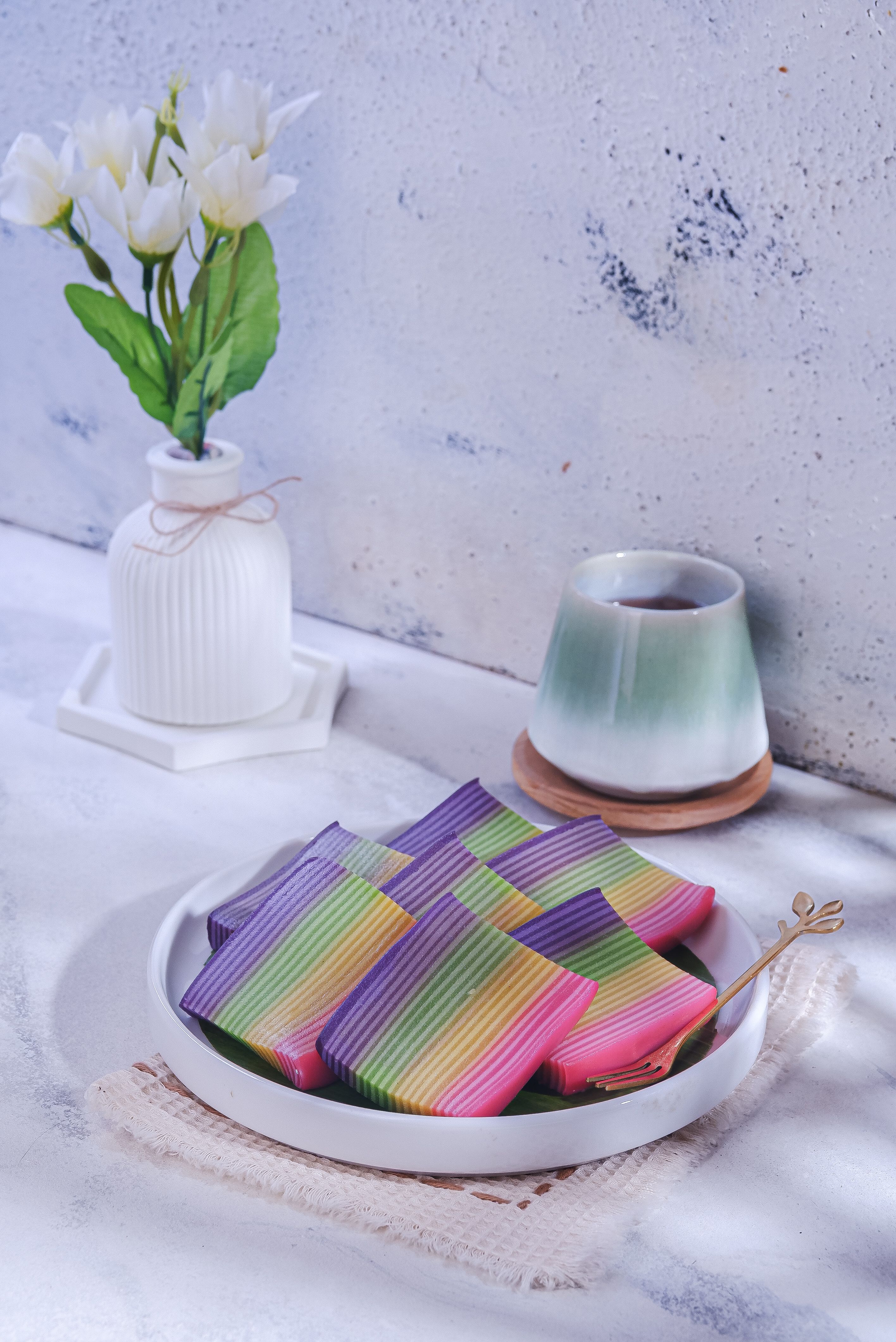
Kuih Lapis
The diets react (see scores below)
Common Ingredients
- rice flour
- tapioca starch
- coconut milk
- sugar
- pandan leaves
- food coloring
- salt
- water
Specific recipes may vary.
Incompatible with 9 of 11 diets
Diet Ratings
Kuih Lapis is fundamentally incompatible with a ketogenic diet. Its primary ingredients — rice flour, tapioca starch, and sugar — are all high-glycemic, high-net-carb components that will immediately disrupt ketosis. A single serving (2-3 layers) can easily contain 30-45g of net carbs, approaching or exceeding the entire daily keto carb limit. Rice flour is a refined grain, tapioca starch is nearly pure starch with negligible fiber, and added sugar provides zero nutritional benefit on keto. The only keto-friendly ingredient is coconut milk, which provides healthy fat, but it cannot offset the carbohydrate load of the other ingredients. There is no viable portion size that makes this snack keto-compatible.
Kuih Lapis as described here is fully plant-based. All listed ingredients — rice flour, tapioca starch, coconut milk, sugar, pandan leaves, food coloring, salt, and water — are derived entirely from plants or are non-animal synthetics. Coconut milk is a plant-based fat source, pandan is a herb, and the starches and flours are grain/root-derived. The only minor caveat is that some commercial food colorings (e.g., carmine/E120) are animal-derived, but the vast majority of food colorings used in this context are synthetic and vegan-compliant. Since the ingredient list simply states 'food coloring' without specifying carmine, and synthetic colorings are the default in modern food production, the dish is evaluated as vegan-friendly. This is a relatively whole-food preparation with no heavily processed vegan substitutes involved, meriting a high score within the approve range.
Kuih Lapis is fundamentally incompatible with the Paleolithic diet. The dish is built on rice flour and tapioca starch — both grain/starch-based processed flours that are explicitly excluded from paleo. Rice flour is a grain derivative, and while tapioca comes from cassava (a tuber), its highly refined starch form is far removed from whole-food paleo eating. Added sugar is a refined ingredient excluded from paleo, and added salt is also discouraged. Food coloring represents an artificial additive with no place in paleo. Pandan leaves and coconut milk are the only paleo-aligned ingredients in the entire recipe. The dish is a heavily processed starchy confection with multiple core violations.
Kuih Lapis is a Malaysian layered steamed cake that fundamentally conflicts with Mediterranean diet principles. It is built on refined starches (rice flour and tapioca starch), high added sugar, and coconut milk as its primary fat source — none of which align with the diet's core tenets. Refined grains and starches lack the fiber and nutrients of whole grains. Added sugar is explicitly minimized in the Mediterranean diet. Coconut milk is high in saturated fat and is entirely absent from traditional Mediterranean culinary traditions, which rely on extra virgin olive oil as the primary fat. Food coloring adds further processing concerns. There is no meaningful nutritional redeeming quality relative to Mediterranean diet guidelines.
Kuih Lapis is entirely plant-based and incompatible with the carnivore diet. Every single ingredient — rice flour, tapioca starch, coconut milk, sugar, pandan leaves, food coloring, and water — is either plant-derived, processed, or contains added sugar. There are zero animal products present. This is a starchy, high-carbohydrate Malaysian layered cake with added sugar, representing the antithesis of carnivore eating principles.
Kuih Lapis contains multiple excluded ingredients. Rice flour is a grain product (rice is explicitly excluded on Whole30). Tapioca starch, while derived from a root vegetable, is a highly processed starch that falls outside compliant foods. Most critically, sugar is explicitly excluded as an added sugar. Even setting aside the spirit-of-the-program concerns, the rice flour and added sugar alone make this dish non-compliant. Additionally, Kuih Lapis is a layered steamed cake — a baked good/sweet treat category that the Whole30 explicitly prohibits even when made with technically compliant ingredients, as it recreates junk food and sweets.
Kuih Lapis is a layered Malaysian steamed cake made primarily from rice flour, tapioca starch, coconut milk, sugar, pandan leaves, food coloring, salt, and water. Most ingredients are individually low-FODMAP: rice flour and tapioca starch are gluten-free and low-FODMAP, sugar (sucrose) is low-FODMAP at normal serving sizes, pandan leaves are used in small amounts as flavoring and are considered low-FODMAP, salt, food coloring, and water are all FODMAP-free. The main concern is coconut milk, which is low-FODMAP at 1/2 cup (125ml) per Monash but becomes high-FODMAP at larger amounts due to sorbitol. In a standard serving of Kuih Lapis (1-2 small pieces, roughly 60-100g), the coconut milk content is likely diluted enough across many pieces to remain within low-FODMAP thresholds. However, the exact coconut milk concentration per serving is unknown without a recipe ratio, and consuming multiple pieces could push total coconut milk intake over the safe threshold. Additionally, this dish has not been directly tested by Monash University, requiring ingredient-by-ingredient analysis with inherent uncertainty.
Monash University has not directly tested Kuih Lapis, so the coconut milk content per serving is the key unknown variable. Clinical FODMAP practitioners may advise caution since coconut milk becomes high-FODMAP above 1/2 cup per serving, and traditional recipes can be coconut milk-heavy — portion control is essential and multiple pieces should be avoided during elimination phase.
Kuih Lapis is a layered Malaysian steamed cake made primarily from rice flour, tapioca starch, coconut milk, and sugar. It conflicts with DASH diet principles on multiple fronts. Coconut milk is high in saturated fat from tropical oils, which DASH explicitly limits. The dish is high in added sugar with no significant fiber, potassium, calcium, or magnesium content. It provides refined starches (rice flour and tapioca starch) with minimal nutritional value relative to DASH priorities. The combination of high saturated fat from coconut milk and high added sugar makes this a food DASH guidelines would categorize as a discretionary sweet to avoid or strictly limit.
Kuih Lapis is a layered Malaysian steamed cake made almost entirely of high-glycemic refined starches (rice flour, tapioca starch) combined with sugar and coconut milk fat. This combination produces a macro profile that is essentially all high-GI carbohydrates and saturated fat with virtually zero protein and no fiber to slow glycemic impact. In Zone terms, it fails on nearly every criterion: the carbohydrate sources are highly unfavorable (refined flours and added sugar), the fat is predominantly saturated (coconut milk), and there is no lean protein component whatsoever. The complete absence of protein means it cannot form any part of a balanced Zone block structure without massive dietary additions that would dwarf the kuih itself. Coconut milk's saturated fat is the wrong fat type for Zone (monounsaturated is preferred). Added sugar is explicitly the type of carbohydrate Dr. Sears most strongly discourages. While tiny quantities could theoretically exist as a minor carb block treat, the glycemic spike from refined starch plus sugar makes this impractical even in small portions. It is not a food that can be 'portioned into Zone' in any meaningful way as a snack category item.
Kuih Lapis is a layered Malaysian steamed cake built on a foundation of refined starches (rice flour and tapioca starch) and significant added sugar — a combination that drives rapid glucose spikes, promotes glycation, and elevates inflammatory markers like CRP and IL-6. Coconut milk does contribute medium-chain triglycerides (MCTs), which have some neutral-to-modest metabolic properties, but in this context it also adds saturated fat without meaningful anti-inflammatory offset. Pandan leaves are a mild positive — they contain some antioxidants and flavonoids — but are used in such small amounts primarily for fragrance and color that they provide negligible anti-inflammatory benefit. Artificial food coloring is a concern flagged by anti-inflammatory frameworks as an unnecessary additive with potential links to inflammatory response. There are no omega-3s, no meaningful polyphenols, no fiber, and no anti-inflammatory compounds in therapeutically relevant quantities. This is essentially a refined carbohydrate and sugar dessert — a category consistently identified as pro-inflammatory across anti-inflammatory diet authorities including Dr. Weil's pyramid and the IF Rating system.
Kuih Lapis is a layered steamed cake made primarily from refined starches (rice flour, tapioca starch), sugar, and coconut milk. It offers virtually no protein, negligible fiber, and derives most of its calories from refined carbohydrates and saturated fat (coconut milk). For GLP-1 patients eating significantly reduced calorie volumes, this is essentially an empty-calorie food — every bite displaces a nutritionally valuable one. The high sugar content risks blood sugar spikes, and the saturated fat from coconut milk can worsen GLP-1 GI side effects like nausea and bloating. The refined starch base is also rapidly digestible in a way that provides no satiety benefit, which is counterproductive when appetite suppression is already limiting total intake. Pandan adds negligible nutritional value. There is no meaningful redeeming nutritional feature for a GLP-1 patient context.
*See how scores were generated at our methodology page.
Nutritional profile
Six traits that cut across every diet.
Fiber & Plants
How much whole-plant food and fiber it delivers.
Healthy Fats
The quality of its fats (unsaturated, omega-3).
Whole / Unprocessed
How close it is to its natural, unprocessed form.
Gut Gentle
How easy it is on digestion (low FODMAP, few irritants).
Low Glycemic
How little it spikes your blood sugar.
Protein Density
How much protein it packs per calorie.
Controversy Index
Higher controversy = more disagreement between diets.
Diet-Specific Tips
 Vegan — 8/10
View tips
- Coconut milk is fully plant-based
- Rice flour and tapioca starch are plant-derived
- Pandan leaves are a natural plant flavoring
- Food coloring is almost certainly synthetic; carmine (animal-derived) would need to be explicitly listed
- No animal products, dairy, eggs, or animal-derived additives in standard recipe
- Moderately processed snack but made from recognizable whole-food ingredients
 Low-FODMAP — 6/10
View tips
- Rice flour and tapioca starch are both low-FODMAP and gluten-free — safe base ingredients
- Coconut milk is low-FODMAP at ≤125ml (1/2 cup) per Monash, but high-FODMAP at larger amounts due to sorbitol
- Pandan leaves used as flavoring are low-FODMAP at culinary quantities
- Sugar (sucrose) is low-FODMAP at standard serving sizes
- No wheat, onion, garlic, legumes, lactose, or other major FODMAP sources in ingredients
- Dish has not been directly tested by Monash University — ingredient-based analysis only
- Portion size is critical: 1-2 small pieces likely safe, but multiple pieces increase coconut milk exposure risk