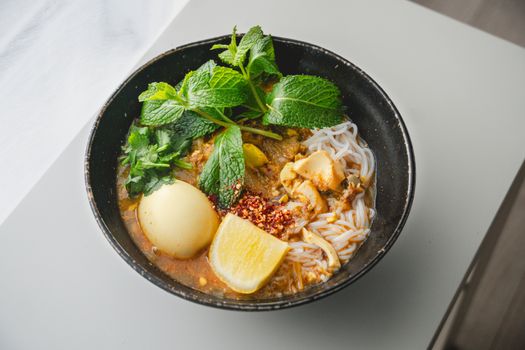
Photo: Su La Pyae / Pexels
The diets react (see scores below)
Common Ingredients
- rice noodles
- coconut milk
- shrimp
- tofu puffs
- bean sprouts
- laksa paste
- lemongrass
- chili
- fish cake
- lime
Specific recipes may vary.
Incompatible with 7 of 11 diets
Diet Ratings
Laksa is fundamentally incompatible with ketogenic eating in its traditional form. The primary disqualifier is rice noodles, which are pure high-glycemic starch delivering approximately 40-50g of net carbs per serving on their own — enough to exceed or saturate the entire daily keto carb budget in one bowl. The laksa paste and fish cake may also contain added sugars and starch fillers. While several individual components are keto-friendly — coconut milk is an excellent high-fat base, shrimp is a clean protein, bean sprouts and lemongrass are low-carb, and chili adds negligible carbs — the rice noodles make the dish as traditionally prepared a clear avoid. A heavily modified version substituting shirataki or zucchini noodles, omitting fish cake, and verifying the paste is sugar-free could be rendered keto-compatible, but that would no longer be authentic laksa.
This laksa contains multiple animal-derived ingredients that make it clearly non-vegan. Shrimp is seafood (an animal product), fish cake is made from processed fish, and traditional laksa paste almost universally contains shrimp paste (belacan) and/or dried shrimp, which are also animal products. These are not incidental trace ingredients but core, defining components of the dish. There is no ambiguity here — this is an animal-product-heavy dish.
Laksa contains multiple non-paleo ingredients that disqualify it outright. Rice noodles are a grain product and strictly excluded from the paleo diet. Tofu puffs are a soy-based legume product, also explicitly excluded. Bean sprouts (from mung beans) are legumes and not paleo-compliant. Laksa paste is a processed condiment that typically contains added salt, shrimp paste with preservatives, and other additives. Fish cake is a processed food product containing fillers, starch, and preservatives. While some ingredients — shrimp, coconut milk, lemongrass, chili, and lime — are paleo-friendly on their own, the dish as a whole is built on a foundation of grains, legumes, and processed ingredients, making it a clear avoid.
Laksa is a flavorful Southeast Asian soup with several Mediterranean-compatible elements — shrimp as the primary protein (encouraged 2-3x weekly), tofu puffs and bean sprouts (plant-based), and aromatic vegetables like lemongrass and chili. However, coconut milk is the dominant fat source, which directly conflicts with the Mediterranean principle of olive oil as the primary fat. Coconut milk is high in saturated fat and has no traditional place in Mediterranean cuisine. Rice noodles are refined carbohydrates, less preferred than whole grains. The laksa paste may contain processed ingredients and added sodium. Fish cake is a mildly processed seafood product. Overall, the dish has a favorable protein profile and vegetable content, but the coconut milk base and refined noodles make it a moderate-caution dish rather than a Mediterranean staple.
Some modern Mediterranean diet interpreters are more permissive about coconut milk when consumed occasionally, arguing that the overall dietary pattern matters more than any single ingredient. Additionally, traditional Southeast Asian diets that include coconut milk, fish, and vegetables have shown favorable health outcomes in some epidemiological studies, leading a minority of researchers to view occasional coconut-based dishes as compatible with a broadly plant-forward, seafood-inclusive dietary pattern.
Laksa is fundamentally incompatible with the carnivore diet. While it contains some animal-derived ingredients (shrimp, fish cake), the dish is overwhelmingly plant-based: rice noodles (grain), tofu puffs (soy/legume), bean sprouts (plant), laksa paste (plant-based spice blend), lemongrass (plant), chili (plant), coconut milk (plant), and lime (fruit). The primary carbohydrate base is rice noodles, which are a grain product and strictly prohibited. Tofu puffs are soy-derived, a legume explicitly excluded. Bean sprouts, lemongrass, chili, and lime are all plant foods. Even the coconut milk, while fatty, is plant-derived. The only carnivore-compatible components — shrimp and fish cake — are incidental and cannot redeem this dish, which is architecturally built around plant foods. No meaningful modification could make this carnivore-compliant while remaining recognizable as laksa.
Laksa contains multiple Whole30-excluded ingredients. Rice noodles are a grain and explicitly excluded. Tofu puffs are made from soy, a legume, which is excluded. Bean sprouts (typically mung bean sprouts) come from legumes and are excluded. Laksa paste commonly contains shrimp paste, sugar, and sometimes soy-based ingredients. Fish cake often contains starch, sugar, and other fillers. Even if individual components like shrimp, coconut milk, lemongrass, chili, and lime are compliant, the combination of rice noodles, tofu puffs, and bean sprouts alone makes this dish firmly non-compliant. This dish as traditionally prepared cannot be made Whole30-compatible without fundamental restructuring.
Laksa is problematic for the low-FODMAP elimination phase primarily because of laksa paste, which virtually always contains high-FODMAP ingredients such as onion, garlic, and shrimp paste (belacan) — all significant sources of fructans and other FODMAPs. Tofu puffs (deep-fried tofu) are high-FODMAP due to their GOS content at standard serving sizes. While several individual ingredients are fine — rice noodles are low-FODMAP, shrimp is low-FODMAP, coconut milk is low-FODMAP in small portions (up to 1/2 cup), lemongrass is low-FODMAP, lime is low-FODMAP, bean sprouts are low-FODMAP, and plain fish cake may be acceptable — the laksa paste is the disqualifying element in any authentic or commercial preparation. Unless a custom low-FODMAP laksa paste is made from scratch (omitting onion, garlic, and using low-FODMAP substitutes like garlic-infused oil and the green tops of spring onions), this dish cannot be considered safe during the elimination phase. Chili is low-FODMAP in moderate amounts but should be monitored. The combination of laksa paste and tofu puffs makes this a clear avoid.
Laksa presents multiple significant conflicts with DASH diet principles. The primary concern is coconut milk, a tropical oil-based ingredient that is high in saturated fat — a category explicitly limited by NIH/NHLBI DASH guidelines. A typical serving of laksa can contain 15-25g of saturated fat from coconut milk alone, far exceeding DASH's saturated fat targets. Laksa paste is typically very high in sodium (shrimp paste, salt, and fermented ingredients), and fish cake adds additional sodium, pushing a single bowl well above 1,500-2,300mg of sodium — potentially exceeding the entire daily DASH sodium budget in one dish. While several individual ingredients are DASH-friendly (shrimp as lean protein, bean sprouts, tofu, lemongrass, lime, rice noodles in moderation), the overall dish as traditionally prepared is incompatible with DASH due to the combination of high saturated fat from coconut milk and very high sodium from the paste and fish cake.
Laksa presents a mixed Zone Diet profile with several conflicting elements. On the positive side, shrimp is an excellent lean protein source, bean sprouts and lemongrass are favorable low-glycemic vegetables, lime adds polyphenols, and tofu puffs provide additional protein. However, the dish has two significant Zone challenges: (1) Rice noodles are a high-glycemic refined carbohydrate that Sears classifies as 'unfavorable' — they drive up insulin rapidly and are difficult to portion into a reasonable carb block without dominating the meal; (2) Coconut milk is high in saturated fat, which conflicts with the Zone's emphasis on monounsaturated fats and anti-inflammatory lipids. A traditional laksa portion would likely be carb-heavy and fat-heavy simultaneously, with the fat skewed toward saturated rather than monounsaturated. The laksa paste and chili do contribute polyphenols (a Sears positive), and the broth-based delivery means some fat is distributed through the liquid. A Zone-adapted laksa could reduce noodle volume dramatically, use light coconut milk, and increase the shrimp and bean sprout ratio — but as traditionally served, the macro balance is off from the 40/30/30 target.
Some Zone practitioners in Southeast Asian contexts argue that the full-fat coconut milk concern is overstated in Sears' later anti-inflammatory framework, which shifted somewhat toward accepting medium-chain triglycerides (MCTs) found in coconut. Additionally, if rice noodles are portioned to a single carb block (roughly 25g cooked), the overall meal could be Zone-balanced with adequate shrimp. The polyphenol richness of laksa paste, lemongrass, and chili aligns with Sears' later OmegaRx and polyphenol-focused writings.
Laksa is a complex dish with both anti-inflammatory and pro-inflammatory components that largely cancel each other out. On the positive side: shrimp provides lean protein and some omega-3s; lemongrass and chili are anti-inflammatory spices with bioactive compounds (citral and capsaicin respectively); tofu puffs contribute whole soy protein; bean sprouts add fiber and micronutrients; lime adds vitamin C and flavonoids; rice noodles are gluten-free and relatively refined-carb neutral. The central concern is coconut milk, which is high in saturated fat (lauric acid) — a consistently flagged ingredient in anti-inflammatory frameworks. While some emerging research suggests lauric acid may have distinct metabolic effects compared to other saturated fats, mainstream anti-inflammatory guidance (including Dr. Weil's framework) recommends limiting full-fat coconut milk. Laksa paste typically contains shrimp paste, candlenuts or macadamia, dried chilies, and galangal — the spice base is broadly anti-inflammatory, but commercial pastes often contain refined salt, preservatives, and sometimes palm oil. Fish cake is a processed ingredient with additives and high sodium. The combination of coconut milk-heavy broth plus processed fish cake makes this a moderate-caution dish rather than something to approve or avoid outright.
Some anti-inflammatory practitioners, particularly those who emphasize a whole-food or Asian traditional diet lens, would rate this more favorably — pointing to the robust spice base (lemongrass, galangal, chili) and its structural similarity to anti-inflammatory Southeast Asian cooking patterns. Conversely, stricter anti-inflammatory protocols that treat all saturated fat as equally pro-inflammatory (and flag processed fish cake and commercial pastes) would push this toward a lower score.
Laksa is a flavorful, nutrient-containing soup but its defining ingredient — coconut milk — makes it a challenging choice for GLP-1 patients. Coconut milk is high in saturated fat, which can worsen nausea, bloating, and reflux, the most common GLP-1 side effects. A standard serving of laksa can contain 20-35g of fat depending on coconut milk concentration, well above what is recommended per meal on a GLP-1 protocol. Shrimp is an excellent lean protein source, and tofu puffs add some protein, but tofu puffs are deep-fried, adding additional fat and reducing digestibility. Rice noodles are refined carbohydrates with minimal fiber and protein, contributing largely empty calories. Bean sprouts add modest fiber and water content, which is a positive. Laksa paste and chili content can be significant — spicy, high-sodium pastes may worsen GI discomfort and reflux. Lemongrass and lime are benign. Fish cake adds modest protein. Overall, the dish has good protein components (shrimp, fish cake) and some hydration benefit from the broth base, but the high saturated fat from coconut milk, fried tofu puffs, refined noodles, spice load, and potential for large portion sizes make it a caution rather than an approve. It is not an avoid because it does contain meaningful protein and is soup-based, but it requires significant modification to be GLP-1 friendly.
Some GLP-1-focused dietitians may rate laksa more harshly, arguing that coconut milk's saturated fat load is a consistent nausea trigger that makes the dish effectively avoidable for most patients on higher doses. Others note that broth-heavy soups are generally well-tolerated on GLP-1 medications and that a reduced-coconut-milk or coconut milk substitute version of laksa could be acceptable, highlighting that individual fat tolerance varies considerably, particularly across dose escalation phases.
*See how scores were generated at our methodology page.
Nutritional profile
Six traits that cut across every diet.
Fiber & Plants
How much whole-plant food and fiber it delivers.
Healthy Fats
The quality of its fats (unsaturated, omega-3).
Whole / Unprocessed
How close it is to its natural, unprocessed form.
Gut Gentle
How easy it is on digestion (low FODMAP, few irritants).
Low Glycemic
How little it spikes your blood sugar.
Protein Density
How much protein it packs per calorie.
Controversy Index
Higher controversy = more disagreement between diets.
Diet-Specific Tips
 Mediterranean — 5/10
View tips
- Shrimp is a Mediterranean-approved protein source
- Coconut milk is high in saturated fat and not a traditional Mediterranean ingredient
- Rice noodles are refined carbohydrates, not whole grains
- Tofu puffs and bean sprouts contribute plant-based content
- Laksa paste may contain processed additives and high sodium
- Fish cake is a mildly processed seafood product
- Dish is nutrient-rich but misaligned with Mediterranean fat principles
 Zone — 4/10
View tips
- Rice noodles are high-glycemic 'unfavorable' carbs in Zone terminology, difficult to portion appropriately in a full soup serving
- Coconut milk is high in saturated fat, conflicting with Zone's monounsaturated fat preference
- Shrimp is an ideal Zone lean protein source — favorable
- Bean sprouts are low-glycemic favorable vegetables
- Tofu puffs add protein but also fat, complicating block calculations
- Laksa paste, lemongrass, and chili contribute anti-inflammatory polyphenols — a Zone positive
- Traditional serving portions are carb-dominant and would require significant modification to hit 40/30/30
- Coconut milk MCT content is partially rehabilitated in Sears' later anti-inflammatory writings
 Anti-Inflammatory — 5/10
View tips
- Coconut milk is high in saturated fat — flagged by most anti-inflammatory frameworks including Dr. Weil's pyramid
- Shrimp provides lean protein with modest omega-3 content
- Lemongrass and chili are genuinely anti-inflammatory spices with bioactive compounds
- Tofu puffs are a whole soy food, emphasized positively in anti-inflammatory diets
- Fish cake is a processed ingredient with potential additives, preservatives, and high sodium
- Commercial laksa paste may contain palm oil, preservatives, and refined salt
- Rice noodles are gluten-free but refined and low in fiber
- Bean sprouts and lime add micronutrients and antioxidants
- Overall dish is high in sodium and saturated fat, limiting its anti-inflammatory profile
 GLP-1 Friendly — 4/10
View tips
- High saturated fat from coconut milk likely to worsen nausea, bloating, and reflux — major GLP-1 side effects
- Tofu puffs are deep-fried, adding additional fat and reducing digestibility
- Rice noodles are refined carbohydrates with minimal fiber or protein — low nutrient density per calorie
- Shrimp is a lean, high-quality protein source — a positive factor
- Fish cake adds additional protein, though sodium content may be high
- Spicy laksa paste and chili may worsen GI discomfort and reflux in GLP-1 patients
- Bean sprouts provide modest fiber and water content
- Soup format supports hydration and portion awareness
- Dish is portion-sensitive — smaller servings with broth emphasis reduce fat load significantly