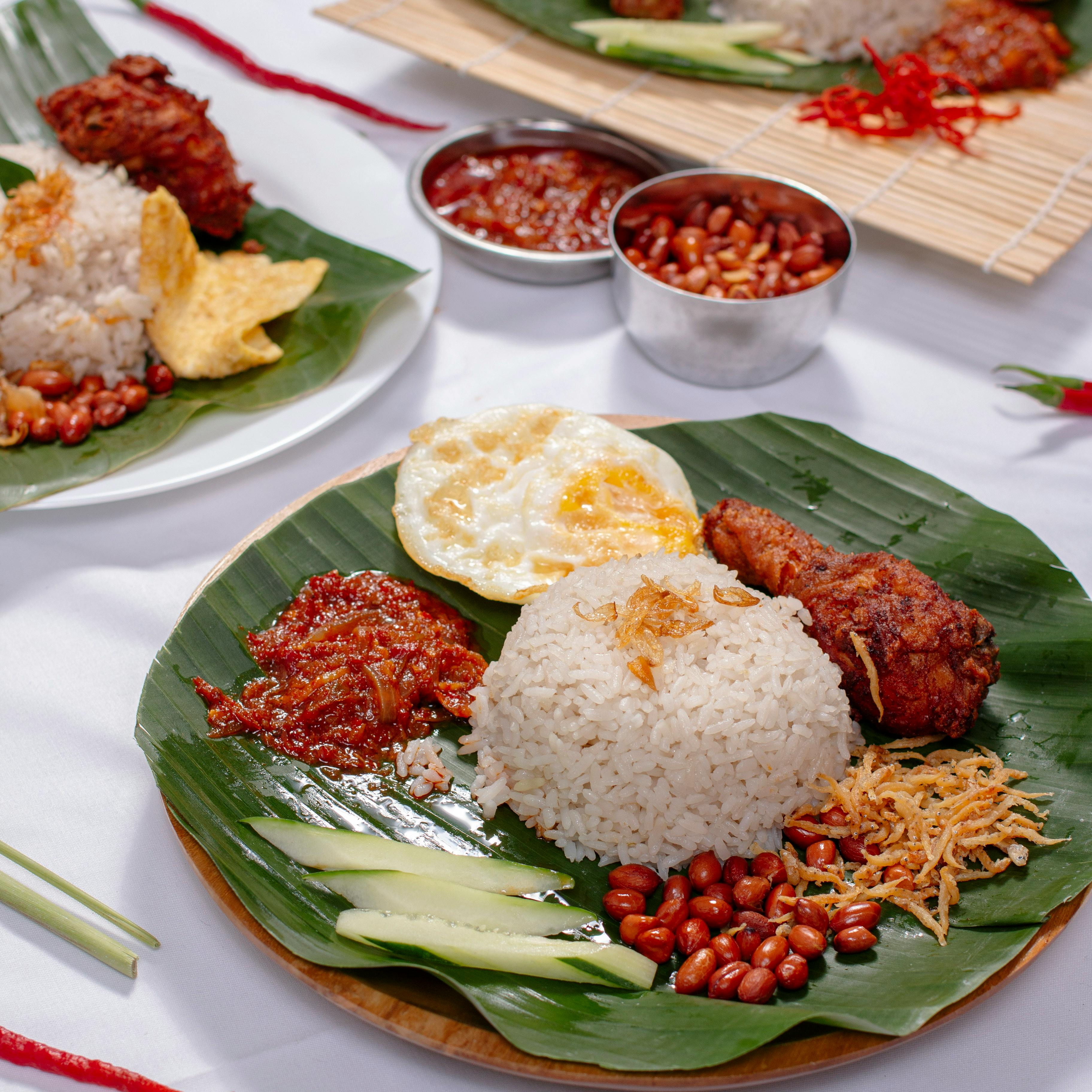
Photo: Suhairy Tri Yadhi / Pexels
Malaysian
Nasi Lemak
The diets react (see scores below)
Common Ingredients
- rice
- coconut milk
- pandan leaves
- anchovies
- peanuts
- sambal
- boiled eggs
- cucumber
- chili
- shallots
Specific recipes may vary.
Incompatible with 10 of 11 diets
Diet Ratings
Nasi Lemak is fundamentally built around white rice, which is one of the highest net-carb foods possible — a standard serving (1 cup cooked) contains approximately 45g of net carbs on its own, instantly consuming or exceeding the entire daily keto carb budget. While some individual components are keto-friendly (coconut milk is high in healthy fats, anchovies provide protein and fat, boiled eggs are excellent keto foods, peanuts are borderline acceptable, cucumber and sambal in small amounts are manageable), the rice base makes the dish as a whole completely incompatible with ketosis. There is no meaningful way to consume traditional Nasi Lemak while maintaining ketosis — the rice is structural and central to the dish, not a minor garnish. The sambal may also contain added sugar, adding further carb load.
Traditional Nasi Lemak as described contains multiple animal-derived ingredients that disqualify it from vegan compliance. Anchovies (ikan bilis) are fish and a core component of the dish. Boiled eggs are an animal product. Sambal in this context typically includes shrimp paste (belacan), which is a fermented crustacean product. These are not trace or incidental ingredients — they are structural, defining components of the dish as traditionally prepared. The rice cooked in coconut milk and pandan leaves, peanuts, cucumber, chili, and shallots are all plant-based, but the animal-derived ingredients are too central to overlook.
Nasi Lemak is fundamentally built around rice, a grain that is universally excluded from the paleo diet. Additionally, peanuts are legumes — also excluded. Sambal often contains added sugar and salt, and anchovies are frequently salted/processed. While several components are paleo-compatible (coconut milk, boiled eggs, cucumber, chili, shallots, pandan leaves), the foundational ingredients — rice and peanuts — are clear paleo violations. This dish cannot be considered paleo in its traditional form.
Nasi Lemak is built around white rice cooked in coconut milk, which presents two significant issues from a Mediterranean diet perspective: refined white rice is a non-whole grain carbohydrate, and coconut milk is high in saturated fat from a non-olive-oil source that has no place in traditional Mediterranean eating patterns. The dish does include several Mediterranean-friendly elements — anchovies (small fish), peanuts (legumes/nuts), eggs, cucumber, shallots, and chili are all acceptable or encouraged foods. However, the foundational cooking method (coconut milk-saturated rice) fundamentally conflicts with Mediterranean fat principles, and white rice as the dominant ingredient lacks the fiber and nutrient density of whole grains. Sambal may also contain added sugars depending on preparation. The overall dish is calorie-dense from saturated fat, not aligned with plant-forward or olive oil-based cooking.
Some modern Mediterranean diet interpreters argue the dish's inclusion of small oily fish (anchovies), nuts, eggs, and vegetables earns partial credit, and that occasional white rice — as seen in some traditional Greek and Southern Italian coastal cuisines — is acceptable in moderation. The coconut milk, however, remains difficult to reconcile with any mainstream Mediterranean diet framework.
Nasi Lemak is fundamentally incompatible with the carnivore diet. The dish is built almost entirely on plant-based ingredients: rice (a grain) forms the base, coconut milk is a plant-derived fat, pandan leaves are plant flavoring, peanuts are legumes, sambal is a plant-based chili paste, cucumber is a vegetable, and shallots and chili are plant foods. While boiled eggs and anchovies are carnivore-approved animal products, they are minor components in a dish that is overwhelmingly plant-derived. No amount of modification could make this dish carnivore-compatible without essentially deconstructing it entirely — the eggs and anchovies would need to be separated and served alone. This dish violates nearly every core carnivore dietary rule simultaneously.
Nasi Lemak contains multiple Whole30-excluded ingredients. Rice is explicitly prohibited as a grain on the Whole30 program. Peanuts are legumes and are explicitly excluded. Sambal, as commonly prepared, often contains added sugar and sometimes other non-compliant ingredients. These are core, non-negotiable exclusions that cannot be substituted out while still calling the dish Nasi Lemak. The remaining ingredients — coconut milk, pandan leaves, anchovies, boiled eggs, cucumber, chili, and shallots — are individually Whole30-compatible, but the foundational components (rice, peanuts, sambal) make this dish non-compliant as traditionally prepared.
Nasi Lemak contains multiple high-FODMAP ingredients that make it unsafe during the elimination phase. Shallots are a significant source of fructans and are high-FODMAP at any meaningful quantity — they are a core aromatic in the dish. Sambal is typically made with onion and/or garlic, both of which are high-FODMAP fructan sources. Peanuts become high-FODMAP at servings above 32 small nuts (GOS content), and the portion served in nasi lemak often exceeds this threshold. Coconut milk is low-FODMAP at small servings (up to 1/2 cup) but becomes high-FODMAP at larger quantities due to sorbitol; the rice cooking process typically uses a moderate amount which may be acceptable, but this depends on the recipe. Rice itself is low-FODMAP, pandan leaves are low-FODMAP, boiled eggs are low-FODMAP, anchovies are low-FODMAP, and cucumber is low-FODMAP. However, the combination of shallots in the dish preparation and garlic/onion-based sambal are essentially unavoidable high-FODMAP components in any authentic preparation, making the dish unsuitable during elimination.
Some FODMAP practitioners note that if sambal is made without onion or garlic (using garlic-infused oil and omitting shallots), and peanuts are kept to a small serving (~32 nuts), a modified nasi lemak could be made low-FODMAP. Monash University has not tested the dish as a whole, so the verdict depends heavily on recipe specifics and restaurant preparation practices that are rarely FODMAP-controlled.
Nasi Lemak presents multiple significant conflicts with DASH diet principles. The defining feature of the dish is rice cooked in coconut milk, a tropical oil-rich ingredient high in saturated fat — explicitly limited by DASH guidelines. Coconut milk is calorie-dense and saturated fat-heavy, directly opposing DASH's emphasis on limiting saturated and total fat. The sambal sauce typically contains high amounts of sodium and added sugar. Fried anchovies (ikan bilis) are extremely high in sodium, often exceeding 1,000mg per small serving. Peanuts, while generally DASH-friendly as a nut, are often salted in this context and consumed in portions that add significant fat. The cumulative sodium load from anchovies, sambal, and salted peanuts likely approaches or exceeds the entire daily DASH sodium limit in a single serving. While some ingredients like cucumber, boiled eggs, chili, shallots, and pandan leaves are benign or beneficial, they are insufficient to offset the core DASH-incompatible elements: high saturated fat from coconut milk and high sodium from anchovies and sambal.
NIH DASH guidelines categorically limit tropical oils and high-sodium condiments, making traditional Nasi Lemak a poor fit. However, some updated DASH-aligned nutritionists note that moderate coconut milk use in the context of an otherwise vegetable-rich meal with portion control is not categorically excluded by the 2020-2025 Dietary Guidelines; a modified version using low-sodium anchovies, reduced sambal, and limited portion size could raise the score to 'caution' territory.
Nasi Lemak is fundamentally incompatible with Zone Diet principles as traditionally prepared. The dish is anchored by white rice cooked in coconut milk — a double strike: white rice is a high-glycemic carbohydrate that Sears explicitly lists as an 'unfavorable' carb, and coconut milk is high in saturated fat, adding significant caloric density without monounsaturated fat benefits. Together, these two core ingredients push the dish far outside the 40/30/30 ratio before any other components are considered. The macronutrient profile skews heavily toward carbohydrates (from rice) and saturated fats (from coconut milk and peanuts), with minimal lean protein — anchovies and boiled eggs offer some protein, but the portions in a standard serving are insufficient to balance the carb/fat load. Peanuts, while containing some monounsaturated fat, are also high in omega-6 fatty acids and add additional fat calories without correcting the imbalance. Sambal and chili are Zone-favorable (polyphenol-rich, low-calorie), and cucumber is a good low-glycemic vegetable, but these components represent a minor fraction of the dish's caloric contribution. As a complete dish, Nasi Lemak cannot reasonably be portioned into Zone balance — reducing the rice enough to fix the carb block would leave a very small, unsatisfying amount of the dish, and the saturated fat from coconut milk has no easy workaround. This is one of the cases where the dish's structural identity conflicts with Zone principles at every macronutrient level.
Nasi Lemak presents a mixed anti-inflammatory profile. On the positive side, it contains several beneficial components: anchovies provide small amounts of omega-3 fatty acids; peanuts offer monounsaturated fats, resveratrol, and some anti-inflammatory polyphenols; chili and shallots contribute capsaicin and quercetin respectively; cucumber adds antioxidants and hydration; and pandan leaves have mild antioxidant properties. However, the dish is anchored in white rice — a refined carbohydrate with a high glycemic index that can promote postprandial inflammation — and coconut milk, which is high in saturated fat (lauric acid). While lauric acid's inflammatory effects are debated, mainstream anti-inflammatory guidance recommends limiting saturated fat. Sambal typically contains chili (anti-inflammatory), but may also include added sugar and vegetable oils depending on preparation. The boiled egg is neutral to mildly beneficial. Overall, the dish is a culturally rich meal with some redeeming anti-inflammatory ingredients, but its refined rice base and coconut milk fat load place it squarely in 'caution' territory — acceptable occasionally, but not an anti-inflammatory staple.
Some anti-inflammatory researchers, particularly those influenced by ancestral or traditional diet frameworks, argue that coconut milk's medium-chain triglycerides (MCTs), especially lauric acid, may have neutral or even anti-inflammatory effects distinct from long-chain saturated fats, and that white rice — a staple in low-inflammation Asian populations — is not inherently problematic in the context of a whole-food diet. This view contrasts with mainstream anti-inflammatory guidance (e.g., Dr. Weil's pyramid) that emphasizes whole grains over refined white rice and recommends limiting saturated fat sources including coconut products.
Nasi Lemak is a traditional Malaysian dish built around rice cooked in coconut milk, which makes it calorie-dense, high in saturated fat, and low in protein relative to its caloric load. Coconut milk is the primary concern: it significantly raises the saturated fat content of the entire dish, worsening GLP-1 side effects like nausea, bloating, and reflux. The sambal and chili components add significant spice, which can worsen reflux and GI discomfort — already elevated risks on GLP-1 medications. The refined white rice base offers minimal fiber and spikes blood sugar rapidly. While the dish does include some nutritionally valuable components — boiled eggs provide modest protein, anchovies offer protein and omega-3s, peanuts contribute protein and healthy fats, and cucumber adds hydration and fiber — these positives are outweighed in the context of a full serving. The portion is also large and calorically dense, which conflicts with the small, nutrient-dense meal approach recommended for GLP-1 patients. Overall, this dish fails on fat quality (high saturated fat), GI tolerability (spicy sambal, high fat slowing already-delayed gastric emptying further), refined carbohydrate load, and low protein density per calorie.
Some GLP-1-aware dietitians would note that the eggs and anchovies provide meaningful protein and that the dish can be partially modified — reducing coconut milk concentration, increasing egg portion, and omitting or reducing sambal — to make it more tolerable. Individual tolerance to spice and fat varies considerably among GLP-1 patients, and a small, modified portion may be acceptable for patients without significant GI side effects.
*See how scores were generated at our methodology page.
Nutritional profile
Six traits that cut across every diet.
Fiber & Plants
How much whole-plant food and fiber it delivers.
Healthy Fats
The quality of its fats (unsaturated, omega-3).
Whole / Unprocessed
How close it is to its natural, unprocessed form.
Gut Gentle
How easy it is on digestion (low FODMAP, few irritants).
Low Glycemic
How little it spikes your blood sugar.
Protein Density
How much protein it packs per calorie.
Controversy Index
Higher controversy = more disagreement between diets.
Diet-Specific Tips
 Anti-Inflammatory — 4/10
View tips
- White rice (refined carbohydrate, high glycemic index) — pro-inflammatory concern
- Coconut milk (high saturated fat, lauric acid) — debated but generally cautioned
- Anchovies (omega-3 source) — anti-inflammatory positive
- Peanuts (monounsaturated fats, polyphenols) — mildly anti-inflammatory
- Chili and shallots (capsaicin, quercetin) — anti-inflammatory contributors
- Sambal (may contain added sugar or refined oils depending on recipe) — variable
- Boiled egg — neutral to mildly beneficial
- Pandan leaves and cucumber — minor antioxidant contributions