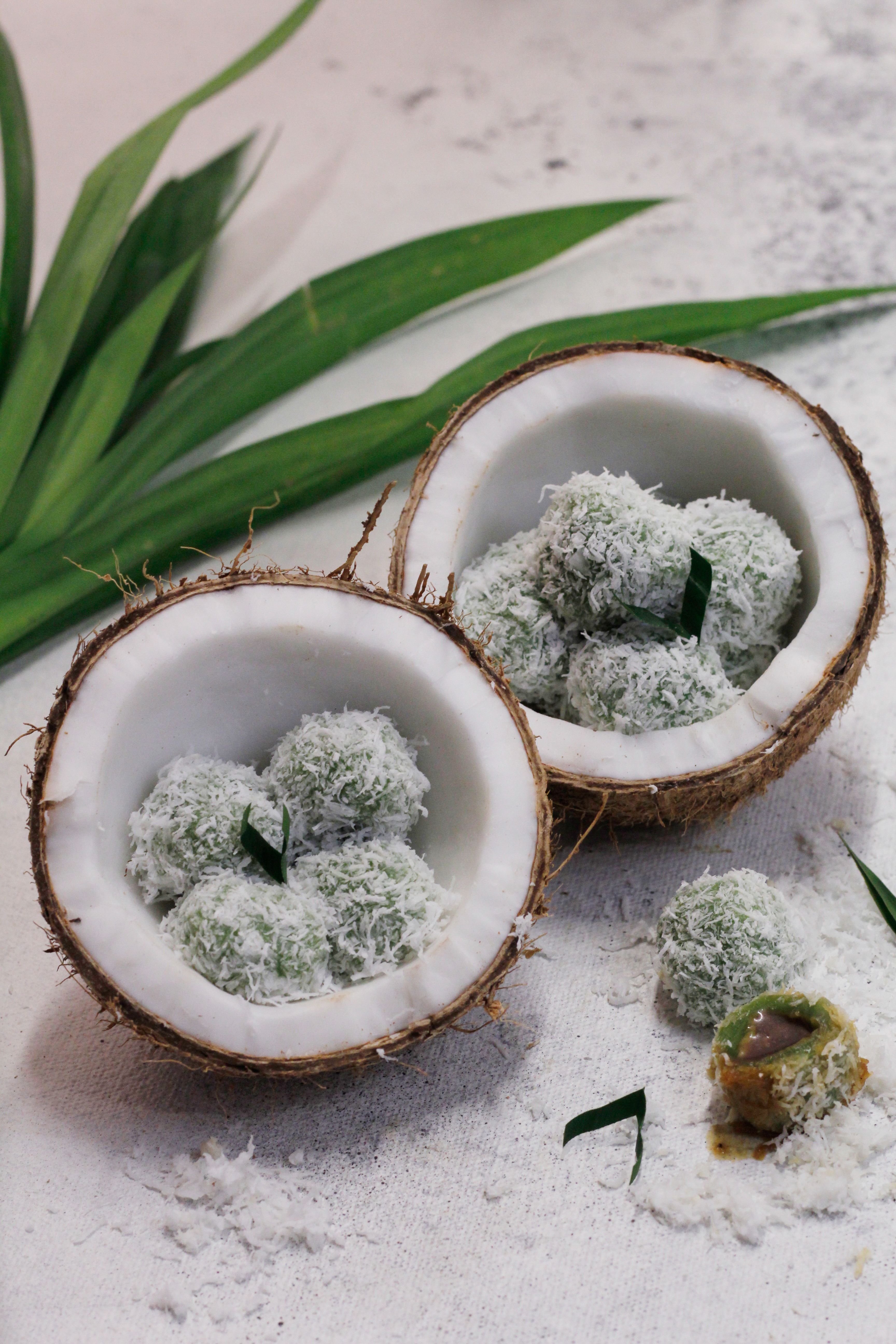
Photo: Henny Wiyanti / Pexels
The diets react (see scores below)
Common Ingredients
- glutinous rice flour
- palm sugar
- pandan leaves
- grated coconut
- sweet potato
- salt
- water
Specific recipes may vary.
Incompatible with 7 of 11 diets
Diet Ratings
Onde Onde is fundamentally incompatible with a ketogenic diet. The dish is built on glutinous rice flour and sweet potato — both extremely high-carb ingredients that would single-handedly exceed a daily keto carb limit in a single serving. Glutinous rice flour is essentially pure starch with negligible fiber, offering nearly 80g of net carbs per 100g. Sweet potato adds further starch and sugars. Palm sugar, used as the filling, is an added sugar that directly disrupts ketosis. A typical serving of 3-5 Onde Onde balls could easily contain 40-60g of net carbs, wiping out an entire day's keto allowance. The only marginally keto-friendly component is the grated coconut coating, which provides healthy fat and fiber, but it cannot offset the overwhelming carb load of the rest of the dish.
Onde onde is made entirely from plant-based ingredients: glutinous rice flour, palm sugar, pandan leaves, grated coconut, sweet potato, salt, and water. There are no animal products or animal-derived ingredients present. However, palm sugar warrants minor attention as some palm sugar products use animal-derived processing aids, though this is uncommon and the ingredient itself is plant-based. The more significant concern within the vegan community is palm oil — while onde onde uses palm sugar (not palm oil), the broader palm industry raises environmental and ethical concerns. More relevantly, grated coconut and palm sugar are whole plant foods, and the dish is minimally processed, which is a positive from a whole-food plant-based perspective. The score is kept at caution/6 rather than a higher approve score primarily due to the palm sugar sourcing ambiguity and the ethical debate around palm-derived products within vegan circles, though most vegans would consider this dish fully vegan-compliant. A score of 8 could be argued for strict ingredient analysis alone.
Some ethical vegans and whole-food plant-based advocates raise concerns about palm-industry products (including palm sugar) due to severe deforestation, orangutan habitat destruction, and ecosystem harm, and may choose to avoid them on environmental-ethical grounds even though they are botanically plant-derived. This is a minority position and most mainstream vegan organizations do not classify palm products as non-vegan.
Onde Onde is firmly non-paleo. The dominant ingredient is glutinous rice flour, a grain product that is explicitly excluded from the paleo diet. Salt is also a prohibited additive. While sweet potato, pandan leaves, grated coconut, and palm sugar have varying degrees of paleo acceptance, they cannot redeem a dish whose structural foundation is a grain-based flour. The dish is essentially a grain-based confection with added salt, placing it clearly in the avoid category.
Onde Onde is a Malaysian sweet snack made primarily from glutinous rice flour (a refined, high-glycemic starch), palm sugar (added sugar), and grated coconut. While it contains no animal products and includes some wholesome elements like sweet potato and pandan, the dish is fundamentally built around refined glutinous rice flour and added sugar — two categories that Mediterranean diet principles explicitly discourage. Glutinous rice flour is a refined grain with minimal fiber, quite different from the whole grains emphasized in the Mediterranean pattern. Palm sugar, though less refined than white sugar, is still a significant source of added sugar. Grated coconut adds saturated fat from a non-Mediterranean source. This snack is essentially a confection with little nutritional alignment to Mediterranean principles, despite being plant-based.
Some Mediterranean diet interpreters might argue the plant-based, minimally processed nature of this snack — featuring sweet potato, coconut, and natural palm sugar — makes it preferable to ultra-processed Western sweets. A lenient reading could treat it as an occasional traditional treat analogous to sweets made with honey and nuts in Greek or Middle Eastern traditions.
Onde Onde is a traditional Malaysian sweet snack made entirely from plant-based ingredients: glutinous rice flour (a grain), palm sugar (a plant-derived sweetener), pandan leaves (a plant flavoring), grated coconut (a plant fat/food), and sweet potato (a starchy vegetable). There is zero animal-derived content in this dish. Every single ingredient violates carnivore diet principles — grains, sugars, plant oils, vegetables, and plant flavorings are all explicitly excluded. This is one of the clearest possible 'avoid' cases on the carnivore diet.
Onde Onde contains glutinous rice flour, which is a grain product (rice-based), and is therefore excluded on Whole30. Additionally, palm sugar is an added sugar, which is also explicitly excluded. Even if these two ingredients were somehow addressed, Onde Onde is a traditional sweet snack/dessert ball that falls squarely into the 'no recreating baked goods/junk food/sweets' rule — it is a confection by nature. Multiple disqualifying ingredients and the spirit of the rule both point firmly to avoid.
Onde onde is a Malaysian glutinous rice ball filled with palm sugar and rolled in grated coconut. Analyzing each ingredient: glutinous rice flour is low-FODMAP and safe during elimination. Palm sugar (gula melaka) is primarily sucrose with minimal fructose excess, generally considered low-FODMAP in small amounts. Pandan leaves are used as flavoring and present in negligible quantities — no significant FODMAP concern. Salt and water are FODMAP-free. Grated coconut (fresh/desiccated) is low-FODMAP at a serving of about 1/2 cup (45g) per Monash, though it becomes moderate-high in polyols (sorbitol) at larger amounts — the coating on onde onde is typically modest. Sweet potato is the key concern: Monash rates sweet potato as low-FODMAP at 70g per serving, but high-FODMAP (due to mannitol, a polyol) at larger portions (>100g). Sweet potato is sometimes added to the dough to improve texture, and the quantity per serving of onde onde is not always standardized. A standard snack serving of 3-5 pieces could push sweet potato content toward or past the mannitol threshold. The dish is generally low-FODMAP in cautious portions, but the sweet potato and coconut combination means portion control is essential, making this a caution rather than a clear approval.
Monash University rates sweet potato as low-FODMAP at 70g, but clinical FODMAP practitioners often advise caution because sweet potato is easy to overconsume and its mannitol content can accumulate alongside other polyol sources in the same meal. Some elimination-phase protocols suggest avoiding sweet potato entirely to reduce polyol load, which would make onde onde a food to avoid during strict elimination.
Onde Onde is a Malaysian sweet snack made from glutinous rice flour balls filled with palm sugar and coated in grated coconut. From a DASH perspective, this dish presents a mixed picture. On the positive side, it is low in sodium, contains no red meat or saturated animal fat, and includes sweet potato which contributes potassium and fiber. However, several concerns apply: (1) Glutinous rice flour is a refined, high-glycemic starch with minimal fiber — DASH emphasizes whole grains over refined starches. (2) Palm sugar, while less processed than white sugar, is still an added sugar and DASH explicitly limits sweets. (3) Grated coconut, particularly in the desiccated or fresh mature form commonly used, contains significant saturated fat from coconut — a tropical oil category that DASH specifically limits. The coconut coating adds meaningful saturated fat per serving. The dish is not heavily processed, not high in sodium, and not made with red meat or full-fat dairy, which prevents an 'avoid' rating. However, the combination of refined starch, added sugar (palm sugar filling), and saturated fat from coconut coating means it is not a DASH-aligned food and should be consumed only occasionally and in small portions.
NIH DASH guidelines broadly categorize coconut as a tropical oil/saturated fat source to limit, and added sugars as foods to restrict. However, some updated DASH-oriented clinicians note that whole food coconut (grated fresh coconut) differs metabolically from coconut oil, and that small portions of traditional sweets with natural sugars like palm sugar may be accommodated within an otherwise DASH-compliant diet — particularly for non-diabetic, non-hypertensive individuals using the standard (not low-sodium) DASH plan.
Onde Onde is a Malaysian glutinous rice ball snack filled with palm sugar and coated in grated coconut. From a Zone Diet perspective, this is a nearly ideal example of what to avoid: the base is glutinous rice flour (extremely high glycemic index, among the highest of any starch), the filling is pure palm sugar (concentrated simple sugar), and sweet potato adds additional high-glycemic carbohydrates. The macronutrient profile is essentially all carbohydrate with minimal protein and the fat present (from coconut) is saturated rather than monounsaturated. There is no lean protein component whatsoever, making the 40/30/30 block ratio impossible to achieve within this dish itself. The carbohydrate load is almost entirely high-glycemic, which Sears explicitly categorizes as 'unfavorable' and warns drives excess insulin production — the central mechanism Zone seeks to control. While grated coconut provides some fiber and the pandan leaves are nutritionally negligible, these do not meaningfully offset the glycemic impact. Even eaten as a small snack alongside a balanced Zone meal, a single piece would contribute a significant high-glycemic carbohydrate block with virtually no protein or favorable fat to balance it. This is one of the clearest cases where a food is genuinely difficult to incorporate into any Zone-balanced approach without significant harm to the meal's hormonal balance.
Onde onde is a traditional Malaysian sweet snack made from glutinous rice flour balls filled with palm sugar and rolled in grated coconut. The ingredient profile is mixed from an anti-inflammatory standpoint. On the positive side: pandan leaves contain antioxidants and have demonstrated some anti-inflammatory properties in preliminary research; grated coconut provides fiber and medium-chain triglycerides; sweet potato (when included as a base addition) is a genuinely anti-inflammatory ingredient rich in beta-carotene and antioxidants; and palm sugar, while still a sugar, has a lower glycemic index than refined white sugar and contains trace minerals. On the negative side: glutinous rice flour is a refined, high-glycemic carbohydrate with virtually no fiber, making it pro-inflammatory in the context of blood sugar spikes; palm sugar is still added sugar contributing to glycemic load; and the snack is calorie-dense with minimal protein or fat to blunt blood sugar response. The grated coconut does add beneficial fiber but also saturated fat (medium-chain, which is debated). The sweet potato component is a genuine positive but is a minor contributor. Overall, this is a refined-starch-and-sugar-dominant snack that falls into the 'limit' or 'moderate' category — not as inflammatory as candy or processed snacks, but not aligned with anti-inflammatory principles either. Occasional consumption is acceptable.
Some anti-inflammatory practitioners following traditional food frameworks (e.g., Weston A. Price–influenced approaches) would view onde onde more favorably given its use of whole, traditionally produced ingredients like palm sugar (less processed than white sugar), freshly grated coconut, and pandan — distinguishing it meaningfully from industrial sweets. Conversely, strict anti-inflammatory protocols and low-glycemic advocates would rate the glutinous rice flour and sugar combination closer to 'avoid' territory due to rapid blood glucose elevation and absence of fiber, omega-3s, or meaningful antioxidant density.
Onde Onde is a traditional Malaysian sweet snack made primarily from glutinous rice flour and palm sugar, with grated coconut on the outside. For GLP-1 patients, this is a poor nutritional choice on nearly every axis. It contains virtually no protein (no meaningful protein source in any ingredient), negligible fiber, and is built almost entirely around refined starchy carbohydrates (glutinous rice flour) and added sugar (palm sugar). The glutinous rice flour is a high-glycemic, rapidly digested starch that offers no satiety benefit and will spike blood sugar quickly — especially problematic given reduced meal volume on GLP-1s. The palm sugar filling adds a significant sugar load in a small package. Grated coconut adds saturated fat. Sweet potato is the one mildly redeeming ingredient, offering some fiber and micronutrients, but it is a minor component and does not meaningfully change the nutritional profile. The overall caloric composition is dominated by empty starch and sugar with no protein anchor — the opposite of what GLP-1 patients need. Small portion size does not help here because the food itself provides nothing clinically useful per calorie. This is a classic example of a traditional treat that is incompatible with GLP-1 dietary priorities.
*See how scores were generated at our methodology page.
Nutritional profile
Six traits that cut across every diet.
Fiber & Plants
How much whole-plant food and fiber it delivers.
Healthy Fats
The quality of its fats (unsaturated, omega-3).
Whole / Unprocessed
How close it is to its natural, unprocessed form.
Gut Gentle
How easy it is on digestion (low FODMAP, few irritants).
Low Glycemic
How little it spikes your blood sugar.
Protein Density
How much protein it packs per calorie.
Controversy Index
Higher controversy = more disagreement between diets.
Diet-Specific Tips
 Vegan — 6/10
View tips
- All ingredients are plant-derived: glutinous rice flour, sweet potato, pandan, coconut, palm sugar, salt, water
- No animal products, dairy, eggs, or animal-derived additives
- Palm sugar is plant-based but sourced from the palm industry, which carries environmental controversy within some vegan communities
- Grated coconut and sweet potato are whole foods, making this nutritionally wholesome by whole-food plant-based standards
- Dish is traditional, minimally processed, and free from synthetic additives
 Low-FODMAP — 5/10
View tips
- Glutinous rice flour is low-FODMAP and the primary ingredient — safe
- Sweet potato contains mannitol (polyol) — low-FODMAP at ≤70g, high-FODMAP above that; portion in onde onde dough is uncertain
- Palm sugar is primarily sucrose — low-FODMAP in typical snack quantities
- Grated coconut is low-FODMAP at ≤45g; the coating amount per serving is generally modest
- Pandan leaf is used as flavoring in trace amounts — no significant FODMAP concern
- Cumulative polyol load from sweet potato + coconut warrants portion caution
- A small serving of 2-3 pieces is likely low-FODMAP; larger servings increase risk
 DASH — 4/10
View tips
- Glutinous rice flour is a refined starch — DASH favors whole grains over refined carbohydrates
- Palm sugar is an added sugar — DASH explicitly limits sweets and added sugars
- Grated coconut contains saturated fat from a tropical oil source, which DASH limits
- Sweet potato is a DASH-positive ingredient, providing potassium, fiber, and micronutrients
- Very low sodium content is DASH-favorable
- No lean protein, lean dairy, or legumes — limited DASH nutritional benefits
- Small snack portion size may partially mitigate concerns if consumed occasionally
 Anti-Inflammatory — 4/10
View tips
- Glutinous rice flour is a refined, high-glycemic carbohydrate with negligible fiber — primary concern
- Palm sugar is still added sugar; raises glycemic load despite lower GI than refined sugar
- Pandan leaves contain antioxidants with emerging anti-inflammatory evidence
- Sweet potato contributes beta-carotene and antioxidants, a genuine positive
- Grated coconut adds fiber and MCTs but also saturated fat
- No protein or omega-3 fatty acids to moderate inflammatory response
- No artificial additives or trans fats — a relative positive vs. processed snacks
- Traditional whole-food ingredients distinguish this from industrial confections