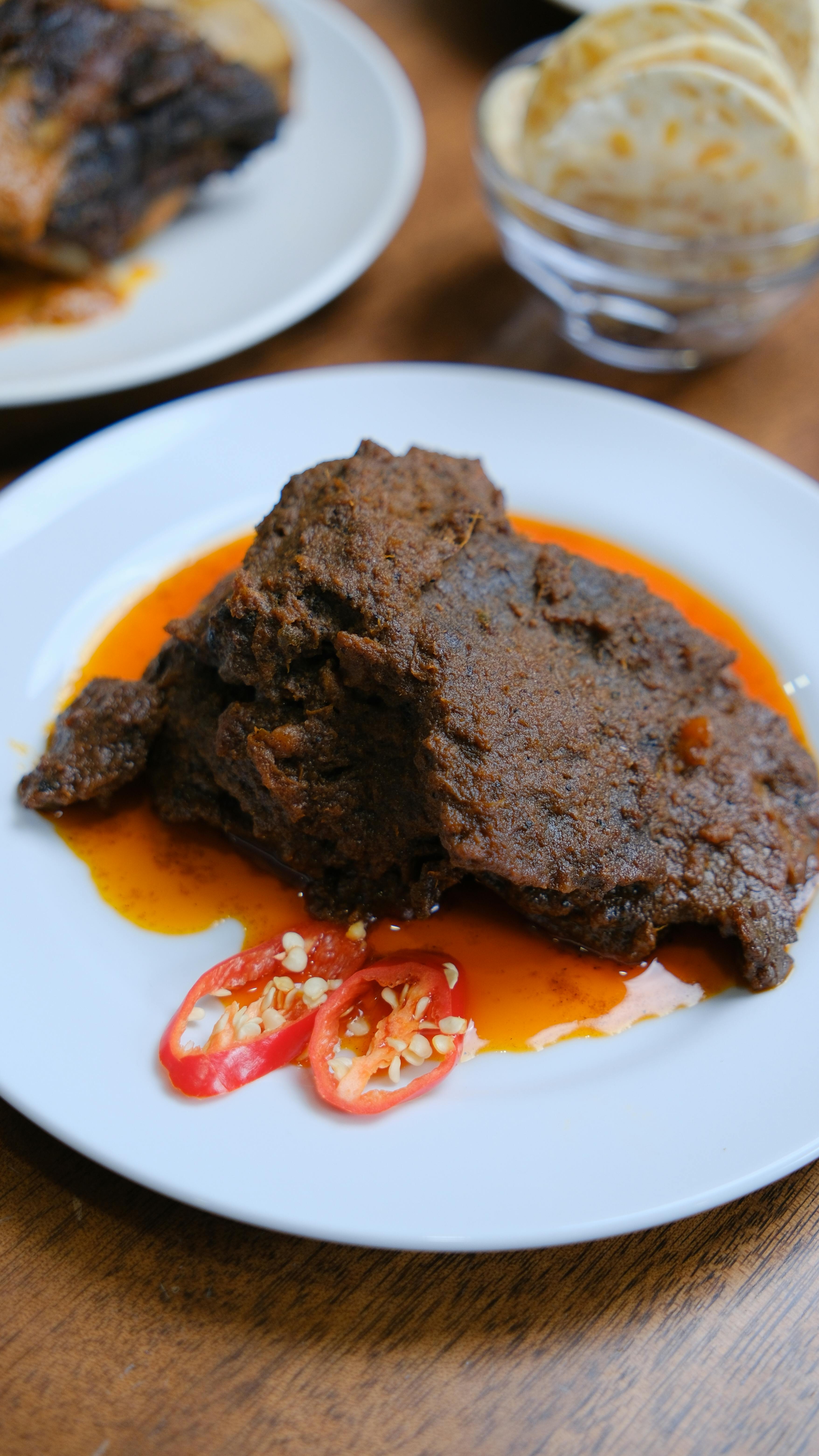
Photo: Fadli Octora Channel / Pexels
Malaysian
Rendang Tok
The diets react (see scores below)
Common Ingredients
- beef
- coconut milk
- toasted coconut
- lemongrass
- galangal
- turmeric
- chili
- garlic
- shallots
- kaffir lime leaves
Specific recipes may vary.
Incompatible with 6 of 11 diets
Diet Ratings
Rendang Tok is an excellent keto dish at its core. Beef provides high-quality protein and fat, while coconut milk and toasted coconut (kerisik) supply substantial healthy saturated fats — exactly what keto demands. The aromatics (lemongrass, galangal, turmeric, chili, garlic, shallots, kaffir lime leaves) contribute minimal net carbs per serving when distributed across the dish. Shallots and lemongrass are the most carb-significant ingredients but remain keto-compatible in typical cooking quantities. Rendang Tok is a dry-style rendang where the coconut milk is fully reduced and absorbed, concentrating the fat content further. A standard serving (150-200g) would likely contain 5-10g net carbs, well within daily limits. No grains, sugars, or starches are present in the traditional recipe.
Some strict keto practitioners flag shallots and the cumulative carb load from multiple aromatic ingredients (lemongrass, galangal, shallots together) as potentially pushing sensitive individuals closer to their daily threshold, particularly if large portions are consumed. Carnivore-adjacent keto adherents may also question plant-based aromatics collectively.
Rendang Tok is a traditional Malaysian dry curry that prominently features beef as its primary protein, making it unequivocally non-vegan. Beef is an animal product and is explicitly excluded under all vegan dietary definitions. While several other ingredients in the dish — coconut milk, lemongrass, galangal, turmeric, chili, garlic, shallots, and kaffir lime leaves — are plant-based, the presence of beef alone disqualifies this dish entirely. There is no meaningful debate within the vegan community on this point.
Rendang Tok is a dry-cooked Malaysian beef dish whose core ingredients align well with paleo principles. Beef is a cornerstone paleo protein, and coconut milk along with toasted coconut are widely accepted paleo fats. All aromatics and spices — lemongrass, galangal, turmeric, chili, garlic, shallots, and kaffir lime leaves — are whole, unprocessed plant foods available to hunter-gatherers. There are no grains, legumes, dairy, refined sugars, or seed oils present. The main point of nuance is shallots (alliums are paleo-approved) and the cooking process itself, which is long and slow but uses no prohibited processing agents. Traditional Rendang Tok is notably drier than standard rendang, with the coconut milk fully absorbed and caramelized, making it a naturally whole-food preparation. The dish scores high but not a perfect 10 because commercial preparations may introduce added salt or preservatives — the home-cooked or traditional version is assumed here.
Strict Cordain-school paleo practitioners may flag the high saturated fat load from both coconut milk and toasted coconut as a concern, as Loren Cordain's original framework was cautious about excessive saturated fat intake even from paleo-approved sources. Some purists also note that the dense, processed texture of fully caramelized coconut solids diverges from the philosophy of minimally processed foods.
Rendang Tok is a slow-cooked Malaysian dry beef curry that presents multiple conflicts with Mediterranean diet principles. The primary protein is beef (red meat), which should be limited to only a few times per month in a Mediterranean pattern. The dish is cooked with generous amounts of coconut milk and toasted coconut, which are high in saturated fat — a fat source entirely absent from the Mediterranean tradition, where extra virgin olive oil is the exclusive primary fat. The combination of red meat and high saturated fat from coconut products makes this dish a double conflict with core Mediterranean principles. While several individual ingredients (lemongrass, galangal, turmeric, chili, garlic, shallots, kaffir lime leaves) are plant-derived aromatics consistent with a whole-food approach, they do not offset the fundamental incompatibilities of the dish's protein and fat sources.
Rendang Tok is fundamentally incompatible with the carnivore diet. While the primary protein is beef — a top-tier carnivore food — the dish is built around an extensive array of plant-based ingredients. Coconut milk and toasted coconut are plant-derived fats. Lemongrass, galangal, turmeric, chili, garlic, shallots, and kaffir lime leaves are all plant foods explicitly excluded from the carnivore framework. The dish is essentially a heavily spiced, plant-forward curry where the beef is secondary to the aromatics and sauce. There is no meaningful way to adapt this dish to carnivore standards — it would cease to be Rendang Tok entirely. The coconut base alone disqualifies it, and the layered plant compounds (antinutrients, oxalates, lectins) from the spice paste are precisely what carnivore practitioners seek to eliminate.
Rendang Tok is a traditional Malaysian dry beef curry whose listed ingredients are entirely Whole30-compliant. Beef is an approved protein, coconut milk is a natural fat source explicitly allowed, and toasted coconut (unsweetened desiccated coconut) is permitted. All aromatics and seasonings — lemongrass, galangal, turmeric, chili, garlic, shallots, and kaffir lime leaves — are whole spices, herbs, and vegetables with no excluded ingredients. This is a whole-food, minimally processed dish in its traditional form with no grains, legumes, dairy, added sugars, or other excluded ingredients present.
Rendang Tok contains two classic high-FODMAP ingredients that make it unsuitable during the FODMAP elimination phase at any standard serving: garlic (high in fructans — avoid at any amount) and shallots (also high in fructans, similar to onions). These are core aromatics in rendang paste and cannot be reduced to trace amounts in a traditional preparation. The remaining ingredients are largely low-FODMAP: beef is fine, coconut milk is low-FODMAP at ≤125ml per serve (though rich dishes may use more), lemongrass is low-FODMAP, galangal has limited Monash data but is used in small quantities, turmeric is low-FODMAP, chili is low-FODMAP (small amounts), and kaffir lime leaves are used in negligible quantities. Toasted coconut (desiccated) is low-FODMAP at ≤½ cup. However, the garlic and shallots are non-negotiable disqualifiers — they are present in significant quantities in rendang and cannot be removed without fundamentally altering the dish.
Rendang Tok is fundamentally incompatible with the DASH diet due to multiple high-concern ingredients. The dish is built on two foods explicitly limited by NIH/NHLBI DASH guidelines: red meat (beef) and coconut milk, a tropical oil-based ingredient extremely high in saturated fat. Toasted coconut compounds the saturated fat burden further. A typical serving of rendang can contain 20-35g of saturated fat, far exceeding DASH's target of keeping saturated fat to less than 6% of total calories (roughly 13g/day on a 2,000-calorie diet). While the aromatic ingredients — lemongrass, galangal, turmarine, chili, garlic, shallots, kaffir lime leaves — are DASH-friendly and nutritionally beneficial, they cannot offset the core nutritional profile of the dish. Rendang Tok is a dry-style rendang where the coconut milk is cooked down and absorbed into the beef along with toasted coconut (kerisik), meaning the saturated fat is concentrated rather than diluted. This dish as traditionally prepared represents a combination of the two food categories DASH most explicitly warns against: red meat and tropical oils.
Rendang Tok presents a mixed Zone Diet profile. On the positive side, the protein source (beef) can work in Zone blocks, and the aromatic spices (lemongrass, galangal, turmeric, chili, garlic, shallots, kaffir lime leaves) are polyphenol-rich and anti-inflammatory, strongly aligning with Sears' later emphasis on eicosanoid balance and inflammation reduction. However, the dish has two significant Zone challenges: (1) The fat profile is problematic — coconut milk and toasted coconut are high in saturated fat, which Zone traditionally limits, and these ingredients dominate the dish's fat contribution, making it very difficult to stay within the 30% fat from primarily monounsaturated sources. (2) The beef cut used in rendang is typically tough, fattier cuts (chuck, short rib) that are slowly braised, meaning saturated fat content is further elevated. The 40/30/30 ratio is nearly impossible to hit with this dish as traditionally prepared — the fat calories will far exceed 30% of the meal's total. To use Rendang Tok in a Zone meal, a very small portion would need to be paired with a large serving of low-glycemic vegetables and the overall fat block would be nearly exhausted by the rendang alone. In Sears' later anti-inflammatory writing, he acknowledges that not all saturated fat is equally harmful, and the medium-chain triglycerides in coconut have a different metabolic profile, which softens (but doesn't eliminate) the concern.
Dr. Sears' later works, including 'The Mediterranean Zone' and 'Toxic Fat,' place greater emphasis on anti-inflammatory polyphenols and omega-3 balance rather than strict saturated fat avoidance. Some Zone practitioners argue that coconut's medium-chain triglycerides (MCTs) are metabolized differently than long-chain saturated fats and are less problematic. Under this view, a carefully portioned Rendang Tok served alongside Zone-favorable vegetables could be a workable Zone meal, nudging the score toward 5-6 rather than 4.
Rendang Tok presents a genuinely mixed anti-inflammatory profile. On the positive side, the spice paste is exceptional — turmeric (curcumin), galangal (closely related to ginger, with similar anti-inflammatory gingerol-like compounds), lemongrass (citral with antioxidant properties), chili (capsaicin), garlic, and shallots (quercetin, allicin) are all well-regarded in anti-inflammatory nutrition. Kaffir lime leaves add polyphenols. However, two ingredients pull the dish firmly toward caution: beef and coconut milk. Beef is a red meat high in saturated fat and arachidonic acid, which are associated with pro-inflammatory pathways (elevated CRP, IL-6) and should be limited in anti-inflammatory frameworks. Rendang Tok, a 'dry' rendang from Perak, is cooked until all the coconut milk is absorbed and caramelized into the meat, meaning the dish is particularly rich in coconut fat — a highly saturated fat (primarily lauric acid) consumed in large quantity. While some researchers argue lauric acid behaves differently from other saturated fats, mainstream anti-inflammatory guidance treats coconut milk/cream as a source of saturated fat to limit. The toasted coconut (kerisik) amplifies this further. The net profile is: powerful anti-inflammatory spice base offset significantly by red meat and very high saturated fat from full-fat coconut milk. Suitable only as an occasional dish.
A minority of anti-inflammatory practitioners, particularly those influenced by ancestral or paleo frameworks, argue that full-fat coconut products contain medium-chain triglycerides (especially lauric acid) that may not behave like long-chain saturated fats and could even support gut health and immune function. Additionally, traditional grass-fed beef has a more favorable omega-6:omega-3 ratio than grain-fed, which could shift the verdict slightly. However, Dr. Weil's Anti-Inflammatory Pyramid explicitly limits red meat and does not list coconut milk as a featured fat, favoring extra virgin olive oil instead.
Rendang Tok is a highly concentrated, slow-cooked Malaysian dry curry where beef is braised in full-fat coconut milk until almost all liquid evaporates, leaving the meat coated in a thick, fat-rich coconut paste with toasted grated coconut added on top. This preparation method results in extremely high saturated fat content from two coconut sources (coconut milk and toasted coconut), a fatty red meat base, and a very rich, heavy texture that is the opposite of easy to digest. GLP-1 medications slow gastric emptying significantly, and high-fat meals are a primary trigger for worsened nausea, bloating, reflux, and prolonged GI discomfort in patients on these medications. While beef does provide protein, the fat-to-protein ratio in this dish is unfavorable — the caloric density comes predominantly from saturated fat rather than lean protein. The significant chili content also poses a reflux and nausea risk for GLP-1 patients who are already GI-sensitive. Lemongrass, galangal, turmeric, garlic, and kaffir lime leaves are nutritionally benign or mildly beneficial, but they cannot offset the core problems. This dish is not portion-rescuable in a standard serving context — even a small portion delivers a concentrated hit of saturated fat and spice.
Some GLP-1-aware dietitians note that beef does provide complete protein with iron and B12 — nutrients GLP-1 patients are at risk of under-consuming — and that turmeric and galangal have anti-inflammatory properties. A very small portion eaten alongside fiber-rich vegetables might be argued as acceptable for patients with stable GI tolerance, though most clinicians managing GLP-1 side effects would still advise against this dish due to its inherently high saturated fat density regardless of portion size.
*See how scores were generated at our methodology page.
Nutritional profile
Six traits that cut across every diet.
Fiber & Plants
How much whole-plant food and fiber it delivers.
Healthy Fats
The quality of its fats (unsaturated, omega-3).
Whole / Unprocessed
How close it is to its natural, unprocessed form.
Gut Gentle
How easy it is on digestion (low FODMAP, few irritants).
Low Glycemic
How little it spikes your blood sugar.
Protein Density
How much protein it packs per calorie.
Controversy Index
Higher controversy = more disagreement between diets.
Diet-Specific Tips
 Keto — 6/10
View tips
- High fat content from coconut milk and toasted coconut (kerisik) aligns well with keto macros
- Beef provides quality protein within keto targets
- Dry-style cooking concentrates fat and eliminates liquid carb carriers
- Aromatics (shallots, garlic, lemongrass, galangal) add minimal net carbs per serving when distributed across multiple portions
- No grains, added sugars, or starchy vegetables in traditional recipe
- Portion control advisable for those highly sensitive to carbs due to cumulative aromatic ingredients
 Paleo — 6/10
View tips
- Beef is a primary paleo protein source
- Coconut milk and toasted coconut are approved paleo fats
- All spices and aromatics (lemongrass, galangal, turmeric, chili, garlic, shallots, kaffir lime leaves) are whole and paleo-compliant
- No grains, legumes, dairy, refined sugar, or seed oils present
- Traditional preparation uses no processed additives
- Commercial versions may contain added salt or preservatives — home-cooked assumed
 Whole30 — 6/10
View tips
- Beef is a fully approved Whole30 protein
- Coconut milk is an approved natural fat
- Toasted coconut must be unsweetened — check labels to confirm no added sugar
- All aromatics (lemongrass, galangal, turmeric, chili, garlic, shallots, kaffir lime leaves) are compliant whole herbs and spices
- No grains, legumes, dairy, or added sugars in the traditional recipe
- Commercial or restaurant versions may add sugar, soy, or other excluded ingredients — verify preparation
 Zone — 4/10
View tips
- High saturated fat from coconut milk and toasted coconut disrupts Zone's 30% fat target and monounsaturated fat preference
- Beef (typically fatty cuts in rendang) adds further saturated fat, compounding the imbalance
- Excellent anti-inflammatory spice profile: turmeric, galangal, lemongrass, chili, and kaffir lime leaves are polyphenol-rich
- No carbohydrate component — dish would need Zone-favorable low-GI vegetables added to approach 40/30/30
- Very small portion required to stay within Zone fat blocks, making satiety difficult
- Coconut MCTs may be metabolically distinct from long-chain saturated fats, a nuance acknowledged in Sears' later anti-inflammatory framework
 Anti-Inflammatory — 4/10
View tips
- Red meat (beef) is pro-inflammatory — high saturated fat and arachidonic acid content
- Full-fat coconut milk is very high in saturated fat; Rendang Tok absorbs it all during dry-frying stage
- Toasted coconut (kerisik) adds additional saturated fat load
- Turmeric provides curcumin — one of the most studied anti-inflammatory compounds
- Galangal and lemongrass offer anti-inflammatory and antioxidant properties similar to ginger
- Garlic and shallots contribute allicin and quercetin, both anti-inflammatory
- Chili pepper provides capsaicin, which has documented anti-inflammatory effects
- Kaffir lime leaves add polyphenols and flavonoids
- Overall: potent spice profile undermined by heavy saturated fat and red meat — occasional consumption only