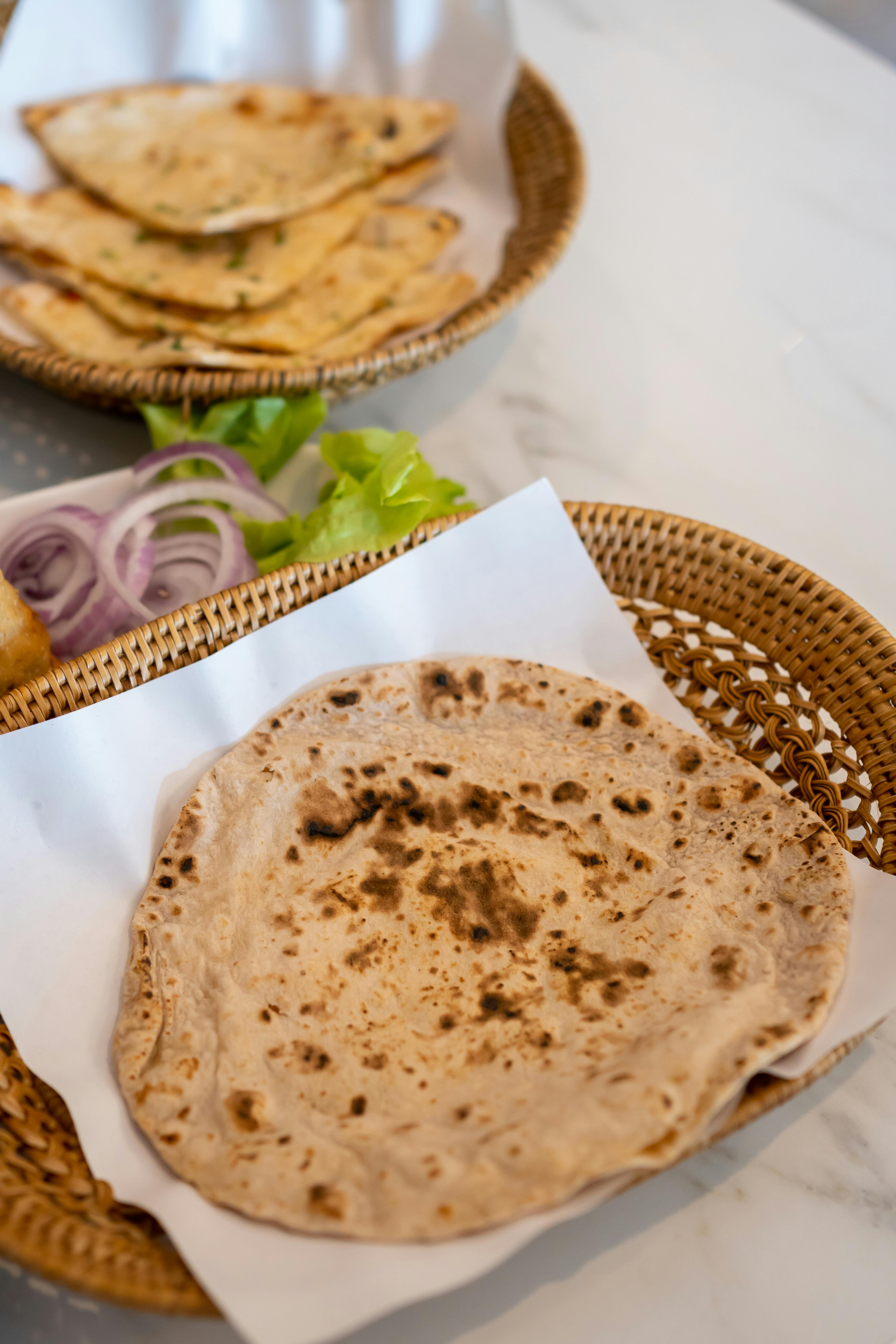
Photo: Rathaphon Nanthapreecha / Pexels
The diets react (see scores below)
Common Ingredients
- flour
- ghee
- water
- salt
- condensed milk
- egg
- dhal
- curry
Specific recipes may vary.
Incompatible with 9 of 11 diets
Diet Ratings
Roti Canai is fundamentally incompatible with a ketogenic diet. The primary ingredient is wheat flour, which is a refined grain and one of the highest net-carb foods possible. A single piece of Roti Canai contains approximately 30-40g of net carbs from the flour alone, easily exceeding or consuming the entire daily keto carb budget in one serving. The condensed milk adds significant sugar on top of that. While ghee and egg are keto-friendly ingredients, they are minor components that cannot offset the massive carbohydrate load from the flour base. The accompanying dhal (lentils) is also high in net carbs. There is no meaningful way to consume this dish within ketogenic parameters.
Roti Canai contains multiple animal-derived ingredients that disqualify it from a vegan diet. Ghee is clarified butter, a dairy product. Egg is a direct animal product. Condensed milk is a dairy product. These three ingredients alone make traditional Roti Canai clearly non-vegan. The dhal and curry accompaniments are typically plant-based and would otherwise be vegan-friendly, but the bread itself is fundamentally incompatible with a vegan diet. Vegan versions of Roti Canai can theoretically be made by substituting ghee with vegetable oil or coconut oil, omitting eggs, and using sweetened condensed coconut milk or no sweetener, but the traditional recipe as listed is not vegan.
Roti Canai is fundamentally incompatible with the Paleo diet. Its base ingredient is wheat flour, a grain explicitly excluded from all paleo frameworks. The dish is served with dhal (lentils), a legume that is universally rejected by paleo authorities. Additional non-paleo elements include added salt, condensed milk (processed dairy with refined sugar), and ghee (debated even in its pure form, but here used in a heavily processed bread context). There are no redeeming paleo-compliant primary components — the egg is the only ingredient that would be paleo-approved, but it plays a minor structural role in an otherwise entirely non-paleo dish.
Roti Canai is fundamentally at odds with Mediterranean diet principles. The base is refined white flour — a refined grain the Mediterranean diet discourages. The primary fat is ghee (clarified butter), a saturated animal fat that directly contradicts the Mediterranean principle of extra virgin olive oil as the primary fat source. Condensed milk adds significant refined sugar and saturated fat. While the accompaniments — dhal (lentils) and curry — are legume-based and plant-forward, which aligns well with Mediterranean values, they do not offset the problematic base. The overall dish is built on refined grains, saturated animal fats, and added sugars, placing it firmly in the 'avoid' category.
Roti Canai is fundamentally incompatible with the carnivore diet. The dish is built primarily on wheat flour, a grain-based carbohydrate that is explicitly excluded from all tiers of carnivore eating. It is served with dhal (lentils — a legume) and curry (a plant-based spice blend), both of which are strictly plant-derived and prohibited. Condensed milk adds processed sugar on top of a dairy derivative. While ghee and egg are animal-derived ingredients, they are minor components in a dish whose entire structure and accompaniments are plant-based. No version of carnivore — not even the more permissive 'animal-based' approach advocated by Paul Saladino — would include flour, lentils, or curry as acceptable foods.
Roti Canai is a flaky flatbread that fails Whole30 on multiple grounds. First, flour (wheat) is an excluded grain. Second, condensed milk is a dairy product with added sugar — both dairy and added sugar are excluded categories. Third, dhal (lentils) is a legume, which is explicitly excluded. Beyond the ingredient violations, Roti Canai is itself a bread/flatbread, which falls squarely under the 'no recreating baked goods/bread' rule (rule 4) even if one were to attempt a compliant version. The curry component and ghee are compliant, but the remaining core ingredients make this dish incompatible with Whole30 on multiple independent grounds.
Roti Canai is a high-FODMAP dish with multiple problematic ingredients. The primary base is wheat flour, which is high in fructans — a major FODMAP trigger. The dish is typically served with dhal (lentils/split peas), which is high in GOS (galacto-oligosaccharides), another significant FODMAP. Condensed milk contains high levels of lactose. The curry accompaniment frequently contains onion and garlic, both of which are very high in fructans. Together, these ingredients stack multiple FODMAP categories (fructans from wheat, GOS from dhal, lactose from condensed milk, fructans from onion/garlic in curry), making this dish unsuitable during the elimination phase at any standard serving size.
Roti Canai is a Malaysian flatbread made with refined white flour, generous amounts of ghee (clarified butter, high in saturated fat), salt, condensed milk (high in added sugar), and egg, typically served with dhal curry. It fails DASH diet criteria on multiple fronts: (1) Ghee is high in saturated fat, which DASH explicitly limits — a single roti can contain 3-6g saturated fat from ghee alone. (2) Condensed milk adds significant refined sugar, contrary to DASH's restriction on sweets. (3) The refined white flour offers little fiber, potassium, magnesium, or calcium compared to whole grains emphasized by DASH. (4) The accompanying curry and salt contribute moderate-to-high sodium. (5) The overall nutrient profile — high saturated fat, refined carbohydrates, added sugar, and moderate sodium — is nearly the opposite of what DASH emphasizes. The dhal component is DASH-friendly (legumes are encouraged), which prevents the lowest possible score, but it does not offset the problematic base.
NIH DASH guidelines clearly limit saturated fat, refined grains, and added sugars — all prominent in Roti Canai. However, some DASH-oriented clinicians note that occasional inclusion of culturally significant dishes can support dietary adherence long-term, and the dhal accompaniment does provide DASH-positive legume nutrition; a reduced-ghee, whole-wheat version with low-sodium dhal could be adapted to a 'caution' rating.
Roti Canai is fundamentally incompatible with Zone Diet principles. The dish centers on refined white flour flatbread (high-glycemic, unfavorable carbohydrate) cooked with ghee (saturated fat), often sweetened with condensed milk (pure sugar — one of the worst Zone offenders). The macronutrient profile is heavily skewed toward high-GI carbohydrates and saturated fat, with virtually no lean protein to establish a Zone-balanced meal. Even accounting for the egg and dhal (lentils), which do offer some protein and favorable fiber-rich carbohydrates, they are minor components that cannot compensate for the dominant refined flour and condensed milk base. Condensed milk alone is a near-disqualifying ingredient — it is essentially concentrated sugar and fat with no redeeming Zone value. Ghee, while not trans fat, is pure saturated fat and contributes no monounsaturated fat benefit. The curry and dhal components are Zone-friendly and somewhat redeeming, but they do not save the overall dish from a deeply unfavorable macro ratio. This meal would cause a significant insulin spike and fails the 40/30/30 balance by a wide margin, with carbohydrates (mostly high-GI) dominating calories and protein being negligible.
Roti Canai is a flaky Malaysian flatbread made with refined white flour, ghee (clarified butter high in saturated fat), and condensed milk (added sugar), which are all pro-inflammatory components. The refined flour has a high glycemic index and lacks fiber, promoting blood sugar spikes that can elevate inflammatory markers like CRP. Ghee contributes saturated fat, and condensed milk adds significant refined sugar — both flagged as 'limit' or 'avoid' in anti-inflammatory frameworks. However, the dish is partially redeemed by its accompaniments: dhal (lentils) is an excellent anti-inflammatory food, rich in fiber, plant protein, and polyphenols that support gut health and reduce inflammation. The curry spices (turmeric, cumin, coriander, chili, ginger, garlic) are strongly anti-inflammatory and represent the most beneficial element of this meal. The egg, if included, adds a moderate nutritional contribution. On balance, the base bread itself is a refined, high-saturated-fat product that pulls the dish into cautionary territory, but the dhal and curry accompaniments provide meaningful anti-inflammatory offset. Occasional consumption is acceptable; it should not be a dietary staple for those following anti-inflammatory principles.
Some anti-inflammatory practitioners (e.g., those following a strict Dr. Weil or whole-foods-based protocol) would rate this more harshly, arguing that refined flour and ghee-heavy preparations should be avoided rather than merely moderated — pushing this toward an 'avoid' rating of 3. Conversely, others emphasize that whole-meal context matters: the lentil dhal and spice-rich curry make this dish more nutritionally complex than a plain white bread product, and the small quantity of ghee per serving may not meaningfully elevate systemic inflammation for a generally healthy person.
Roti Canai is a flaky, layered flatbread made by folding ghee into white flour dough, resulting in a refined carbohydrate base with significant saturated fat content. On its own, it is nutritionally poor for GLP-1 patients: low protein, low fiber, high in refined starch and saturated fat from ghee, and often served with condensed milk which adds sugar. However, the inclusion of dhal (lentil curry) meaningfully changes the nutritional profile — dhal is high in plant protein, fiber, and micronutrients. A standard Roti Canai serving with dhal provides roughly 8–12g protein and 4–6g fiber from the dhal side, partially compensating for the bread's weaknesses. The egg, if incorporated into the dough or served alongside, adds further protein. The curry sauce may contain spices that worsen GLP-1 nausea or reflux in sensitive individuals. The condensed milk dipping option should be avoided entirely by GLP-1 patients. Overall, the dish sits in caution territory: acceptable occasionally if eaten primarily with the dhal and egg components, in a small portion, but the roti itself is not a GLP-1-friendly food base. Patients should prioritize the dhal and limit the bread portion.
Some GLP-1-focused dietitians working with South and Southeast Asian patient populations argue that culturally familiar foods like Roti Canai with dhal should not be discouraged entirely, as dhal provides meaningful protein and fiber that partially redeem the meal — the key modification is reducing roti portion size and skipping condensed milk. Others maintain that the refined flour and ghee combination reliably worsens gastric emptying symptoms and bloating in GLP-1 patients and should be avoided during active dose escalation phases.
*See how scores were generated at our methodology page.
Nutritional profile
Six traits that cut across every diet.
Fiber & Plants
How much whole-plant food and fiber it delivers.
Healthy Fats
The quality of its fats (unsaturated, omega-3).
Whole / Unprocessed
How close it is to its natural, unprocessed form.
Gut Gentle
How easy it is on digestion (low FODMAP, few irritants).
Low Glycemic
How little it spikes your blood sugar.
Protein Density
How much protein it packs per calorie.
Controversy Index
Higher controversy = more disagreement between diets.
Diet-Specific Tips
 Anti-Inflammatory — 4/10
View tips
- Refined white flour base — high glycemic index, low fiber, pro-inflammatory potential
- Ghee — high in saturated fat, flagged as 'limit' in anti-inflammatory frameworks
- Condensed milk — added refined sugar, pro-inflammatory
- Dhal (lentils) — strong anti-inflammatory: rich in fiber, plant protein, and polyphenols
- Curry spices (turmeric, ginger, garlic, chili) — potent anti-inflammatory compounds
- Egg — moderate contribution, mixed but generally acceptable in moderation
- Overall dish is a mixed profile: pro-inflammatory bread base offset by anti-inflammatory accompaniments
 GLP-1 Friendly — 4/10
View tips
- Refined white flour base is low in fiber and high glycemic — poor fit for GLP-1 patients
- Ghee is high in saturated fat, which worsens nausea and bloating on GLP-1 medications
- Dhal component adds meaningful plant protein and fiber, partially improving the overall meal profile
- Egg ingredient adds protein if present
- Condensed milk dipping version should be avoided — adds sugar with no nutritional benefit
- Curry spices may trigger reflux or nausea in GLP-1 patients with GI sensitivity
- Small portion of roti paired with a larger serving of dhal is the harm-reduction approach
- Culturally significant dish — full avoidance may be impractical; modification is the pragmatic guidance