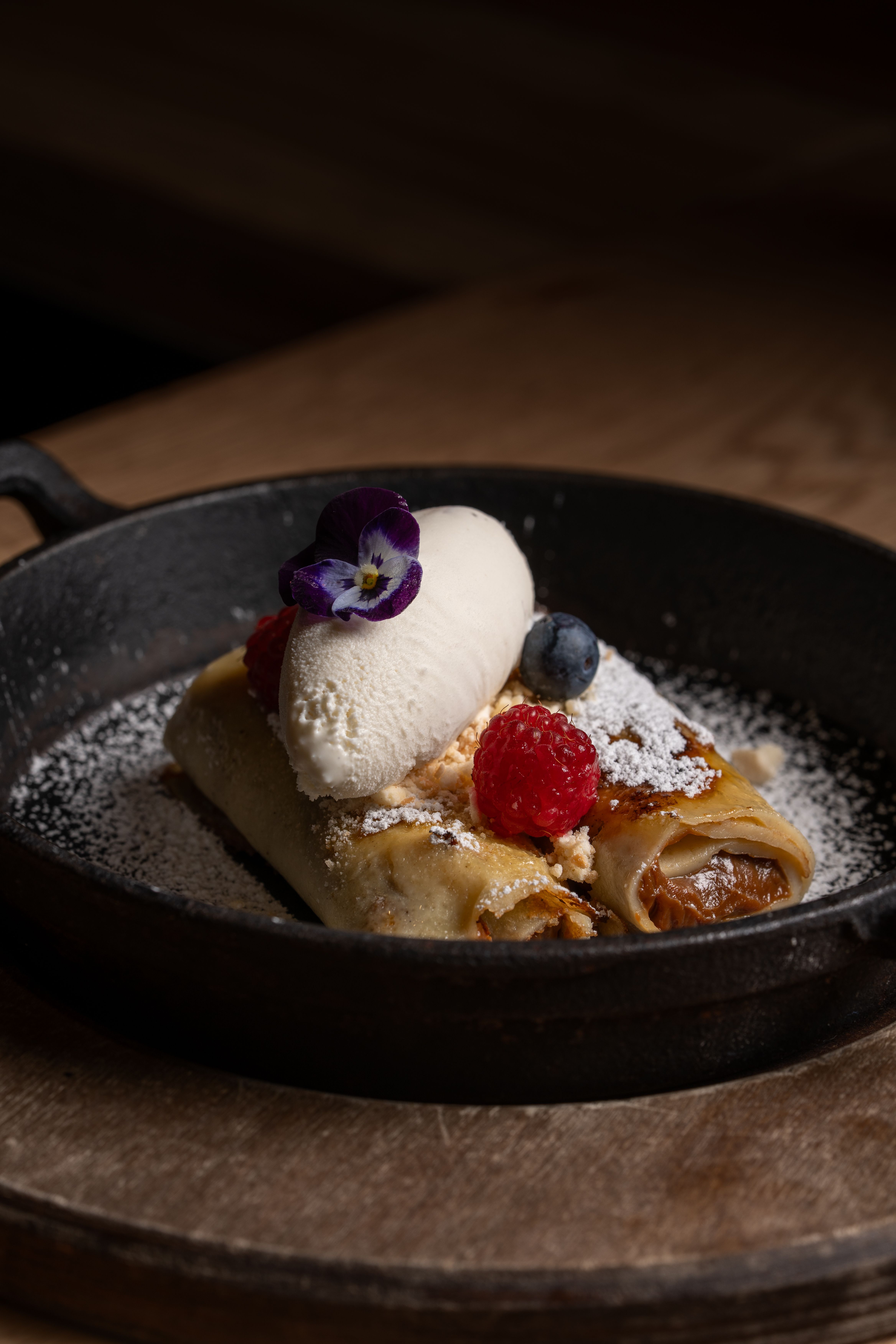
Photo: Nano Erdozain / Pexels
The diets react (see scores below)
Common Ingredients
- flour
- eggs
- butter
- sugar
- milk
- dulce de leche
- oaxaca cheese
- vanilla
Specific recipes may vary.
Incompatible with 11 of 11 diets
Diet Ratings
A marquesita is a Mexican crispy crepe/waffle cone snack made primarily from flour and sugar, filled with dulce de leche (a high-sugar caramel spread) and Oaxaca cheese. This dish is fundamentally incompatible with ketogenic eating. Flour provides high net carbs (a single crepe shell can contain 20-30g of net carbs), sugar adds direct glucose load, and dulce de leche is essentially condensed milk cooked with sugar — one of the highest-sugar fillings possible. The combination easily exceeds an entire day's keto carb budget in a single serving. While the eggs, butter, and Oaxaca cheese are keto-friendly ingredients, they are vastly outweighed by the carbohydrate and sugar content of the other components. There is no meaningful way to make this dish keto-compatible without replacing virtually every primary ingredient.
Marquesita contains multiple animal-derived ingredients, making it clearly incompatible with a vegan diet. Eggs and butter are direct animal products, milk is dairy, dulce de leche is a dairy-based caramel, and Oaxaca cheese is an animal-derived dairy product. With five distinct non-vegan ingredients, there is no ambiguity here.
Marquesita is a Mexican street snack made by rolling a thin crispy crepe (made from wheat flour) around fillings. Nearly every ingredient violates paleo guidelines: wheat flour is a grain and explicitly excluded, milk and oaxaca cheese are dairy products, butter is dairy, sugar is refined sugar, and dulce de leche is a heavily processed dairy-and-sugar product. The only paleo-compliant ingredients in the entire dish are eggs and vanilla extract. This dish is fundamentally incompatible with the paleo diet at its core structural level — the crepe shell itself is a grain product — making it impossible to adapt without completely reconstructing the dish.
A marquesita is a Mexican street snack made from a crispy crepe rolled with fillings. This version contains refined white flour, butter as the primary fat (not olive oil), added sugar, dulce de leche (a high-sugar caramel spread), and oaxaca cheese. The combination of refined grains, significant added sugars, saturated fat from butter and cheese, and a sweet caramel filling directly contradicts Mediterranean diet principles. There are no whole grains, no vegetables, no legumes, no olive oil, and no plant-forward components. The dulce de leche alone disqualifies it as a high-sugar processed ingredient. This is essentially a dessert snack with multiple problematic elements stacked together.
A Marquesita is a Mexican crispy crepe/waffle snack that is fundamentally incompatible with the carnivore diet. While it contains a few animal-derived ingredients (eggs, butter, milk, Oaxaca cheese), the dish is built on a foundation of plant-based, highly processed components. Flour (grain-derived) is the primary structural ingredient, sugar is a pure carbohydrate with no place on carnivore, dulce de leche is a heavily sweetened dairy product, and vanilla is a plant-derived flavoring. The dish is essentially a dessert snack centered around grains and sugar — two of the most excluded categories on any carnivore protocol. The presence of eggs, butter, cheese, and milk does not redeem a dish that is predominantly grain- and sugar-based.
A Marquesita is a Mexican crispy crepe/waffle roll that violates Whole30 on multiple levels. First, it contains flour (wheat grain — excluded). Second, it contains butter (dairy — excluded; only ghee/clarified butter is allowed). Third, it contains sugar (added sugar — excluded). Fourth, it contains milk (dairy — excluded). Fifth, dulce de leche is a caramel-like dairy confection made from milk and sugar (both excluded). Sixth, Oaxaca cheese is a dairy product (excluded). Even if all those ingredients were somehow compliant, the Marquesita itself is a crepe/waffle-style rolled snack, which falls squarely into the 'no recreating baked goods/junk food' rule — Whole30 explicitly lists crepes and waffles as prohibited formats. This dish fails on virtually every dimension of the Whole30 program.
A marquesita is a Mexican rolled wafer snack (popular in the Yucatan) that contains multiple high-FODMAP ingredients. The wheat flour is a primary concern, contributing fructans at any standard serving size. Milk contributes lactose, which is high-FODMAP in the quantities used in a batter. Dulce de leche is doubly problematic: it contains both lactose (concentrated milk) and often excess fructose or fructans depending on preparation. Oaxaca cheese is a fresh, high-moisture cheese similar to mozzarella or string cheese; Monash rates fresh cheeses as high in lactose, making it high-FODMAP. The combination of wheat flour (fructans), milk (lactose), dulce de leche (lactose + possible excess fructose), and Oaxaca cheese (lactose) makes this dish clearly high-FODMAP with multiple FODMAP classes stacking. Eggs, butter, sugar, and vanilla are low-FODMAP and not a concern.
A Marquesita is a crispy rolled wafer filled with dulce de leche and Oaxaca cheese, made from refined white flour, butter, sugar, and full-fat dairy ingredients. This snack conflicts with DASH diet principles on multiple fronts: it is made with refined (not whole grain) flour, contains significant added sugar and dulce de leche (a high-sugar caramel spread), uses butter which is high in saturated fat, and is filled with full-fat Oaxaca cheese — all categories that DASH explicitly limits. The combination of high saturated fat, high added sugar, low fiber, and refined carbohydrates makes this incompatible with DASH eating goals. It offers minimal potassium, magnesium, or fiber — the key nutrients DASH emphasizes. As a sweet snack, it falls squarely in the 'sweets' category that DASH restricts to ≤5 servings per week and only in small portions.
A Marquesita is a Mexican street snack consisting of a thin, crispy rolled waffle (crepe-like pastry) made from refined flour, butter, sugar, and milk, then filled with dulce de leche and Oaxaca cheese. From a Zone Diet perspective, this food is deeply problematic across nearly all macronutrient dimensions. The carbohydrate base is refined white flour — a high-glycemic, unfavorable carb in Zone terminology. Sugar is added both in the batter and via dulce de leche, which is essentially concentrated caramelized sugar and milk — one of the highest-glycemic, most insulin-spiking carb sources imaginable. There is no meaningful lean protein source (eggs contribute some protein but the dominant profile is fat and carbs). The fat profile is saturated (butter, full-fat cheese), not monounsaturated as Zone prefers. There are no low-glycemic vegetables, no omega-3s, no polyphenols. The 40/30/30 ratio cannot be approximated without radically altering the dish beyond recognition. While Oaxaca cheese provides some protein, it is a high-fat, saturated dairy product that does not redeem the dish's overall macro imbalance. This is a dessert-like snack built on refined carbs and sugar — the category Zone most consistently identifies as driving insulin dysregulation.
A marquesita is a crispy crepe-like street snack from the Yucatán region of Mexico, made by rolling a thin waffle into a cone or cylinder filled with dulce de leche and Oaxacan cheese. From an anti-inflammatory perspective, this dish is a near-perfect storm of pro-inflammatory ingredients. Refined white flour provides high-glycemic refined carbohydrates with no fiber or nutrient density. Butter contributes saturated fat. Dulce de leche is essentially concentrated added sugar combined with full-fat dairy — a double inflammatory hit. Oaxacan cheese adds more full-fat dairy and saturated fat. Sugar appears as an independent ingredient in the batter as well. The combination of refined carbohydrates and high added sugar drives glycemic spikes and promotes production of advanced glycation end-products (AGEs), both well-documented drivers of inflammatory markers like CRP and IL-6. Butter and full-fat dairy are in the 'limit' category individually, but their combined presence here is cumulative. Eggs and milk are the only ingredients with neutral-to-moderate profiles. Vanilla extract provides minimal polyphenol benefit at typical culinary quantities. There are essentially no anti-inflammatory positives — no omega-3s, no colorful vegetables, no fiber, no meaningful antioxidants. This is a treat food with a strongly pro-inflammatory nutritional profile.
A marquesita is a crispy rolled wafer (similar to a crepe or rolled waffle cone) filled with dulce de leche and Oaxaca cheese. It is a high-sugar, high-fat, low-protein, low-fiber snack with very poor nutrient density per calorie — the opposite of what GLP-1 patients need. The dulce de leche contributes significant added sugar, the butter and cheese add saturated fat, and the refined flour base offers no meaningful fiber. While Oaxaca cheese does provide a small amount of protein, the overall macronutrient profile is dominated by refined carbohydrates, sugar, and saturated fat. High-sugar and high-fat foods are known to worsen GLP-1 side effects including nausea, reflux, and bloating. The slowed gastric emptying caused by GLP-1 medications means a heavy, fatty, sugary snack like this will sit in the stomach longer and is likely to cause significant GI discomfort. There is no meaningful fiber. This food offers almost no nutritional value for the calorie cost and directly conflicts with the core priorities of protein density, fiber, low fat, and nutrient density per calorie.
*See how scores were generated at our methodology page.
Nutritional profile
Six traits that cut across every diet.
Fiber & Plants
How much whole-plant food and fiber it delivers.
Healthy Fats
The quality of its fats (unsaturated, omega-3).
Whole / Unprocessed
How close it is to its natural, unprocessed form.
Gut Gentle
How easy it is on digestion (low FODMAP, few irritants).
Low Glycemic
How little it spikes your blood sugar.
Protein Density
How much protein it packs per calorie.
Controversy Index
Higher controversy = more disagreement between diets.