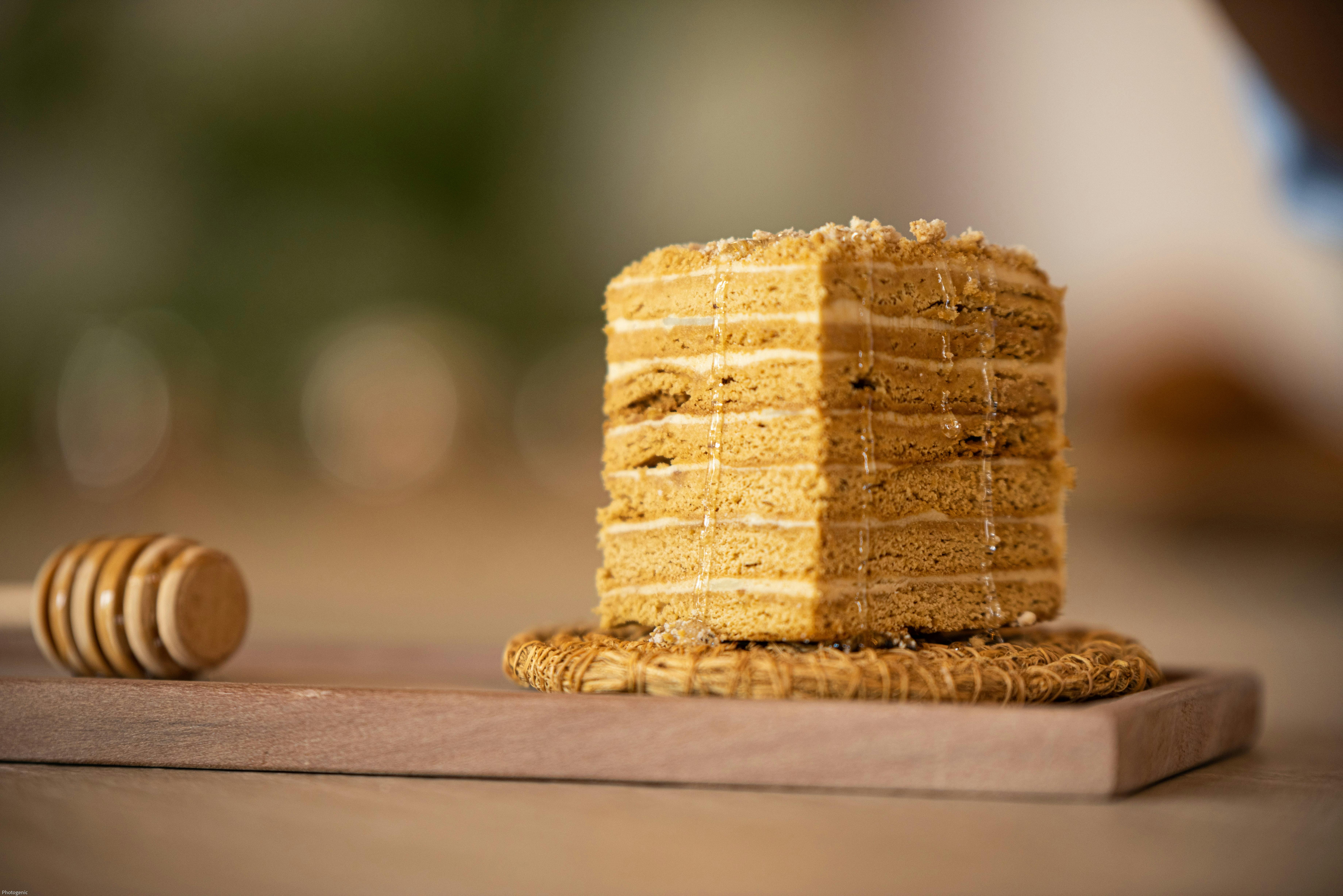
The diets react (see scores below)
Common Ingredients
- eggs
- honey
- sugar
- flour
- baking soda
- sour cream
- butter
- condensed milk
Specific recipes may vary.
Incompatible with 11 of 11 diets
Diet Ratings
Medovik is a Russian honey cake that is fundamentally incompatible with ketogenic eating. It contains multiple high-carbohydrate ingredients: flour (a grain-based starch), sugar, honey, and condensed milk — all of which are among the most keto-incompatible foods possible. A single slice of Medovik easily contains 50-80g of net carbs, far exceeding the entire daily keto allowance. There is no meaningful way to consume this dish in a traditional form and maintain ketosis. Butter, eggs, and sour cream are keto-friendly ingredients, but they are vastly outweighed by the carb-dense components.
Medovik is a traditional Russian honey cake that contains multiple animal-derived ingredients, making it entirely incompatible with a vegan diet. The ingredient list includes eggs, honey, sour cream, butter, and condensed milk — five distinct animal products. Eggs are a direct animal product, sour cream and butter are dairy derivatives, condensed milk is a concentrated dairy product, and honey is excluded by the overwhelming majority of vegan organizations including the Vegan Society and PETA. There is no ambiguity here: this dish is fundamentally built on animal products at every structural level (leavening, fat, liquid, sweetener, and cream layers). A vegan version would require substituting all five animal-derived ingredients simultaneously, which would produce a substantially different product.
Medovik is a Russian honey cake that is fundamentally incompatible with the paleo diet. The dish contains multiple clearly non-paleo ingredients: flour (wheat grain), sugar (refined), sour cream (dairy), condensed milk (dairy + refined sugar), and butter (dairy). While eggs and honey are paleo-approved, the overwhelming presence of grains, refined sugar, and dairy products makes this dish firmly in the 'avoid' category. There is no meaningful paleo adaptation possible without completely deconstructing the recipe, as the non-paleo ingredients are structural to the dish.
Medovik is a Russian honey cake that fundamentally contradicts Mediterranean diet principles across multiple dimensions. It is built on refined white flour, large quantities of added sugar, condensed milk (heavily sweetened), and butter as the primary fat — the opposite of olive oil. The sour cream adds saturated dairy fat beyond moderate amounts. While honey and eggs are not inherently problematic in small quantities, here they serve as vehicles for a high-sugar, high-saturated-fat dessert. This dish is a processed, sugar-laden confection with no plant-forward elements, no whole grains, no legumes, no vegetables, and no olive oil. It represents exactly the category of food the Mediterranean diet discourages.
Medovik is a Russian honey cake that is fundamentally incompatible with the carnivore diet. The dish is predominantly plant-based and heavily processed: flour and baking soda are grain/mineral-derived, sugar is a refined plant product, and condensed milk and sour cream add processed dairy with high sugar content. While eggs, butter, and honey have some carnivore adjacency, they are entirely overshadowed by the dominant plant-based carbohydrate ingredients. This is essentially a dessert cake — the antithesis of carnivore eating — with no meaningful animal protein and a macronutrient profile dominated by refined carbohydrates and sugar. There is no version of this dish that could be considered carnivore-compatible without completely reconstructing it.
Medovik (Russian honey cake) contains multiple excluded ingredients: sugar (added sweetener), flour (grain), sour cream (dairy), butter (dairy — only ghee/clarified butter is allowed), and condensed milk (dairy with added sugar). Additionally, as a layered cake, it falls squarely into the 'no recreating baked goods/junk food' rule even if individual ingredients were somehow made compliant. This dish is fundamentally incompatible with Whole30 on multiple levels.
Medovik (Russian honey cake) contains multiple high-FODMAP ingredients that make it unsuitable during the elimination phase. Honey is high in excess fructose and is a well-established high-FODMAP ingredient at any meaningful serving. Regular wheat flour is high in fructans. Condensed milk is very high in lactose. Sour cream contains lactose (though at lower levels). Together, these ingredients stack multiple FODMAP categories — excess fructose, fructans, and lactose — making this cake a high-FODMAP food at any standard serving size. Even small portions would deliver problematic FODMAP loads from at least two categories simultaneously.
Medovik is a Russian honey cake that is fundamentally incompatible with DASH diet principles. The ingredient list reads as a catalog of foods DASH explicitly limits or avoids: butter (high in saturated fat), sour cream (full-fat dairy), condensed milk (high in added sugar and saturated fat), and large amounts of sugar and honey (high added sugars). This dessert is high in saturated fat, added sugars, refined carbohydrates (white flour), and calories — all of which DASH discourages. There are no redeeming DASH-positive nutrients in meaningful quantities: no significant fiber, potassium, magnesium, or calcium from low-fat dairy sources. The honey provides minimal nutritional benefit when consumed in the quantities used in this cake. As a snack, this would contribute substantially to daily saturated fat and added sugar limits, making it incompatible with DASH goals of reducing cardiovascular risk.
Medovik is a traditional Russian honey cake that is fundamentally incompatible with Zone Diet principles. The dish is dominated by high-glycemic, insulin-spiking ingredients: honey, sugar, white flour, and condensed milk form the core of both the cake layers and the cream filling. These carbohydrates are exactly what Zone methodology labels 'unfavorable' — rapidly digested, high-glycemic, and highly insulin-stimulating. There is no lean protein component (eggs are present but in small relative quantity and buried in a high-fat, high-sugar matrix), no monounsaturated fat (butter is the primary fat, contributing saturated fat), and no low-glycemic vegetables or fruits. The macronutrient ratio is wildly skewed — predominantly simple carbohydrates and saturated fat, with minimal protein. Condensed milk adds yet another layer of concentrated sugar and fat. Even in controlled portions, this dessert cannot be meaningfully balanced into Zone blocks without reducing a serving to a nutritionally insignificant amount. This is a celebration dessert designed for indulgence, not hormonal balance.
Medovik is a Russian honey layer cake with an ingredient profile that is almost entirely pro-inflammatory from an anti-inflammatory diet perspective. The cream layers combine sour cream, butter, and condensed milk — all full-fat dairy products high in saturated fat, which is explicitly flagged as inflammatory in anti-inflammatory frameworks. Condensed milk is extremely high in added sugar, and the cake layers themselves are made from refined white flour and additional sugar, representing the refined carbohydrates that spike blood glucose and promote inflammatory cytokine release. Butter adds further saturated fat load. While honey has trace antioxidant and antimicrobial properties, the quantity used here is primarily acting as a refined sugar equivalent in terms of glycemic impact, with negligible anti-inflammatory benefit at dessert-portion concentrations. Eggs are a moderately mixed food but are the least concerning ingredient here. There are no anti-inflammatory stars in this dish — no omega-3s, no polyphenols, no fiber, no colorful produce, no beneficial spices. This is a dessert almost perfectly engineered from an anti-inflammatory standpoint to promote inflammation: high saturated fat, high refined sugar, high refined carbohydrates, high glycemic load.
Medovik is a traditional Russian honey layer cake composed almost entirely of ingredients that are counterproductive for GLP-1 patients. The primary components — sugar, condensed milk, honey, butter, and sour cream — deliver a high load of refined sugar and saturated fat with negligible protein and minimal fiber. A typical serving is calorie-dense with essentially empty nutritional value relative to those calories, the opposite of what GLP-1 patients need when appetite and portion size are already severely reduced. The high sugar content risks blood sugar spikes, and the saturated fat from butter, sour cream, and condensed milk is likely to worsen GLP-1 side effects including nausea, bloating, and reflux, given slowed gastric emptying. The flour base is refined with no meaningful fiber contribution. The small amount of egg in the dough does not meaningfully raise the protein density of the final product. This dish fails on every primary GLP-1 dietary criterion: it is low protein, low fiber, high fat, high sugar, calorie-dense, and difficult to digest in the context of delayed gastric emptying.
*See how scores were generated at our methodology page.
Nutritional profile
Six traits that cut across every diet.
Fiber & Plants
How much whole-plant food and fiber it delivers.
Healthy Fats
The quality of its fats (unsaturated, omega-3).
Whole / Unprocessed
How close it is to its natural, unprocessed form.
Gut Gentle
How easy it is on digestion (low FODMAP, few irritants).
Low Glycemic
How little it spikes your blood sugar.
Protein Density
How much protein it packs per calorie.
Controversy Index
Higher controversy = more disagreement between diets.