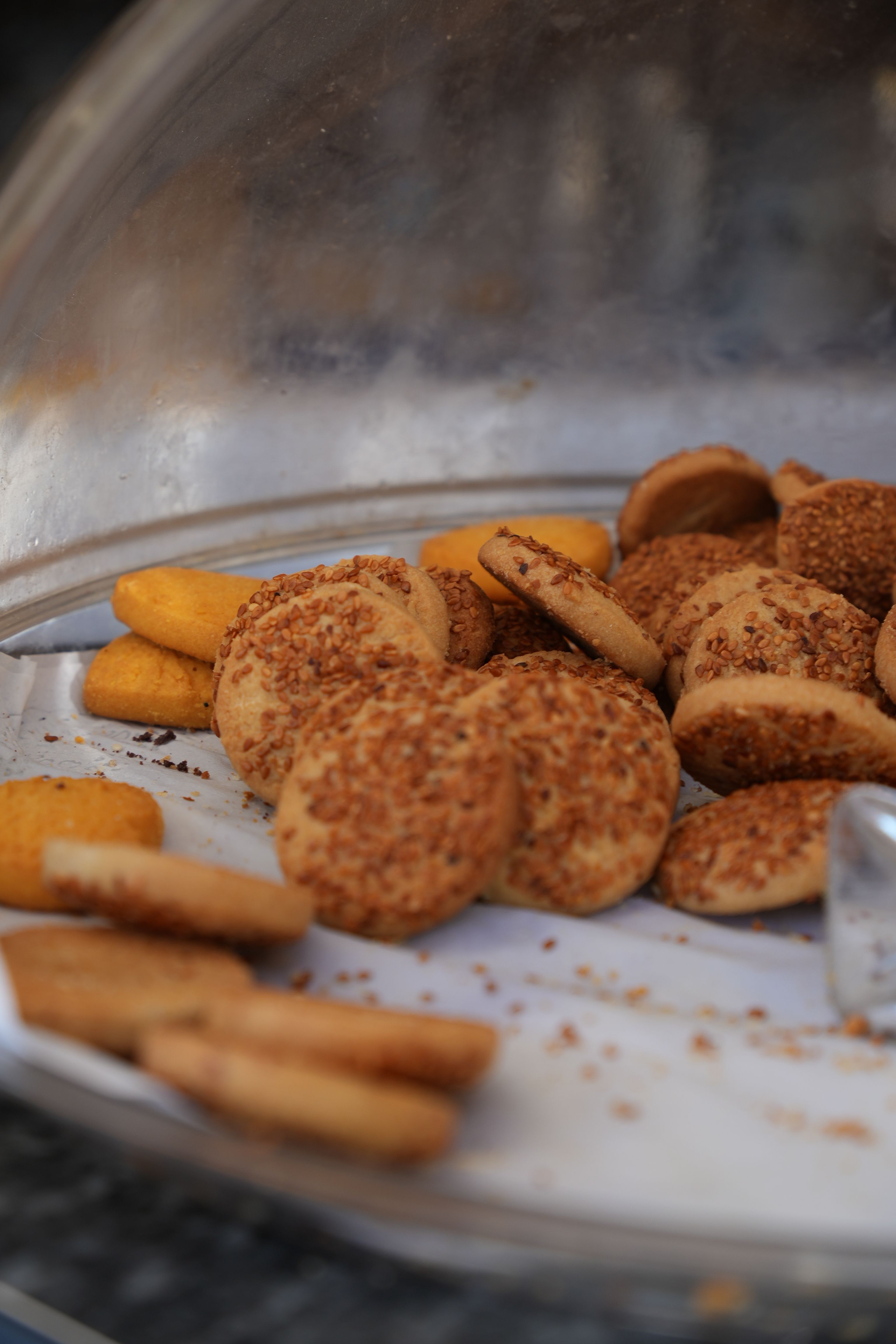
Photo: Murat Bilgin / Pexels
The diets react (see scores below)
Common Ingredients
- flour
- semolina
- olive oil
- walnuts
- honey
- sugar
- cinnamon
- baking powder
- orange zest
- cloves
Specific recipes may vary.
Incompatible with 9 of 11 diets
Diet Ratings
Melomakarona are traditional Greek honey-soaked cookies that are fundamentally incompatible with a ketogenic diet. The primary ingredients — wheat flour, semolina, honey, and sugar — are all high-carb, high-glycemic foods that would spike blood glucose and immediately break ketosis. A single melomakarono typically contains 30-40g of net carbs, which alone can exceed the entire daily keto carb allowance. There is no meaningful way to consume this food within ketogenic parameters in its traditional form.
Melomakarona are Greek honey-walnut cookies made entirely from plant-derived ingredients except for honey, which is the central contested ingredient. Flour, semolina, olive oil, walnuts, sugar, cinnamon, baking powder, orange zest, and cloves are all unambiguously vegan. However, honey is explicitly excluded by major vegan organizations including the Vegan Society and PETA, as bees are animals and honey is an animal-derived product. This places the dish in 'caution' rather than 'approve' territory. The score reflects that the dish is otherwise entirely plant-based and minimally processed, but the honey is not incidental — it is a defining ingredient used both in the dough and typically in the syrup that soaks the cookies. A vegan version can easily be made by substituting agave syrup or maple syrup for honey.
A minority of plant-based eaters and some whole-food advocates argue that honey from small-scale or treatment-free beekeeping does not meaningfully harm bees and therefore falls within an ethical plant-based framework; under this view, melomakarona would be fully approved as a whole-food, minimally processed snack.
Melomakarona is a traditional Greek honey cookie that contains multiple non-paleo ingredients. The two primary structural ingredients — wheat flour and semolina — are grains, which are categorically excluded from the paleo diet due to their gluten, lectin, and phytate content. Sugar is a refined sweetener, also strictly excluded. Baking powder is a processed additive not aligned with paleo principles. While several ingredients are paleo-compliant (olive oil, walnuts, honey, cinnamon, orange zest, cloves), the foundation of the dish is built on grains and refined sugar, making the overall dish firmly in the avoid category. There is no meaningful way to consider this dish paleo-compatible in its traditional form.
Melomakarona are traditional Greek Christmas honey cookies with a mixed Mediterranean profile. On the positive side, they use extra virgin olive oil (a core Mediterranean fat), walnuts (healthy nuts with omega-3s), honey (a more natural sweetener), warming spices, and orange zest — all ingredients with roots in the Mediterranean tradition. However, they also contain refined flour, added sugar, and are calorie-dense sweets. The Mediterranean diet does not prohibit sweets outright but emphasizes that they should be consumed occasionally, not as daily staples. As a festive, seasonal treat made with genuinely Mediterranean ingredients (olive oil replacing butter, walnuts, honey), melomakarona sit in a better position than most cookies, but their refined grain base and added sugar prevent an 'approve' rating.
Some Mediterranean diet authorities, particularly those rooted in traditional Greek dietary culture, would view melomakarona favorably as an example of how the diet incorporates sweets made with wholesome, local ingredients (olive oil, honey, nuts) rather than industrial fats and refined sugars — distinguishing them positively from modern processed confections. Conversely, strict clinical interpretations (e.g., modern PREDIMED-style guidelines) would flag any added-sugar treat as an 'avoid' regardless of the quality of other ingredients.
Melomakarona is a traditional Greek honey cookie that is entirely plant-based. Every single ingredient — flour, semolina, olive oil, walnuts, honey, sugar, cinnamon, baking powder, orange zest, and cloves — is either plant-derived or a refined carbohydrate. There is no animal product present whatsoever. This dish is fundamentally incompatible with the carnivore diet at every level: it contains grains (flour, semolina), plant oils (olive oil), nuts (walnuts), refined sugar, plant spices (cinnamon, cloves), and citrus zest. Even honey, which some animal-based practitioners debate, is present alongside a matrix of completely excluded plant foods. This is one of the clearest possible violations of carnivore principles.
Melomakarona are traditional Greek honey-walnut cookies, and this dish fails Whole30 compliance on multiple levels. First, flour and semolina are grain-based ingredients, both explicitly excluded from the Whole30 program. Second, sugar is an added sweetener, which is excluded. Third, honey counts as added sugar and is also excluded. Fourth, even setting aside the excluded ingredients, this dish is a cookie/baked good, which falls squarely under the Whole30 rule against recreating baked goods and junk food — cookies are explicitly in the spirit-of-the-program violation category. There is no compliant version of this dish possible within the Whole30 framework.
Melomakarona contains multiple high-FODMAP ingredients that make it unsuitable during the elimination phase. Wheat flour is the primary base ingredient and is high in fructans, which are a major FODMAP category. Semolina is also derived from wheat and contributes additional fructans. Honey is high in excess fructose and is explicitly listed as high-FODMAP by Monash University at typical serving amounts. Walnuts, while low-FODMAP at small portions (10 halves per Monash), are often used in larger quantities in this recipe. The combination of wheat flour, semolina, and honey alone is sufficient to classify this dish as high-FODMAP at any standard serving. Orange zest, cinnamon, and cloves are low-FODMAP, and olive oil and sugar are safe, but they cannot offset the core high-FODMAP ingredients.
Melomakarona are traditional Greek honey-soaked cookies that are high in added sugars (honey + sugar), refined carbohydrates (white flour + semolina), and significant caloric density from olive oil. While olive oil and walnuts are DASH-friendly ingredients, and the dish is low in sodium and saturated fat, the dominant nutritional profile is driven by added sugars and refined grains — both of which DASH explicitly limits. The honey syrup soaking common in this recipe means a single serving can deliver a substantial sugar load with minimal fiber, potassium, calcium, or magnesium benefit. DASH guidelines specifically call for limiting sweets to ≤5 servings per week (small portions), and these cookies, even as an occasional treat, represent a concentrated sweet snack rather than a core DASH food. The refined flour base also conflicts with DASH's emphasis on whole grains.
Melomakarona are traditional Greek honey-soaked cookies made primarily from flour, semolina, honey, and sugar — a combination that is essentially a pure high-glycemic carbohydrate bomb with no meaningful protein component. The macronutrient profile is wildly skewed: very high carbohydrates (predominantly from refined flour, semolina, honey, and added sugar), moderate fat from olive oil and walnuts, and virtually zero protein. This makes it essentially impossible to construct a Zone-balanced block ratio around this food. Even in small portions, the carbohydrate load from refined grains plus concentrated sugars would spike insulin dramatically, which is precisely the hormonal response the Zone Diet is designed to prevent. The olive oil and walnuts are Zone-favorable fats, and the cinnamon and orange zest offer polyphenol benefits Sears would appreciate, but these minor positives cannot offset the structural imbalance. As a standalone snack with no protein, it fails the 40/30/30 ratio entirely. While the Zone is ratio-based rather than exclusionary, melomakarona represent a case where the macro imbalance is so extreme — essentially 70-80% carbohydrate calories, most from high-glycemic sources, with ~0% protein — that incorporating them into a Zone framework would require consuming impractically large amounts of lean protein and fat alongside a very tiny portion, undermining the entire snack concept.
Melomakarona are traditional Greek honey-walnut cookies with a genuinely mixed anti-inflammatory profile. On the positive side, the ingredient list includes several notable anti-inflammatory components: olive oil (oleocanthal, polyphenols), walnuts (omega-3 ALA, polyphenols), honey (antioxidants, though amounts are significant), cinnamon (cinnamaldehyde, anti-inflammatory polyphenols), orange zest (flavonoids, vitamin C), and cloves (eugenol, one of the highest antioxidant spices by ORAC). These are meaningful contributors, not trace amounts. However, the base of the cookie is refined flour and semolina — refined carbohydrates that spike blood glucose and promote glycation-driven inflammation — and the recipe contains added sugar in addition to honey, making the total glycemic load substantial. As a sweet baked good, it is consumed primarily as a treat and cannot be considered a net anti-inflammatory food despite its beneficial ingredients. The olive oil and walnuts distinguish it favorably from butter-based cookies, and the spice profile is genuinely strong, but the refined carb and dual-sugar load keeps this firmly in 'caution' territory. Best consumed occasionally and in small portions rather than avoided entirely.
Melomakarona are traditional Greek honey-soaked cookies made primarily from refined flour, semolina, olive oil, sugar, and honey — a combination that is high in simple carbohydrates and sugar with negligible protein and minimal fiber. For GLP-1 patients, this food fails on nearly every key criterion: it provides empty calories with no meaningful protein contribution, it is high in sugar (honey plus added sugar), it is calorie-dense in small servings, and the refined grain base offers little fiber. While olive oil and walnuts provide unsaturated fats, the overall fat load per cookie is moderate-to-high relative to the nutritional return. The sugar content poses a particular concern — GLP-1 patients eating fewer total calories cannot afford foods that deliver calories without protein, fiber, or micronutrient value. The syrup-soaked texture also makes portion control difficult, as satiety cues from the medication may still leave room for high-palatability sweets. There is no meaningful clinical case for including this food in a GLP-1 dietary pattern.
*See how scores were generated at our methodology page.
Nutritional profile
Six traits that cut across every diet.
Fiber & Plants
How much whole-plant food and fiber it delivers.
Healthy Fats
The quality of its fats (unsaturated, omega-3).
Whole / Unprocessed
How close it is to its natural, unprocessed form.
Gut Gentle
How easy it is on digestion (low FODMAP, few irritants).
Low Glycemic
How little it spikes your blood sugar.
Protein Density
How much protein it packs per calorie.
Controversy Index
Higher controversy = more disagreement between diets.
Diet-Specific Tips
 Mediterranean — 4/10
View tips
- Uses extra virgin olive oil instead of butter — a genuine Mediterranean positive
- Walnuts provide healthy fats and are a core Mediterranean nut
- Contains both refined flour and added sugar, contradicting whole-grain and low-sugar principles
- Honey is a more traditional sweetener but still adds significant sugar load
- Traditional seasonal/festive item — Mediterranean diet allows occasional sweets
- Spices (cinnamon, cloves) and orange zest are authentically Mediterranean
- Not a daily food; portion and frequency are key modifiers
 Anti-Inflammatory — 4/10
View tips
- Olive oil base (not butter) provides oleocanthal and monounsaturated fats — a meaningful anti-inflammatory advantage over most cookies
- Walnuts contribute omega-3 ALA and polyphenols
- Cinnamon and cloves are among the most potent anti-inflammatory spices by polyphenol density
- Orange zest adds flavonoids and vitamin C
- Honey has antioxidant properties but is present in large quantities, contributing to glycemic load
- Added sugar compounding honey raises total glycemic impact significantly
- Refined flour and semolina base drives blood glucose response and glycation, a key inflammatory mechanism
- Overall: pro-inflammatory baked goods structure with genuinely anti-inflammatory ingredients embedded within it