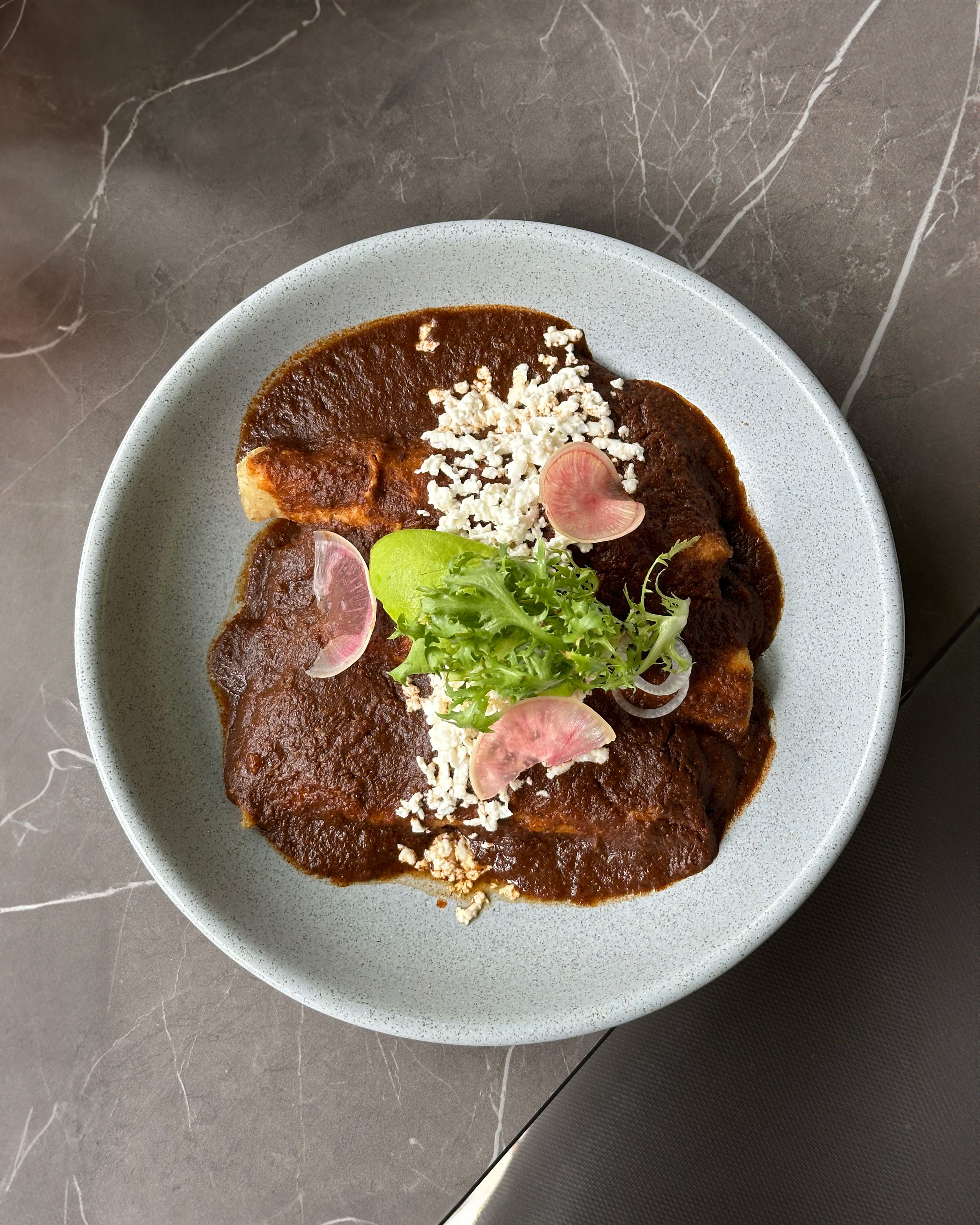
Photo: Kuiyibo Campos / Pexels
Mexican
Enfrijoladas
The diets react (see scores below)
Common Ingredients
- tortilla
- black beans
- epazote
- onion
- garlic
- queso fresco
- crema
- avocado
Specific recipes may vary.
Incompatible with 6 of 11 diets
Diet Ratings
Enfrijoladas are fundamentally incompatible with a ketogenic diet. The dish is built on two major keto-breaking components: corn tortillas and black beans. Corn tortillas contain roughly 12-15g net carbs each, and a standard serving uses 2-3 tortillas, contributing 24-45g net carbs from tortillas alone — nearly or fully exceeding the entire daily keto budget. Black beans add another 20-25g net carbs per half-cup serving. Together, these two staple ingredients easily push a single serving to 50-70g net carbs, making ketosis impossible. The remaining ingredients (epazote, onion, garlic, queso fresco, crema, avocado) are keto-friendly, but they cannot offset the foundational carb load of the dish. This is not a portion-control situation — the dish's core identity relies on beans and tortillas, which are categorically excluded from keto.
Enfrijoladas as listed contain two clear animal-derived dairy ingredients: queso fresco (fresh cheese made from cow's milk) and crema (Mexican soured cream). Both are unambiguously non-vegan. The base of the dish — corn tortillas, black beans, epazote, onion, garlic, and avocado — is entirely plant-based and would score highly on its own. However, the dairy toppings are traditional and integral to the dish as described, making this version incompatible with a vegan diet. A vegan adaptation is straightforward: substitute queso fresco with a cashew-based or store-bought vegan cheese, and replace crema with cashew cream, coconut cream, or a commercial vegan sour cream.
Enfrijoladas are fundamentally incompatible with the paleo diet. The dish is built on two core non-paleo elements: tortillas (corn, a grain) and black beans (a legume). Both are explicitly excluded from the paleo framework. Corn is a grain that was selectively bred and is high in anti-nutrients; legumes like black beans contain lectins and phytic acid that paleo authorities consistently flag as problematic. Beyond these structural violations, queso fresco and crema are dairy products, also excluded. Epazote, onion, garlic, and avocado are paleo-approved, but they are minor supporting ingredients that cannot redeem a dish whose foundation is entirely non-paleo. There is no meaningful paleo substitution that would preserve the identity of this dish.
Enfrijoladas feature several Mediterranean diet-friendly elements: black beans as the primary protein are an excellent legume source, avocado provides healthy monounsaturated fats, and aromatics like onion and garlic are staples. However, the corn tortillas are a refined grain not native to the Mediterranean tradition, and the dish includes both queso fresco and crema — two dairy products simultaneously — which pushes it toward the moderate/caution zone. The overall dish is plant-forward and legume-centered, which aligns well with Mediterranean principles, but the combination of processed dairy and refined grain base prevents a full approval.
Some modern Mediterranean diet practitioners would score this higher, arguing that legume-centered dishes with healthy fats (avocado) and vegetables capture the spirit of the diet regardless of culinary tradition, and that corn tortillas, while non-traditional, are a whole-grain-adjacent minimally processed starch similar to how some Mediterranean regions use flatbreads. The dual dairy components (crema + queso fresco) would still be a moderate concern even in this interpretation.
Enfrijoladas is an entirely plant-based dish that is fundamentally incompatible with the carnivore diet. The primary protein source is black beans, which are legumes — strictly excluded from any tier of carnivore eating. The dish is built on corn tortillas (grain), smothered in a black bean and epazote (herb) sauce, topped with onion, garlic, and avocado — all plant foods. The only animal-derived components are queso fresco and crema, which are dairy and would themselves be debated on strict carnivore. There is no meaningful animal protein present. This dish represents exactly the type of plant-centered, grain-and-legume-based meal that the carnivore diet is designed to eliminate entirely.
Enfrijoladas contains multiple excluded ingredients that make it firmly non-compliant with Whole30. Tortillas are explicitly listed as a prohibited food under Rule 4 (no recreating junk food/wraps/tortillas). Black beans are legumes, which are excluded under Rule 1. Queso fresco is dairy (cheese), which is excluded. Crema is dairy (sour cream equivalent), which is excluded. The dish has at least four distinct Whole30 violations across different rule categories, making it one of the most non-compliant dishes possible.
Enfrijoladas contain multiple high-FODMAP ingredients that make this dish unsuitable during the elimination phase. Black beans are the primary protein and primary sauce base — they are high in GOS (galacto-oligosaccharides) at any meaningful serving size, making the dish inherently high-FODMAP. Onion and garlic are two of the most concentrated sources of fructans and should be strictly avoided during elimination. Queso fresco is a soft, fresh cheese high in lactose. Crema (Mexican sour cream) contains significant lactose. Avocado is low-FODMAP only at 1/8 avocado per Monash, but typical garnish portions far exceed this. Corn tortillas themselves are generally low-FODMAP, and epazote is an herb used in small quantities that poses no significant FODMAP concern. However, the combination of black beans as both the sauce and protein, onion, garlic, queso fresco, and crema creates an overwhelming FODMAP load across multiple categories (GOS, fructans, lactose, polyols). There is no realistic way to modify this dish into a low-FODMAP version without fundamentally changing its character.
Enfrijoladas feature several DASH-friendly components — black beans are an excellent source of potassium, magnesium, fiber, and plant-based protein, all core DASH nutrients. Corn tortillas are whole-grain adjacent and low in sodium when made traditionally. Onion, garlic, and epazote are DASH-approved aromatics with negligible sodium. Avocado adds healthy monounsaturated fats. However, the dish is pulled into 'caution' territory by queso fresco and crema. Queso fresco is a moderately high-sodium cheese (typically 200–400mg per oz) and adds saturated fat. Mexican crema is a full-fat dairy product that DASH explicitly discourages in favor of low-fat alternatives. Together, these two toppings introduce saturated fat and sodium that conflict with DASH principles. Portion control on the dairy toppings and using low-fat substitutes (e.g., low-fat sour cream or Greek yogurt for crema, reduced-sodium cheese) could push this dish closer to 'approve.'
NIH DASH guidelines specifically call for low-fat dairy and limiting saturated fat, which places crema and queso fresco outside ideal parameters. However, updated clinical interpretations note that recent meta-analyses (e.g., Astrup et al., 2019) suggest full-fat dairy may not adversely affect cardiovascular outcomes, leading some DASH-oriented dietitians to allow modest amounts of full-fat cheese and crema when overall saturated fat intake remains within daily limits.
Enfrijoladas present a classic Zone challenge: the macro ratios are significantly skewed toward carbohydrates. The primary components — corn tortillas and black beans — are both carbohydrate sources, creating a double carb load with minimal lean protein. Black beans do provide some protein (vegetarian), but in Zone's vegetarian fat block rule, this means fat portions must be larger (3g fat per block rather than 1.5g), and the beans themselves carry substantial carb load alongside their protein. Corn tortillas are classified as 'unfavorable' carbs in Zone terminology — moderate-to-high glycemic and grain-based. Crema (high saturated fat) and queso fresco (saturated fat) push the fat profile away from the preferred monounsaturated direction, though avocado partially redeems this with excellent monounsaturated fat. Epazote, onion, and garlic are Zone-favorable additions. The dish lacks sufficient lean protein to balance the carb load — beans alone at a typical serving size cannot bridge the gap without dramatically increasing bean quantity (which further worsens the carb ratio). A Zone-adapted version would require: using fewer tortillas (or corn tortilla strips in small amounts), adding egg whites or lean chicken alongside beans, replacing crema with more avocado, and reducing queso fresco. As traditionally prepared, it's carb-heavy and fat-imbalanced for Zone purposes.
Some Zone practitioners working with vegetarian or Mexican cuisine argue that black beans are among the better 'unfavorable' carbs — they have moderate glycemic index due to fiber content, and their protein contribution (roughly 7g protein per ½ cup) makes them a legitimate dual-use block food. Sears' later writings on polyphenols also favor legumes for their anti-inflammatory properties. If tortilla portions are minimized (1 small corn tortilla) and avocado is emphasized over crema, this dish can be reasonably accommodated within Zone principles, perhaps earning a score of 5-6 with careful portioning.
Enfrijoladas present a genuinely mixed anti-inflammatory profile. On the positive side, black beans are an anti-inflammatory staple — high in fiber, plant protein, polyphenols (anthocyanins), and associated with reduced CRP. Garlic and onion contribute quercetin, allicin, and sulfur compounds with well-documented anti-inflammatory effects. Epazote is an herb with antioxidant properties. Avocado is explicitly emphasized in anti-inflammatory frameworks for its oleic acid, monounsaturated fats, and carotenoids. These are all genuinely strong contributors. The limiting factors are queso fresco and crema, both full-fat dairy products that the anti-inflammatory framework recommends limiting due to saturated fat content. Crema in particular can be used generously and pushes the dish toward the caution zone. Corn tortillas (the traditional base) are a whole grain option and relatively neutral, while flour tortillas would be more inflammatory due to refined carbohydrates. The dish overall has a solid plant-forward foundation but is moderated by the dairy components. With mindful portioning of queso fresco and crema, or substituting lower-fat dairy, this dish could score higher. As traditionally prepared with moderate dairy garnishes, a 6 is appropriate.
Some anti-inflammatory practitioners, particularly those following Autoimmune Protocol (AIP) or lectin-avoidance frameworks (e.g., Dr. Steven Gundry), would flag corn tortillas and black beans as problematic due to lectin content, which they argue contributes to gut permeability and systemic inflammation in sensitive individuals. Mainstream anti-inflammatory nutrition, including Dr. Weil's pyramid, strongly endorses legumes and whole grain corn as beneficial.
Enfrijoladas are corn tortillas dipped in a black bean sauce (with epazote, onion, and garlic) and topped with queso fresco, crema, and avocado. The black bean base is a genuine strength — beans provide meaningful fiber (7–8g per half-cup) and plant-based protein, and are easy to digest. Epazote, onion, and garlic add micronutrient value with negligible caloric cost. However, the dish has several GLP-1 caution flags: (1) corn tortillas are refined-grain-adjacent and add carbohydrate load with modest fiber unless made from whole-grain masa; (2) crema is high in saturated fat and low in protein — a classic empty-calorie concern for GLP-1 patients eating small portions; (3) queso fresco adds some protein but also saturated fat; (4) avocado contributes healthy unsaturated fat but adds caloric density in a dish where calories need to work hard. The dish is not fried, not spicy by default, and the bean sauce base makes it meaningfully more GLP-1-compatible than many Mexican comfort foods. The core problem is the fat from crema and cheese landing in a small-portion meal where protein is already marginal — black beans alone rarely hit the 15–30g per meal protein target without a substantial serving size. A modified version (crema omitted or drastically reduced, queso fresco minimized, extra beans, smaller tortilla portion) could score higher.
Some GLP-1-focused dietitians would rate this more favorably, arguing that black beans as a primary protein-plus-fiber source in a non-fried, whole-food preparation is exactly the kind of nutrient-dense meal that works well for patients who tolerate legumes — and that crema and avocado in typical restaurant portions are small enough not to significantly worsen GI side effects. Others would score it lower, noting that the protein-per-calorie ratio is poor compared to animal proteins, and that crema's saturated fat content is an unnecessary GI risk in a population already prone to nausea and reflux.
*See how scores were generated at our methodology page.
Nutritional profile
Six traits that cut across every diet.
Fiber & Plants
How much whole-plant food and fiber it delivers.
Healthy Fats
The quality of its fats (unsaturated, omega-3).
Whole / Unprocessed
How close it is to its natural, unprocessed form.
Gut Gentle
How easy it is on digestion (low FODMAP, few irritants).
Low Glycemic
How little it spikes your blood sugar.
Protein Density
How much protein it packs per calorie.
Controversy Index
Higher controversy = more disagreement between diets.
Diet-Specific Tips
 Mediterranean — 5/10
View tips
- Black beans as primary protein strongly aligns with Mediterranean legume emphasis
- Avocado provides Mediterranean-compatible healthy monounsaturated fats
- Garlic and onion are Mediterranean staples
- Corn tortillas are refined grains not native to Mediterranean traditions
- Dual dairy (queso fresco + crema) exceeds typical Mediterranean moderation for dairy
- No red meat or highly processed ingredients — avoids worst-case components
- Non-Mediterranean cuisine but structurally plant-forward
 DASH — 5/10
View tips
- Black beans are a DASH-core food: high in potassium, magnesium, fiber, and plant protein
- Queso fresco adds 200–400mg sodium per oz and saturated fat — conflicts with DASH sodium and fat limits
- Crema is full-fat dairy, which DASH guidelines recommend limiting in favor of low-fat alternatives
- Avocado provides DASH-friendly monounsaturated fats and potassium
- Corn tortillas are low-sodium and acceptable in DASH when portion-controlled
- Overall dish sodium is moderate but could escalate with generous cheese/crema portions
- Substituting low-fat Greek yogurt for crema and reducing cheese quantity would significantly improve DASH compatibility
 Zone — 4/10
View tips
- Double carbohydrate load: both tortillas (unfavorable, grain-based) and black beans contribute high carb content
- Insufficient lean protein: beans provide vegetarian protein but not enough to balance carbs without increasing bean quantity paradoxically
- Saturated fat concern: crema and queso fresco skew fat profile away from Zone-preferred monounsaturated fats
- Avocado is a Zone-ideal fat source and partially redeems the fat profile
- Black beans have moderate glycemic index due to fiber, making them better than many carbs but still 'unfavorable' in Zone classification
- Vegetarian protein rule requires larger fat block allocations, complicating macro balancing
- Epazote, onion, garlic: Zone-favorable low-glycemic, anti-inflammatory additions
- Dish can be Zone-adapted but requires significant portion modification from traditional preparation
 Anti-Inflammatory — 6/10
View tips
- Black beans: high in fiber, anthocyanins, and plant protein — core anti-inflammatory food
- Avocado: monounsaturated fats and carotenoids, explicitly approved in anti-inflammatory frameworks
- Garlic and onion: quercetin, allicin, and sulfur compounds with anti-inflammatory activity
- Epazote: antioxidant herb, adds benefit
- Queso fresco and crema: full-fat dairy — anti-inflammatory guidelines recommend limiting saturated fat sources
- Corn tortillas (assumed): whole grain, relatively neutral; flour tortillas would be more inflammatory
- No processed ingredients, artificial additives, or refined sugars — clean whole-food base
 GLP-1 Friendly — 5/10
View tips
- Black bean sauce provides meaningful fiber and plant protein — a genuine GLP-1 asset
- Crema is high in saturated fat and adds calories with minimal protein — counterproductive in small-portion eating
- Queso fresco contributes some protein but also saturated fat
- Avocado adds healthy unsaturated fat but increases caloric density
- Corn tortillas are moderate glycemic load with limited fiber unless whole-grain masa is used
- Dish is not fried and not inherently spicy — digestibility is relatively good
- Protein per serving likely falls short of the 15–30g per meal target without a large serving size
- Easily modified: reducing crema, increasing beans, and limiting tortilla quantity improves the GLP-1 profile significantly