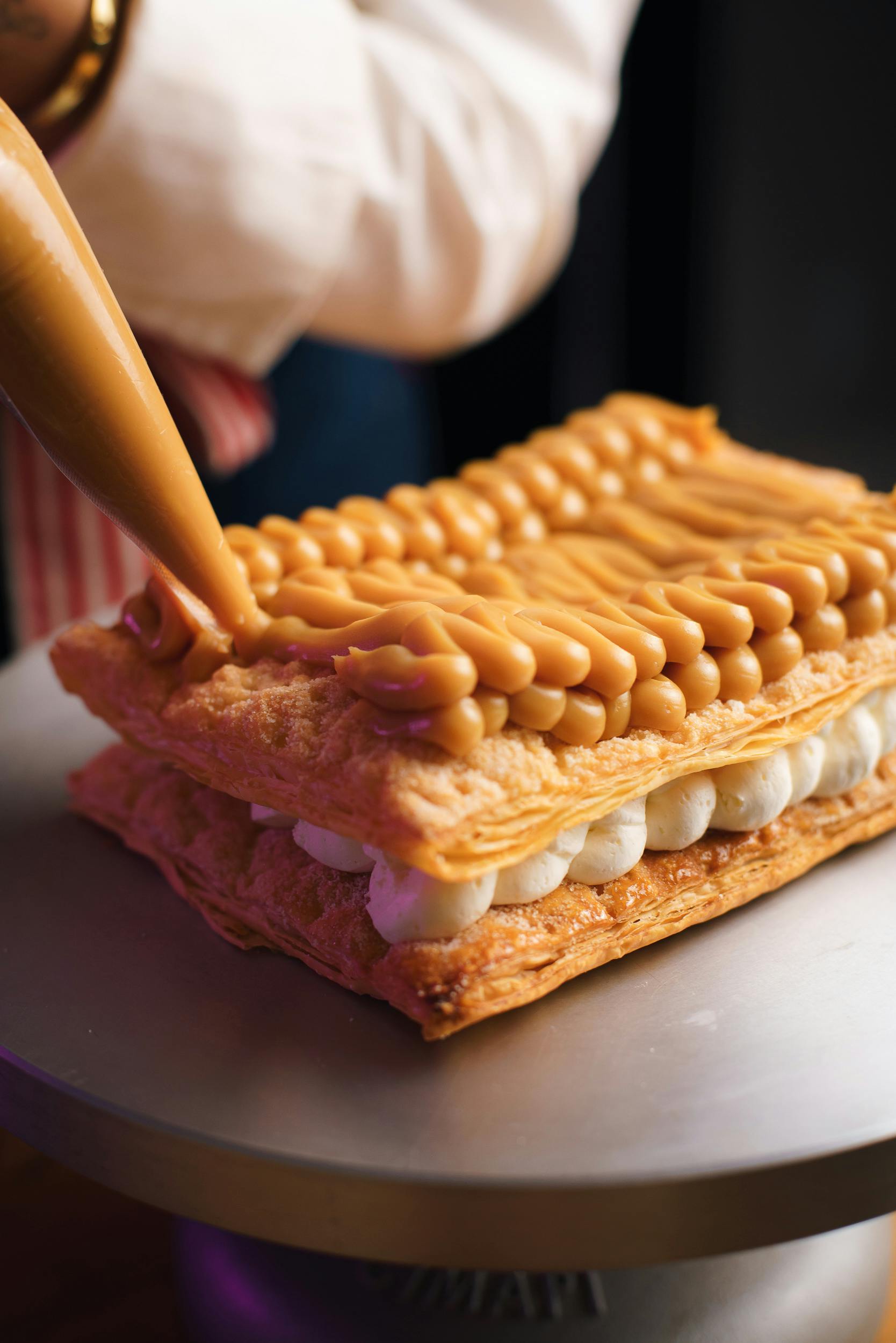
Photo: Midtrack - / Pexels
French
Mille-Feuille
The diets react (see scores below)
Common Ingredients
- puff pastry
- pastry cream
- milk
- egg yolk
- butter
- flour
- sugar
- vanilla
- icing sugar
Specific recipes may vary.
Incompatible with 11 of 11 diets
Diet Ratings
Mille-Feuille is fundamentally incompatible with a ketogenic diet. It is built almost entirely on high-carbohydrate ingredients: puff pastry (wheat flour-based, extremely high in carbs and refined starch), pastry cream thickened with flour, added sugar throughout, and icing sugar on top. A single standard serving would deliver well over 50g of net carbs — potentially 60-80g — from multiple sources including refined flour, white sugar, and icing sugar. There is no meaningful fat-to-carb ratio that could redeem this dish for keto purposes. None of its primary components are keto-compatible in their standard form.
Mille-Feuille is fundamentally incompatible with a vegan diet. It contains multiple explicit animal-derived ingredients: milk and butter (dairy products) in the puff pastry and pastry cream, and egg yolks in the pastry cream. These are core, non-incidental ingredients that define the dish's structure and flavor — there is no version of traditional Mille-Feuille that omits them. All three ingredients are unambiguously excluded under vegan dietary rules.
Mille-Feuille is essentially a showcase of paleo's most prohibited ingredient categories. Puff pastry is made from wheat flour — a grain that is unambiguously excluded from the paleo diet. The pastry cream contains milk (dairy), flour (grain), and sugar (refined). Icing sugar is refined sugar. Butter and milk are dairy products. There is virtually no paleo-compliant ingredient in this dish beyond the egg yolk and vanilla. This is one of the clearest possible avoid verdicts — a highly processed, bakery-style dessert built entirely on grains, dairy, and refined sugar.
Mille-Feuille is a classic French pastry that fundamentally contradicts Mediterranean diet principles. It is built on puff pastry — a heavily processed, refined flour product with very high butter content (typically 30-50% fat by weight, almost entirely saturated). The pastry cream filling adds further sugar, egg yolk, and milk, and the dish is finished with icing sugar. There are no vegetables, legumes, whole grains, or olive oil. Butter, not olive oil, is the dominant fat. The added sugars and refined grain base place this squarely in the 'avoid' category. While eggs and dairy (milk, egg yolk) are individually acceptable in moderation on the Mediterranean diet, here they serve as vehicles for a high-sugar, high-saturated-fat dessert with no redeeming plant-forward qualities.
Mille-Feuille is a classic French pastry that is almost entirely plant-based and processed, making it completely incompatible with the carnivore diet. The primary structure is puff pastry made from flour (a grain product) and butter, layered with pastry cream containing milk, egg yolk, flour, sugar, and vanilla. While eggs, milk, and butter are animal-derived, they are minor components surrounded by flour, sugar, and vanilla — all plant-derived or processed ingredients. The dish has no meaningful protein source and is dominated by refined carbohydrates and sugar. Even the most lenient 'animal-based' practitioners would not include this dessert.
Mille-Feuille is entirely incompatible with Whole30. It contains multiple excluded ingredients: flour (a grain product used in both puff pastry and pastry cream), butter (dairy, not ghee), milk (dairy), and sugar/icing sugar (added sugar). Beyond the ingredient violations, Mille-Feuille is a classic pastry — exactly the type of baked good/junk food recreation the Whole30 program explicitly prohibits, even if compliant ingredient substitutions were attempted.
Mille-Feuille contains multiple high-FODMAP ingredients that make it unsuitable during the elimination phase. Puff pastry is made primarily from wheat flour, which is high in fructans — a major FODMAP trigger. Pastry cream (crème pâtissière) is made with full-fat milk, which contains lactose, and also includes wheat flour as a thickener, compounding the fructan load. Together, these two components — wheat-based pastry layers and a lactose- and wheat-containing cream — make this dessert clearly high-FODMAP at any standard serving. Sugar, butter, egg yolk, and vanilla are low-FODMAP on their own, but they cannot offset the significant FODMAP burden from the wheat and milk components. Even a single serving of mille-feuille would involve multiple layers of wheat pastry and a generous portion of pastry cream, ensuring a high total FODMAP dose.
Mille-Feuille is a classic French pastry that is fundamentally incompatible with DASH diet principles. Puff pastry is made with large amounts of butter, producing a product extremely high in saturated fat. The pastry cream filling combines egg yolks, butter, sugar, and whole milk, adding further saturated fat, cholesterol, and significant added sugar. Icing sugar on top adds yet more refined sugar. DASH explicitly limits saturated fat, total fat, and sweets/added sugars. This dessert offers virtually none of the DASH-emphasized nutrients — no meaningful potassium, magnesium, or fiber — while delivering concentrated sources of what DASH restricts: saturated fat from butter and full-fat dairy components, and high added sugar from pastry cream and icing sugar. As a snack, it provides empty calories with no compensating nutritional benefit aligned with DASH goals.
Mille-Feuille is a French pastry composed almost entirely of Zone-unfavorable ingredients: refined puff pastry (high-glycemic refined flour with significant saturated butter fat), pastry cream (sugar, egg yolk, butter, flour, milk), and icing sugar on top. The macronutrient profile is dominated by high-glycemic refined carbohydrates and saturated fat, with virtually no lean protein. This is essentially the opposite of a Zone-balanced food — it would spike insulin dramatically, contains no favorable carbohydrates (no vegetables, no low-GI fruit), and the fat profile is saturated rather than monounsaturated. There is no realistic way to portion this into a Zone block structure that achieves anything close to a 40/30/30 ratio. As a snack with no protein source, it fails on every Zone dimension simultaneously. The sugar load alone (refined pastry + pastry cream sugar + icing sugar) places it firmly in the 'avoid' category, alongside candy and soda.
Mille-Feuille is a classic French pastry that is heavily pro-inflammatory by nearly every anti-inflammatory metric. Puff pastry is made from refined white flour and large quantities of butter (saturated fat), layered repeatedly to create its characteristic flakiness — this combination of refined carbohydrates and saturated fat is precisely what anti-inflammatory frameworks flag as problematic. The pastry cream filling adds more butter, egg yolks, refined sugar, and full-fat milk, compounding the inflammatory load. Icing sugar on top adds further refined sugar. There are no meaningful anti-inflammatory components: no omega-3s, no significant antioxidants or polyphenols, no fiber, no colorful vegetables or fruits, no beneficial spices. Vanilla provides negligible anti-inflammatory benefit at culinary quantities. The high glycemic load from refined flour and added sugars promotes insulin spikes and elevated inflammatory markers like CRP and IL-6. The saturated fat content from butter and full-fat dairy, consumed in the quantities typical of this pastry, aligns with pro-inflammatory dietary patterns. This is an occasional indulgence food with no redemptive anti-inflammatory properties.
Mille-Feuille is a poor fit for GLP-1 patients across nearly every dietary criterion. It is built around puff pastry — a laminated dough loaded with butter and refined white flour — layered with pastry cream made from egg yolks, whole milk, butter, flour, and sugar, then finished with icing sugar. The result is a high-fat, high-sugar, low-protein, low-fiber dessert with very low nutrient density per calorie. The saturated fat content from butter in both the pastry and the cream is likely to worsen GLP-1 side effects including nausea, bloating, and reflux. The high sugar load offers empty calories with no meaningful protein or fiber to offset them. The refined pastry layers are not easy to digest in the context of slowed gastric emptying. Even as an occasional small-portion snack, it contributes almost nothing to the daily protein (100–120g) or fiber (25–30g) targets that GLP-1 patients must prioritize given their significantly reduced caloric intake. Every calorie needs to count nutritionally, and Mille-Feuille fails that standard decisively.
*See how scores were generated at our methodology page.
Nutritional profile
Six traits that cut across every diet.
Fiber & Plants
How much whole-plant food and fiber it delivers.
Healthy Fats
The quality of its fats (unsaturated, omega-3).
Whole / Unprocessed
How close it is to its natural, unprocessed form.
Gut Gentle
How easy it is on digestion (low FODMAP, few irritants).
Low Glycemic
How little it spikes your blood sugar.
Protein Density
How much protein it packs per calorie.
Controversy Index
Higher controversy = more disagreement between diets.