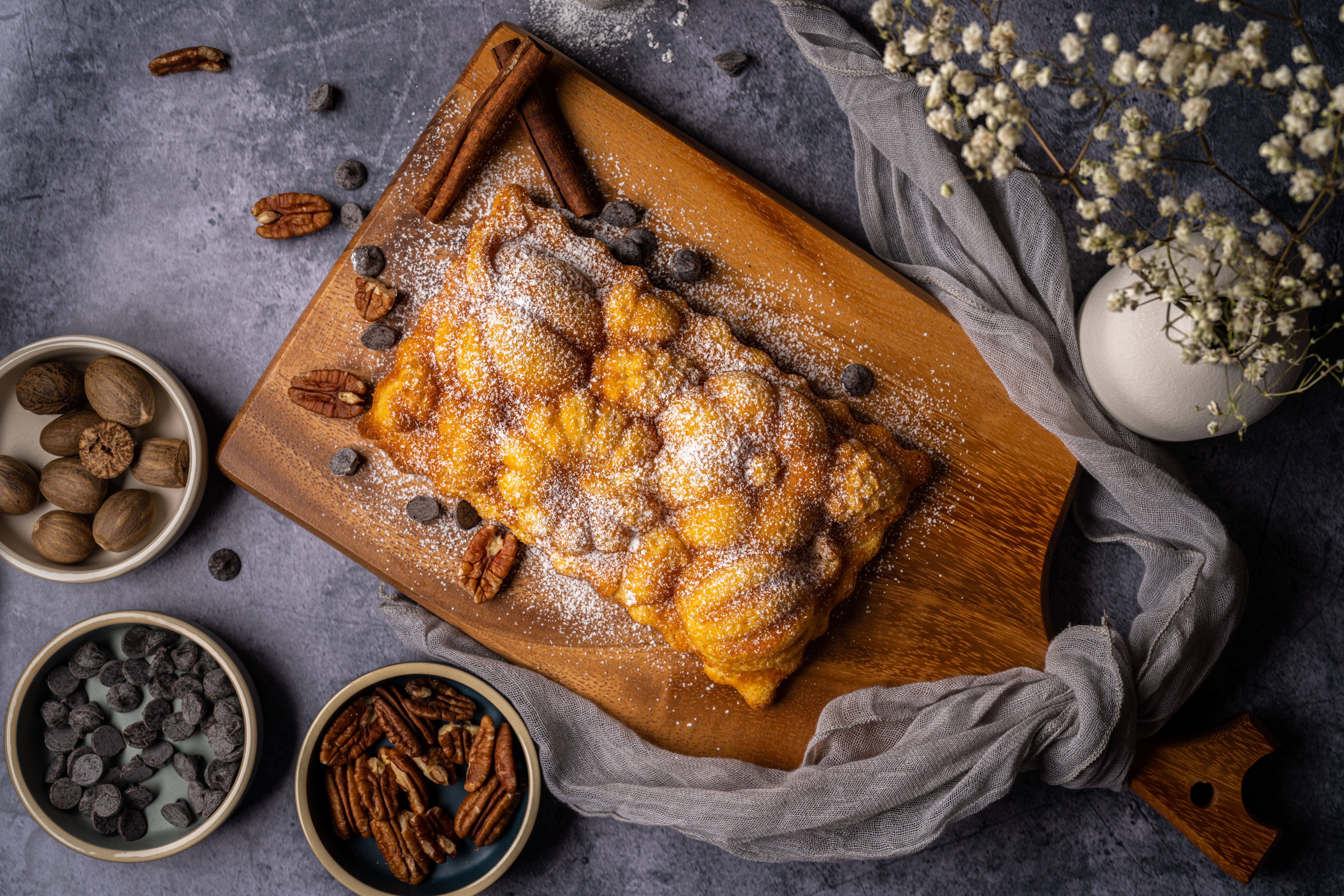
Photo: Skyler Ewing / Pexels
American
Monkey Bread
The diets react (see scores below)
Common Ingredients
- biscuit dough
- butter
- cinnamon
- sugar
- brown sugar
- caramel sauce
Specific recipes may vary.
Incompatible with 11 of 11 diets
Diet Ratings
Monkey Bread is fundamentally incompatible with a ketogenic diet. It is made from biscuit dough (refined flour), coated in sugar and cinnamon-sugar, and drenched in butter-brown sugar caramel sauce. The combination of grain-based dough and multiple layers of added sugar makes this an extremely high-carb, high-sugar food. A single serving could easily contain 50-80g of net carbs, which alone would exceed or obliterate an entire day's keto carb allowance. There is nothing in this dish that aligns with ketogenic principles beyond the butter content.
Traditional Monkey Bread contains multiple animal-derived ingredients that disqualify it from a vegan diet. Biscuit dough typically contains dairy (milk, buttermilk) and sometimes eggs. Butter is a dairy product derived from cow's milk. Caramel sauce in its standard form is made with butter and heavy cream. These ingredients collectively make this dish clearly non-vegan. Vegan versions can be made by substituting plant-based butter, dairy-free dough, and coconut cream-based caramel, but the default/traditional preparation is firmly non-vegan.
Monkey Bread is one of the clearest possible violations of the Paleo diet. Its foundation is biscuit dough, which is made from refined wheat flour — a grain that is categorically excluded from Paleo eating. Beyond the grain-based dough, the dish is loaded with refined white sugar, brown sugar, butter (dairy), and caramel sauce (refined sugar and dairy combined). There is not a single Paleo-compliant ingredient in this dish. This is a heavily processed, grain-and-sugar-dominant dessert snack with zero redeeming Paleo qualities.
Monkey Bread is a highly processed American sweet snack made from refined biscuit dough, large amounts of added sugars (white sugar, brown sugar, caramel sauce), and butter as the primary fat. It directly contradicts nearly every core Mediterranean diet principle: it relies on refined grains rather than whole grains, uses butter instead of olive oil, and is loaded with added sugars. It contains no vegetables, legumes, whole grains, or other plant-forward components. This is essentially a dessert confection with negligible nutritional alignment to the Mediterranean dietary pattern.
Monkey Bread is entirely plant-based and heavily processed, containing biscuit dough (wheat flour, grains), cinnamon (plant spice), sugar, brown sugar, and caramel sauce — all of which are explicitly excluded on the carnivore diet. The only marginally acceptable ingredient is butter, but it is present in a context dominated by grains and sugar. This dish is the antithesis of carnivore eating: it is a grain-based, sugar-laden, plant-derived snack with zero animal protein and no redeeming carnivore-compatible qualities.
Monkey Bread is excluded on multiple fronts. It contains biscuit dough (a grain-based product, violating the no-grains rule), butter (dairy, not the allowed ghee/clarified butter exception), sugar and brown sugar (added sugars, explicitly excluded), and caramel sauce (typically contains sugar, butter, and cream — all excluded). Beyond individual ingredients, Monkey Bread is a classic baked sweet treat that falls squarely under the Whole30 'no recreating baked goods/junk food' rule, which explicitly prohibits items like bread, biscuits, and sweet pastries even if somehow made with compliant ingredients. This dish fails on nearly every axis of the Whole30 program.
Monkey Bread is built on biscuit dough, which is traditionally made with wheat flour — a high-FODMAP ingredient due to its significant fructan content. This is the central, unavoidable ingredient in the dish and cannot be consumed in low-FODMAP quantities given that biscuit dough forms the entire base structure. Butter and cinnamon in typical quantities are low-FODMAP, and plain sugar and brown sugar are also low-FODMAP (sucrose contains no excess fructose). Caramel sauce made from butter, cream, and sugar is generally low-FODMAP, but standard caramel sauces may contain high-FODMAP additives. However, the dominant issue is the wheat-based biscuit dough: a standard serving of Monkey Bread would involve multiple pieces of dough, delivering a large fructan load well above the Monash threshold. There is no realistic portion of this dish that would remain low-FODMAP during the elimination phase.
Monkey bread is a highly processed sweet pastry made from refined biscuit dough, butter, brown sugar, cinnamon sugar, and caramel sauce. It is fundamentally incompatible with DASH diet principles on multiple fronts: it is high in added sugars, saturated fat from butter and caramel sauce, refined carbohydrates from white flour biscuit dough, and likely moderate to high in sodium from the processed biscuit dough. It provides negligible amounts of the nutrients DASH emphasizes — potassium, magnesium, calcium, and fiber — while delivering excess calories from fat and sugar. DASH explicitly limits sweets, added sugars, saturated fats, and heavily processed foods, all of which describe monkey bread. This is precisely the type of indulgent treat the DASH diet advises minimizing or eliminating.
Monkey Bread is essentially a pure high-glycemic, high-sugar, high-saturated-fat confection with no redeeming Zone qualities. The base is refined biscuit dough (processed white flour, high-glycemic), coated in cinnamon-sugar and brown sugar, bound with butter, and drenched in caramel sauce. There is no meaningful protein, no monounsaturated fat, no fiber, and no low-glycemic carbohydrates. The carbohydrate load is almost entirely from refined flour and multiple forms of added sugar — exactly what the Zone Diet categorizes as maximally 'unfavorable.' The fat is predominantly saturated (butter, caramel). There is no path to balancing this into a Zone-compliant block structure: you cannot add enough lean protein or monounsaturated fat to offset the glycemic spike and sugar density without making the dish unrecognizable. This is as close to a categorically excluded food as the Zone framework produces.
Monkey bread is a highly processed, sugar-laden pastry that conflicts with virtually every principle of the anti-inflammatory diet. It is built around refrigerated biscuit dough (refined white flour, processed fats, preservatives, and additives), then layered with butter (saturated fat), white sugar, brown sugar, and caramel sauce (concentrated added sugars, often containing high-fructose corn syrup or artificial additives). This combination delivers a heavy load of refined carbohydrates that spike blood glucose and insulin — a well-established driver of inflammatory markers like CRP and IL-6. The saturated fat from butter compounds the pro-inflammatory effect. There are essentially no anti-inflammatory redeeming qualities: no omega-3s, no significant antioxidants or polyphenols, no fiber, no whole grains. Cinnamon is a mildly anti-inflammatory spice present, but in the trace amounts used here it contributes negligibly against a strongly pro-inflammatory nutritional backdrop. This dish represents exactly the type of processed, high-sugar, high-refined-carb food that anti-inflammatory frameworks consistently identify as most harmful.
Monkey bread is essentially a dessert masquerading as a snack, made from biscuit dough (refined carbohydrates), butter (saturated fat), sugar, brown sugar, and caramel sauce. It offers virtually no protein, negligible fiber, and is extremely high in sugar, refined carbs, and saturated fat. This is the definition of empty calories — precisely what GLP-1 patients cannot afford given their significantly reduced appetite and caloric intake. The high sugar content risks rapid blood sugar spikes, the saturated fat load can worsen nausea and GI side effects (particularly reflux and bloating due to slowed gastric emptying), and the sticky, sweet format makes portion control nearly impossible. There is no meaningful nutritional redemption in this food for a GLP-1 patient.
*See how scores were generated at our methodology page.
Nutritional profile
Six traits that cut across every diet.
Fiber & Plants
How much whole-plant food and fiber it delivers.
Healthy Fats
The quality of its fats (unsaturated, omega-3).
Whole / Unprocessed
How close it is to its natural, unprocessed form.
Gut Gentle
How easy it is on digestion (low FODMAP, few irritants).
Low Glycemic
How little it spikes your blood sugar.
Protein Density
How much protein it packs per calorie.
Controversy Index
Higher controversy = more disagreement between diets.