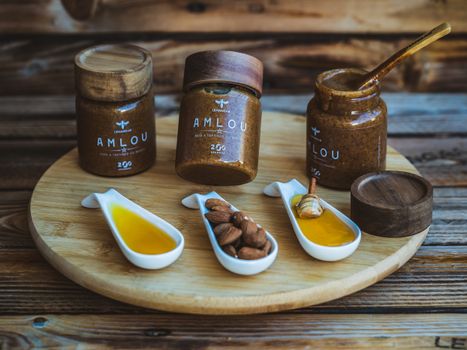
Photo: Kito Digital / Pexels
The diets react (see scores below)
Common Ingredients
- almonds
- argan oil
- honey
- salt
- roasted almonds
Specific recipes may vary.
Incompatible with 3 of 11 diets
Diet Ratings
Amlou is a Moroccan condiment made from ground almonds, argan oil, and honey. The almonds and argan oil are highly keto-friendly — almonds provide healthy fats and moderate protein with reasonable net carbs (~2-3g per tbsp of almond paste), and argan oil is pure fat with zero carbs. However, honey is the critical problem: it is a concentrated sugar (~17g net carbs per tablespoon) with no fiber offset. Traditional amlou uses a significant quantity of honey, which can easily spike the carb count beyond keto limits in even a modest serving. With strict portion control (a teaspoon-level serving), the honey-derived carbs may stay manageable, but as a condiment it is easy to overconsume. The dish sits in caution territory — the base ingredients are keto-sound, but honey makes it a conditional food requiring careful measurement.
Some lazy keto and dirty keto practitioners accept small amounts of raw honey as a natural, unprocessed sugar and argue a teaspoon serving of amlou is tolerable within daily carb limits. Conversely, strict keto adherents consider any honey an absolute avoid, arguing the fructose content is antithetical to ketosis regardless of quantity, and would reject amlou entirely.
Amlou is a traditional Moroccan condiment made from almonds, argan oil, honey, and salt — all plant-derived except honey. Almonds and argan oil are fully vegan-compliant whole/minimally processed plant ingredients. However, honey is excluded by the Vegan Society and most major vegan organizations because it is an animal-derived product (produced by bees). This single ingredient prevents a clean 'approve' verdict for strict vegans. The dish is otherwise nutritionally dense and whole-food in character, which would otherwise earn a high score. A vegan-friendly version can easily be made by substituting honey with date syrup or agave nectar.
A minority of plant-based eaters, sometimes called 'beegan' or plant-based (rather than strictly vegan), argue that bee-keeping does not require animal slaughter and that honey consumption is ethically acceptable, and would consider traditional amlou fully compatible with their diet. However, the Vegan Society and PETA explicitly classify honey as non-vegan.
Amlou is a Moroccan almond-argan oil-honey paste. Most of its ingredients are paleo-friendly: almonds are approved nuts, argan oil is a fruit-derived oil generally accepted in paleo (it's not a seed oil in the excluded category), and honey is a natural sweetener allowed in moderation (caution tier). However, the dish includes added salt, which is excluded under strict paleo rules, and honey pushes it into the caution zone due to its concentrated natural sugar content. The combination of these factors — one avoid ingredient (salt) and one caution ingredient (honey) — lands the dish firmly in caution territory. Argan oil itself is debated by some as it is technically pressed from the kernels of the argan fruit, but it is generally distinguished from the excluded industrial seed oils.
Strict Cordain-school paleo would flag both the added salt and honey (concentrated sugar) as problematic, potentially pushing this to avoid. Some paleo authorities argue honey should be used only sparingly as a rare treat, not as a primary condiment ingredient.
Amlou is a traditional Moroccan condiment made from almonds, argan oil, and honey. Almonds are a Mediterranean diet staple — nutrient-dense nuts high in healthy monounsaturated fats, fiber, and protein. Argan oil, while not the canonical extra virgin olive oil of the Mediterranean diet, is a traditional North African plant-based oil rich in monounsaturated fats and vitamin E, aligning well with the diet's emphasis on healthy plant fats. Honey adds natural sugar, which should be consumed in moderation, but as a condiment used in small amounts this is acceptable. The dish is whole-food, minimally processed, and plant-based throughout — strongly aligned with Mediterranean principles. The primary caveat is the honey's added sugar content and portion discipline as a condiment.
Some Mediterranean diet purists and clinical guideline frameworks (e.g., PREDIMED-based models) center olive oil as the canonical fat and may not formally recognize argan oil as an equivalent substitute, potentially rating this lower due to the non-traditional fat source. Additionally, the honey content means caution is warranted if consumed in large quantities rather than as a true condiment.
Amlou is a Moroccan condiment made entirely from plant-derived ingredients: almonds (nuts), argan oil (plant oil pressed from the argan tree), and honey. All three primary components are explicitly excluded from the carnivore diet. Almonds and argan oil are plant foods with no place in any tier of carnivore eating. Honey, while animal-produced, is plant-derived and only appears in Paul Saladino's more liberal 'animal-based' framework — even there, amlou would still be rejected due to the almonds and argan oil. There is no animal-derived ingredient of significance in this dish, and it contains none of the approved food categories (meat, fish, eggs, animal fats, dairy, organ meats). This is unanimously incompatible with carnivore principles.
Amlou contains honey, which is an added sugar and explicitly excluded on the Whole30 program. Honey falls squarely within the 'added sugar (real or artificial)' prohibition regardless of how natural or unprocessed it is. The other ingredients — almonds, argan oil, and salt — are individually Whole30-compliant, but the presence of honey makes this dish non-compliant in its traditional form.
Amlou is a Moroccan condiment made from ground almonds, argan oil, and honey. Each ingredient must be evaluated individually. Almonds are low-FODMAP at 10 almonds (approximately 12g) per Monash, but become high-FODMAP (excess fructans and GOS) at larger servings of around 20+ almonds. Argan oil is a pure fat and contains no FODMAPs — fully safe. Honey is high-FODMAP due to excess fructose and should be avoided during the elimination phase; even small amounts (1 teaspoon) are rated high-FODMAP by Monash. Salt is FODMAP-free. The presence of honey is the primary concern here, as it is a significant FODMAP ingredient even in small quantities. As a condiment, Amlou is typically used in small amounts (spread on bread), which may reduce honey exposure, but the honey content makes it problematic during strict elimination. If consumed in a very small portion (e.g., 1 teaspoon), the honey load may be marginal, but this is an unrealistically cautious serving for most people enjoying this dish.
Monash University rates honey as high-FODMAP due to excess fructose, making any honey-containing dish risky during elimination. However, some clinical FODMAP practitioners may allow very small amounts (under 1 teaspoon total) of honey in a dish if it is divided across a large number of servings, though this approach is not standard Monash elimination protocol.
Amlou is a Moroccan condiment made from almonds, argan oil, and honey. Its components have mixed DASH compatibility. Almonds are a DASH-approved food, rich in magnesium, potassium, healthy monounsaturated fats, and fiber — nuts are explicitly encouraged in the DASH eating plan (4-5 servings per week). Argan oil is predominantly monounsaturated fat (oleic acid) with some polyunsaturated fat, making it more favorable than saturated fat sources; DASH encourages vegetable oils over saturated fats. However, honey adds significant added sugar, which DASH advises limiting. As a condiment, amlou is calorie-dense and typically consumed in small amounts spread on bread; portion control is critical. The salt content is a mild concern but condiment-level use likely contributes minimally to daily sodium. Overall, this is not a core DASH food but is acceptable in small portions due to its nut and healthy oil base, tempered by its added sugar content and caloric density.
NIH DASH guidelines limit sweets and added sugars broadly, which would place honey-containing foods in the 'caution' to 'avoid' range depending on quantity. However, updated clinical interpretations recognize that whole-food natural sweeteners like honey, when used in small condiment-level amounts, contribute minimally to glycemic load and that the dominant nutritional profile of almonds and argan oil (monounsaturated fats, magnesium, fiber) may make small portions of amlou compatible with DASH goals.
Amlou is a Moroccan condiment made from ground almonds, argan oil, and honey. From a Zone perspective, it presents a mixed picture. The fat profile is excellent — both almonds and argan oil are rich in monounsaturated fats, which are precisely the fats Dr. Sears recommends. Almonds also provide protein and fiber. However, the significant honey content introduces a moderate-to-high glycemic load with rapidly absorbed simple sugars, which Sears classifies as unfavorable carbohydrates. The dish lacks any lean protein source, meaning it cannot anchor a Zone meal on its own. As a condiment used in small quantities, it can fit into a Zone meal — contributing favorable fat blocks and some protein blocks from the almonds — but the honey component needs to be carefully accounted for and portioned to avoid disrupting the 40/30/30 ratio. The absence of protein and the honey's glycemic impact prevent a higher score, but the excellent fat quality from argan oil and almonds keep it out of 'avoid' territory.
Some Zone practitioners following Sears' later anti-inflammatory writings (e.g., 'The Mediterranean Zone') might view amlou more favorably due to argan oil's exceptional polyphenol and oleic acid content, which aligns strongly with Sears' Mediterranean Zone emphasis. If used as a trace condiment (1 teaspoon), the honey's glycemic impact is negligible and the fat-protein contribution from almonds is genuinely Zone-compatible. In this interpretation, it could edge toward a score of 6-7 as a fat block enhancer.
Amlou is a traditional Moroccan condiment made from ground almonds, argan oil, honey, and salt. Its ingredient profile is impressively anti-inflammatory. Almonds are rich in vitamin E (a potent antioxidant), monounsaturated fats, magnesium, and fiber — all associated with reduced inflammatory markers. Argan oil is the standout ingredient: it is exceptionally rich in oleic acid, tocopherols (vitamin E), polyphenols, and squalene, with research specifically linking it to reductions in CRP and oxidative stress. It shares many properties with extra virgin olive oil and is considered one of the most anti-inflammatory oils available. Honey contributes flavonoids and antimicrobial compounds, though it also adds natural sugars, which warrants some moderation in quantity. The dish has no refined carbohydrates, no processed ingredients, no seed oils, and no trans fats. Used as a condiment in reasonable amounts (as is traditional), this dish is a strong fit for the anti-inflammatory framework. The main caveat is honey's sugar content, which could be a concern if consumed in large quantities, and the caloric density of the combination.
Honey, while natural, is still a source of fructose and glucose; some anti-inflammatory practitioners (particularly those following stricter protocols like AIP or low-glycemic anti-inflammatory approaches) caution against any concentrated added sugars, including honey. However, the small quantities typical of condiment use and honey's documented antioxidant flavonoids make this a minor concern for most anti-inflammatory frameworks, including Dr. Weil's pyramid which permits moderate natural sweeteners.
Amlou is a Moroccan condiment made primarily from roasted almonds, argan oil, and honey — essentially a nut butter paste with added sugar. Per standard serving (1-2 tablespoons), it is very calorie-dense with high fat content (predominantly from almonds and argan oil), moderate sugar from honey, and negligible protein relative to calories. For GLP-1 patients eating significantly reduced volumes, this condiment offers poor nutritional return per calorie: minimal protein, minimal fiber in typical condiment-sized portions, high fat that may worsen nausea and slow gastric emptying further, and added sugar from honey. While argan oil does provide beneficial unsaturated fats and some omega content, and almonds offer some micronutrient value, these benefits do not offset the high fat-to-protein ratio and caloric density at condiment serving sizes. As a spread or dip, it is easy to overconsume and displaces more nutrient-dense foods in an already calorie-restricted eating window.
Some GLP-1-focused dietitians may view small amounts of almond-based condiments as acceptable given argan oil's favorable unsaturated fat profile and almonds' micronutrient density (vitamin E, magnesium). The disagreement centers on whether the fat source quality justifies inclusion when overall fat tolerance is compromised and caloric space is extremely limited — individual GI tolerance to high-fat foods on GLP-1s varies considerably.
*See how scores were generated at our methodology page.
Nutritional profile
Six traits that cut across every diet.
Fiber & Plants
How much whole-plant food and fiber it delivers.
Healthy Fats
The quality of its fats (unsaturated, omega-3).
Whole / Unprocessed
How close it is to its natural, unprocessed form.
Gut Gentle
How easy it is on digestion (low FODMAP, few irritants).
Low Glycemic
How little it spikes your blood sugar.
Protein Density
How much protein it packs per calorie.
Controversy Index
Higher controversy = more disagreement between diets.
Diet-Specific Tips
 Keto — 4/10
View tips
- Honey is a high-glycemic sugar (~17g net carbs/tbsp) and the primary keto concern
- Almonds are keto-friendly with moderate net carbs and healthy fats
- Argan oil is pure fat — zero carbs, excellent for keto
- Traditional preparation uses substantial honey, making standard servings high-carb
- Portion control to ~1 tsp serving could limit carb impact to ~2-4g net carbs
- As a condiment, overconsumption risk is high
 Vegan — 5/10
View tips
- Almonds are fully vegan — whole plant food
- Argan oil is fully vegan — plant-derived oil
- Honey is the key contested ingredient — excluded by most vegan organizations as an animal product
- No meat, dairy, eggs, or other clear animal products present
- Easy to make vegan by substituting honey with agave or date syrup
 Paleo — 5/10
View tips
- Almonds are fully paleo-approved
- Argan oil is generally accepted (fruit-kernel oil, not an industrial seed oil)
- Honey is a natural sweetener — allowed in moderation but a caution ingredient
- Added salt is excluded under strict paleo rules
- Overall dish is a condiment with concentrated natural sugars and added salt, making regular consumption inconsistent with strict paleo
 Mediterranean — 8/10
View tips
- Almonds are a core Mediterranean diet nut — high in healthy fats, fiber, and plant protein
- Argan oil is a traditional North African plant-based fat rich in monounsaturated fats, analogous to olive oil
- Honey contributes natural sugar — acceptable in small condiment-level amounts
- No processed ingredients, refined grains, or animal products
- Whole-food, minimally processed preparation
- Portion control is key — calorie-dense and honey adds sugar
 Low-FODMAP — 5/10
View tips
- Honey is high-FODMAP due to excess fructose — a primary concern even in small amounts
- Almonds are low-FODMAP at ≤10 nuts but high-FODMAP at larger servings
- Argan oil is a pure fat and fully FODMAP-free
- Amlou is a condiment, so portion size may be small, but honey content remains a risk
- Salt is FODMAP-free
- Dish contains no garlic, onion, wheat, or other classic high-FODMAP triggers beyond honey
 DASH — 5/10
View tips
- Almonds are explicitly DASH-approved (nuts: 4-5 servings/week)
- Argan oil is rich in monounsaturated fat — preferred over saturated fats in DASH
- Honey adds significant added sugar, which DASH advises limiting to <5 servings/week of sweets
- High caloric density requires strict portion control
- Salt content is a minor concern at typical condiment serving sizes
- No saturated fat or processed ingredients — nutritional profile is relatively clean
 Zone — 5/10
View tips
- Argan oil is exceptionally high in monounsaturated fat and polyphenols — ideal Zone fat source
- Almonds provide favorable monounsaturated fat and some protein and fiber
- Honey is a high-glycemic simple sugar classified as 'unfavorable' in Zone carbohydrate lists
- No lean protein source present — cannot constitute a Zone meal alone
- Portioning is critical — small amounts as a condiment are more Zone-compatible than larger servings
- Net carbs from honey must be tracked carefully as a carb block contribution
- Aligns well with anti-inflammatory and Mediterranean Zone principles due to argan oil's polyphenol content
 Anti-Inflammatory — 8/10
View tips
- Argan oil is rich in oleic acid, tocopherols, and polyphenols — strongly anti-inflammatory and comparable to extra virgin olive oil
- Almonds provide vitamin E, monounsaturated fats, magnesium, and fiber, all linked to reduced inflammation
- Honey adds natural sugars, which should be moderated, but also contributes antioxidant flavonoids
- No refined carbohydrates, trans fats, seed oils, or artificial additives
- Whole-food, minimally processed condiment with a strong nutritional profile
- Caloric density warrants mindful portion sizes