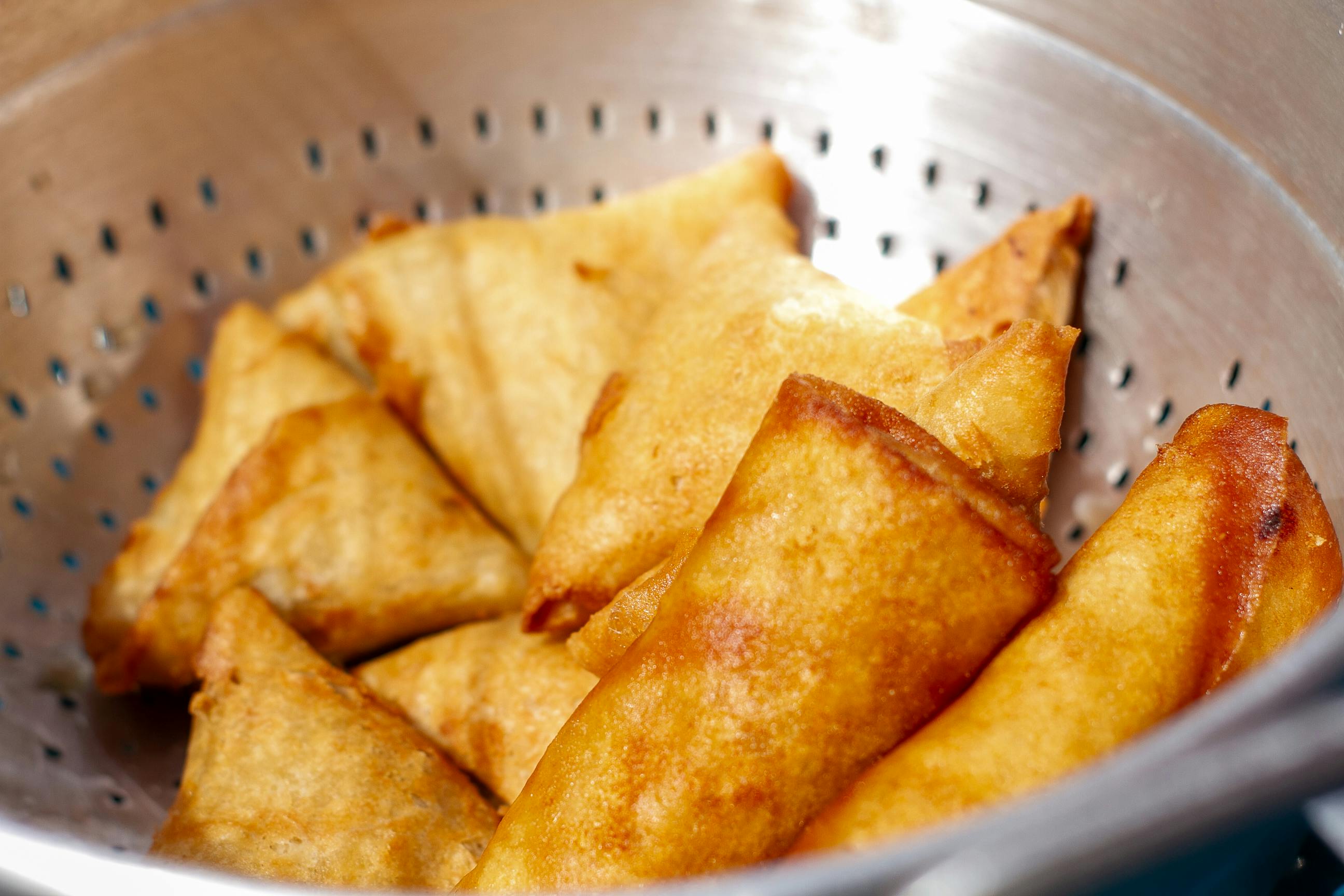
Photo: Hashtag Melvin / Pexels
The diets react (see scores below)
Common Ingredients
- warqa pastry
- almonds
- ground meat
- onion
- cinnamon
- sugar
- egg
- oil
Specific recipes may vary.
Incompatible with 9 of 11 diets
Diet Ratings
Briouat is fundamentally incompatible with a ketogenic diet. The dish is wrapped in warqa pastry, a thin flour-based dough similar to phyllo, which is a grain-based, high-carb wrapper that alone disqualifies it. Additionally, the filling contains added sugar and cinnamon-sweetened almonds or meat, compounding the carbohydrate load. The combination of refined flour pastry and sugar makes this a high-net-carb food with no realistic portion size that would keep it within keto limits.
Briouat contains multiple animal-derived ingredients that are strictly excluded from a vegan diet. Ground meat is an animal product, and egg is used as a binding or sealing agent for the pastry. Both are clear disqualifiers. Warqa pastry itself may also contain egg or butter in traditional preparations, further compounding the issue. There is no ambiguity here — this dish is not vegan in its listed form.
Briouat is a Moroccan pastry that is fundamentally incompatible with the paleo diet. The defining ingredient is warqa pastry, a thin wheat-based dough similar to phyllo, which is a grain product and strictly excluded from paleo. Sugar is a refined sweetener, also excluded. The unspecified 'oil' is likely a seed or vegetable oil (commonly used in Moroccan cooking), which is another red flag. While some individual ingredients — almonds, ground meat, onion, cinnamon, and egg — are paleo-approved, the foundational structure of this dish (a grain-based pastry shell) makes it entirely non-paleo regardless of the filling.
Briouat combines several elements that conflict with Mediterranean diet principles. The warqa pastry is a refined, processed dough similar to phyllo — a refined grain product offering little nutritional value. Ground meat (typically lamb or beef) is a red meat, which the Mediterranean diet limits to a few times per month. Added sugar is explicitly discouraged. The frying in oil (typically seed/vegetable oil rather than olive oil) adds further concern. While almonds and onion are positive components, and cinnamon is neutral, the overall profile — refined pastry, red meat, added sugar, and deep-frying — stacks multiple Mediterranean diet violations into a single dish.
Some Mediterranean diet scholars acknowledge North African culinary traditions (Moroccan, Tunisian) as part of the broader Mediterranean food culture, and occasional consumption of celebratory pastries made with nuts and spices could be tolerated within a predominantly plant-forward diet. If baked rather than fried and consumed rarely, a more lenient 'caution' rating could be argued.
Briouat is fundamentally incompatible with the carnivore diet. The dish is built around warqa pastry (a grain-based dough), almonds (plant-based nuts), onion (vegetable), cinnamon (plant spice), sugar (processed plant-derived sweetener), and oil (plant-based). While it does contain ground meat and egg — both carnivore-approved ingredients — these are completely overwhelmed by the volume and number of plant-based and processed components. Even the most lenient 'animal-based' carnivore frameworks would reject this dish outright due to the grain pastry, sugar, and multiple plant additives. There is no meaningful way to adapt this dish within carnivore principles without fundamentally deconstructing it.
Briouat contains multiple Whole30-excluded ingredients. Warqa pastry is a thin flour-based dough (grain-based, like phyllo), which is excluded as a grain product. Sugar is explicitly excluded as an added sweetener. Additionally, even if the individual filling ingredients were compliant, warqa/pastry wrapping falls squarely into the excluded 'wraps' and pastry/baked goods category. The dish cannot be made Whole30-compliant without fundamentally changing its nature.
Briouat contains multiple high-FODMAP ingredients that make it unsuitable during the elimination phase. The most significant offenders are: (1) Warqa pastry, which is a thin wheat-based dough similar to filo/brick pastry — wheat is high in fructans and a primary FODMAP trigger; (2) Onion, one of the highest-fructan foods and a major FODMAP offender even in small amounts; (3) Almonds, which are low-FODMAP only at a very restricted serving of 10 nuts (approximately 12g) — the quantity typically used in briouat filling may exceed this threshold. Ground meat, egg, cinnamon, sugar (small amounts), and oil are low-FODMAP and unproblematic. However, the combination of wheat pastry and onion alone makes this dish high-FODMAP with no reasonable workaround at standard serving sizes.
Monash University has tested almonds as low-FODMAP at 10 nuts per serve, but clinical FODMAP practitioners often flag almond-heavy dishes as risky because portion control is difficult in traditional recipes. The wheat pastry and onion issues are less debatable — most FODMAP practitioners and Monash both classify these as high-FODMAP at any standard serving.
Briouat is a deep-fried Moroccan pastry filled with a combination of ground meat, almonds, sugar, and cinnamon, wrapped in warqa (thin pastry similar to filo). This dish presents multiple DASH diet concerns: (1) Deep-frying in oil significantly increases total fat content and caloric density, contrary to DASH principles favoring vegetable oils in controlled amounts rather than as a cooking medium for frying. (2) Ground meat (commonly lamb or beef) is a red meat high in saturated fat, which DASH explicitly limits. (3) Warqa pastry is a refined grain product, not a whole grain. (4) Added sugar is present, which DASH recommends limiting. (5) The combination of fried pastry, red meat, and added sugar creates a tri-factor problem that places this firmly in the avoid category. While almonds and onion are individually DASH-friendly ingredients, they cannot compensate for the overall nutritional profile. The dish is typically served as a snack, making portion control difficult and the nutrient-to-calorie ratio poor from a DASH perspective.
NIH DASH guidelines would categorically flag this due to red meat, frying oil, refined pastry, and added sugar. However, some DASH-aligned clinicians note that if briouat were baked rather than fried, made with lean poultry instead of red meat, and consumed as an occasional small portion, the almonds and modest protein could make it a borderline 'caution' food — though this would represent a significant departure from the traditional preparation.
Briouat is a Moroccan pastry that presents multiple Zone Diet challenges. The warqa pastry (thin dough similar to phyllo/brick pastry) is a refined, high-glycemic carbohydrate with little fiber, making it an 'unfavorable' carb in Zone terminology. The addition of sugar further drives up the glycemic load. The filling does contain some Zone-friendly elements — almonds provide monounsaturated fat, ground meat provides protein, and onion contributes a small amount of favorable carbohydrate — but the overall dish is dominated by unfavorable, high-glycemic carbs (pastry + sugar) with very little protein relative to carbohydrate calories. The dish is also deep-fried in oil, adding excess fat (likely omega-6-heavy seed oils) that further skews the 40/30/30 ratio. Unlike a dish that can be portioned into balanced Zone blocks, the structural ratio of this snack — carb-heavy pastry wrapper, added sugar, fried fat — makes it very difficult to fit into a Zone-balanced meal without the macro ratios being significantly off. It scores a 3 because while technically not a pure-sugar food, it combines refined carbs, added sugar, and frying oil in a way that is nearly impossible to Zone-balance as a snack.
Some Zone practitioners argue that small portions of Briouat, particularly savory versions without added sugar, can fit within a Zone snack if the ground meat filling provides adequate protein and the almonds contribute favorable monounsaturated fat. In this framing, one small briouat could approximate a partial Zone block if the pastry portion is minimal. Sears' later anti-inflammatory writings also acknowledge that occasional indulgence in traditional foods, if kept in small portions, doesn't invalidate an overall Zone-compliant eating pattern.
Briouat is a Moroccan stuffed pastry with a mixed anti-inflammatory profile. On the positive side, almonds provide vitamin E, healthy monounsaturated fats, and magnesium with documented anti-inflammatory properties. Cinnamon is a well-regarded anti-inflammatory spice. Onion contains quercetin, a potent anti-inflammatory flavonoid. However, several factors work against it: the dish is deep-fried in oil (likely refined vegetable or seed oil), which both adds excessive omega-6 fatty acids and creates oxidation byproducts from high-heat cooking — both pro-inflammatory. Warqa (or warqa-style) pastry is a refined flour product with minimal fiber or nutrient density. Ground meat (assumed red meat given the Moroccan context) contributes saturated fat and arachidonic acid. Added sugar further tips the balance toward a pro-inflammatory profile. The combination of refined pastry, fried preparation, red meat, and sugar outweighs the benefits of almonds, cinnamon, and onion. Occasional consumption is acceptable, but this is not a dish that aligns well with anti-inflammatory eating principles when consumed regularly.
Some anti-inflammatory practitioners might note that the almond and cinnamon content, combined with the relatively small portion size typical of briouats as a snack, could make occasional consumption tolerable — particularly if fried in high-oleic oils or baked rather than fried. Dr. Weil's framework emphasizes dietary patterns over individual foods, so a single occasional treat in an otherwise anti-inflammatory diet would not be condemned. However, the refined carbohydrate, added sugar, and fried preparation make this difficult to recommend even occasionally for those managing inflammatory conditions.
Briouat is a deep-fried or baked Moroccan pastry filled with a sweet-savory mixture of ground meat, almonds, sugar, cinnamon, and egg, wrapped in thin warqa pastry. The typical preparation is deep-fried, making it high in fat from frying oil and almonds combined. The addition of sugar further reduces its nutritional value per calorie, turning what modest protein exists from ground meat and almonds into an empty-calorie-heavy snack. For GLP-1 patients, this dish hits multiple avoid triggers simultaneously: it is fried (or at minimum oil-heavy), high in fat, contains added sugar, is low in fiber, and offers poor protein density relative to its calorie load. The small-portion format of a snack does not redeem it — each individual piece still delivers a disproportionate fat and sugar load relative to protein or fiber. Gastric emptying is already slowed on GLP-1 medications, and high-fat fried pastry is among the most likely food types to worsen nausea, bloating, and reflux. Even a baked version would remain high in fat from almonds and oil with significant added sugar, keeping it firmly in avoid territory.
*See how scores were generated at our methodology page.
Nutritional profile
Six traits that cut across every diet.
Fiber & Plants
How much whole-plant food and fiber it delivers.
Healthy Fats
The quality of its fats (unsaturated, omega-3).
Whole / Unprocessed
How close it is to its natural, unprocessed form.
Gut Gentle
How easy it is on digestion (low FODMAP, few irritants).
Low Glycemic
How little it spikes your blood sugar.
Protein Density
How much protein it packs per calorie.
Controversy Index
Higher controversy = more disagreement between diets.
Diet-Specific Tips
 Zone — 5/10
View tips
- Warqa/phyllo-style pastry is a refined, high-glycemic carbohydrate — 'unfavorable' in Zone terminology
- Added sugar significantly increases glycemic load and disrupts the 40/30/30 ratio
- Deep-fried preparation adds excess fat, likely from omega-6-heavy seed oils, increasing inflammation
- Ground meat and almonds provide some Zone-friendly protein and monounsaturated fat, but are insufficient to offset the carb load
- As a snack, it lacks the vegetable-based low-glycemic carbohydrates the Zone prioritizes
- The sweet-savory combination with pastry + sugar makes portion control very difficult
 Anti-Inflammatory — 4/10
View tips
- Deep-fried preparation introduces oxidized oils and excessive omega-6 fatty acids
- Refined warqa pastry provides minimal fiber and has a high glycemic impact
- Added sugar contributes to pro-inflammatory glycemic load
- Ground red meat adds saturated fat and arachidonic acid
- Almonds are a strong anti-inflammatory ingredient (vitamin E, monounsaturated fats)
- Cinnamon is a well-supported anti-inflammatory spice
- Onion provides quercetin and other anti-inflammatory polyphenols
- Overall profile is pro-inflammatory due to preparation method and refined/sugary ingredients