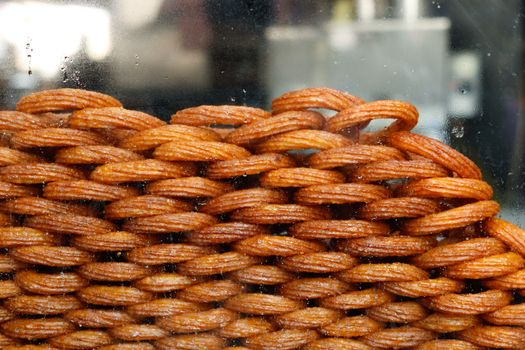
Photo: Esra Korkmaz / Pexels
The diets react (see scores below)
Common Ingredients
- flour
- sesame seeds
- honey
- orange blossom water
- anise
- cinnamon
- oil
- sugar
Specific recipes may vary.
Incompatible with 11 of 11 diets
Diet Ratings
Chebakia is a traditional Moroccan pastry that is fundamentally incompatible with a ketogenic diet. It is made primarily from wheat flour (high in carbohydrates) and is deep-fried before being coated or soaked in honey and sugar. A single piece contains an extremely high carbohydrate load from multiple sources: refined flour, honey, and added sugar. These ingredients alone would far exceed the entire daily net carb allowance of 20-50g in just one or two pieces. There is nothing in this dish that can be modified or portion-controlled to make it keto-friendly — the flour, honey, and sugar are structural and defining ingredients.
Chebakia is a Moroccan sesame and honey cookie made entirely from plant-derived ingredients — flour, sesame seeds, orange blossom water, anise, cinnamon, oil, and sugar — with one contested ingredient: honey. The Vegan Society and most major vegan organizations classify honey as a non-vegan animal product, since it is produced by bees and its harvesting is considered exploitative of insects. However, a notable minority within plant-based communities accepts honey, arguing that bees are not sentient in a morally relevant way and are not directly harmed by responsible beekeeping. Because honey is both central to and inseparable from traditional chebakia (it is used as a deep coating glaze, not a trace ingredient), this is not a case where a simple substitution is incidental — the honey is structural to the dish. A strict vegan would need to substitute agave syrup or maple syrup to make it compliant. All other ingredients are unambiguously plant-based. The dish is also fried and sugar-heavy, which whole-food plant-based advocates would flag, keeping the score in the caution range even setting aside the honey question.
A minority of plant-based eaters and some health-focused vegans accept honey on the grounds that bees are invertebrates whose welfare is not meaningfully compromised by ethical beekeeping practices; under this view, chebakia would be fully plant-based and approvable. Strict ethical vegans aligned with the Vegan Society position, however, maintain that honey is unequivocally an animal product and chebakia in its traditional form is therefore not vegan.
Chebakia is a traditional Moroccan sesame and honey cookie that is fundamentally incompatible with the paleo diet. The primary ingredient is wheat flour, a grain explicitly excluded from paleo. It also contains refined sugar, another clear violation. The unspecified 'oil' is likely a seed oil (sunflower or vegetable), which is also excluded. While honey, sesame seeds, anise, cinnamon, and orange blossom water are paleo-compatible, the foundational ingredients — wheat flour and refined sugar — make this dish an unambiguous avoid with no meaningful gray area.
Chebakia is a traditional Moroccan sesame and honey cookie that is deep-fried in oil and coated in honey, then rolled in sesame seeds. While it contains some Mediterranean-friendly ingredients like sesame seeds, honey, and aromatic spices (anise, cinnamon, orange blossom water), the overall profile is problematic for the Mediterranean diet. The dish is built around refined white flour, added sugar, and is deep-fried, making it high in refined carbohydrates, added sugars, and unhealthy fats. This combination of refined grains, high sugar load, and frying method directly contradicts core Mediterranean diet principles that minimize processed foods, refined grains, and added sugars. As an occasional festive treat it may be tolerable, but as a regular snack it is clearly misaligned.
Some Mediterranean diet interpretations rooted in traditional North African and Levantine culinary heritage acknowledge that honey-based sweets with nuts and seeds have a long regional history, and that small portions during cultural celebrations are consistent with the diet's emphasis on food culture and enjoyment. The presence of sesame seeds and natural honey rather than refined syrups could be seen as marginally better than Western confectionery by some practitioners.
Chebakia is a Moroccan pastry made entirely from plant-based ingredients: flour (grain), sesame seeds (seeds), honey (debated but moot here), orange blossom water (plant extract), anise (spice), cinnamon (spice), oil (plant oil), and sugar. There are zero animal-derived ingredients. Every single component is explicitly excluded on the carnivore diet. Flour and grains are among the most universally rejected foods in the carnivore community, and sugar is categorically off-limits. This dish has no redeeming carnivore-compatible elements whatsoever.
Chebakia contains multiple excluded ingredients that make it clearly non-compliant with Whole30. Flour (a grain product) is excluded, sugar is excluded as added sugar, and honey is also considered an added sweetener excluded on Whole30. Additionally, this dish is a traditional Moroccan pastry — a fried, honey-dipped cookie — which falls squarely into the 'no recreating baked goods/junk food' rule even if compliant ingredient substitutions were attempted. The combination of grain-based dough, added sugar, and honey makes this a clear avoid.
Chebakia contains two major high-FODMAP ingredients that make it unsuitable during the elimination phase. First, regular wheat flour is the primary base ingredient and is high in fructans at any standard serving size — this alone disqualifies the dish. Second, honey is high in excess fructose and is a well-documented high-FODMAP ingredient that must be avoided during elimination. The remaining ingredients (sesame seeds, orange blossom water, anise in small culinary amounts, cinnamon, oil, and sugar/sucrose) are generally low-FODMAP at typical serving sizes, but the combination of wheat flour and honey makes this a firmly high-FODMAP food. There is no realistic way to consume a standard serving of chebakia without significant FODMAP exposure from both fructans and excess fructose.
Chebakia is a traditional Moroccan pastry that is deep-fried in oil and then coated in honey, making it very high in added sugars, refined carbohydrates, and fat. The primary ingredients — refined wheat flour, honey, sugar, and frying oil — are precisely what the DASH diet discourages: added sugars, sweets, and high-fat preparations. While sesame seeds, anise, and cinnamon offer modest nutritional benefits (small amounts of magnesium and fiber), they are present in quantities too small to offset the overall nutritional profile. DASH guidelines explicitly limit sweets to ≤5 servings per week (and only small portions), and fried confections with high sugar loads are clearly outside the spirit and letter of the eating plan. There is no meaningful potassium, calcium, or fiber contribution, and the caloric density is high with minimal nutrient return relevant to hypertension management.
Chebakia is a traditional Moroccan sesame and honey cookie that is essentially a concentrated source of high-glycemic carbohydrates and sugar with no redeeming protein content and minimal nutritional value from a Zone perspective. The primary ingredients are white flour (high-glycemic, refined carbohydrate), honey (rapidly absorbed sugar), and added sugar — all of which Dr. Sears explicitly categorizes as 'unfavorable' or outright problematic carbohydrates that spike insulin and disrupt the Zone hormonal balance. The dish is deep-fried in oil (likely omega-6-heavy vegetable oil), adding inflammatory fat with no lean protein to balance the macronutrient ratio. There is no practical way to incorporate Chebakia into a Zone meal without completely upending the 40/30/30 ratio — it would require enormous amounts of lean protein and low-GI vegetables to compensate, effectively making the Chebakia itself a negligible component. The sesame seeds offer a minor positive (some monounsaturated fat, small protein contribution), and spices like cinnamon and anise are polyphenol-rich and Zone-friendly, but these are negligible against the dominant sugar and refined flour load. This is one of the rare foods that scores in the 'avoid' range because its macro profile is fundamentally incompatible with Zone principles.
Chebakia is a traditional Moroccan fried pastry heavily coated in honey and made with refined white flour and added sugar — a combination that creates a high glycemic load and significant added sugar content, both well-established drivers of inflammatory markers like CRP and IL-6. The dish is deep-fried in oil (likely a refined seed oil), adding oxidized fats and excess omega-6 fatty acids. While a few ingredients offer anti-inflammatory value — sesame seeds contain sesamin and sesamol (lignan antioxidants), cinnamon and anise are anti-inflammatory spices, and honey has mild antioxidant properties — these beneficial components are minor in proportion and overwhelmed by the dominant inflammatory profile. The refined flour provides no fiber to buffer glycemic response, and the combination of frying, sugar, and refined carbs is precisely the pattern that anti-inflammatory frameworks universally flag as pro-inflammatory. Occasional consumption as a cultural treat is understandable, but from a nutritional assessment standpoint, this falls clearly in the 'avoid' category.
Chebakia is a traditional Moroccan pastry made by deep-frying shaped dough and coating it in honey. It is high in refined carbohydrates, added sugars, and frying oil, with virtually no protein and minimal fiber despite the sesame seeds. This profile is directly contrary to every core GLP-1 dietary priority: it provides empty calories with poor nutrient density, its high fat and sugar content are likely to worsen GLP-1 side effects such as nausea, bloating, and reflux, and it offers no meaningful contribution to the 100-120g daily protein target or the 25-30g fiber target. The honey and sugar coating represent a concentrated sugar load, and the deep-frying adds significant saturated and potentially trans fat depending on the oil used. Even in a small portion, the caloric cost relative to nutritional return makes it a poor choice for patients on GLP-1 medications who have reduced caloric capacity and must prioritize nutrient density.
*See how scores were generated at our methodology page.
Nutritional profile
Six traits that cut across every diet.
Fiber & Plants
How much whole-plant food and fiber it delivers.
Healthy Fats
The quality of its fats (unsaturated, omega-3).
Whole / Unprocessed
How close it is to its natural, unprocessed form.
Gut Gentle
How easy it is on digestion (low FODMAP, few irritants).
Low Glycemic
How little it spikes your blood sugar.
Protein Density
How much protein it packs per calorie.
Controversy Index
Higher controversy = more disagreement between diets.