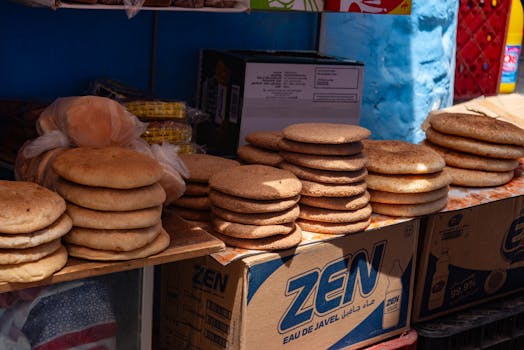
Photo: Diego F. Parra / Pexels
The diets react (see scores below)
Common Ingredients
- semolina
- flour
- yeast
- water
- salt
- sugar
- olive oil
Specific recipes may vary.
Incompatible with 5 of 11 diets
Diet Ratings
Khobz is a traditional Moroccan bread made primarily from semolina and white flour, both of which are high-glycemic grains that are fundamentally incompatible with a ketogenic diet. A single serving would easily exceed the entire daily net carb allowance of 20-50g. Added sugar further compounds the issue. The minimal olive oil content does not offset the overwhelming carbohydrate load from two grain-based flours.
Khobz is a traditional Moroccan flatbread made entirely from plant-based ingredients: semolina, flour, yeast, water, salt, sugar, and olive oil. All components are clearly vegan with no animal products or animal-derived ingredients present. Yeast is a fungus, not an animal product, and is universally accepted in vegan diets. The use of whole-grain semolina and minimal processing make this a wholesome, nutritious bread that aligns well with both strict vegan and whole-food plant-based principles. The only marginal deduction is that refined flour and sugar are processed ingredients, though this is standard for bread and not a meaningful concern within vegan ethics.
Khobz is a traditional Moroccan bread made primarily from semolina and wheat flour — both are grains that are strictly excluded from the Paleolithic diet. Grains were not part of the pre-agricultural human diet and are consistently rejected across all major paleo frameworks due to their gluten content, anti-nutrients (phytates, lectins), and inflammatory potential. Beyond the grains, the recipe also includes added salt and refined sugar, both of which are excluded under paleo guidelines. While olive oil is paleo-approved, it cannot redeem a dish built entirely around a grain-based foundation. There is no version of this bread that could be considered paleo-compatible without fundamentally changing its core ingredients.
Khobz is a traditional Moroccan bread made from semolina and white flour, both of which are refined grains rather than whole grains. The Mediterranean diet emphasizes whole grains over refined ones, which lowers its standing. However, it does contain olive oil and is a culturally integral part of North African Mediterranean cuisine, used to accompany vegetables, legumes, and fish dishes. The small amount of sugar is negligible. The blend of semolina (which has a slightly lower glycemic index than pure white flour) partially redeems it. As a side bread in modest portions alongside core Mediterranean foods, it is acceptable but not a dietary staple to emphasize.
Traditional North African and broader Mediterranean culinary practice has long included semolina-based breads as everyday staples, and some Mediterranean diet authorities recognize that whole semolina retains more nutrients than refined white flour, placing it closer to acceptable whole-grain territory. Conversely, stricter modern clinical interpretations of the Mediterranean diet would prefer 100% whole wheat or whole grain breads and would rate refined-grain breads more cautiously.
Khobz is a traditional Moroccan bread made entirely from plant-derived ingredients: semolina, flour, yeast, water, salt, sugar, and olive oil. It contains zero animal products and is the archetypal food excluded from the carnivore diet. Grains (semolina and wheat flour) are among the most strictly forbidden foods in all tiers of the carnivore diet, as they are high-carbohydrate plant foods that carnivore practitioners specifically seek to eliminate. Sugar and olive oil (a plant oil) further compound the incompatibility. There is universal consensus across all carnivore authorities and protocols that bread of any kind is completely off-limits.
Khobz is a traditional Moroccan bread made with semolina and flour, both of which are grain-based ingredients explicitly excluded on the Whole30 program. Even if the sugar were removed, the semolina (durum wheat) and wheat flour alone disqualify this dish. Furthermore, even if compliant ingredients were somehow substituted, bread falls squarely into the 'no recreating baked goods' rule — bread is one of the explicitly prohibited food forms on Whole30 regardless of ingredients.
Khobz is a traditional Moroccan bread made primarily from wheat flour and semolina, both of which are high in fructans — the primary FODMAP concern with wheat products. During the elimination phase, wheat-based breads are firmly in the high-FODMAP category regardless of preparation method (unlike long-fermented sourdough which can reduce fructan content). The yeast-leavened, relatively short fermentation process used in khobz does not meaningfully reduce fructan levels. Semolina is durum wheat semolina and is equally high in fructans. The remaining ingredients (water, salt, sugar in small amounts, olive oil, yeast) are low-FODMAP, but the wheat flour and semolina base make this bread unsuitable during the elimination phase at any standard serving size.
Khobz is a Moroccan flatbread made primarily from semolina and white flour, which places it in the refined grain category rather than the whole grain category emphasized by DASH guidelines. DASH recommends 6-8 daily servings of grains with at least half being whole grains. The semolina component offers slightly more protein and fiber than pure white flour, but both are refined grains. The inclusion of salt adds sodium (amount varies by recipe but typically 300-500mg per serving), and the small amount of sugar and olive oil are minor concerns — olive oil is actually DASH-friendly as a vegetable oil. The bread is not inherently harmful and fits within DASH grain allowances in moderate portions, but it falls short of the whole grain ideal. If made with whole wheat semolina or whole grain flour, it would score higher.
NIH DASH guidelines specifically emphasize whole grains and list refined breads as foods to limit in favor of whole grain alternatives. However, some updated clinical DASH interpretations acknowledge that semolina-based breads have a moderate glycemic profile relative to pure white bread and can fit within a DASH pattern when portion-controlled, particularly when paired with DASH-positive foods like vegetables and legumes as is common in Moroccan cuisine.
Khobz is a traditional Moroccan bread made primarily from semolina and white flour — both high-glycemic, refined carbohydrate sources. In Zone terminology, bread (especially white/refined) is classified as an 'unfavorable' carbohydrate. The semolina component gives it a slightly lower glycemic index than pure white bread, which is a modest positive, but the overall profile is still carbohydrate-dense with a high glycemic load per serving. The small amount of olive oil is a favorable fat addition consistent with Zone principles. The sugar used in yeast activation is negligible in the final product. As a side dish with no protein component, Khobz will heavily skew a meal's macronutrient ratio toward carbohydrates, making the 40/30/30 balance difficult to achieve without very strict portioning. Zone allows for 0-1 servings of grain-based carbs per day, so Khobz can technically fit as a small, carefully portioned carb block — but it is an 'unfavorable' choice. A small piece (roughly 1 oz) could serve as 1 carb block, but most real-world servings will constitute multiple carb blocks, making Zone balance challenging.
Khobz is a traditional Moroccan flatbread made primarily from semolina and wheat flour, leavened with yeast. Its anti-inflammatory profile is mixed. On the positive side, semolina (durum wheat) has a lower glycemic index than refined white flour, retains more protein and some nutrients, and the inclusion of olive oil adds a genuinely anti-inflammatory element (oleocanthal, monounsaturated fats). The small amount of sugar used for yeast activation is nutritionally negligible. However, the combination of refined wheat flour and semolina — while not as processed as white sandwich bread — still lacks the fiber, bran, and germ of true whole grains. Refined and semi-refined grain products raise blood glucose and insulin more than whole grains, which can promote low-grade inflammation over time. The anti-inflammatory framework emphasizes whole grains (barley, brown rice, quinoa, farro, oats) over refined grain products. Khobz occupies a middle ground: better than highly refined white bread due to semolina's properties, but not a whole-grain food. As a side bread consumed in moderation alongside an otherwise anti-inflammatory Moroccan meal (vegetables, legumes, olive oil, spices), it is acceptable but not beneficial.
Some anti-inflammatory practitioners and researchers (including those aligned with Mediterranean diet principles) view traditional breads like Khobz more favorably, noting that semolina has a moderate GI compared to refined flour and that traditional fermentation via yeast may partially break down gluten and antinutrients. Others following stricter anti-inflammatory or autoimmune protocols (such as AIP or grain-free approaches advocated by practitioners like Dr. Tom O'Bryan) would rate any wheat-based bread more harshly, citing gluten and lectin content as potential drivers of intestinal permeability and systemic inflammation.
Khobz is a traditional Moroccan white bread made primarily from semolina and refined flour — a refined carbohydrate with minimal protein, low fiber, and moderate caloric density. For GLP-1 patients, it offers little nutritional value per calorie eaten: no meaningful protein contribution, negligible fiber (semolina has some but far less than whole grain alternatives), and it displaces higher-priority foods in a stomach that empties slowly and holds less volume. The small amount of olive oil is a positive (unsaturated fat), and it is easy to digest, which is a minor point in its favor. However, refined grains are explicitly in the limit category per GLP-1 dietary guidance, and as a side dish with no primary protein, it occupies stomach space that GLP-1 patients can ill afford to waste. A small portion alongside a high-protein main is the only acceptable use case.
*See how scores were generated at our methodology page.
Nutritional profile
Six traits that cut across every diet.
Fiber & Plants
How much whole-plant food and fiber it delivers.
Healthy Fats
The quality of its fats (unsaturated, omega-3).
Whole / Unprocessed
How close it is to its natural, unprocessed form.
Gut Gentle
How easy it is on digestion (low FODMAP, few irritants).
Low Glycemic
How little it spikes your blood sugar.
Protein Density
How much protein it packs per calorie.
Controversy Index
Higher controversy = more disagreement between diets.
Diet-Specific Tips
 Vegan — 9/10
View tips
- All ingredients are 100% plant-based
- Semolina and flour are plant-derived grains
- Yeast is a fungus accepted universally by vegans
- Olive oil is a plant-based fat
- No dairy, eggs, or animal-derived additives
- Traditional preparation involves no animal products
- Nutritious whole-food bread with minimal processing concerns
 Mediterranean — 5/10
View tips
- Contains refined white flour, not a whole grain
- Semolina is less refined than white flour but still not a whole grain
- Olive oil included, a positive Mediterranean ingredient
- Culturally integral to North African Mediterranean cuisine
- Small amount of added sugar is negligible
- Best consumed in moderation as an accompaniment to plant-based or seafood dishes
 DASH — 5/10
View tips
- Primarily refined grains (semolina + white flour), not whole grains as DASH emphasizes
- Semolina provides modestly more protein and some fiber compared to pure white flour
- Salt adds meaningful sodium per serving — sodium reduction would improve DASH compatibility
- Olive oil is a DASH-approved fat source, a positive ingredient
- No saturated fat, no added sugar beyond trace amounts — no major red flags
- Moderate portions fit within DASH grain servings (6-8/day); portion control is key
- Whole grain version would score significantly higher on DASH compliance
 Zone — 4/10
View tips
- Made from refined semolina and white flour — both classified as 'unfavorable' high-glycemic carbohydrates in Zone methodology
- Semolina has a moderately lower glycemic index than pure white flour, providing a slight advantage over typical white bread
- Contains olive oil, a favorable monounsaturated fat consistent with Zone principles
- No protein content — contributes only carbohydrates and fat, making Zone 40/30/30 balancing dependent on pairing foods
- Zone permits 0-1 grain servings per day; Khobz can fit as that allotment only if portioned very small (1 oz ≈ 1 carb block)
- Typical real-world servings (1 full roll or large piece) would exceed a Zone-friendly carb allocation for a single meal
 Anti-Inflammatory — 5/10
View tips
- Semolina (durum wheat) has a lower GI than refined white flour — a modest advantage
- Olive oil inclusion adds a genuine anti-inflammatory benefit
- Not a whole grain product — bran and germ are largely absent, reducing fiber and nutrient density
- Small amount of added sugar is nutritionally negligible in context
- Refined grain products are associated with modestly elevated inflammatory markers compared to whole grains
- Acceptable in moderation, especially as part of an otherwise anti-inflammatory meal pattern
 GLP-1 Friendly — 4/10
View tips
- Refined carbohydrate — semolina and white flour offer low fiber and minimal protein
- No primary protein source — fails the #1 GLP-1 dietary priority
- Displaces nutrient-dense foods in a reduced-capacity stomach
- Olive oil content is a minor positive — unsaturated fat in small quantity
- Easy to digest — does not worsen GI side effects, which is a marginal benefit
- Small portion alongside high-protein main is the only acceptable use case
- Refined grains are explicitly flagged for limitation in GLP-1 dietary guidance