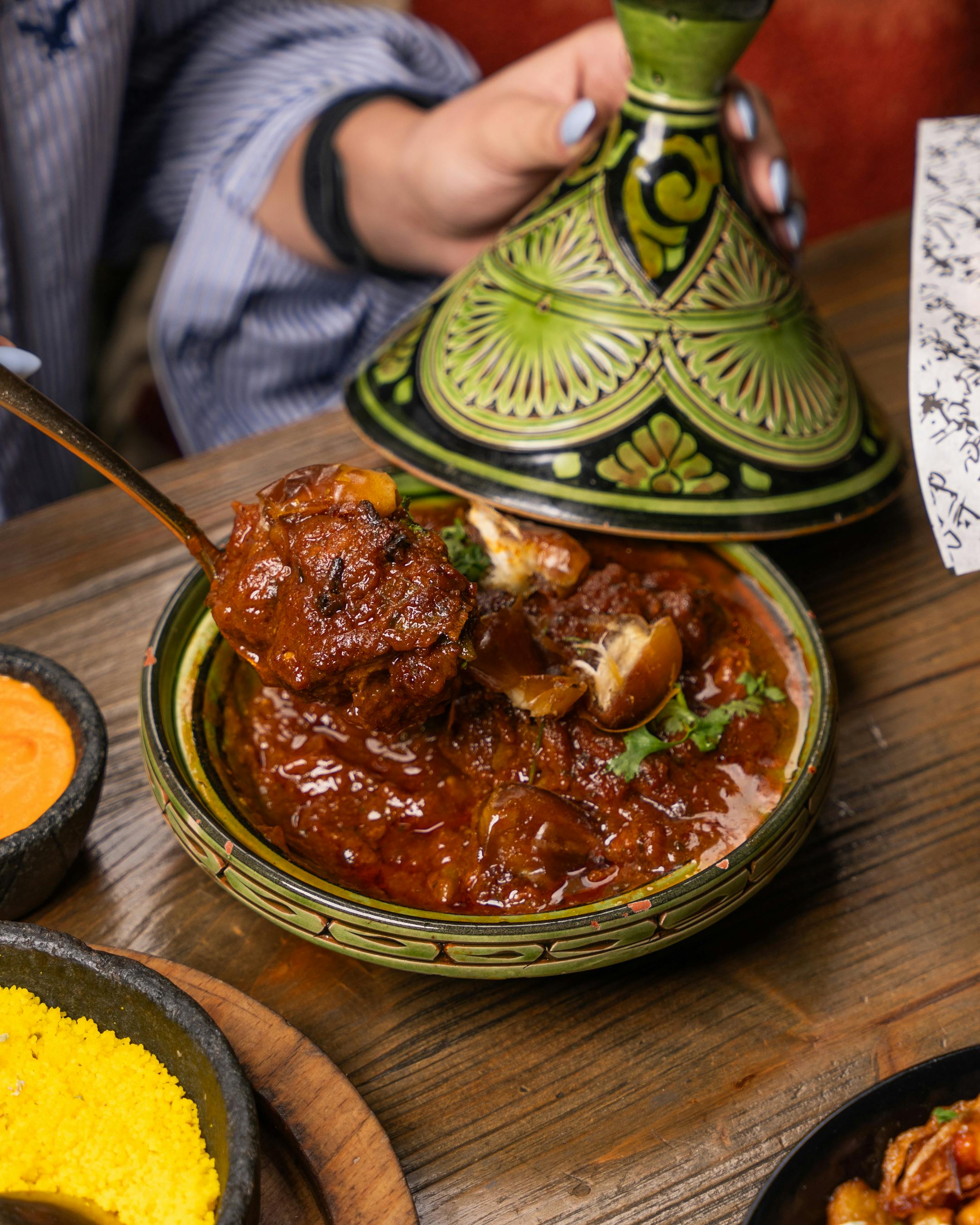
Photo: Ali Dashti / Pexels
The diets react (see scores below)
Common Ingredients
- beef
- preserved lemon
- garlic
- cumin
- saffron
- smen
- olive oil
- ras el hanout
Specific recipes may vary.
Incompatible with 5 of 11 diets
Diet Ratings
Tanjia is a slow-cooked Moroccan beef dish that is naturally low in carbohydrates. The primary ingredients — beef, olive oil, smen (fermented butter), garlic, and spices — are all keto-friendly. Preserved lemon contributes minimal net carbs in typical quantities (usually just the rind is used). Ras el hanout and cumin are spice blends used in small amounts, adding negligible carbs. Saffron is essentially zero-carb. The dish is protein-rich with healthy fats from olive oil and smen, making it a strong fit for keto. The main concern is ras el hanout, which can occasionally include small amounts of sweeter spices, but in culinary quantities this is inconsequential. Overall net carbs for a standard serving should remain well under 5g.
Some strict keto practitioners flag smen (aged fermented butter) due to concerns about trace casein and potential insulin response in dairy-sensitive individuals, and may also scrutinize ras el hanout blends for hidden sugars or non-keto spice fillers depending on brand or preparation.
Tanjia is a traditional Moroccan slow-cooked dish that is fundamentally incompatible with a vegan diet. It contains beef as the primary protein, which is an animal product and an unambiguous violation of vegan principles. Additionally, smen — a fermented, salted Moroccan butter — is a dairy product derived from animal milk, providing a second animal-derived ingredient. These two ingredients alone make this dish clearly non-vegan with no ambiguity.
Tanjia is a slow-cooked Moroccan beef dish that is largely paleo-compatible but contains two problematic ingredients. Beef, garlic, cumin, saffron, and olive oil are all clearly paleo-approved. Ras el hanout is a spice blend that is generally paleo-friendly, though some commercial blends may contain non-paleo additives or salt. Preserved lemon is a gray area — lemons themselves are paleo, but traditional preserved lemons are cured with significant added salt, which is excluded under strict paleo rules. The most problematic ingredient is smen, a fermented and aged Moroccan butter similar to ghee in that water and some proteins are reduced, but it remains a dairy-derived fat with a stronger fermented profile. Like ghee, strict Cordain-school paleo excludes all dairy derivatives including smen, while more moderate paleo practitioners may accept it given the reduced lactose and casein content. The combination of added salt (via preserved lemon) and smen pushes this dish into caution territory rather than approval.
Strict paleo authorities following Loren Cordain's original framework would avoid smen entirely as a dairy derivative, and would flag preserved lemon for its significant added salt content. Those following this interpretation might rate the dish as 'avoid' rather than 'caution.'
Tanjia is a traditional Moroccan slow-cooked beef dish that presents several concerns from a Mediterranean diet perspective. Beef is a red meat, which the Mediterranean diet limits to only a few times per month. The dish also contains smen (a fermented, aged butter similar to ghee), which is a saturated animal fat that conflicts with the Mediterranean principle of olive oil as the primary fat source. While the dish does include olive oil and beneficial spices (cumin, saffron, ras el hanout) and preserved lemon, the dominant protein is red meat and the secondary fat is a high-saturated-fat animal product. The combination of these two factors pushes this dish firmly into 'avoid' territory for regular consumption.
Some Mediterranean diet scholars acknowledge that North African culinary traditions — including Moroccan cuisine — are part of the broader Mediterranean food culture, and occasional consumption of spiced, slow-cooked red meat dishes is consistent with traditional patterns in the region. The rich spice profile and presence of olive oil are positive elements, and if consumed only a few times per month as a celebratory dish, some practitioners would classify it as 'caution' rather than 'avoid'.
Tanjia is a Moroccan slow-cooked beef dish that, while centered on beef, is heavily laden with plant-derived ingredients that are strictly excluded from the carnivore diet. Preserved lemon is a plant food. Garlic is a plant food. Cumin, saffron, and ras el hanout are plant-based spices. Olive oil is a plant-derived oil. Smen (a fermented Moroccan butter) is the only other animal-derived component, and even that is a debated dairy product. The dish as traditionally prepared is fundamentally incompatible with carnivore principles — the beef itself is carnivore-approved, but the surrounding ingredient profile is predominantly plant-based. There is no meaningful way to consume this dish as described while adhering to a carnivore diet.
Most ingredients in Tanjia are straightforwardly Whole30-compliant: beef, preserved lemon, garlic, cumin, saffron, and olive oil are all approved whole foods. Ras el hanout is a spice blend that is generally compliant but requires label-checking, as some commercial versions include non-compliant additives or fillers. The critical concern is smen — a traditional Moroccan fermented, aged butter. Smen is a dairy product (butter-based), and unlike ghee or clarified butter, it is not clarified and retains milk solids and proteins. Regular butter is explicitly excluded on Whole30, and smen, being an aged fermented butter, falls into the same excluded dairy category. If smen is omitted or substituted with ghee, the dish becomes compliant. As commonly prepared with smen, however, this dish contains an excluded dairy ingredient.
Some Whole30 practitioners might argue that smen, due to its long fermentation process, could be considered analogous to other fermented exceptions, but official Whole30 guidelines under Melissa Urban explicitly only carve out ghee and clarified butter from the dairy exclusion — fermented or aged butter products like smen do not qualify for this exception.
Tanjia contains two significant high-FODMAP ingredients that make it unsuitable during the elimination phase. Garlic is one of the highest-FODMAP foods tested by Monash University, rich in fructans, and is used as a core flavoring ingredient in this dish — not merely as an infusion in oil. Ras el hanout is a complex Moroccan spice blend that almost universally contains garlic powder and onion powder, both extremely high in fructans; even small amounts of these powdered forms deliver a concentrated FODMAP hit. Preserved lemon contributes some concern as the rind (typically used) contains moderate fructans, though the flesh is generally lower-FODMAP. Smen (fermented butter) contains some lactose but in the small quantities typically used as a flavoring, it is likely tolerable for most. Beef, cumin, saffron, and olive oil are all low-FODMAP. The dish is not salvageable without significant reformulation — removing garlic cloves and substituting a FODMAP-safe ras el hanout (omitting garlic and onion powders) would be necessary minimum changes.
Monash University has not specifically tested traditional Tanjia or ras el hanout as a blend, so the FODMAP load depends on the exact spice formulation. Some clinical FODMAP practitioners suggest that slow-cooked garlic left whole may leach fewer FODMAPs into oil-based dishes, but this remains unverified, and standard elimination phase guidance treats any garlic — whole or powdered — as high-FODMAP and to be avoided entirely.
Tanjia is a slow-cooked Moroccan beef dish with several DASH-conflicting components. Beef is a red meat that DASH explicitly limits due to saturated fat content. Smen (aged fermented Moroccan butter) is a high saturated fat ingredient similar to butter or ghee, which DASH discourages. Preserved lemon is very high in sodium, a significant concern for DASH's core sodium restriction. Ras el hanout spice blend can contain added salt depending on preparation. On the positive side, olive oil is DASH-friendly, garlic and spices like cumin and saffron provide beneficial phytonutrients, and the dish avoids added sugars and processed fillers. The combination of red meat, high-sodium preserved lemon, and saturated fat from smen pushes this dish into 'caution' territory — acceptable only in small portions with modifications such as rinsing preserved lemon, replacing smen with olive oil only, and using a leaner cut of beef. The aromatic spice base aligns well with DASH's encouragement of herbs and spices as sodium substitutes.
NIH DASH guidelines clearly limit both red meat and sodium-rich preserved ingredients like preserved lemon, making this dish a borderline choice. However, some updated DASH-oriented Mediterranean diet interpretations note that occasional lean red meat in small portions, combined with anti-inflammatory spices and olive oil, may be acceptable within a broader heart-healthy pattern — particularly if sodium from preserved lemon is managed by rinsing or reducing quantity.
Tanjia is a Moroccan slow-cooked beef dish that presents a mixed Zone profile. The beef provides protein but is typically made with fatty cuts (shank or chuck) rather than lean cuts, increasing saturated fat intake beyond Zone ideals. Olive oil is a Zone-favorable monounsaturated fat. However, smen (a fermented, aged Moroccan butter) adds saturated fat, which early Zone methodology strictly discouraged. The spices (cumin, saffron, ras el hanout) are anti-inflammatory polyphenol-rich ingredients that align well with Sears' later anti-inflammatory emphasis. Preserved lemon and garlic add negligible carbohydrates and are Zone-friendly flavor enhancers. The primary concern is that the dish is essentially a protein-and-fat preparation with almost no carbohydrate component, making it only one-third of a Zone meal — a significant carbohydrate block (low-glycemic vegetables or fruit) would need to be added to achieve the 40/30/30 ratio. As a protein-fat component of a Zone meal, it can work with careful portioning (lean cuts, reduced smen) and pairing with a substantial low-GI vegetable side. The fatty cut of beef and smen together push this into caution territory.
Sears' later writings (The OmegaRx Zone, Zone Perfect Meals) placed greater emphasis on anti-inflammatory foods and acknowledged that some saturated fat from whole-food sources is less problematic than processed fats. A Zone practitioner following his later anti-inflammatory framework might view smen more leniently as a traditional, minimally processed fat, potentially rating this dish higher if lean beef cuts are used and the dish is paired correctly with vegetables.
Tanjia is a traditional Moroccan slow-cooked beef dish with a genuinely mixed anti-inflammatory profile. On the positive side, it contains several strongly anti-inflammatory ingredients: olive oil (oleocanthal, polyphenols), garlic (allicin, organosulfur compounds), cumin and saffron (antioxidants, anti-inflammatory phytochemicals), and ras el hanout — a complex spice blend typically including turmeric, ginger, cinnamon, coriander, and black pepper, all of which have meaningful anti-inflammatory credentials. Preserved lemon adds polyphenols and vitamin C. The slow-cooking method in an earthenware urn is also relatively gentle. The problematic elements are beef (a red meat high in saturated fat and arachidonic acid, which is categorized as 'limit' in anti-inflammatory frameworks) and smen, a fermented aged butter with a strong flavor used in traditional preparation. Smen is a full-fat dairy fat high in saturated fat, placing it in the 'limit' category alongside butter. The combination of red meat and a saturated animal fat as the two primary fat sources pulls the dish meaningfully toward a pro-inflammatory profile, even though the spice and aromatics composition is impressive. The overall dish lands in 'caution' territory: the spice profile is genuinely protective and aligns well with anti-inflammatory principles, but the primary protein and one of the key fats are foods that anti-inflammatory guidelines recommend limiting. Occasional consumption is acceptable; it should not be a dietary staple for someone following a strict anti-inflammatory protocol.
Some anti-inflammatory-oriented practitioners, particularly those influenced by traditional food movements, would argue that grass-fed beef and traditionally fermented smen (a probiotic-rich aged fat) are less inflammatory than their conventional counterparts, and that the powerful spice blend and garlic may substantially offset the saturated fat burden. Conversely, stricter anti-inflammatory protocols (such as those emphasizing low arachidonic acid intake) would rate this dish more harshly given that red meat is the primary protein and saturated fat is present from both the meat and smen.
Tanjia is a Moroccan slow-braised beef dish traditionally made with a fatty cut (typically chuck or shank), cooked low and slow in its own fat along with smen (a pungent fermented butter that is high in saturated fat) and olive oil. While beef provides meaningful protein, the overall fat profile of this dish is a significant problem for GLP-1 patients. The combination of fatty red meat, smen, and olive oil results in a high-fat, calorie-dense dish that is likely to worsen GLP-1 side effects — particularly nausea, bloating, and reflux — because fat slows gastric emptying further on top of the medication's own effect. Ras el hanout is a complex spice blend that can be moderately to heavily spiced and may trigger reflux or GI discomfort in sensitive patients. Preserved lemon and garlic are fine. The dish lacks fiber entirely. Portion control could theoretically mitigate some concerns, but the fat content and spice intensity make this a poor choice even in small servings for most GLP-1 patients.
Some GLP-1-focused dietitians note that red meat, including slow-braised beef, can be acceptable in lean cuts and modest portions as a protein source, and individual spice tolerance varies widely — patients who tolerated Moroccan spicing before starting medication may continue to tolerate it. However, the presence of smen (fermented butter) as a core ingredient — not an optional garnish — makes it difficult to recommend this dish in its traditional preparation, as there is no straightforward substitution without fundamentally changing the recipe.
*See how scores were generated at our methodology page.
Nutritional profile
Six traits that cut across every diet.
Fiber & Plants
How much whole-plant food and fiber it delivers.
Healthy Fats
The quality of its fats (unsaturated, omega-3).
Whole / Unprocessed
How close it is to its natural, unprocessed form.
Gut Gentle
How easy it is on digestion (low FODMAP, few irritants).
Low Glycemic
How little it spikes your blood sugar.
Protein Density
How much protein it packs per calorie.
Controversy Index
Higher controversy = more disagreement between diets.
Diet-Specific Tips
 Keto — 8/10
View tips
- Beef is a high-protein, zero-carb primary protein — strong keto fit
- Olive oil and smen provide healthy fats consistent with keto macros
- Preserved lemon rind used in small quantities contributes minimal net carbs
- Ras el hanout is a spice blend — used in trace amounts, negligible carb impact
- No grains, starches, or added sugars in traditional preparation
- Garlic adds minor carbs but negligible in typical quantities used
 Paleo — 5/10
View tips
- Beef is a core paleo protein — approved
- Olive oil is a preferred paleo fat — approved
- Garlic, cumin, saffron, and ras el hanout are paleo-compatible spices
- Smen is a fermented aged butter (dairy derivative) — debated, similar to ghee but stricter dairy concerns apply
- Preserved lemon introduces significant added salt, which is excluded under strict paleo rules
- Overall dish is close to paleo but two ingredients create meaningful compliance concerns
 Whole30 — 5/10
View tips
- Smen is a fermented aged butter — excluded as dairy (not ghee/clarified butter)
- Beef, preserved lemon, garlic, cumin, saffron, and olive oil are all Whole30-compliant
- Ras el hanout requires label verification to ensure no non-compliant additives
- Dish becomes compliant if smen is replaced with ghee
- As traditionally prepared, smen disqualifies this dish from full approval
 DASH — 4/10
View tips
- Red meat (beef) is limited on DASH due to saturated fat content
- Preserved lemon is high in sodium, conflicting with DASH's <2,300mg/day (or <1,500mg) sodium limit
- Smen (aged Moroccan butter) adds saturated fat, which DASH discourages
- Olive oil is DASH-approved and partially offsets fat concerns
- Garlic, cumin, saffron, and ras el hanout are DASH-friendly spices that can replace salt
- No added sugars, processed ingredients, or trans fats
- Dish can be modified toward DASH compliance with leaner cuts, rinsed preserved lemon, and substituting smen with olive oil
 Zone — 5/10
View tips
- Beef is typically a fatty cut (shank/chuck) — not ideal lean Zone protein; leaner cuts would improve compatibility
- Smen (fermented butter) adds saturated fat, which conflicts with Zone's preference for monounsaturated fats
- Olive oil is a Zone-favorable fat source
- Spices (saffron, cumin, ras el hanout) are polyphenol-rich and anti-inflammatory — align with Sears' later framework
- Dish lacks carbohydrate component entirely — must be paired with low-glycemic vegetables to achieve 40/30/30 ratio
- Preserved lemon and garlic are Zone-neutral flavor enhancers with negligible macronutrient impact
- Saturated fat from combined smen and fatty beef may exceed Zone's recommended limits
 Anti-Inflammatory — 5/10
View tips
- Beef (red meat) is categorized as 'limit' in anti-inflammatory frameworks due to saturated fat and arachidonic acid content
- Smen (fermented aged butter) is a full-fat dairy fat high in saturated fat — also in the 'limit' category
- Olive oil provides anti-inflammatory oleocanthal and monounsaturated fats
- Ras el hanout spice blend likely contains turmeric, ginger, and cinnamon — all with strong anti-inflammatory evidence
- Garlic contains organosulfur compounds (allicin) with documented anti-inflammatory and immune-modulating effects
- Saffron contains crocin and crocetin, potent antioxidant carotenoids
- Preserved lemon contributes polyphenols and vitamin C
- Cumin adds anti-inflammatory flavonoids and terpenes
- Slow-cooking method is relatively benign compared to high-heat methods (e.g., grilling/charring)