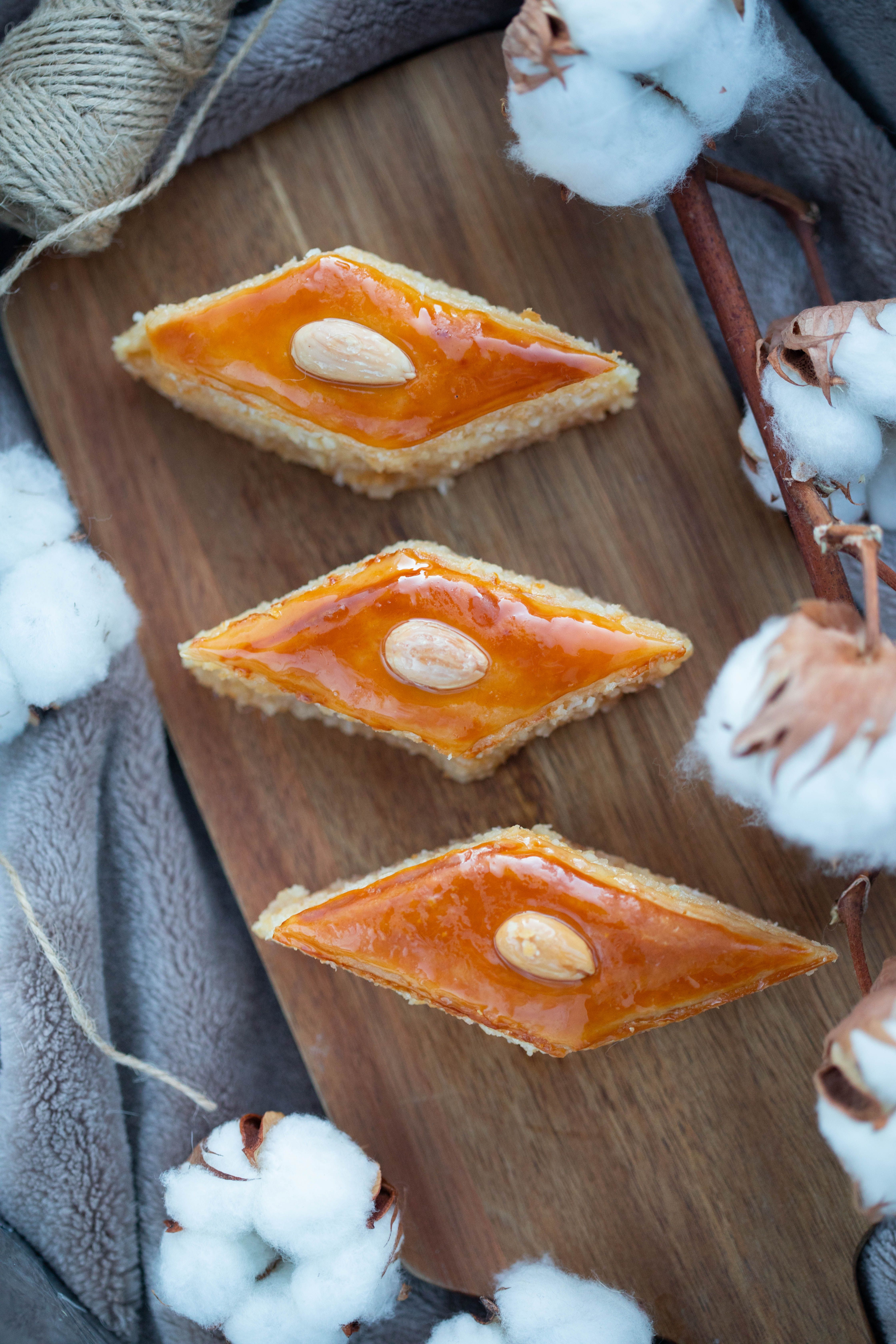
Photo: Valeria Boltneva / Pexels
The diets react (see scores below)
Common Ingredients
- semolina
- yogurt
- coconut
- sugar
- baking powder
- almonds
- simple syrup
- rose water
Specific recipes may vary.
Incompatible with 10 of 11 diets
Diet Ratings
Namoura is a Levantine semolina cake that is fundamentally incompatible with ketogenic eating. Its primary ingredient is semolina, a high-carb wheat-derived grain flour, combined with added sugar and simple syrup — a triple carbohydrate assault. A single small piece would likely exceed an entire day's keto carb allowance. There is no meaningful fat content to offset the carb load, and the sugar-laden simple syrup glaze adds further pure glucose. No portion size makes this dish compatible with ketosis.
Namoura contains yogurt, which is a dairy product derived from cow's (or goat's) milk. Dairy is unambiguously excluded from a vegan diet. All other ingredients — semolina, coconut, sugar, baking powder, almonds, simple syrup, and rose water — are plant-based, so the dish could be made vegan by substituting the yogurt with a plant-based alternative such as coconut yogurt or non-dairy yogurt. As traditionally prepared, however, this dish is not vegan-compatible.
Namoura is fundamentally incompatible with the Paleo diet. Its base ingredient is semolina, a coarse wheat flour — a grain explicitly excluded from Paleo. Yogurt is a dairy product, also excluded. Sugar and simple syrup are refined sweeteners, banned under Paleo rules. Baking powder is a processed additive. While almonds and coconut are Paleo-approved, and rose water is generally acceptable, they are minor components in a dish dominated by non-Paleo ingredients. There is no meaningful way to consider this dish Paleo-compatible.
Namoura is a traditional Levantine semolina cake that conflicts with several Mediterranean diet principles. The primary concerns are refined semolina (a refined grain), substantial added sugar in both the batter and the simple syrup soak, and coconut (not a traditional Mediterranean ingredient). While yogurt and almonds are Mediterranean-compatible, they are minor components. The dish is essentially a dessert confection high in refined carbohydrates and added sugars, which the Mediterranean diet strongly limits. The heavy simple syrup soak makes this particularly problematic from a glycemic standpoint.
Some Mediterranean diet scholars acknowledge that traditional sweets made with nuts, yogurt, and natural flavorings like rose water represent a culturally authentic occasional indulgence within Levantine Mediterranean traditions. Semolina, while refined, is less processed than white flour and has a long history in the region; consumed very rarely and in small portions, such traditional desserts may fit within a culturally inclusive interpretation of the diet.
Namoura is a Levantine semolina cake that is entirely plant-based and heavily processed with sugar. Every single ingredient — semolina (grain), yogurt (the only potentially animal-derived ingredient, but outweighed entirely by the plant ingredients), coconut (plant), sugar (processed), baking powder (plant/chemical leavener), almonds (nuts), simple syrup (sugar), and rose water (plant extract) — violates carnivore diet principles. This dish is essentially a grain-based, sugar-laden dessert with no meaningful animal protein or fat. Even the yogurt, which could marginally qualify as an animal product, is used in such a minor capacity within a predominantly grain-and-sugar matrix that it provides no redemption. There is universal consensus across all carnivore camps that grains, sugar, nuts, and plant-based ingredients are strictly excluded.
Namoura is a Levantine semolina cake that contains multiple excluded ingredients. Semolina is a wheat-derived grain product, which is explicitly excluded on Whole30. Sugar is an excluded added sweetener. Yogurt is dairy, which is excluded (ghee and clarified butter are the only dairy exceptions). Simple syrup is pure added sugar. Even setting aside the spirit-of-the-program rule against recreating baked goods and sweets, this dish fails on at least four hard-excluded ingredients: grains (semolina/wheat), added sugar, dairy (yogurt), and simple syrup (more added sugar). There is no compliant version of this dish possible without fundamentally changing what it is.
Namoura contains multiple high-FODMAP ingredients that make it problematic during the elimination phase. Semolina is made from durum wheat, which is high in fructans — a primary FODMAP concern. Yogurt (unless lactose-free) contains lactose, which is a disaccharide FODMAP. Coconut in larger amounts (shredded/desiccated coconut is low-FODMAP at 1/4 cup per Monash but often used in greater quantities in baking). Simple syrup made from sucrose is generally low-FODMAP, and rose water is not a FODMAP concern. Almonds are low-FODMAP at 10 whole almonds but can become high in GOS and polyols at larger quantities. The semolina and yogurt combination alone makes this dish high-FODMAP at any standard serving size. As a sweet cake/dessert, portion sizes are typically large enough that even borderline ingredients tip into high-FODMAP territory.
Monash University has not specifically tested Namoura as a composite dish. Some FODMAP practitioners note that the fructan content of durum wheat semolina may differ slightly from regular wheat flour, but no evidence suggests it is safe during elimination at realistic serving sizes. Lactose-free yogurt could be substituted to address one concern, but the wheat semolina base remains a core high-FODMAP issue that cannot be easily mitigated.
Namoura is a Levantine semolina cake that conflicts with core DASH diet principles on multiple fronts. The dish is high in added sugar (both within the batter and from the simple syrup soaking), which DASH explicitly limits. Coconut is a tropical ingredient that, in the shredded/desiccated form used in sweets, contributes saturated fat from coconut oil content — a category DASH guidelines flag. Refined semolina lacks the fiber of whole grains that DASH emphasizes. The heavy simple syrup soak adds a substantial sugar load, making this a high-glycemic, calorie-dense sweet with little nutritional benefit in the form of potassium, magnesium, calcium, or fiber. While almonds and yogurt are individually DASH-friendly ingredients, their positive contributions are overwhelmed by the sugar, refined grain, and coconut fat content of the overall dish. This is a dessert/sweet snack that falls squarely into the 'sweets' category that DASH limits to 5 or fewer servings per week, and even then encourages low-fat, low-sugar choices.
Namoura is a Levantine semolina cake soaked in simple syrup, making it one of the most Zone-incompatible foods possible. The macronutrient profile is overwhelmingly carbohydrate-dominant, with virtually no protein and minimal beneficial fat. The primary carbohydrate sources — semolina (a refined, high-glycemic grain) and simple syrup (pure sugar) — are exactly the types of carbohydrates Dr. Sears explicitly categorizes as 'unfavorable' and advises against. The sugar load from both the baked dough and the syrup soak would cause a significant insulin spike, directly opposing the Zone's core goal of insulin modulation. There is no lean protein to balance the meal, and the fat from almonds and coconut, while partially beneficial, is far too small relative to the carbohydrate load to create anything near a 40/30/30 ratio. This dish has no practical path to Zone balance without fundamentally reconstructing it into something unrecognizable.
Namoura is a traditional Levantine semolina cake soaked in simple syrup, presenting a mixed inflammatory profile. The primary concerns are the refined semolina (a refined grain with moderate glycemic impact), substantial added sugar via simple syrup, and the sugar inherent in the recipe itself — all of which can promote inflammatory markers like CRP when consumed in excess. Coconut, while containing some medium-chain triglycerides (MCTs), also contributes saturated fat, and is not emphasized in anti-inflammatory frameworks. On the positive side, yogurt provides probiotics and anti-inflammatory potential; almonds contribute vitamin E, healthy monounsaturated fats, and polyphenols with documented anti-inflammatory effects; and rose water is essentially neutral. Baking powder is benign. Overall, this is a sugar-forward dessert/snack with refined carbohydrates as the backbone — enjoyable occasionally but not aligned with anti-inflammatory principles as a regular food. The beneficial elements (almonds, yogurt) are present but minor relative to the inflammatory load from sugar and refined semolina.
Namoura is a Levantine semolina cake soaked in simple syrup, making it essentially a high-sugar, refined-carbohydrate dessert with negligible protein and minimal fiber. The primary ingredients — semolina, sugar, and simple syrup — deliver a rapid glycemic spike with little nutritional payoff per calorie, which is directly counterproductive for GLP-1 patients who have severely reduced caloric intake and must maximize nutrient density in every bite. The yogurt contributes a small amount of protein but is diluted across a serving dominated by refined starch and sugar. Coconut adds saturated fat. Almonds offer trace protein and some healthy fat but are present in small garnish quantities insufficient to offset the overall profile. The dense, sticky texture and high sugar load may also worsen nausea, bloating, or reflux due to slowed gastric emptying. There is no meaningful fiber, no significant protein, and the caloric content is almost entirely empty. This is a treat food that has no practical place in a GLP-1 dietary framework, even as an occasional snack.
*See how scores were generated at our methodology page.
Nutritional profile
Six traits that cut across every diet.
Fiber & Plants
How much whole-plant food and fiber it delivers.
Healthy Fats
The quality of its fats (unsaturated, omega-3).
Whole / Unprocessed
How close it is to its natural, unprocessed form.
Gut Gentle
How easy it is on digestion (low FODMAP, few irritants).
Low Glycemic
How little it spikes your blood sugar.
Protein Density
How much protein it packs per calorie.
Controversy Index
Higher controversy = more disagreement between diets.
Diet-Specific Tips
 Anti-Inflammatory — 4/10
View tips
- High added sugar load from simple syrup — a known driver of inflammatory markers (CRP, IL-6)
- Refined semolina base has moderate-to-high glycemic impact, promoting blood sugar spikes
- Almonds contribute anti-inflammatory vitamin E and monounsaturated fats, a modest positive
- Yogurt provides probiotics and may have mild anti-inflammatory benefits
- Coconut adds saturated fat, which anti-inflammatory frameworks advise limiting
- No omega-3 sources, antioxidant-rich vegetables, or key anti-inflammatory phytonutrients present
- Acceptable as an occasional treat; not suitable as a regular anti-inflammatory snack