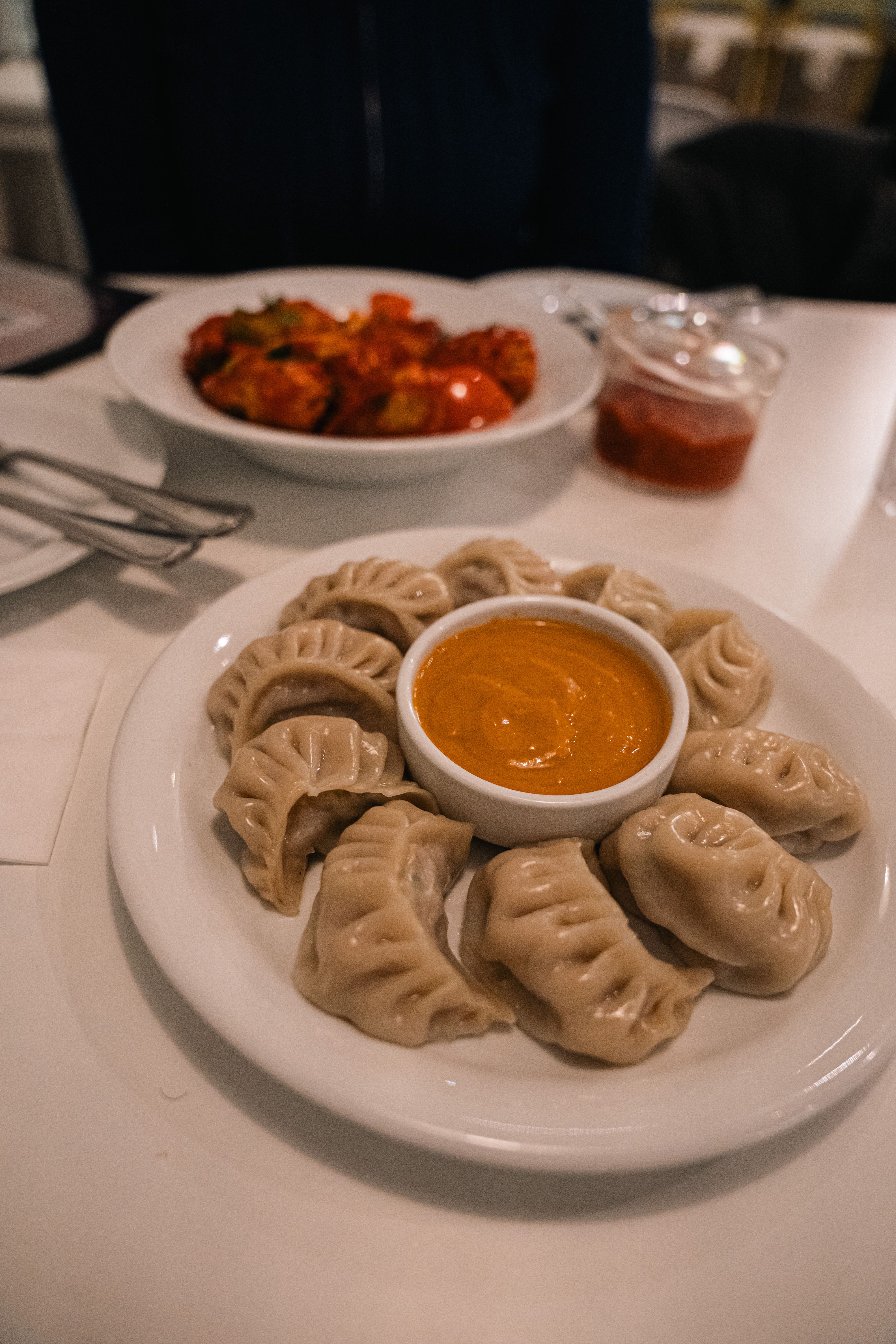
Photo: apertur 2.8 / Pexels
The diets react (see scores below)
Common Ingredients
- flour
- minced chicken
- onion
- garlic
- ginger
- cilantro
- cumin
- tomato
- chili
Specific recipes may vary.
Incompatible with 6 of 11 diets
Diet Ratings
Momo is a traditional Nepali dumpling made with wheat flour dough as the wrapper, which is the primary and disqualifying ingredient for keto. Wheat flour is a high-glycemic grain that delivers a substantial carbohydrate load — a single serving of 6-8 momos can contain 30-50g of net carbs from the dough alone, easily exceeding the daily keto limit. While the filling of minced chicken, onion, garlic, ginger, and spices is relatively low-carb and keto-friendly, the flour wrapper makes the dish fundamentally incompatible with ketosis. The dipping sauce (typically tomato and chili-based) adds minor additional carbs. There is no standard keto-adapted version of this dish in its traditional form.
Momo in this preparation contains minced chicken as the primary protein, which is an animal product and strictly excluded from a vegan diet. There is no ambiguity here — poultry is clearly non-vegan. The remaining ingredients (flour, onion, garlic, ginger, cilantro, cumin, tomato, chili) are all plant-based, but the inclusion of chicken makes this dish entirely incompatible with vegan dietary standards.
Momo is a Nepali dumpling whose defining feature is a wheat flour wrapper — a grain-based dough that is explicitly excluded from the paleo diet. While the filling contains several paleo-approved ingredients (minced chicken, onion, garlic, ginger, cilantro, cumin, tomato, chili), the flour dough is non-negotiable and disqualifies the dish as a whole. The dipping sauce (tomato and chili) is paleo-friendly, but the dumpling itself cannot be consumed in its traditional form on a paleo diet.
Momo is a Nepali dumpling made with refined white flour dough wrapped around minced chicken with aromatic vegetables and spices. The chicken filling is lean and acceptable in the Mediterranean diet (poultry is moderate/occasional), and the vegetable aromatics (onion, garlic, ginger, cilantro, tomato, chili) are Mediterranean-friendly. However, the refined white flour wrapper is a notable concern — the Mediterranean diet strongly favors whole grains over refined grains. The dish contains no olive oil and is not plant-forward. It is not a heavily processed or high-sugar food, so it doesn't reach 'avoid' territory, but the refined flour and overall profile keep it in the caution zone rather than approved.
Some Mediterranean diet interpreters allow refined flour in moderate quantities, particularly in traditional dishes from Mediterranean-adjacent cultures, arguing that the overall dietary pattern matters more than any single ingredient. From this perspective, the lean chicken and vegetable-rich filling could push this dish toward acceptable occasional consumption.
Momo is a Nepali dumpling that is fundamentally incompatible with the carnivore diet. The dish is built around a wheat flour dough wrapper, which is a grain-based plant food and a primary exclusion on carnivore. Beyond the dough, virtually every other ingredient except the minced chicken is plant-derived: onion, garlic, ginger, cilantro, cumin, tomato, and chili are all vegetables, aromatics, or spices explicitly excluded from the carnivore diet. The dipping sauce components (tomato, chili) add further plant content. While minced chicken is a carnivore-compatible protein, it represents only one component of a dish that is overwhelmingly plant and grain-based. This dish cannot be adapted to carnivore without completely reconstructing it — at which point it would no longer be a momo.
Momo are Nepali dumplings made with wheat flour dough wrappers filled with seasoned minced chicken. Wheat flour is a grain and is explicitly excluded on the Whole30. Additionally, momos fall squarely into the 'no recreating baked goods/junk food' rule — they are essentially dumplings/pasta-style wrappers, analogous to the noodles, pasta, and wraps that are explicitly prohibited even when made with compliant ingredients. The filling ingredients (minced chicken, onion, garlic, ginger, cilantro, cumin, tomato, chili) are all individually Whole30-compatible, but the flour wrapper disqualifies the dish entirely.
Momo contains multiple high-FODMAP ingredients that make it unsuitable during the elimination phase. The dumpling wrapper is made from wheat flour, which is high in fructans — a major FODMAP category. The filling includes both onion and garlic, which are among the highest-fructan foods tested by Monash University and are not safe at any standard serving size during elimination. These three ingredients alone — wheat, onion, and garlic — are sufficient to classify this dish as high-FODMAP regardless of portion size. The tomato-chili dipping sauce commonly served with momos may also contain onion and garlic. Minced chicken, ginger, cilantro, cumin, and fresh chili are individually low-FODMAP, but they cannot offset the core high-FODMAP components.
Momo (Nepali steamed dumplings) uses lean chicken as the primary protein, which is DASH-friendly, along with vegetables like onion, garlic, ginger, tomato, and cilantro that align well with DASH principles. The spices (cumin, chili) add flavor without sodium, which is a DASH-positive approach. However, the white flour wrapper is a refined grain rather than a whole grain, which DASH de-emphasizes in favor of whole grains. The dish is typically steamed, avoiding added fats, which is a positive preparation method. The main DASH concern is that white flour dumplings are not a core DASH food, and sodium content can vary significantly depending on how much salt is added to the filling and any accompanying dipping sauce (often soy-based and high in sodium). As commonly consumed with a tomato-chili dipping sauce, the sodium remains moderate, but restaurant or packaged versions may add considerable salt. Overall, momos made at home with minimal salt and a low-sodium dipping sauce are acceptable in moderation, but the refined flour wrapper and potential sodium additions prevent full approval.
NIH DASH guidelines emphasize whole grains over refined grains, which would place white-flour dumplings outside the core DASH foods; however, updated clinical interpretations note that when refined grains are portion-controlled and paired with lean protein and vegetables in a low-sodium preparation, the overall dietary pattern impact is modest, and some DASH-aligned clinicians consider such dishes acceptable in moderation.
Momo (Nepali dumplings) present a mixed Zone Diet profile. The filling contains lean minced chicken (favorable Zone protein), low-glycemic aromatics like onion, garlic, and ginger, and polyphenol-rich spices (cumin, cilantro) — all Zone-friendly components. The tomato-chili dipping sauce adds beneficial polyphenols and low-glycemic carbs. However, the dumpling wrapper made from refined white flour is a high-glycemic, unfavorable carb in Zone terminology, similar to white bread, and significantly disrupts the ideal 40/30/30 block ratio. A typical serving of momos contains considerably more carbohydrate (from the flour wrapper) relative to protein, meaning the ratio is skewed carb-heavy and toward high-glycemic carbs. That said, Zone is ratio-based: a small controlled portion (2-3 momos) paired with additional lean protein or vegetables on the side could be worked into a Zone-balanced meal. The dish is not a Zone disaster but requires active portioning discipline.
Some Zone practitioners and later Sears-influenced coaches argue that the vegetable-and-protein-rich filling partially offsets the glycemic impact of the flour wrapper, especially in steamed preparation (no added fats), and that steaming keeps caloric density low. In smaller snack-sized portions (1-2 pieces), momos could plausibly fit within a Zone snack block framework without dramatically spiking blood sugar, particularly when the wrapper is thin. Sears' later writings also emphasize polyphenols and anti-inflammatory foods, and the spice profile of momos (ginger, cumin, chili) aligns well with that focus.
Nepali chicken momos present a mixed anti-inflammatory profile. On the positive side, the filling contains several genuinely anti-inflammatory ingredients: garlic and ginger are well-documented for reducing inflammatory markers, cumin and chili provide anti-inflammatory phytochemicals, onion contributes quercetin, tomato delivers lycopene, and cilantro adds antioxidant polyphenols. Lean chicken is classified as a moderate, acceptable protein in anti-inflammatory frameworks. The wrapper, however, is made from refined white flour — a refined carbohydrate that can spike blood glucose and modestly promote inflammatory responses, and which lacks the fiber and nutrients of whole grains. The overall dish is not heavily processed, contains no trans fats, added sugars, seed oils, or artificial additives, and has a favorable spice profile. The main anti-inflammatory limitation is the refined flour dough, which pulls the dish down from an 'approve' rating. If made with whole wheat flour, the score would rise. As a moderate snack rather than a dietary staple, momos are acceptable within an anti-inflammatory framework but not exemplary.
Chicken momos are steamed dumplings made with refined flour wrappers and a spiced minced chicken filling. The steamed preparation method is a meaningful positive — no frying means low added fat and easy digestibility, which aligns well with GLP-1 guidelines. Minced chicken provides a solid lean protein source, and aromatics (garlic, ginger, onion) support digestion. However, the refined flour wrapper is low in fiber and nutrient-poor per calorie, which is a notable drawback given how critical nutrient density is on GLP-1 medications. Chili in the filling may cause or worsen reflux and nausea in some GLP-1 patients, especially those with slowed gastric emptying. Portion size matters: a small serving of 4–6 steamed momos can deliver a reasonable protein hit with manageable carb load, but the dish is not protein-dense enough per calorie to rank as a top-tier GLP-1 food. Typically served with a tomato-chili dipping sauce, which adds mild spice risk. If fried (kothey or pan-fried style), the score drops significantly — this rating applies to the steamed version only.
Some GLP-1-focused dietitians would rate steamed momos more favorably when consumed in small portions, citing the lean protein content and steamed preparation as sufficient for a snack category. Others would flag the refined flour wrapper and chili more strongly, recommending the patient avoid this dish entirely during the early high-side-effect phase of GLP-1 titration.
*See how scores were generated at our methodology page.
Nutritional profile
Six traits that cut across every diet.
Fiber & Plants
How much whole-plant food and fiber it delivers.
Healthy Fats
The quality of its fats (unsaturated, omega-3).
Whole / Unprocessed
How close it is to its natural, unprocessed form.
Gut Gentle
How easy it is on digestion (low FODMAP, few irritants).
Low Glycemic
How little it spikes your blood sugar.
Protein Density
How much protein it packs per calorie.
Controversy Index
Higher controversy = more disagreement between diets.
Diet-Specific Tips
 Mediterranean — 5/10
View tips
- Refined white flour wrapper contradicts whole grain preference
- Lean chicken protein is acceptable in moderation per Mediterranean guidelines
- Aromatic vegetables (onion, garlic, tomato, ginger) are Mediterranean-compatible
- No olive oil present — primary fat source of Mediterranean diet is absent
- Not a Mediterranean cuisine, but individual ingredients assessed on compatibility
- Low in added sugars and not heavily processed
 DASH — 5/10
View tips
- Lean chicken protein is DASH-approved
- Steamed preparation avoids added saturated fat
- White flour wrapper is a refined grain, not whole grain
- Vegetables and spices contribute potassium and micronutrients
- Sodium varies widely based on salt added to filling and dipping sauce
- Soy-based dipping sauces commonly served alongside are high in sodium
- Portion control is important as dumplings are energy-dense
 Zone — 5/10
View tips
- Refined white flour wrapper is a high-glycemic, unfavorable Zone carbohydrate
- Minced chicken filling is a lean, favorable Zone protein source
- Macro ratio is carb-heavy relative to ideal 40/30/30 Zone balance
- Steamed preparation avoids added unhealthy fats — a Zone positive
- Aromatics and spices (garlic, ginger, cumin, cilantro) are anti-inflammatory and Zone-favorable
- Tomato-chili dipping sauce adds low-glycemic, polyphenol-rich carbs
- Portion control is essential — a large serving significantly overshoots carb blocks
 Anti-Inflammatory — 5/10
View tips
- Refined white flour wrapper — pro-inflammatory refined carbohydrate, lacks fiber
- Lean chicken filling — acceptable moderate protein per anti-inflammatory guidelines
- Garlic and ginger — strong anti-inflammatory properties, well-supported by research
- Cumin and chili — provide anti-inflammatory phytochemicals and capsaicin
- Onion and tomato — quercetin and lycopene add antioxidant value
- No trans fats, seed oils, added sugars, or artificial additives
- Whole wheat flour substitution would meaningfully improve the anti-inflammatory profile
 GLP-1 Friendly — 5/10
View tips
- Steamed preparation — no added fat, easy to digest
- Lean minced chicken provides moderate protein per serving
- Refined flour wrapper — low fiber, low nutrient density per calorie
- Chili ingredient may worsen GLP-1-related nausea or reflux
- Portion-sensitive: small servings (4–6 momos) are more appropriate than a full plate
- Spiced dipping sauce (tomato-chili) adds additional reflux risk
- Score would drop to avoid range if fried version (kothey style)