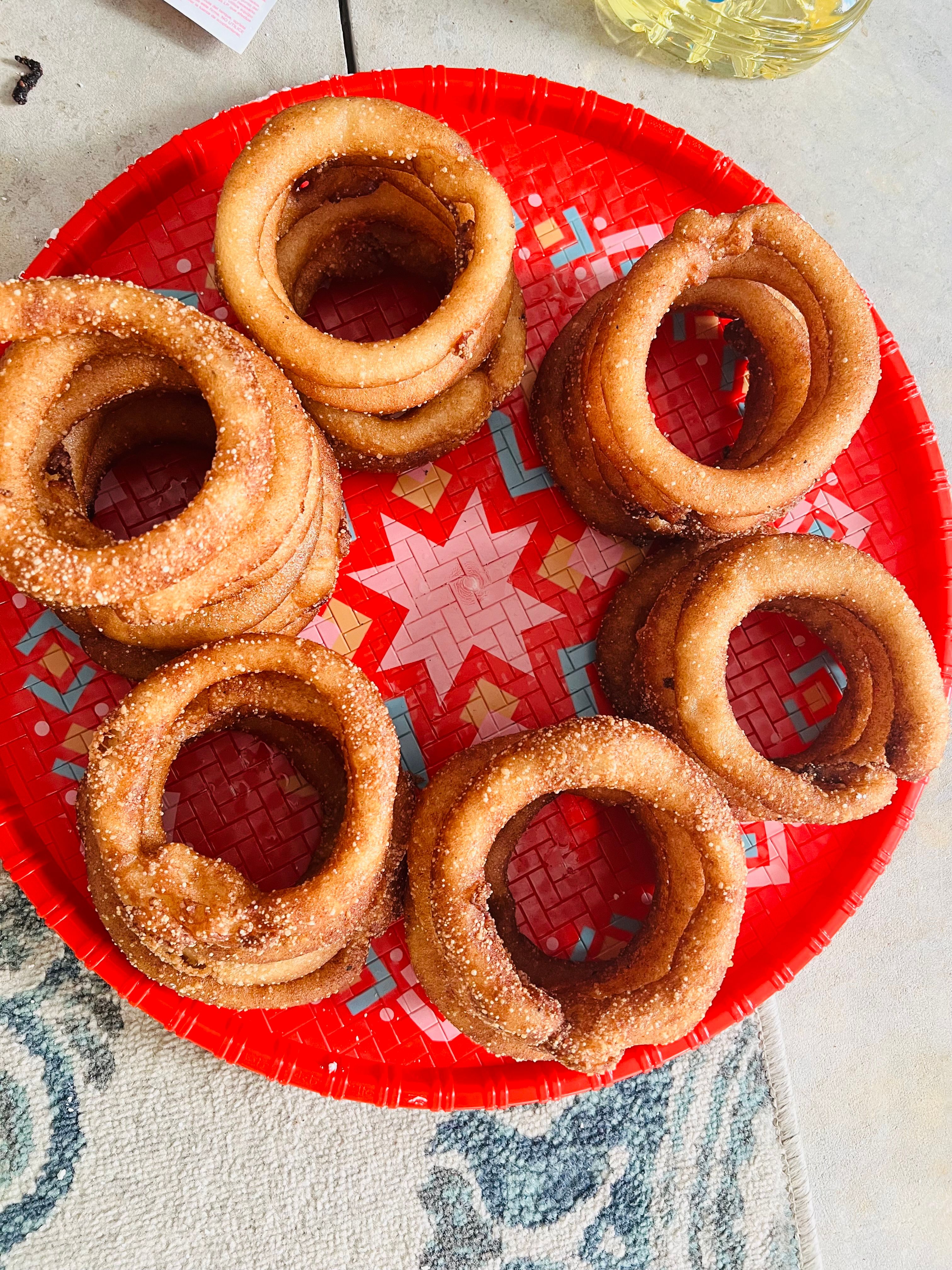
Photo: Barsha Bhetwal Adhikari / Pexels
The diets react (see scores below)
Common Ingredients
- rice flour
- sugar
- banana
- ghee
- cardamom
- milk
- salt
Specific recipes may vary.
Incompatible with 8 of 11 diets
Diet Ratings
Sel Roti is a traditional Nepali ring-shaped fried bread made primarily from rice flour and sugar, with banana adding additional natural sugars. Rice flour is a high-glycemic grain-based flour with very high net carbs (roughly 75-80g net carbs per 100g), making it fundamentally incompatible with ketosis. Added sugar and banana further compound the carbohydrate load. A single Sel Roti can easily contain 30-50g of net carbs, which alone could exceed or consume an entire day's keto carb allowance. While ghee and cardamom are keto-friendly, they cannot offset the core ingredients. This dish is structurally a grain-and-sugar-based food with no practical keto modification possible without completely changing its nature.
Sel Roti contains two clear animal-derived ingredients: ghee (clarified butter, a dairy product) and milk (also dairy). Both are unambiguously excluded from a vegan diet. The remaining ingredients — rice flour, sugar, banana, cardamom, and salt — are all plant-based, but the presence of ghee and milk disqualifies this dish entirely. A vegan version could be made by substituting ghee with coconut oil or vegan butter, and milk with a plant-based alternative such as oat or coconut milk.
Sel Roti is a traditional Nepali ring-shaped bread that is fundamentally incompatible with the paleo diet. The base ingredient is rice flour, which is a grain and strictly excluded from paleo. Beyond the grain issue, the recipe also contains milk (dairy, excluded), sugar (refined sweetener, excluded), and salt (added salt, excluded). While banana, ghee, and cardamom have varying degrees of paleo acceptability, the core non-paleo ingredients — rice flour, milk, sugar, and salt — make this dish clearly off-limits. There is no meaningful way to assess this as a gray-area food; multiple foundational paleo exclusions are violated simultaneously.
Sel Roti is a traditional Nepali ring-shaped bread made from refined rice flour, fried in ghee, and sweetened with sugar and banana. From a Mediterranean diet perspective, this dish presents multiple concerns: it uses refined rice flour (a refined grain with low fiber), added sugar, and is deep-fried in ghee (a saturated animal fat rather than the preferred extra virgin olive oil). The combination of refined carbohydrates, added sugar, and saturated fat directly contradicts Mediterranean diet principles. While banana and cardamom add minor nutritional value, they do not offset the core issues. Milk and ghee place it in the dairy category, but the preparation method and refined grain base make this more of a caution-to-avoid item overall.
Some Mediterranean diet interpreters who take a more flexible, whole-foods cultural approach might note that banana provides potassium and natural sweetness, and that moderate dairy (milk, ghee) has precedent in some traditional Mediterranean regions like parts of the Middle East and Balkans. However, mainstream Mediterranean diet clinical guidelines (Willett et al., Trichopoulou et al.) would still flag the refined flour frying base and added sugar as incompatible.
Sel Roti is a traditional Nepali ring-shaped bread made almost entirely from plant-derived ingredients. Rice flour is a grain — completely excluded on carnivore. Sugar is a processed plant-derived sweetener — excluded. Banana is a fruit — excluded. Cardamom is a plant spice — excluded. Milk is the only animal-derived ingredient, but it is a minor component in a dish that is fundamentally a grain-based fried bread. The presence of ghee and milk does not redeem a dish whose primary structure is built on rice flour, sugar, and banana. There is no meaningful animal protein source. This dish has no place on any tier of the carnivore diet.
Sel Roti contains multiple excluded ingredients and violates core Whole30 rules. First, rice flour is a grain product and grains are explicitly excluded on Whole30. Second, sugar is explicitly excluded as an added sugar. Third, milk is dairy and explicitly excluded (only ghee/clarified butter is the dairy exception). Finally, even setting aside those ingredient violations, Sel Roti is a traditional ring-shaped fried bread/donut — it falls squarely into the 'no recreating baked goods or junk food' rule, as it is essentially a sweet fried pastry. This dish fails on multiple independent grounds.
Sel Roti contains several ingredients that require careful consideration. Rice flour is low-FODMAP and forms the safe base. Ghee is low-FODMAP (lactose-free fat). Cardamom and salt are low-FODMAP. The problematic ingredients are: (1) Banana — ripe bananas are high-FODMAP due to excess fructose and sorbitol; unripe/firm bananas are low-FODMAP at one small banana (~100g). Traditional Sel Roti uses ripe banana for sweetness, making this a significant concern. (2) Milk — contains lactose and is high-FODMAP unless a lactose-free alternative is used or only a very small amount is included. (3) Sugar — plain table sugar (sucrose) is low-FODMAP at moderate amounts. The combination of ripe banana and regular cow's milk means this dish as traditionally prepared is likely high-FODMAP at a standard serving. Substitutions (unripe banana, lactose-free milk) could make it low-FODMAP, but as traditionally made, caution is warranted.
Monash University has not specifically tested Sel Roti as a dish, so assessment relies on individual ingredients. Some FODMAP practitioners might rate this as 'avoid' during strict elimination given the dual risk of ripe banana (high sorbitol/fructose) and lactose from milk, while others might argue that the small per-serving quantities of milk and banana in the batter — once divided across multiple pieces — could fall within safe thresholds.
Sel Roti is a traditional Nepali ring-shaped fried bread made primarily from rice flour, sugar, banana, ghee, and milk. From a DASH perspective, several concerns arise: (1) It is deep-fried in ghee, which is clarified butter high in saturated fat — a fat category DASH explicitly limits. (2) It contains added sugar, which DASH recommends minimizing. (3) Rice flour is a refined grain rather than a whole grain, lacking the fiber emphasized by DASH. On the positive side, banana contributes potassium and natural sweetness, milk adds calcium, cardamom is a benign spice, and sodium content is relatively low. The dish is not aggressively high in sodium or processed additives, but the combination of saturated fat (ghee), refined grain (rice flour), and added sugar places it in the caution category. Occasional consumption in small portions is acceptable, but it should not be a daily DASH breakfast staple.
NIH DASH guidelines clearly restrict saturated fat and refined grains, which would mark this dish as a poor fit. However, some updated DASH-aligned clinicians note that ghee in small quantities, banana's potassium contribution, and the relatively low sodium content mean Sel Roti consumed occasionally and in small portions need not be categorically excluded — especially compared to heavily processed Western breakfast items.
Sel Roti is a traditional Nepali rice flour donut/ring bread that is deeply problematic for Zone Diet adherence. The dish is essentially a high-glycemic carbohydrate bomb: rice flour is a refined, high-GI starch, banana is one of the Zone's explicitly 'unfavorable' high-sugar fruits, and added sugar compounds the glycemic load further. The fat source is ghee (saturated fat), which is not a preferred Zone fat — monounsaturated fats like olive oil and avocado are favored instead. Critically, there is no protein component whatsoever, making it impossible to construct even a semblance of the 40/30/30 ratio from this dish alone. The macronutrient profile is overwhelmingly carbohydrate-dominant with saturated fat, essentially the opposite of Zone balance. While cardamom offers minor polyphenol benefit and milk adds a small protein contribution, these are insufficient to redeem the overall profile. Even with strict portioning, the refined starch-sugar-banana combination creates a high glycemic response that would destabilize insulin, directly contradicting Zone's core anti-inflammatory objective. This is one of the rare cases where a food earns a low score — not because Zone excludes foods categorically, but because no reasonable portion size can bring this dish into Zone balance without fundamentally changing its nature.
Sel Roti is a traditional Nepali ring-shaped bread made by deep-frying a batter of rice flour, sugar, banana, ghee, milk, cardamom, and salt. The dish has a mixed anti-inflammatory profile. On the positive side, banana contributes modest amounts of potassium and resistant starch; cardamom is a fragrant spice with mild antioxidant properties; and rice flour is gluten-free and relatively easy to digest. However, several features push this dish toward caution: (1) Added sugar is a meaningful concern — it directly promotes pro-inflammatory signaling and is listed as a food to limit or avoid in anti-inflammatory frameworks. (2) Ghee (clarified butter) is high in saturated fat; while some integrative nutrition advocates consider traditional ghee acceptable in small amounts and even anti-inflammatory due to butyrate content, mainstream anti-inflammatory guidelines place full-fat dairy fats in the 'limit' category. (3) The dish is deep-fried, which concentrates saturated fat intake and, depending on the frying oil used in practice (often ghee or refined vegetable oil), may introduce additional pro-inflammatory compounds. (4) White rice flour is a refined carbohydrate with a high glycemic index, which can spike blood glucose and drive inflammatory pathways. Banana provides some mitigation, but not enough to offset the sugar, refined starch, ghee, and frying method. Occasional consumption is unlikely to cause harm, but Sel Roti is not a dish that supports an anti-inflammatory dietary pattern when eaten regularly.
Some traditional food advocates, including Ayurvedic practitioners, view ghee as a healing fat with anti-inflammatory butyrate content and would rate it more favorably than butter or cream; additionally, banana and cardamom carry genuine anti-inflammatory value. However, mainstream anti-inflammatory nutrition authorities, including Dr. Weil's pyramid, consistently flag added sugars and refined carbohydrates as primary inflammatory drivers, which limits how favorably Sel Roti can be rated even accounting for its beneficial ingredients.
Sel roti is a traditional Nepali ring-shaped fried bread made primarily from rice flour and sugar, deep-fried in ghee. It fails on nearly every GLP-1 dietary criterion. It provides essentially no protein, very low fiber (refined rice flour), is deep-fried in a saturated fat (ghee), and is high in sugar and refined carbohydrates — making it calorie-dense with minimal nutritional return. The frying process and high fat content are likely to worsen GLP-1 side effects including nausea, bloating, and reflux due to slowed gastric emptying. Sugar and refined carbs offer rapid blood glucose spikes with no satiety support. Banana adds minor potassium and some natural sugar but does not meaningfully offset the profile. As a breakfast item on GLP-1 therapy, it would consume a significant portion of limited daily caloric intake while contributing almost nothing toward the 100–120g daily protein target or the 25–30g fiber target.
*See how scores were generated at our methodology page.
Nutritional profile
Six traits that cut across every diet.
Fiber & Plants
How much whole-plant food and fiber it delivers.
Healthy Fats
The quality of its fats (unsaturated, omega-3).
Whole / Unprocessed
How close it is to its natural, unprocessed form.
Gut Gentle
How easy it is on digestion (low FODMAP, few irritants).
Low Glycemic
How little it spikes your blood sugar.
Protein Density
How much protein it packs per calorie.
Controversy Index
Higher controversy = more disagreement between diets.
Diet-Specific Tips
 Low-FODMAP — 5/10
View tips
- Rice flour is low-FODMAP and a safe base ingredient
- Ripe banana is high-FODMAP (sorbitol, excess fructose) — the ripeness level is critical
- Cow's milk contains lactose and is high-FODMAP unless used in very small amounts or substituted with lactose-free milk
- Ghee is lactose-free and low-FODMAP
- Sugar (sucrose) is low-FODMAP at typical recipe quantities
- Cardamom is low-FODMAP at culinary amounts
- Portion size matters — one or two pieces may dilute banana and milk content to safer levels
 DASH — 4/10
View tips
- Fried in ghee — high in saturated fat, which DASH explicitly limits
- Contains added sugar, discouraged on DASH diet
- Made with refined rice flour rather than whole grain — lower fiber
- Banana provides beneficial potassium aligned with DASH goals
- Milk contributes calcium, a key DASH nutrient
- Relatively low sodium content is a positive factor
- Occasional small-portion consumption is acceptable but not ideal as a regular DASH breakfast
 Anti-Inflammatory — 4/10
View tips
- Added sugar is a direct pro-inflammatory ingredient
- White rice flour is a refined, high-glycemic carbohydrate
- Deep-frying concentrates saturated fat and may introduce oxidation products
- Ghee (clarified butter) is a saturated fat — limited in anti-inflammatory frameworks, though debated
- Banana provides modest fiber, potassium, and resistant starch — mildly beneficial
- Cardamom contributes antioxidant polyphenols — a small positive
- No omega-3 sources, antioxidant-rich vegetables, or other anti-inflammatory anchors present