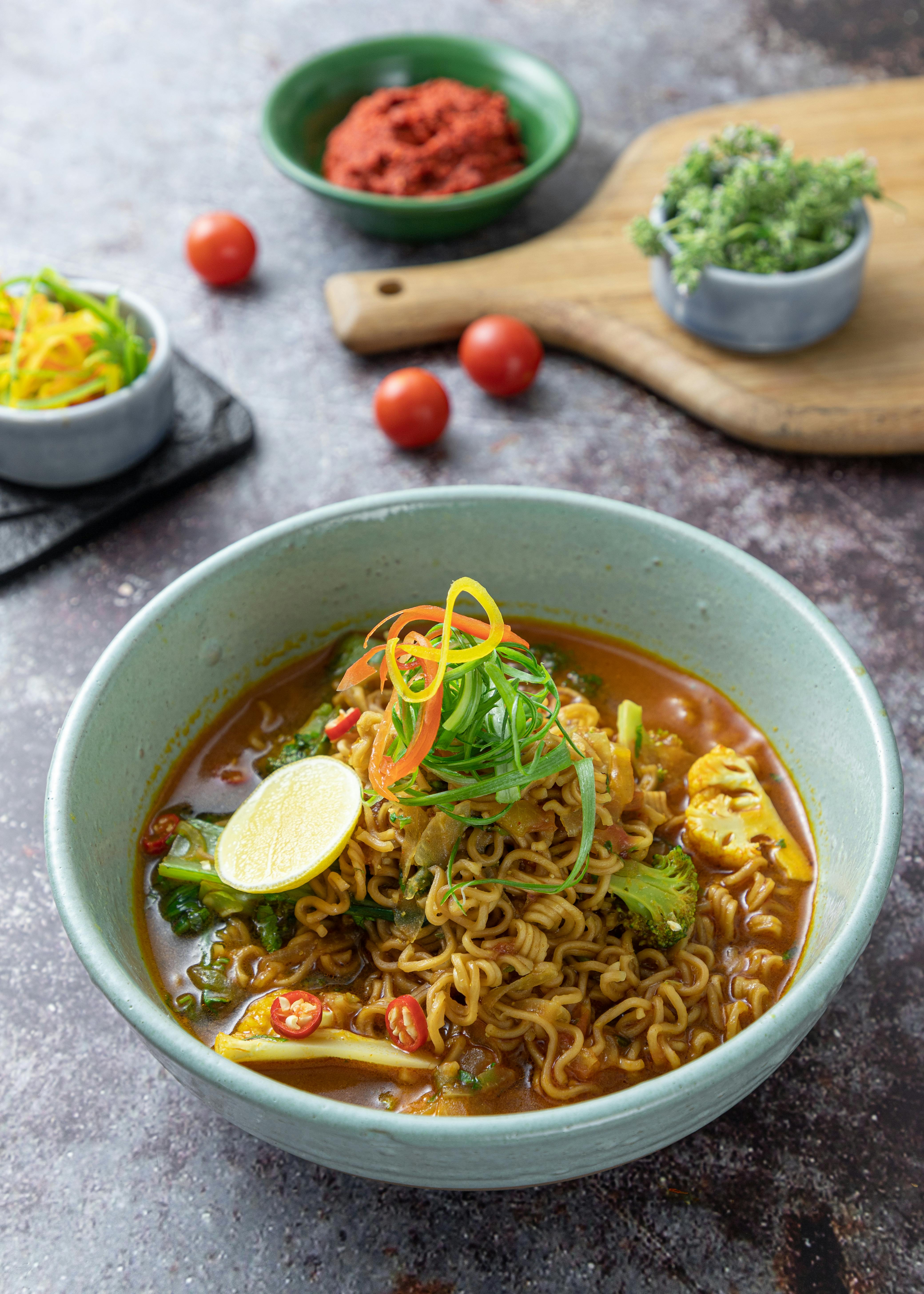
The diets react (see scores below)
Common Ingredients
- wheat noodles
- chicken
- onion
- garlic
- ginger
- tomato
- carrot
- cabbage
- cilantro
- cumin
Specific recipes may vary.
Incompatible with 6 of 11 diets
Diet Ratings
Thukpa is fundamentally incompatible with a ketogenic diet due to its primary ingredient: wheat noodles. Wheat noodles are a high-carbohydrate grain product that can contain 40-60g of net carbs per serving, instantly exceeding the entire daily keto carb limit. The broth base with chicken, spices, and low-carb vegetables (garlic, ginger, cumin, cilantro, cabbage) would otherwise be keto-friendly, but the noodles are non-negotiable and disqualifying. Carrots and tomatoes also add moderate carbs, compounding the issue. This dish cannot be made keto-compatible without fundamentally replacing the noodles with a keto alternative (e.g., shirataki or zucchini noodles), which would make it a different dish entirely.
Thukpa in this preparation contains chicken, which is animal flesh and a clear violation of vegan dietary principles. There is no ambiguity here — chicken is an animal product, making this dish entirely incompatible with a vegan diet. The remaining ingredients (wheat noodles, onion, garlic, ginger, tomato, carrot, cabbage, cilantro, cumin) are all plant-based and would be suitable for a vegan version, but the inclusion of chicken as the primary protein disqualifies this dish outright.
Thukpa is a Himalayan noodle soup whose defining ingredient is wheat noodles — a grain-based, processed food that is unambiguously excluded from the paleo diet. Wheat is a cereal grain that was not available to Paleolithic hunter-gatherers and contains gluten, lectins, and other anti-nutrients that paleo principles specifically reject. The remaining ingredients (chicken, onion, garlic, ginger, tomato, carrot, cabbage, cilantro, cumin) are all paleo-compliant, but the wheat noodles are the structural core of the dish and cannot be omitted without fundamentally changing it. There is unanimous consensus across all major paleo authorities — Loren Cordain, Mark Sisson, Robb Wolf — that wheat and wheat-derived products are a hard exclusion.
Thukpa is a Himalayan noodle soup with a generally healthy profile, but it sits in 'caution' territory under Mediterranean diet principles. The vegetable-rich base (onion, garlic, ginger, tomato, carrot, cabbage) and aromatic spices (cumin, cilantro) align well with Mediterranean emphasis on plant-forward eating. Chicken as the protein is acceptable in moderation (a few times per week). However, wheat noodles are likely refined rather than whole grain, which conflicts with the Mediterranean preference for whole grains. There is no olive oil as the primary fat (the dish traditionally uses neutral oils or butter). Overall, it is a moderately compatible dish that could be improved by using whole-grain noodles and cooking in olive oil.
Some Mediterranean diet practitioners would view this soup more favorably, noting that the overall dish is minimally processed, vegetable-dense, and uses lean poultry — qualities that mirror traditional Mediterranean soups like minestrone or avgolemono. If wheat noodles are assumed to be whole-wheat and olive oil is used in preparation, the score could rise to the lower 'approve' range.
Thukpa is a Nepali noodle soup that is fundamentally incompatible with the carnivore diet. The dish is built around wheat noodles, a grain-based food that is strictly excluded. Beyond the noodles, the recipe is loaded with plant foods: onion, garlic, ginger, tomato, carrot, cabbage, cilantro, and cumin. While chicken is a carnivore-compatible protein, it is merely one ingredient in a dish that is overwhelmingly plant-based and grain-based. No amount of modification would make this dish carnivore — it would need to be completely reconstructed from scratch, retaining only the chicken.
Thukpa contains wheat noodles, which are a grain product and explicitly excluded on the Whole30 program. Grains (including wheat) are banned for the full 30 days. Additionally, noodles are specifically listed in the program's Rule 4 as a food that cannot be recreated or consumed even with compliant ingredients. All other ingredients — chicken, onion, garlic, ginger, tomato, carrot, cabbage, cilantro, and cumin — are fully Whole30 compliant, but the wheat noodles are a hard disqualifier.
Thukpa contains multiple high-FODMAP ingredients that make it unsuitable during the elimination phase. Wheat noodles are high in fructans and are a primary FODMAP trigger. Onion and garlic are among the highest-FODMAP foods tested by Monash University, both rich in fructans, and are used as foundational flavor bases in this dish — not incidental trace amounts. Together, these three ingredients alone are sufficient to classify this dish as high-FODMAP at any standard serving. Tomato is low-FODMAP at small servings (up to 65g) but can become moderate at larger amounts. Cabbage is low-FODMAP at small portions. Carrot, ginger, cilantro, cumin, and chicken are all low-FODMAP and non-problematic. However, the wheat noodles, onion, and garlic represent unavoidable, structurally integral components of Thukpa that cannot be simply reduced to a safe portion — the dish would not be recognizable without them.
Thukpa is a Nepali noodle soup that aligns well with DASH diet principles in its traditional home-cooked form. The dish features lean chicken as the primary protein, an abundance of vegetables (onion, tomato, carrot, cabbage, cilantro), and anti-inflammatory aromatics (garlic, ginger, cumin). Wheat noodles provide carbohydrates and some fiber, though whole-grain noodles would score higher. The vegetable load contributes potassium, magnesium, and fiber consistent with DASH emphasis. The primary concern is sodium — restaurant or packaged versions may use added salt, soy sauce, or bouillon cubes that can push sodium content well above DASH targets. Home-prepared Thukpa with controlled salt and no high-sodium condiments is genuinely DASH-compatible. The absence of saturated fats, added sugars, processed ingredients, or tropical oils is a strong positive. Overall, this dish is a solid DASH-friendly option when prepared with sodium awareness.
NIH DASH guidelines broadly endorse vegetable-rich soups with lean protein as core DASH foods, supporting an approve rating. However, updated clinical interpretation notes that soups — including home-cooked versions — can accumulate significant sodium through broth preparation and table salt, and wheat noodles (refined vs. whole grain) may reduce fiber quality; some DASH clinicians would assign 'caution' unless whole-grain noodles and explicit low-sodium preparation are confirmed.
Thukpa is a Nepali noodle soup with a solid Zone foundation but one notable concern: wheat noodles. The dish features lean chicken (excellent Zone protein), a strong lineup of low-glycemic vegetables (onion, garlic, ginger, tomato, carrot, cabbage, cilantro), and anti-inflammatory spices (cumin, ginger, garlic). These components align well with Zone principles. The problem is the wheat noodles, which are a higher-glycemic, refined carbohydrate — classified as 'unfavorable' in Zone terminology. In a typical Thukpa serving, noodles dominate the carb block, pushing the glycemic load higher than Zone prefers and potentially disrupting the 40/30/30 ratio if portioned generously. However, because Thukpa is a broth-based soup, the noodle quantity can be meaningfully reduced while increasing vegetable volume, making Zone-compatible adjustment feasible. With controlled noodle portions (roughly 1/4 to 1/3 cup cooked), balanced chicken protein (~3 oz), and a small drizzle of olive oil, Thukpa can be restructured into a reasonable Zone meal. The dish is not inherently incompatible — it just requires intentional portioning of the noodle component.
Some Zone practitioners and later Sears writings take a more lenient view of whole wheat noodles in small portions, particularly in the context of a vegetable-rich broth soup where the overall glycemic load is moderated by fiber from cabbage, carrot, and tomato. In this reading, Thukpa with reduced noodles could earn a low 'approve' rating (7) given its strong anti-inflammatory spice profile and lean protein base.
Thukpa is a Himalayan noodle soup with a genuinely mixed anti-inflammatory profile. On the positive side, the ingredient list is rich in anti-inflammatory staples: garlic and ginger are well-documented inflammation modulators (gingerols, allicin), tomato contributes lycopene, carrot provides beta-carotene, cabbage and onion offer flavonoids and quercetin, cilantro has antioxidant polyphenols, and cumin contains thymoquinone with anti-inflammatory properties. Chicken is a lean protein — acceptable in moderate quantities under anti-inflammatory frameworks. The broth-based format is also inherently healthier than heavy cream or fried preparations. The main limiting factor is the wheat noodles: refined wheat noodles are a refined carbohydrate with a moderate-to-high glycemic load, contributing to postprandial blood glucose spikes that can drive inflammatory markers. If made with whole wheat noodles, the score would rise closer to 7-8. The vegetable-to-noodle ratio matters significantly — a vegetable-heavy bowl is considerably more favorable than a noodle-heavy one. Overall, this is a moderately anti-inflammatory dish that scores better than most noodle soups due to its spice and vegetable foundation, but the refined noodle base prevents a full approval.
Some anti-inflammatory practitioners, particularly those following stricter gluten-aware or low-glycemic protocols (such as Dr. David Perlmutter's grain-brain approach), would flag wheat noodles as pro-inflammatory regardless of their refined vs. whole grain status, potentially downgrading this to a low 'caution' or even 'avoid.' Conversely, Dr. Weil's pyramid and mainstream anti-inflammatory nutrition consider whole grains acceptable, and a broth-heavy, vegetable-loaded preparation like Thukpa would likely earn a qualified approval in that framework.
Thukpa is a Nepali noodle soup with a generally GLP-1-friendly profile, but earns a caution rating due to the wheat noodles. The broth-based format is excellent — easy to digest, high water content, and small portions are naturally satisfying. Chicken provides meaningful lean protein (15–25g depending on portion size). The vegetable mix (cabbage, carrot, onion, tomato) adds fiber, micronutrients, and water content. Garlic, ginger, and cumin are gentle on digestion and may actually support GI comfort. The main drawback is the wheat noodles: refined wheat noodles are low in fiber and protein relative to calories, and represent a less nutrient-dense carbohydrate source. They also contribute to a higher glycemic load. The dish is not high-fat, not fried, and not spicy, which are all positives. Overall it is a reasonable choice — especially if noodle portion is kept modest and chicken portion is generous — but it falls short of an approve rating due to the refined carbohydrate content displacing higher-value macronutrients in a small-appetite meal context.
Some GLP-1-focused dietitians would rate this higher, noting that broth-based soups are among the most GI-tolerated formats for patients experiencing nausea, and that the overall dish is far superior to most alternatives patients reach for. Others would caution that wheat noodles, even in soup, may cause bloating in patients experiencing slowed gastric emptying, and recommend substituting with lentil or chickpea pasta to improve both protein and fiber density.
*See how scores were generated at our methodology page.
Nutritional profile
Six traits that cut across every diet.
Fiber & Plants
How much whole-plant food and fiber it delivers.
Healthy Fats
The quality of its fats (unsaturated, omega-3).
Whole / Unprocessed
How close it is to its natural, unprocessed form.
Gut Gentle
How easy it is on digestion (low FODMAP, few irritants).
Low Glycemic
How little it spikes your blood sugar.
Protein Density
How much protein it packs per calorie.
Controversy Index
Higher controversy = more disagreement between diets.
Diet-Specific Tips
 Mediterranean — 5/10
View tips
- Abundant vegetables (onion, garlic, tomato, carrot, cabbage) strongly align with Mediterranean principles
- Chicken is an acceptable moderate-consumption protein
- Wheat noodles are likely refined, not whole grain — a notable drawback
- No olive oil specified as cooking fat — primary fat source unclear
- Aromatic spices (cumin, ginger, cilantro) are Mediterranean-compatible and add flavor without added sugars or salt
- Minimally processed, whole-food ingredients overall
 DASH — 8/10
View tips
- Lean chicken protein — aligns with DASH lean meat recommendations
- High vegetable variety (carrot, cabbage, tomato, onion) — contributes potassium, fiber, and micronutrients
- Aromatics (garlic, ginger, cumin) add flavor without sodium, supporting salt reduction
- Wheat noodles — refined grain is less ideal than whole grain; fiber content lower than DASH optimal
- Sodium risk — restaurant or salted broth preparations may exceed DASH sodium limits; home cooking with minimal salt is preferred
- No saturated fat sources, no added sugar, no processed or tropical oil ingredients
- Broth base provides hydration and is naturally low in calories
 Zone — 6/10
View tips
- Wheat noodles are a higher-glycemic 'unfavorable' carbohydrate in Zone terminology, requiring strict portion control
- Lean chicken is an ideal Zone protein source, scoring well against the 7g-per-block protein target
- Vegetable array (carrot, cabbage, tomato, onion) is Zone-favorable and provides low-glycemic carb blocks with fiber
- Broth-based format allows easy adjustment of noodle-to-vegetable ratio to improve Zone compliance
- Anti-inflammatory ingredients (ginger, garlic, cumin, cilantro) align with Sears' polyphenol and omega-3 anti-inflammatory framework
- No added fat is listed — a small addition of olive oil or avocado would be needed to complete the Zone fat block
 Anti-Inflammatory — 6/10
View tips
- Wheat noodles (refined carbohydrates) are the main inflammatory concern — glycemic load depends on portion size and noodle type
- Ginger is a potent anti-inflammatory ingredient (gingerols inhibit COX-2 enzymes)
- Garlic provides allicin with documented anti-inflammatory and immune-modulating effects
- Tomato, carrot, and cabbage contribute antioxidants (lycopene, beta-carotene, quercetin, vitamin C)
- Cumin contains thymoquinone, associated with reduced inflammatory markers in research
- Lean chicken is an acceptable moderate protein under anti-inflammatory guidelines
- Broth-based format is inherently lower in saturated fat than cream- or butter-heavy preparations
- No processed ingredients, seed oils, added sugars, or trans fats present
- Dish quality improves substantially if whole wheat or grain noodles are substituted
 GLP-1 Friendly — 6/10
View tips
- Broth-based format supports hydration and easy digestibility
- Lean chicken protein is GLP-1 appropriate
- Vegetable mix adds fiber and micronutrient density
- Wheat noodles are low fiber and lower protein density per calorie
- No frying, no high-fat ingredients, not heavily spiced
- Portion control important — noodle-to-protein ratio should favor chicken
- High water content supports GLP-1 hydration needs