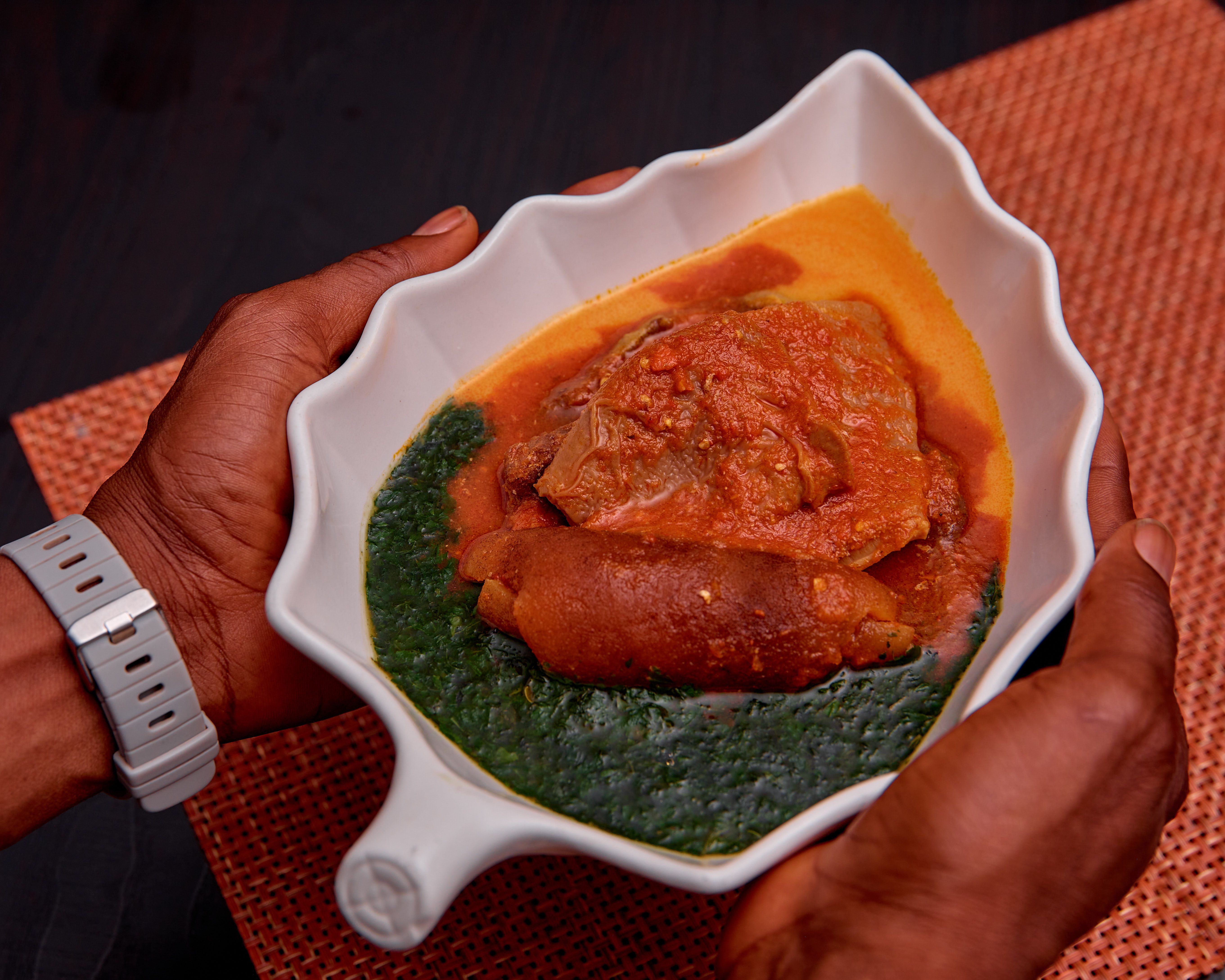
Photo: Tochukwu Ekeh / Pexels
Nigerian
Amala and Ewedu
The diets react (see scores below)
Common Ingredients
- yam flour
- jute leaves
- locust beans
- crayfish
- scotch bonnet peppers
- tomatoes
- palm oil
- onion
Specific recipes may vary.
Incompatible with 6 of 11 diets
Diet Ratings
Amala and Ewedu is fundamentally incompatible with a ketogenic diet. The primary component, Amala, is made from yam flour — a starchy, high-carbohydrate ingredient that delivers an extremely high glycemic load. A standard serving of Amala alone can contain 50-80g or more of net carbs, which single-handedly exceeds the entire daily carb allowance for ketosis. The Ewedu soup base (jute leaves, locust beans, crayfish, palm oil) contains ingredients that are individually more keto-friendly, but they cannot offset the massive carb burden of the yam flour. Tomatoes, onions, and scotch bonnet peppers add small additional carb contributions. There is no realistic portion of this dish that would keep a person within the 20-50g daily net carb threshold.
This dish contains crayfish, which is a dried seafood ingredient (an animal product) commonly used in West African cooking for umami depth. Despite the otherwise plant-based ingredient list — yam flour, jute leaves, locust beans, vegetables, and palm oil — the inclusion of crayfish makes this dish non-vegan. Crayfish are crustaceans and clearly fall under the exclusion of all animal products in a vegan diet. The traditional preparation of Amala and Ewedu almost universally includes crayfish and sometimes meat-based stock as well. A vegan adaptation would need to omit the crayfish and substitute with a plant-based umami source such as additional locust beans, mushroom powder, or seaweed.
Amala and Ewedu fails paleo standards primarily due to yam flour, which is a processed grain-like flour product made from dried yams. While whole yams/tubers are generally paleo-approved, yam flour is a heavily processed derivative that contradicts paleo philosophy — analogous to how whole potatoes are debated but potato flour would be avoided. Locust beans (fermented African carob seeds) are a legume product and are strictly excluded under paleo rules. The remaining ingredients — jute leaves (ewedu), crayfish, scotch bonnet peppers, tomatoes, palm oil, and onion — are paleo-compatible. However, the two core components of this dish (yam flour and locust beans) are clear paleo violations, making the overall dish a firm avoid.
Amala and Ewedu is a whole-food, plant-forward Nigerian dish with several Mediterranean-compatible elements. Jute leaves (ewedu) are a nutrient-dense leafy green similar to vegetables celebrated in Mediterranean cuisine. Tomatoes, onions, and scotch bonnet peppers align well with the vegetable-heavy emphasis. Locust beans are a fermented legume product, broadly compatible with the legume pillar of the diet. However, palm oil is the primary fat used rather than extra virgin olive oil — this is the main point of tension, as palm oil is high in saturated fat and not part of Mediterranean tradition. Yam flour (amala) is a refined starchy carbohydrate, somewhat analogous to white rice or white bread, and modern Mediterranean guidelines prefer whole grains. Crayfish (dried/ground seafood) is a modest positive, aligning with seafood inclusion. Overall, the dish is whole-food, minimally processed, and vegetable-rich, but the palm oil and refined yam flour prevent a full approval.
Some Mediterranean diet researchers emphasize the broader pattern of whole-food, plant-centered eating over specific regional ingredients, and would note that palm oil, while not traditional to the Mediterranean basin, is a plant-derived fat used in traditional cuisines. From this perspective, the dish's emphasis on leafy greens, legumes, and vegetables could warrant a more favorable score, especially compared to heavily processed Western foods.
Amala and Ewedu is entirely plant-based and incompatible with the carnivore diet. Amala is made from yam flour, a starchy plant-derived carbohydrate. Ewedu is a soup made from jute leaves (a leafy plant). The dish also contains locust beans (a legume-based fermented condiment), scotch bonnet peppers, tomatoes, and onion — all plant foods strictly excluded on carnivore. Palm oil, while a fat, is plant-derived and also excluded. Crayfish is the only animal-derived ingredient present, but it plays a minor seasoning role in an otherwise fully plant-based dish. There is no meaningful animal protein source. Every core component violates carnivore diet principles.
Amala is made from yam flour (specifically dried and ground yam, which is Whole30-compliant as a root vegetable) — however, the critical issue is locust beans (also known as iru or dawadawa). Locust beans are a legume, and legumes are explicitly excluded on Whole30. They are a foundational seasoning in this dish and cannot simply be omitted without fundamentally changing the recipe. The remaining ingredients — jute leaves, crayfish, scotch bonnet peppers, tomatoes, palm oil, and onion — are all Whole30-compliant. However, the presence of locust beans as a core ingredient makes this dish non-compliant as traditionally prepared.
Amala and Ewedu contains multiple high-FODMAP ingredients that make it unsuitable during the elimination phase. The most significant offenders are: (1) Onion — one of the highest-fructan foods tested by Monash, problematic even in small amounts; (2) Locust beans (iru/dawadawa) — a fermented legume condiment high in GOS and fructans, not specifically tested by Monash but recognized as high-FODMAP by practitioners; (3) Yam flour (used to make amala) — yam itself is rated low-FODMAP by Monash at ~75g, but the concentrated flour form and typical serving sizes of amala (a dense dough ball) likely exceed safe thresholds. Jute leaves (ewedu) have limited Monash data but are generally considered low-risk as a leafy green. Crayfish, palm oil, scotch bonnet peppers, and tomatoes are generally low-FODMAP at standard servings. However, the combination of onion and locust beans alone makes this dish high-FODMAP regardless of other ingredients.
Monash University has not specifically tested locust beans or amala (yam flour dough) in the standard quantities consumed in Nigerian cuisine, so exact FODMAP loads are uncertain. Some clinical FODMAP practitioners may consider this dish borderline if onion is omitted and locust beans are minimized, but standard preparation as described clearly presents multiple FODMAP risks.
Amala and Ewedu is a traditional Nigerian dish with a mixed DASH profile. On the positive side, jute leaves (ewedu) are highly nutritious, rich in calcium, potassium, magnesium, iron, and fiber — strongly aligned with DASH principles. Yam flour (amala) is a whole-food starch source providing fiber and potassium. Tomatoes, onions, scotch bonnet peppers, and locust beans add micronutrients and antioxidants. However, the dish has two notable DASH concerns: (1) Palm oil is a tropical oil high in saturated fat, which DASH explicitly limits — its inclusion flags this dish for caution. (2) Locust beans (iru/dawadawa) and crayfish are both high-sodium fermented/dried ingredients commonly used in significant quantities, pushing sodium content up considerably. The combination of these two factors — saturated fat from palm oil and elevated sodium from fermented/dried seafood and locust beans — prevents an 'approve' rating despite the dish's many nutritious components. With palm oil reduced or replaced with a vegetable oil, and sodium-contributing ingredients moderated, this dish could approach DASH-approval.
NIH DASH guidelines categorically limit tropical oils like palm oil due to saturated fat content; however, some updated clinical interpretations note that red palm oil (unlike palm kernel oil) contains beta-carotene and tocotrienols and that its saturated fat is predominantly palmitic acid, which some researchers argue has a more neutral cardiovascular impact than lauric acid — a minority of DASH-oriented dietitians in African dietary contexts may permit small amounts rather than full exclusion.
Amala and Ewedu presents a mixed Zone Diet profile. Amala, made from yam flour (dried yam), is a high-glycemic, starchy carbohydrate that would be classified as 'unfavorable' in Zone terminology — it produces a rapid blood sugar response similar to other refined starch products. The ewedu soup component (jute leaves) is actually Zone-favorable: jute leaves are a nutrient-dense, low-glycemic leafy green rich in polyphenols and anti-inflammatory compounds that Sears would appreciate. Locust beans provide some protein and fermented polyphenols. Crayfish adds modest lean protein. Tomatoes, peppers, and onions are favorable Zone carbohydrate sources. However, palm oil is a significant concern — it is high in saturated fat (palmitic acid), which conflicts with Zone's emphasis on monounsaturated fats and anti-inflammatory eating, though Sears' later writings acknowledge that saturated fat is less villainized than trans fats. The dish's macro balance is skewed: it is predominantly carbohydrate-heavy from the amala with insufficient protein (no primary protein listed) and the fat source is pro-inflammatory saturated fat rather than monounsaturated. To approach Zone compliance, the meal would need a lean protein addition (fish, chicken), significantly reduced amala portions, and ideally replacement or reduction of palm oil with olive oil. As presented, the dish is difficult to balance into the 40/30/30 ratio without substantial modification.
Some Zone-aware Nigerian diet practitioners argue that amala, while higher glycemic than ideal, is consumed with fiber-rich ewedu and protein sources like stewed meat or fish in traditional servings, which blunts the glycemic response. Sears' later Zone works (e.g., 'The Zone') acknowledge that whole-food starch sources in the context of a mixed meal with fiber and protein can be more manageable than their isolated glycemic index suggests. Additionally, palm oil contains tocotrienols and some carotenoids that have anti-inflammatory properties, and Sears' anti-inflammatory framework in later books softens his stance on all saturated fats. A practitioner emphasizing the polyphenol and vegetable richness of ewedu might rate this dish more favorably if protein is added.
Amala and Ewedu is a traditional Nigerian dish with a mixed anti-inflammatory profile. On the positive side, jute leaves (ewedu) are nutritionally dense, rich in beta-carotene, vitamins C and E, calcium, and chlorophyll — all with antioxidant and anti-inflammatory properties. Locust beans (iru) are a fermented ingredient that provides beneficial probiotics and bioactive compounds. Scotch bonnet peppers contain capsaicin, a well-documented anti-inflammatory compound. Tomatoes and onions contribute lycopene, quercetin, and other polyphenols. Crayfish adds a modest omega-3 contribution and umami depth. The main concern is palm oil: while it contains some beneficial antioxidants (tocotrienols, beta-carotene), it is high in saturated fat, which most anti-inflammatory protocols recommend limiting. The anti-inflammatory framework does not strictly prohibit palm oil, but it is not endorsed the way extra virgin olive oil is. Yam flour (amala) is a whole food starch with moderate fiber and a reasonable glycemic profile compared to refined grains, making it preferable to white bread or pasta, though not particularly anti-inflammatory in itself. Overall, this dish has genuine nutritional strengths from its vegetables, fermented ingredients, and spices, offset by the palm oil content and absence of an omega-3-rich protein.
Palm oil's role in an anti-inflammatory diet is debated. Many anti-inflammatory authorities (including Dr. Weil's framework) flag its high saturated fat content and omega-6 load as reasons to limit it, placing dishes heavy in palm oil in 'caution' or 'avoid' territory. However, a growing body of research highlights red palm oil's unique phytonutrient content — particularly tocotrienols and carotenoids — leading some nutritionists to view unrefined red palm oil as conditionally acceptable, similar to coconut oil discussions. The distinction between refined and unrefined palm oil matters significantly here.
Amala and Ewedu is a traditional Nigerian dish with a mixed nutritional profile for GLP-1 patients. Amala (yam flour) is a starchy, refined carbohydrate base that is low in protein and moderate in fiber, though its glycemic impact is somewhat mitigated by the resistant starch in dried yam flour. Ewedu (jute leaves) is a genuine positive — it is high in fiber, rich in micronutrients (iron, calcium, folate), and contributes to the mucilaginous, easy-to-digest texture of the soup. Locust beans (iru) add a meaningful but small amount of plant-based protein and fiber. Crayfish contributes a modest protein boost. The primary concern is palm oil, a saturated fat that GLP-1 patients should limit due to its potential to worsen nausea, reflux, and bloating from slowed gastric emptying. Scotch bonnet peppers are a significant flag — they are among the hotter chili varieties and may worsen GLP-1-associated reflux and nausea in sensitive individuals. The dish is also low in total protein for a main meal, falling well short of the 15–30g per meal target with no primary protein source listed. It is portion-sensitive: a small serving of amala with ewedu is more manageable than a large portion of the starchy base. The dish is not fried and is easy to digest in moderate portions, which are points in its favor.
Some GLP-1-focused dietitians working with West African patient populations would argue this dish deserves more favorable consideration, as the ewedu provides genuine fiber and micronutrient value, the overall meal is not heavily processed, and cultural appropriateness of dietary guidance strongly affects adherence. Others would caution more firmly against the palm oil and scotch bonnet content, particularly in patients who are in early GLP-1 dose titration and experiencing peak GI side effects.
*See how scores were generated at our methodology page.
Nutritional profile
Six traits that cut across every diet.
Fiber & Plants
How much whole-plant food and fiber it delivers.
Healthy Fats
The quality of its fats (unsaturated, omega-3).
Whole / Unprocessed
How close it is to its natural, unprocessed form.
Gut Gentle
How easy it is on digestion (low FODMAP, few irritants).
Low Glycemic
How little it spikes your blood sugar.
Protein Density
How much protein it packs per calorie.
Controversy Index
Higher controversy = more disagreement between diets.
Diet-Specific Tips
 Mediterranean — 5/10
View tips
- Jute leaves (ewedu) are a highly nutritious leafy green, consistent with Mediterranean vegetable emphasis
- Palm oil replaces olive oil as primary fat — higher in saturated fat and not Mediterranean-traditional
- Yam flour (amala) is a refined carbohydrate; whole grain options are preferred in Mediterranean guidelines
- Locust beans are a fermented legume, broadly compatible with Mediterranean legume principles
- Tomatoes, onions, and peppers are core Mediterranean-compatible vegetables
- Crayfish (dried seafood) adds a small seafood component, positively aligned with Mediterranean principles
- No red meat, added sugars, or highly processed ingredients — whole-food profile is a positive
 DASH — 5/10
View tips
- Jute leaves (ewedu) are highly DASH-compatible: rich in potassium, calcium, magnesium, and fiber
- Palm oil is a DASH-restricted tropical oil high in saturated fat
- Locust beans (iru) are a fermented ingredient with high sodium content
- Crayfish is a dried/fermented seafood that adds significant sodium
- Yam flour provides complex carbohydrates and some fiber — acceptable whole-food starch
- Tomatoes, peppers, and onions are DASH-approved vegetables adding micronutrients
- No lean animal protein listed; dish is plant-forward which aligns with DASH
- Overall sodium load from fermented ingredients likely exceeds DASH thresholds as commonly prepared
- Substituting palm oil with canola or olive oil would significantly improve DASH score
 Zone — 4/10
View tips
- Amala (yam flour) is a high-glycemic, starchy carbohydrate classified as 'unfavorable' in Zone methodology
- Jute leaves (ewedu) are an excellent Zone-favorable vegetable: low-glycemic, nutrient-dense, anti-inflammatory polyphenols
- No primary protein source listed — the meal lacks the lean protein component essential for Zone balance
- Palm oil is high in saturated fat, conflicting with Zone's monounsaturated fat preference and anti-inflammatory goals
- Crayfish and locust beans provide small amounts of protein but insufficient to meet Zone's ~25g protein per meal target
- Tomatoes, peppers, and onions are Zone-favorable low-glycemic carbohydrate contributors
- Macro ratio is heavily skewed toward carbohydrates with inadequate protein and suboptimal fat quality
 Anti-Inflammatory — 5/10
View tips
- Jute leaves (ewedu) are rich in beta-carotene, vitamins C and E, and chlorophyll — strong anti-inflammatory antioxidants
- Locust beans (iru) are fermented, providing probiotics and bioactive anti-inflammatory compounds
- Scotch bonnet peppers contain capsaicin, a well-researched anti-inflammatory agent
- Tomatoes and onions contribute lycopene and quercetin (anti-inflammatory polyphenols)
- Palm oil is high in saturated fat, which anti-inflammatory protocols recommend limiting
- Crayfish provides a small omega-3 contribution
- Yam flour is a whole food carbohydrate with moderate fiber — preferable to refined starches but not actively anti-inflammatory
- No omega-3-rich protein source present to offset palm oil's saturated fat
 GLP-1 Friendly — 4/10
View tips
- Amala (yam flour) is a high-starch, low-protein refined carbohydrate base — poor protein density for a GLP-1 main meal
- No primary protein source listed; dish falls significantly short of the 15–30g per meal protein target
- Ewedu (jute leaves) is a high-fiber, nutrient-dense green — a strong positive for digestion and GLP-1 side effect management
- Locust beans and crayfish add modest protein and fiber but insufficient to meet GLP-1 protein priorities
- Palm oil is a saturated fat that may worsen GLP-1 side effects (nausea, bloating, reflux) — should be limited
- Scotch bonnet peppers are high-heat chili peppers that may exacerbate GLP-1-associated reflux and nausea
- Dish is not fried and ewedu has a soft, easy-to-digest texture — favorable for slowed gastric emptying
- Protein augmentation (e.g., adding fish, chicken, or beans) would significantly improve GLP-1 compatibility
- Portion sensitivity: small amala portion with ewedu-forward serving is more appropriate than a large starchy base