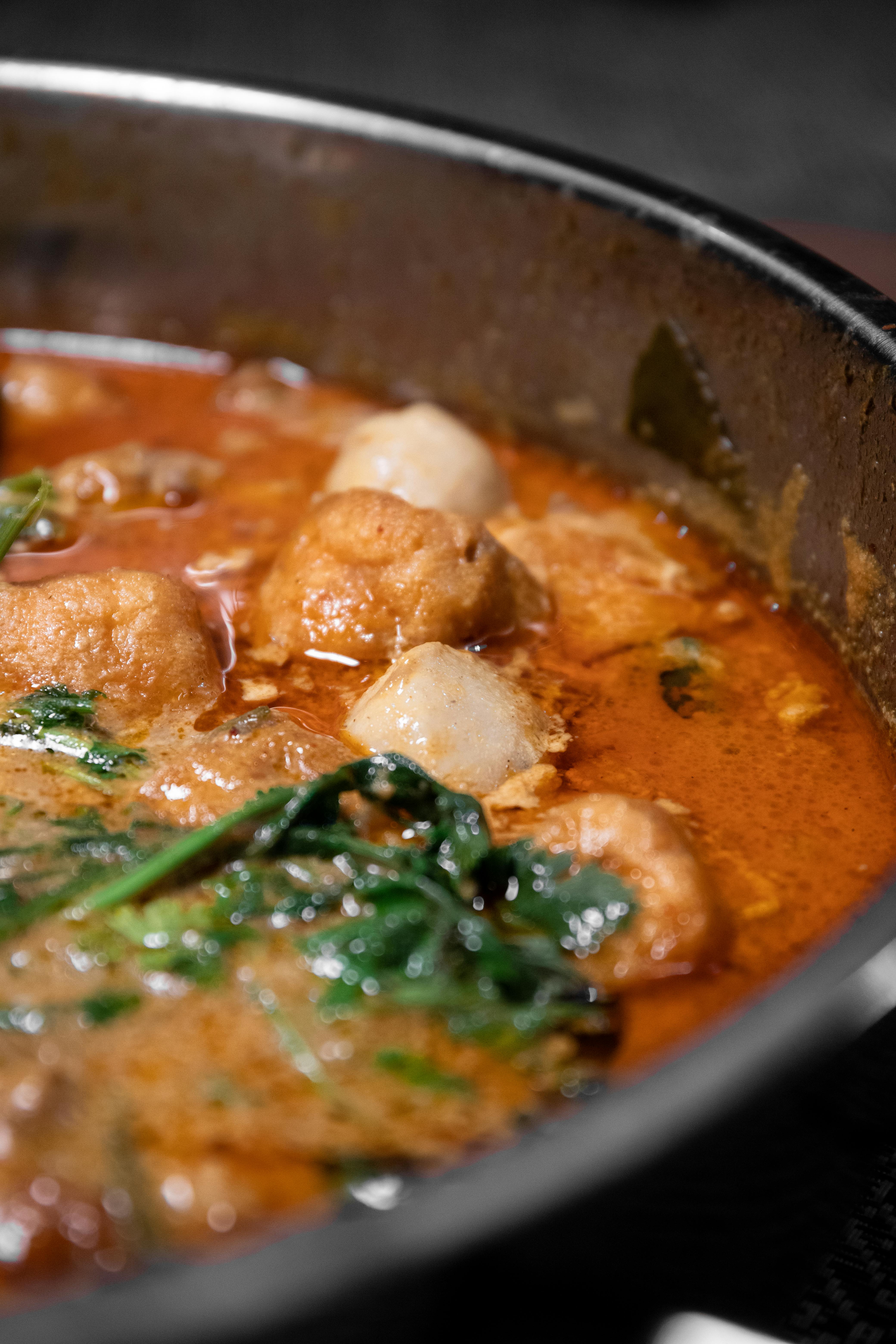
Photo: AMANDA LIM / Pexels
Nigerian
Banga Soup
The diets react (see scores below)
Common Ingredients
- palm nuts
- catfish
- beef
- crayfish
- banga spices
- scent leaf
- scotch bonnet peppers
- onion
Specific recipes may vary.
Incompatible with 6 of 11 diets
Diet Ratings
Banga Soup is built on a palm nut base, making it naturally very high in fat — one of the most keto-aligned cooking foundations possible. Palm nuts are rich in saturated fat with minimal net carbs. The dual protein sources (catfish and beef) fit well within keto macros. Crayfish, scent leaf, scotch bonnet peppers, and onion add micronutrients and flavor with only modest carb contributions. Banga spices (typically a blend of irugeje, oburunbebe stick, and similar botanicals) are used in small quantities and are generally low-carb. The main watch item is onion and scotch bonnet quantity — in typical soup amounts these stay well within keto limits. No grains, starchy thickeners, or added sugars are present in the traditional recipe. This dish is a strong keto candidate with no portion-control anxiety needed for the fat base.
Some strict keto practitioners flag palm oil-based dishes with caution due to concerns about the overall inflammatory profile of high saturated fat from palm sources, preferring olive or avocado oil. Additionally, very cautious keto adherents may question the cumulative carb load of scotch bonnet peppers and onion if used generously, arguing small portions of each ingredient can add up across a full bowl.
Banga Soup contains multiple animal products that are strictly excluded from a vegan diet. Catfish and beef are direct animal flesh, crayfish is a shellfish-derived ingredient commonly used as a seasoning in Nigerian cuisine, and together these make the dish entirely incompatible with veganism. The plant-based components — palm nuts, banga spices, scent leaf, scotch bonnet peppers, and onion — are all vegan-friendly, but they cannot offset the presence of three distinct animal-derived ingredients. There is no ambiguity here; this dish is clearly non-vegan.
Banga Soup is built on a foundation of whole, unprocessed ingredients that align well with paleo principles. Palm nuts (the base) are a natural whole fruit rich in healthy saturated fats — palm fruit oil is generally accepted in paleo circles as distinct from refined industrial seed oils. Catfish and beef provide clean animal protein, crayfish is a whole dried seafood ingredient, and the aromatics (scent leaf, scotch bonnet peppers, onion) are all paleo-approved vegetables and herbs. The 'banga spices' (typically ehuru/calabash nutmeg, oburunbebe stick, ataiko, and similar West African spices) are natural dried spices consistent with paleo. There are no grains, legumes, dairy, refined sugars, or seed oils present. The main consideration is salt — many traditional preparations add salt, which is discouraged in strict paleo. Assuming minimal or no added salt, this is a strong paleo-compliant dish.
Some strict paleo adherents question palm fruit products due to concerns about processing methods used to extract palm oil from the nuts, and the high saturated fat content. Additionally, 'banga spices' is an umbrella term and if any commercial spice blend contains additives, preservatives, or fillers, it would compromise paleo compliance.
Banga Soup is a traditional Nigerian dish with several conflicts with Mediterranean diet principles. The primary fat base is palm oil (extracted from palm nuts), which is high in saturated fat and is not part of the Mediterranean dietary tradition — extra virgin olive oil is the canonical fat source. The dish also combines both fish (catfish, which is positive) and beef (red meat, which should be limited to a few times per month) in the same preparation, compounding the red meat concern. On the positive side, the dish includes vegetables and aromatics (scent leaf, scotch bonnet peppers, onion), crayfish as a seafood element, and no refined grains or added sugars. However, the saturated-fat-heavy palm nut base and the inclusion of red meat alongside fish make this dish difficult to reconcile with core Mediterranean diet principles, particularly as a regular meal.
Some modern Mediterranean diet interpreters take a broader 'traditional whole-foods' view, noting that palm nuts are a minimally processed plant food and that the herb, spice, and vegetable profile of this dish aligns with plant-forward cooking. From this perspective, removing the beef and treating it as an occasional fish-and-vegetable soup might elevate its compatibility to 'caution' territory.
Banga Soup is fundamentally incompatible with the carnivore diet. While it does contain animal proteins (catfish and beef) and crayfish, the dish is built on a plant-derived base — palm nuts provide the primary fat and flavor foundation, which is a plant oil/fruit product entirely excluded from carnivore. Additionally, the recipe includes multiple plant-based ingredients: banga spices (plant-derived seasoning blend), scent leaf (a herb), scotch bonnet peppers, and onion. The majority of this dish's ingredients and its foundational character are plant-derived. Even the most lenient carnivore practitioners who tolerate spices and coffee would not accept palm nut broth, leafy herbs, hot peppers, and onions as a base. The animal ingredients (catfish, beef, crayfish) are carnivore-compatible, but they are minor components surrounded by disqualifying plant matter.
Banga Soup is a traditional Nigerian palm nut soup whose core ingredients are all Whole30-compatible. Palm nuts (and palm fruit extract/oil) are a natural fat and explicitly allowed. Catfish and beef are compliant proteins. Crayfish (dried/ground shrimp) is a whole seafood ingredient with no excluded additives. Scent leaf (African basil), scotch bonnet peppers, and onion are all vegetables/herbs that are fully compliant. The main area of caution is 'banga spices' — this is a proprietary spice blend that varies by brand and could include additives, anti-caking agents, or flavor enhancers. Label-reading is essential for any packaged banga spice mix. If made from scratch with individual spices (irugeje, oburunbebe stick, atama leaves, etc.), compliance is straightforward.
The term 'banga spices' refers to a blend that may be purchased pre-packaged; some commercial versions could contain non-compliant additives. Official Whole30 guidelines require checking all packaged spice blends for excluded ingredients. Community practitioners generally advise making spice blends from whole, individual spices to stay clearly within the program's spirit.
Banga Soup contains onion as a primary ingredient, which is high in fructans and must be avoided during the FODMAP elimination phase. Onion is one of the most significant FODMAP offenders with no safe low-FODMAP serving size when cooked into dishes (fructans leach into the broth/soup base). Additionally, 'banga spices' is a traditional spice blend that typically includes ingredients like oburunbebe stick, atama leaves, and other regional aromatics whose FODMAP status is largely untested by Monash University. The remaining core ingredients — palm nuts, catfish, beef, crayfish, scotch bonnet peppers, and scent leaf — are generally low-FODMAP or FODMAP-neutral. The dish could theoretically be modified (omitting onion, using only verified spices), but as traditionally prepared it is unsuitable for the elimination phase due to onion.
Monash University has not specifically tested many of the traditional banga spice blend ingredients, so their FODMAP contribution is uncertain — clinical FODMAP practitioners would likely advise avoidance of the full dish during elimination due to both the confirmed onion content and the unknown spice blend, while acknowledging the fish, beef, and palm nut base are inherently low-FODMAP.
Banga Soup is a Nigerian palm nut-based soup that poses significant concerns under DASH diet guidelines. The primary issue is palm nuts/palm oil, a tropical oil that is extremely high in saturated fat (approximately 50% saturated fat), which DASH explicitly limits. DASH guidelines specifically call out tropical oils — including palm and palm kernel oil — as foods to limit due to their adverse effects on LDL cholesterol and cardiovascular risk. Additionally, the inclusion of beef (red meat, high in saturated fat) alongside catfish compounds the saturated fat burden. Crayfish and banga spices can be very high in sodium. The combination of high saturated fat from palm nuts, red meat, and potentially high sodium from crayfish and spices makes this dish poorly aligned with DASH principles. Positive elements include the presence of catfish (lean fish), scent leaf (herb), scotch bonnet peppers (vegetable), and onions — but these are outweighed by the problematic core ingredients. The dish could be partially modified (replace palm nuts with tomato base, remove beef, use low-sodium seasonings), but as traditionally prepared it conflicts with core DASH restrictions.
NIH DASH guidelines explicitly restrict palm oil as a tropical oil high in saturated fat; however, some updated nutritional researchers note that the saturated fat profile of palm oil (rich in palmitic acid and tocopherols) may not affect cardiovascular outcomes as negatively as trans fats, and some DASH-oriented clinicians working with West African populations argue for culturally sensitive modifications that retain palm oil in small quantities rather than outright exclusion.
Banga Soup presents a mixed Zone Diet profile. On the positive side, it contains lean protein sources (catfish, crayfish) alongside some beef, low-glycemic vegetables and aromatics (scent leaf, scotch bonnet, onion), and anti-inflammatory polyphenol-rich spices. The carbohydrate load is relatively low, coming primarily from the vegetables and spices rather than starchy fillers — which is Zone-friendly. The primary concern is palm oil/palm nuts, which are extremely high in saturated fat (roughly 50% saturated fatty acids) and are used in significant quantities as the base of this soup. This conflicts with the Zone's preference for monounsaturated fats and its caution around saturated fat sources. Additionally, the beef adds further saturated fat load. The fat profile skews heavily toward saturated fat rather than the monounsaturated fats (olive oil, avocado, almonds) that Dr. Sears recommends. However, the soup does provide solid protein from multiple sources, minimal high-glycemic carbohydrates, and anti-inflammatory spices, making it workable in Zone with careful portioning — particularly by reducing palm nut quantity, controlling the beef portion, and pairing with a lean protein source to hit the 40/30/30 ratio.
Some Zone practitioners and later Sears writings acknowledge that not all saturated fats are equally problematic — palm oil contains palmitic acid, which has mixed research outcomes, and the rich polyphenol content of traditional Nigerian spices and the omega-3 contribution from catfish partially offset inflammatory concerns. Additionally, traditional Banga Soup is naturally low-carb, which aligns well with Zone macronutrient ratios. A practitioner emphasizing the anti-inflammatory and low-glycemic aspects of Zone might rate this more favorably, particularly if palm nut quantity is moderate.
Banga Soup presents a genuinely mixed anti-inflammatory profile. On the positive side, catfish provides lean protein and some omega-3s, and the spice blend is a standout — scotch bonnet peppers are rich in capsaicin (a well-documented anti-inflammatory compound), scent leaf (African basil) contains eugenol and other anti-inflammatory phytochemicals, and banga spices (typically including irugeje, oburunbebe, and atariko/alligator pepper) carry polyphenols and aromatic compounds with anti-inflammatory potential. Onion contributes quercetin. Crayfish adds umami and trace minerals. The key concern is palm nut oil, which is the soul of this dish. Palm fruit oil is high in saturated fat and palmitic acid, which research associates with activation of inflammatory pathways (TLR4 signaling). However, red palm oil — as derived from palm fruit rather than refined palm kernel oil — is meaningfully different: it contains significant tocotrienols (a form of vitamin E) and beta-carotene, both antioxidants, which partially offset its saturated fat burden. The second concern is the inclusion of beef, a red meat, alongside fish, which adds further saturated fat load. The combination of high saturated fat (palm oil + beef) tempers what would otherwise be a reasonably anti-inflammatory dish. Prepared with a smaller proportion of beef, the dish would score higher.
Red palm fruit oil is treated differently across anti-inflammatory frameworks. Dr. Weil and mainstream anti-inflammatory guidelines flag all high-saturated-fat oils, placing palm oil in the 'limit' category alongside butter. However, a notable dissenting camp — including functional medicine practitioners and researchers focused on traditional African dietary patterns — argues that unrefined red palm fruit oil's rich tocotrienol and carotenoid content gives it net anti-inflammatory properties distinct from refined palm kernel oil or other tropical saturated fats; Bruce Fife and ancestral diet advocates have made this case explicitly.
Banga soup is built on a palm nut base, which makes it inherently very high in saturated fat — palm pulp is roughly 50% saturated fat by composition, and traditional recipes use it in large quantities to form the thick, oily broth. This directly conflicts with GLP-1 dietary priority #3 (low fat per serving) and is likely to worsen nausea, bloating, and reflux, which are already common GLP-1 side effects. The scotch bonnet peppers add significant spice heat, further raising the risk of reflux and GI irritation in GLP-1 patients. On the positive side, the soup contains meaningful dual-protein sources (catfish and beef), crayfish adds micronutrient density, and scent leaf contributes antioxidants and digestibility support. However, the fat load from palm nuts and the spice intensity of scotch bonnets are disqualifying factors for most GLP-1 patients, particularly those in early treatment phases when GI side effects are most pronounced. The dish is not inherently low-nutrient — it is simply poorly matched to the GLP-1 physiological context.
Some GLP-1-focused dietitians working with West African patient populations may advocate for a modified version — reduced palm nut quantity, scotch bonnet adjusted to tolerance — arguing that cultural dietary continuity supports long-term adherence and that the protein content is clinically valuable. Others maintain that the saturated fat load from palm nuts is difficult to reduce sufficiently without fundamentally changing the dish, and that nausea risk alone warrants avoidance during active GLP-1 dose titration.
*See how scores were generated at our methodology page.
Nutritional profile
Six traits that cut across every diet.
Fiber & Plants
How much whole-plant food and fiber it delivers.
Healthy Fats
The quality of its fats (unsaturated, omega-3).
Whole / Unprocessed
How close it is to its natural, unprocessed form.
Gut Gentle
How easy it is on digestion (low FODMAP, few irritants).
Low Glycemic
How little it spikes your blood sugar.
Protein Density
How much protein it packs per calorie.
Controversy Index
Higher controversy = more disagreement between diets.
Diet-Specific Tips
 Keto — 8/10
View tips
- Palm nuts are extremely high in fat and very low in net carbs — ideal keto base
- Dual protein from catfish and beef supports moderate protein macros
- No grains, starchy vegetables, or added sugars in traditional recipe
- Scotch bonnet, onion, and scent leaf are low-carb in typical soup quantities
- Crayfish adds umami and nutrition with negligible carbs
- Banga spices used in trace amounts pose no meaningful carb concern
- Traditional preparation requires no thickeners or flour
 Paleo — 8/10
View tips
- Palm nuts are a whole natural fruit; palm fruit oil is generally paleo-accepted
- Catfish and beef are clean, unprocessed animal proteins
- Crayfish (dried whole seafood) is paleo-approved
- Scent leaf, scotch bonnet, and onion are paleo-compliant vegetables/herbs
- Banga spices are natural West African spices — paleo-friendly if no additives
- No grains, legumes, dairy, refined sugar, or seed oils present
- Added salt, if used, is technically discouraged in strict paleo
 Whole30 — 8/10
View tips
- Palm nuts/palm fruit are a natural, Whole30-compliant fat source
- Catfish and beef are compliant whole-food proteins
- Crayfish (dried ground shrimp) is a whole seafood ingredient — compliant
- Scent leaf, scotch bonnet, and onion are compliant vegetables and herbs
- Banga spices blend requires label scrutiny — commercial versions may contain non-compliant additives
- Dish is a traditional whole-food soup, not a recreation of a junk food or baked good
 Zone — 5/10
View tips
- Palm nuts/palm oil is the base — very high in saturated fat, conflicting with Zone's monounsaturated fat preference
- Catfish and crayfish are lean, Zone-favorable protein sources
- Beef adds additional saturated fat load; lean cuts would improve Zone compatibility
- Soup is naturally very low in carbohydrates — favorable for Zone macro ratios
- Scotch bonnet, onion, and scent leaf are low-glycemic, polyphenol-rich vegetables — Zone-approved
- No starchy carbohydrates in the dish, which is a Zone positive
- Anti-inflammatory spices support Zone's polyphenol-focus from Sears' later writings
- Portioning palm nut quantity is critical to managing the fat block and saturated fat intake
 Anti-Inflammatory — 5/10
View tips
- Palm nut oil is high in saturated fat (palmitic acid), which is associated with pro-inflammatory TLR4 pathway activation
- Unrefined red palm fruit oil contains tocotrienols and beta-carotene, which are antioxidants that partially offset saturated fat concerns
- Beef adds additional saturated fat burden alongside fish, worsening the omega-3 to saturated fat ratio
- Catfish provides lean protein and modest omega-3 fatty acids
- Scotch bonnet peppers are rich in capsaicin, a well-documented anti-inflammatory phytochemical
- Scent leaf (African basil) contains eugenol and anti-inflammatory polyphenols
- Onion contributes quercetin, an anti-inflammatory flavonoid
- Banga spices carry traditional anti-inflammatory aromatic compounds
- Crayfish is a whole food ingredient contributing minerals and umami with minimal inflammatory concern