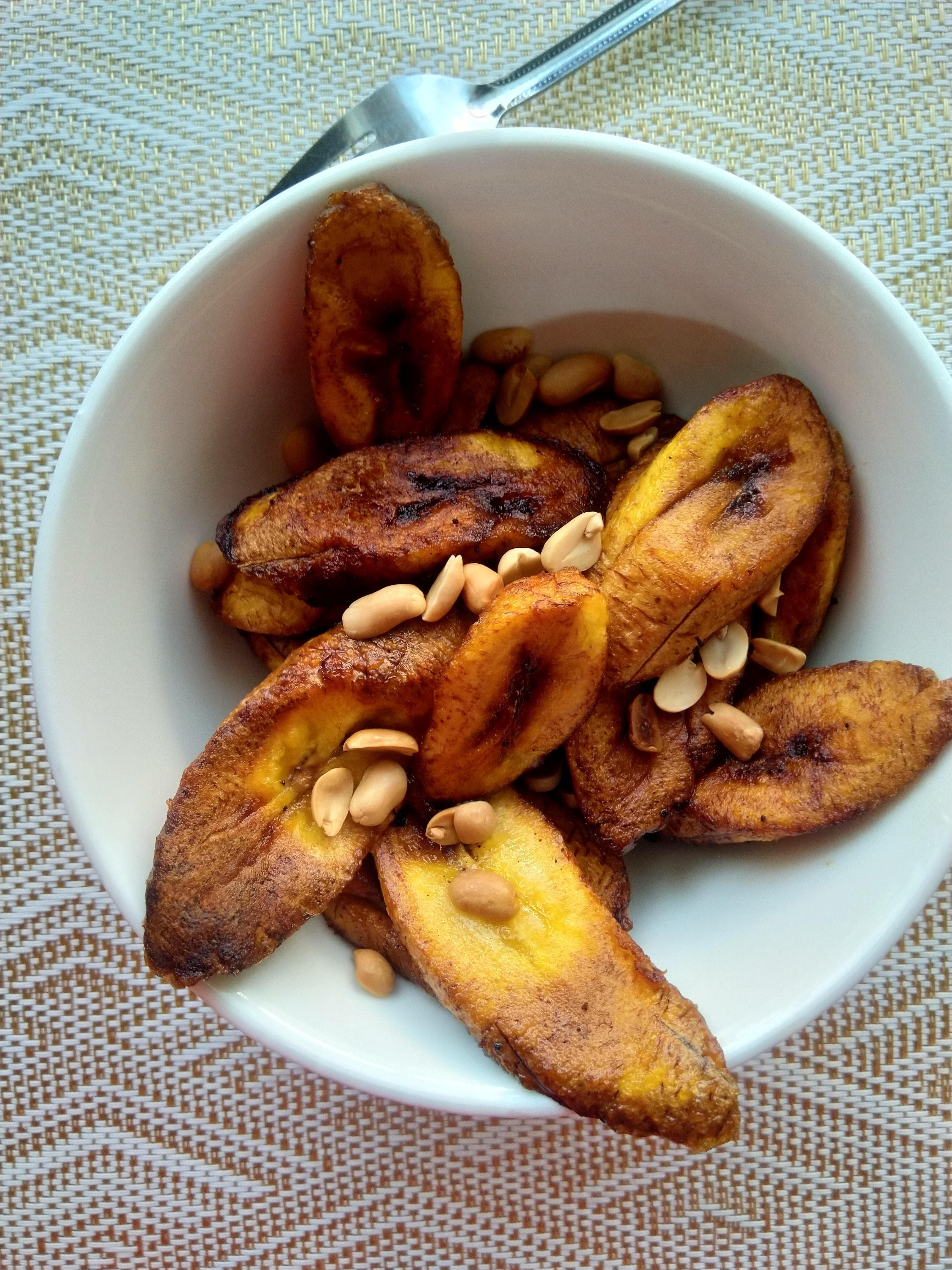
Photo: Ophelia Acquah / Pexels
The diets react (see scores below)
Common Ingredients
- plantains
- palm oil
- peppers
- onion
- groundnuts
- salt
Specific recipes may vary.
Incompatible with 5 of 11 diets
Diet Ratings
Boli is a Nigerian roasted plantain snack that is fundamentally incompatible with ketogenic eating. Plantains are the primary ingredient and are extremely high in net carbs — a single medium plantain contains approximately 50-55g of net carbs, which alone exceeds the entire daily keto carb budget. While the dish does contain some keto-friendly elements (palm oil, peppers, onion in small amounts, groundnuts), the plantain base is non-negotiable and disqualifying. No portion size of this dish can be made keto-compatible without fundamentally replacing the main ingredient.
Boli is a Nigerian street snack of roasted or grilled plantains, typically served with groundnuts (peanuts) and a pepper-onion sauce. All listed ingredients — plantains, peppers, onion, groundnuts, and salt — are fully plant-based, making this dish vegan-compliant at its core. The inclusion of palm oil, however, places it in the 'caution' zone for a notable portion of the vegan community. Palm oil is botanically plant-derived and contains no animal ingredients, but its production is heavily linked to deforestation, orangutan habitat destruction, and biodiversity loss — concerns that many ethical vegans consider incompatible with vegan values. The dish itself is otherwise a whole-food, minimally processed snack with strong nutritional merit (complex carbs from plantains, healthy fats and protein from groundnuts).
Many ethical vegans and vegan organizations such as Vegan Society formally classify palm oil as vegan since it contains no animal products, and argue that environmental harm, while serious, falls outside the strict definition of veganism. However, a significant minority of ethical vegans actively avoid palm oil on the grounds that its environmental destruction causes mass animal suffering and death, and consider its consumption incompatible with vegan principles.
Boli (roasted plantain served with groundnuts) contains three non-compliant ingredients that disqualify it from a paleo diet. Groundnuts (peanuts) are legumes — explicitly excluded from paleo. Added salt is discouraged under strict paleo guidelines. While plantains, palm oil, peppers, and onion are all paleo-compatible, the combination of groundnuts and salt makes this dish a clear avoid. The dish cannot be assessed in a modified form without fundamentally changing its character.
Boli is a Nigerian roasted plantain snack served with groundnuts and a pepper-onion sauce. Most ingredients align well with Mediterranean principles: plantains are a whole plant food rich in fiber and nutrients, groundnuts (peanuts) are legumes similar to other nuts and legumes emphasized in the diet, and peppers and onions are excellent vegetables. However, the use of palm oil is a significant point of divergence. Palm oil is high in saturated fat and is not part of the Mediterranean dietary tradition, where extra virgin olive oil is the canonical fat. The dish is otherwise whole-food, plant-based, minimally processed, and snack-portioned, which are all positives. The palm oil prevents a full approval, but the overall nutritional profile is reasonably compatible.
Some modern Mediterranean diet researchers argue that minimally processed, traditional plant-based dishes from non-Mediterranean cuisines can be considered compatible in spirit, and that small amounts of palm oil used in cooking do not negate the overall plant-forward, whole-food quality of the dish. Others, however, strictly apply the saturated fat criterion and would rate the palm oil use as a meaningful concern equivalent to using butter.
Boli is a Nigerian street food consisting entirely of plant-based ingredients: roasted plantains served with palm oil, peppers, onion, groundnuts (peanuts), and salt. There is not a single animal-derived ingredient in this dish. Plantains are starchy fruits, groundnuts are legumes, peppers and onions are vegetables, and palm oil is a plant-derived oil. Every component is explicitly excluded on the carnivore diet. This is unambiguously incompatible with carnivore eating principles at any tier.
Boli is a Nigerian roasted plantain snack served with groundnuts (peanuts) and a palm oil pepper sauce. While plantains, palm oil, peppers, onion, and salt are all Whole30-compliant ingredients, groundnuts (peanuts) are explicitly excluded on Whole30. Peanuts are legumes, and the Whole30 program explicitly bans all legumes including peanuts and peanut-derived products. Since groundnuts are a core, traditional component of this dish, the dish as described cannot be approved.
Boli is a Nigerian roasted/grilled plantain dish typically served with groundnuts (peanuts) and a pepper-onion sauce. The dish contains two significant high-FODMAP ingredients during the elimination phase: onion (high in fructans — one of the most potent FODMAP triggers) and groundnuts/peanuts (high in GOS at standard serving sizes per Monash, though low-FODMAP at very small portions like 32 small nuts/~28g). Plantains themselves are low-FODMAP at a moderate serving (Monash rates unripe plantain as low-FODMAP at around 75g), and palm oil, salt, and peppers are all low-FODMAP. However, the combination of onion in the pepper sauce and a standard serving of groundnuts makes this dish high-FODMAP as typically prepared and served. Omitting onion and limiting groundnuts would be necessary modifications, which fundamentally alter the dish.
Monash University rates peanuts/groundnuts as low-FODMAP at a small serving of ~32 small nuts (28g), so some FODMAP practitioners may consider a small portion of groundnuts acceptable; however, most clinical dietitians advise avoiding onion in any amount during elimination as it is one of the highest fructan-containing foods, and it is rarely used in small enough quantities to be safe.
Boli is a Nigerian roasted/grilled plantain snack served with groundnuts and a pepper-onion sauce. The dish has several DASH-friendly elements: plantains are rich in potassium, fiber, and complex carbohydrates; peppers and onions are DASH-approved vegetables; and groundnuts (peanuts) provide healthy unsaturated fats, protein, and magnesium. However, the inclusion of palm oil is a significant concern under DASH guidelines, as palm oil is a tropical oil high in saturated fat, which DASH explicitly limits. The salt content also requires monitoring. The overall dish is not heavily processed and contains no added sugars or red meat, but the palm oil prevents a full approval. If prepared with minimal palm oil and salt, this dish leans more favorably toward DASH principles due to its whole-food, plant-forward profile.
NIH DASH guidelines categorically advise against tropical oils like palm oil due to their saturated fat content. However, some updated clinical interpretations note that palm oil (particularly red palm oil) contains tocotrienols and beta-carotene, and that its saturated fat composition (predominantly palmitic acid) may have a more neutral cardiovascular effect than lauric acid-heavy oils like coconut oil — some DASH-oriented dietitians in West African dietary contexts allow small amounts without strict exclusion.
Boli is a Nigerian roasted or grilled plantain snack, typically served with groundnuts (peanuts) and a pepper-onion sauce using palm oil. From a Zone perspective, this dish has several issues but also some redeeming qualities. Plantains are the dominant ingredient and are a higher-glycemic carbohydrate — Zone classifies them as 'unfavorable' carbs similar to bananas, with a notably higher glycemic load than most Zone-approved vegetables or low-GI fruits. A typical serving of plantain is carbohydrate-dense and would require careful portioning. Palm oil is saturated fat (primarily palmitic acid), which Zone diet — especially in Sears' earlier writings — discourages in favor of monounsaturated fats like olive oil. Groundnuts (peanuts) add some protein and monounsaturated fat (oleic acid), partially redeeming the fat profile. Peppers and onions are Zone-favorable low-glycemic vegetables providing polyphenols. The snack also has no direct lean protein source, making it difficult to hit the 40/30/30 ratio without pairing it with a protein like grilled chicken or a boiled egg. The combination of high-glycemic plantain, saturated palm oil, and absent lean protein makes this a 'caution' Zone food, usable in small portions but requiring significant modification or pairing to approach Zone balance.
Some later Zone practitioners and Sears' anti-inflammatory framework (The OmegaRx Zone, Zone Perfect Meals in Minutes) acknowledge that palm oil's saturated fat profile is more nuanced than seed oils — it contains tocotrienols (vitamin E forms) with some anti-inflammatory properties. Additionally, green/unripe plantains have a lower glycemic index than ripe yellow ones; if Boli is made with less-ripe plantains, the glycemic impact is meaningfully reduced. Groundnuts also add monounsaturated fat and some protein, partially supporting Zone ratios. A strict Sears purist would rate this lower; a more flexible Zone practitioner might accept small portions of Boli with a protein side as a reasonable snack.
Boli is a Nigerian roasted/grilled plantain snack typically served with groundnuts and a pepper-onion sauce, sometimes brushed with palm oil. The profile is mixed from an anti-inflammatory standpoint. Plantains are a whole, unprocessed starchy fruit with meaningful fiber, potassium, vitamins A and C, and moderate antioxidant content — a reasonable carbohydrate source. Groundnuts (peanuts) provide protein, fiber, resveratrol, and some anti-inflammatory polyphenols, and are generally considered acceptable to beneficial in anti-inflammatory frameworks. Peppers and onions are colorful vegetables rich in flavonoids (quercetin in onion, capsaicin and vitamin C in peppers), both positively regarded. Salt is neutral at moderate amounts. The main concern is palm oil. Red/unrefined palm oil contains carotenoids (beta-carotene) and tocotrienols and is sometimes distinguished from refined palm oil in nutritional discussions — however, it is high in saturated fat (palmitic acid), which most anti-inflammatory guidelines recommend limiting. Dr. Weil's framework specifically cautions saturated fats, and palmitic acid has been linked to activation of inflammatory pathways (TLR4) in cellular research. If this dish uses only a small amount of palm oil as a brush or condiment, the overall profile tilts more neutral-to-positive; if heavily coated, the saturated fat burden becomes more significant. Overall, this is a mostly whole-food snack with one notable inflammatory ingredient, landing it firmly in the caution zone.
Some nutritionists, particularly those with an African food heritage lens and those studying traditional diets, argue that unrefined red palm oil is nutritionally distinct from refined palm oil and its carotenoid and tocotrienol content may offset some inflammatory concerns — a view supported by researchers like Dr. Kerin O'Dea who emphasize food context in traditional diets. However, mainstream anti-inflammatory authorities including Dr. Weil classify palm oil as a saturated fat to limit, and most anti-inflammatory scoring systems (IF Rating) penalize it accordingly.
Boli is a Nigerian street snack of roasted or grilled plantain, typically served with groundnuts (peanuts) and a pepper-onion sauce. The plantain itself is a starchy, moderate-glycemic carbohydrate with some fiber and potassium but negligible protein. Groundnuts add meaningful unsaturated fat and modest protein, partially offsetting the lack of a primary protein source. Palm oil is high in saturated fat, which can worsen GLP-1 side effects such as nausea, bloating, and reflux — though the quantity used as a condiment or in the pepper sauce is typically small. The dish is not fried (roasted/grilled preparation), which improves its digestibility profile compared to fried plantain (dodo). Fiber from the plantain and peppers is a modest positive. The core problem for GLP-1 patients is that this snack is carbohydrate-dominant with very low protein density, meaning it consumes limited appetite capacity without meaningfully contributing to the 100–120g daily protein target. It is portion-sensitive: a small serving of plantain with a handful of groundnuts is more acceptable than a large portion. The snack is not a high-sugar, fried, or alcohol-containing food, so it does not meet the threshold for 'avoid,' but it falls short of 'approve' due to negligible protein and saturated fat from palm oil.
Some GLP-1-focused dietitians would permit boli as an occasional snack given its whole-food ingredients, reasonable fiber content, and grilled preparation, particularly if paired with extra groundnuts to boost protein and healthy fat. Others would flag the palm oil and high carbohydrate load as problematic for patients struggling with nausea or blood sugar management, recommending substitution with a higher-protein snack instead.
*See how scores were generated at our methodology page.
Nutritional profile
Six traits that cut across every diet.
Fiber & Plants
How much whole-plant food and fiber it delivers.
Healthy Fats
The quality of its fats (unsaturated, omega-3).
Whole / Unprocessed
How close it is to its natural, unprocessed form.
Gut Gentle
How easy it is on digestion (low FODMAP, few irritants).
Low Glycemic
How little it spikes your blood sugar.
Protein Density
How much protein it packs per calorie.
Controversy Index
Higher controversy = more disagreement between diets.
Diet-Specific Tips
 Vegan — 6/10
View tips
- All ingredients are plant-derived — no animal products present
- Palm oil inclusion triggers ethical debate within the vegan community over environmental harm and animal habitat destruction
- Plantains and groundnuts are whole, nutritious plant foods
- Peppers, onion, and salt are unambiguously vegan
- No processed or animal-derived additives listed
 Mediterranean — 5/10
View tips
- Plantains are whole plant foods with fiber and micronutrients, compatible with Mediterranean principles
- Groundnuts (peanuts) function similarly to nuts and legumes, which are strongly encouraged
- Peppers and onions are excellent Mediterranean-compatible vegetables
- Palm oil is high in saturated fat and not part of Mediterranean culinary tradition — olive oil is the prescribed fat
- No refined grains, added sugars, or processed ingredients
- Portion size as a snack limits overall palm oil exposure
 DASH — 5/10
View tips
- Plantains are potassium- and fiber-rich, strongly aligned with DASH principles
- Palm oil is a tropical oil high in saturated fat, explicitly limited by DASH guidelines
- Groundnuts provide healthy unsaturated fats, plant-based protein, and magnesium — DASH-approved
- Peppers and onions are DASH-friendly vegetables adding micronutrients
- Salt content should be minimized to stay within DASH sodium limits (<2,300mg/day)
- No added sugars, no red meat, no full-fat dairy — positives for DASH compliance
- Dish is minimally processed and whole-food based, favorable for DASH overall
 Zone — 4/10
View tips
- Plantains are high-glycemic 'unfavorable' carbs in Zone terminology, similar to bananas
- Palm oil is predominantly saturated fat, not Zone-preferred monounsaturated fat
- No lean protein source — fails Zone's protein-at-every-meal requirement
- Groundnuts contribute partial monounsaturated fat and modest protein
- Peppers and onions are Zone-favorable polyphenol-rich vegetables
- Ripe vs. unripe plantain matters significantly for glycemic load
- As a standalone snack, macronutrient ratio is heavily skewed toward carbohydrates and saturated fat
- Pairing with a lean protein source would improve Zone compatibility
 Anti-Inflammatory — 5/10
View tips
- Plantains are a whole-food carbohydrate with fiber, vitamins A and C, and moderate antioxidants
- Groundnuts provide anti-inflammatory polyphenols (resveratrol), fiber, and protein
- Peppers and onions contribute flavonoids (quercetin, capsaicin) and vitamin C
- Palm oil is high in saturated palmitic acid, which activates pro-inflammatory TLR4 pathways
- Unrefined red palm oil contains carotenoids and tocotrienols, partially offsetting concerns
- Amount of palm oil used significantly affects overall inflammatory profile
- No refined carbohydrates, added sugars, trans fats, or artificial additives
 GLP-1 Friendly — 4/10
View tips
- No primary protein source — fails the 15–30g protein per meal/snack target
- Plantain is starchy and moderate-glycemic — carbohydrate-dominant with limited protein
- Groundnuts contribute unsaturated fat and modest protein — partial positive
- Palm oil is high in saturated fat — may worsen nausea, bloating, or reflux in GLP-1 patients
- Grilled/roasted preparation is preferable to fried — easier to digest than fried plantain
- Some fiber from plantain and peppers — modest contribution toward daily fiber target
- Portion-sensitive: small serving with extra groundnuts is more acceptable than a large portion
- Nutrient density per calorie is low relative to GLP-1 dietary priorities