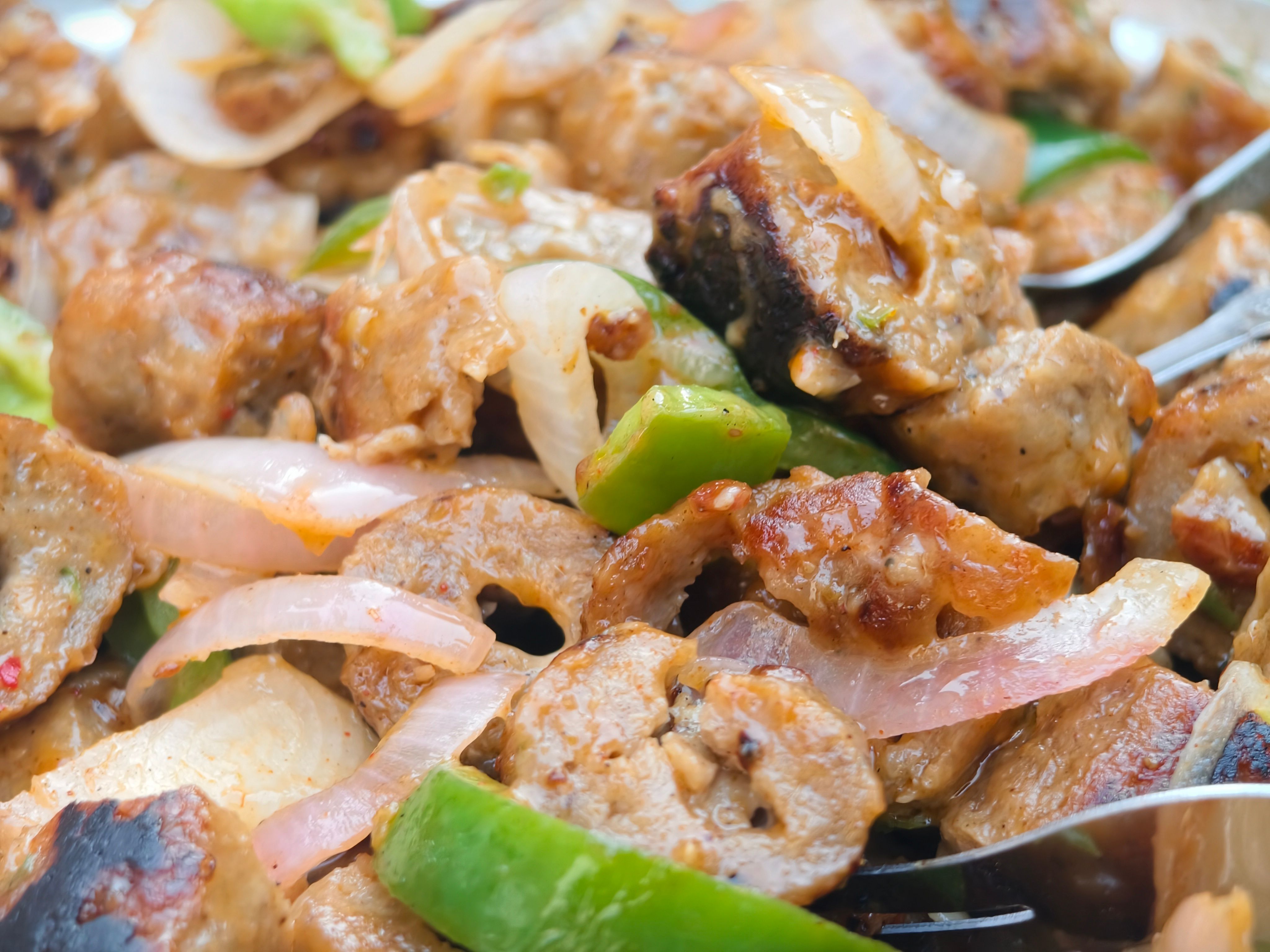
Photo: vikesh zen / Pexels
The diets react (see scores below)
Common Ingredients
- cow foot
- palm oil
- potash
- utazi leaves
- ground crayfish
- scotch bonnet peppers
- onion
- ehu seeds
Specific recipes may vary.
Incompatible with 8 of 11 diets
Diet Ratings
Nkwobi is a Nigerian spiced cow foot dish that aligns well with ketogenic principles. Cow foot is a collagen-rich, high-fat, moderate-protein animal product with essentially zero net carbs. Palm oil is one of the most keto-friendly fats available, being rich in saturated fats. Utazi leaves, ground crayfish, scotch bonnet peppers, onion, and ehu seeds contribute minimal net carbs in the quantities used as seasonings. The primary concern is potash (potassium carbonate/kaun), which is used as an emulsifier to thicken the palm oil sauce — it is not a carb source and poses no issue for ketosis. Onion and scotch bonnet add small amounts of carbs but are used in modest seasoning quantities. Overall, the dish is high-fat, moderate-protein, and very low in net carbs, making it a strong keto fit.
Some stricter keto practitioners may flag the use of onion and scotch bonnet peppers as cumulative carb contributors, particularly if the dish is consumed in large portions. Those following clinical or zero-carb keto protocols may also object to the use of potash as a non-whole-food additive.
Nkwobi is a traditional Nigerian delicacy built around cow foot (beef), a direct animal product, making it incompatible with a vegan diet. Additionally, ground crayfish is a dried seafood ingredient, adding a second animal-derived component. These two ingredients are central and non-incidental to the dish — removing them would fundamentally alter its identity. The remaining ingredients (palm oil, potash/kaun, utazi leaves, scotch bonnet peppers, onion, and ehu/calabash nutmeg seeds) are all plant-based, but they cannot redeem a dish whose core proteins are animal-derived.
Nkwobi is a traditional Nigerian spiced cow foot dish that is largely paleo-friendly in concept — cow foot (collagen-rich animal protein), palm oil (a natural fruit oil generally accepted in paleo), utazi leaves, ground crayfish, scotch bonnet peppers, and onion are all whole, unprocessed ingredients aligned with paleo principles. However, the critical disqualifying ingredient is potash (kaun/akanwu), a processed alkaline salt/lye compound used as a food additive to emulsify the palm oil and create the dish's characteristic thick coating. Potash is a chemically processed additive — it falls squarely under the 'added salt/processed additives' exclusion in paleo guidelines. Ehu seeds (Calabash nutmeg) are a natural spice and paleo-compatible. Without the potash, this dish would score quite well; its presence as a defining, non-optional ingredient drops the verdict to avoid.
Some flexible paleo practitioners might argue that potash is a naturally-occurring mineral compound (wood ash derivative) used by traditional cultures for millennia, placing it in a similar category to baking soda or mineral-rich salts — and might accept the dish on that basis, especially given the otherwise excellent ingredient profile.
Nkwobi is a Nigerian spiced cow foot dish that conflicts with Mediterranean diet principles on multiple fronts. The primary protein is beef (cow foot), which is red meat — limited to only a few times per month in Mediterranean guidelines. More significantly, the primary fat is palm oil, which is high in saturated fat and entirely outside the Mediterranean dietary tradition, where extra virgin olive oil is the canonical fat source. Potash (a food-grade alkaline salt used as a thickener/emulsifier here) is a processed additive not aligned with whole-food Mediterranean principles. While the dish does include some positive elements — utazi leaves (bitter greens), scotch bonnet peppers, onions, and crayfish (seafood) — these do not offset the core incompatibilities of red meat as the primary ingredient and palm oil as the primary fat.
Nkwobi is a traditional Nigerian spiced cow foot dish that, while based on an animal product (cow foot), is heavily laden with plant-derived ingredients that are all excluded on a carnivore diet. Palm oil is a plant-based oil derived from palm fruit and is not permitted (tallow or lard would be the carnivore-approved alternatives). Potash (potassium carbonate used as a thickener) is a mineral additive that gives the dish its characteristic thick coating — non-animal and debated even outside carnivore contexts. Utazi leaves are a bitter plant herb, ground crayfish is a notable animal-derived ingredient that would be approved, but scotch bonnet peppers, onion, and ehu seeds (African nutmeg) are all plant-derived spices and aromatics explicitly excluded from the carnivore diet. The cow foot itself is an excellent carnivore food — rich in collagen, connective tissue, and gelatin — but the preparation method renders the overall dish non-compliant. A carnivore adaptation would require stripping the dish down to just the cow foot cooked in tallow or lard with salt.
Most ingredients in Nkwobi are Whole30-compatible: cow foot (meat), palm oil (natural fat), utazi leaves (herb/vegetable), ground crayfish (seafood-derived seasoning), scotch bonnet peppers (vegetable), onion (vegetable), and ehu seeds (spice). The primary concern is potash (kaun/akanwu), an alkaline salt used as a food additive and emulsifier to bind palm oil into the characteristic paste-like sauce. Potash is a naturally derived mineral salt (potassium carbonate), not a synthetic additive, grain, legume, or dairy product. It is not on the Whole30 excluded list. However, it is a processed mineral compound used as a food additive rather than a whole food ingredient, which places it in a gray area. The Whole30 program does not explicitly address potash. All other ingredients are straightforwardly compliant whole foods. If potash is accepted as a natural mineral additive (similar to baking soda in some contexts), the dish is fully compliant.
Official Whole30 guidelines do not address potash (potassium carbonate/kaun) directly. Some Whole30 practitioners may argue that potash, as a processed mineral additive/emulsifier rather than a whole food ingredient, conflicts with the program's spirit of avoiding additives and processed agents — even if it isn't on the explicit exclusion list. Others in the community would consider it a natural mineral salt, similar to iodized salt with dextrose, and fully acceptable.
Nkwobi contains several problematic FODMAP ingredients. Onion is a major fructan source and is high-FODMAP at any meaningful quantity — it is one of the highest-FODMAP foods and a primary concern during elimination. Scotch bonnet peppers are used in quantities that may push fructan levels up, though chili/capsicum itself is low-FODMAP in small amounts. Cow foot (collagen-rich beef tripe/tendon) is a plain protein and inherently low-FODMAP. Palm oil is fat-based and FODMAP-free. Potash (food-grade potassium carbonate/kaun) is a mineral salt used as an emulsifier — it has no FODMAP content. Utazi leaves (Gongronema latifolium) and ehu seeds (Calabash nutmeg/Ehuru) are West African regional ingredients with no Monash University FODMAP testing data, introducing significant uncertainty. Ground crayfish (dried shrimp powder) is a protein/seafood product and expected to be low-FODMAP. The dish-defining problem is onion, which is a core, non-optional ingredient used in substantial quantity in Nkwobi. This alone classifies the dish as high-FODMAP during elimination phase. The lack of Monash data on utazi leaves and ehu seeds adds further caution.
Monash University has not tested utazi leaves or ehu seeds specifically, so their FODMAP status is unknown — a FODMAP dietitian might advise trialing the dish post-elimination with caution rather than a blanket avoid, if onion could be replaced with onion-free alternatives (e.g., garlic-infused oil, scallion greens only). However, traditional Nkwobi recipes do not omit onion, making a low-FODMAP adaptation a significant departure from the original dish.
Nkwobi is a Nigerian delicacy made primarily from cow foot cooked in palm oil with potash (kaun/akanwu), which creates a thick, emulsified sauce. This dish conflicts with DASH diet guidelines on multiple fronts. Palm oil is a tropical oil high in saturated fat (approximately 50% saturated fat by composition), which DASH explicitly limits. Cow foot (beef trotter) is high in cholesterol and saturated fat, and while it does provide collagen/gelatin, it falls under the red meat category that DASH discourages. Potash (potassium carbonate/sodium-containing alkaline salt) can contribute significant sodium depending on quantity used. The overall fat profile dominated by palm oil makes this dish incompatible with DASH principles. The positive elements — utazi leaves (bitter leafy green providing some fiber/micronutrients), scotch bonnet peppers, onion, and ground crayfish — do not sufficiently offset the core concerns. This dish is high in saturated fat from both palm oil and the fatty cuts of cow foot, making it a clear 'avoid' under standard DASH guidelines.
Nkwobi is a traditional Nigerian delicacy made primarily from cow foot cooked in palm oil with utazi leaves, potash, crayfish, peppers, and spices. From a Zone Diet perspective, it presents a mixed profile. The cow foot (protein) is a tough, collagen-rich cut that is relatively lean in muscle protein but contains significant connective tissue and some saturated fat — it's not an ideal lean protein like skinless chicken breast, but it does contribute protein blocks. The palm oil is the most problematic ingredient: it is high in saturated fat (palmitic acid) and lacks the monounsaturated profile Zone favors (olive oil, avocado oil). However, palm oil does contain some beneficial tocotrienols and is not as inflammatory as omega-6-heavy seed oils. The utazi leaves, scotch bonnet peppers, onion, ground crayfish, and ehu seeds are all low-glycemic, polyphenol-rich ingredients that align well with Zone anti-inflammatory principles. The dish is notably carbohydrate-light (very few carbs), which means it would be heavily unbalanced toward protein and fat as a standalone meal — it lacks the carbohydrate block component Zone requires (approximately 40% calories from low-GI carbs). As a snack or meal component paired with a substantial serving of low-GI vegetables or fruit to balance macros, it could fit into a Zone framework with careful portioning. The palm oil and saturated fat load, combined with the macro imbalance (protein/fat heavy, minimal carbs), keep this in caution territory rather than a clear approve or avoid.
Some Zone practitioners following Dr. Sears' later anti-inflammatory writings (Zone Diet and Omega Rx Zone) acknowledge that not all saturated fats are equally harmful, and palm oil's tocotrienol content has some antioxidant value. Additionally, cow foot's high collagen/gelatin content may support gut health, which aligns with Sears' broader wellness philosophy. A stricter Zone follower would flag palm oil as an unfavorable fat and the protein source as not cleanly lean, while a more flexible practitioner might allow small portions paired with ample vegetables to correct the carb deficit.
Nkwobi is a traditional Nigerian delicacy made primarily from cow foot (a collagen-rich, high-saturated-fat cut) cooked in palm oil with potash (kaun/akanwu) as an emulsifier. From an anti-inflammatory standpoint, this dish has several significant concerns. Cow foot is a fatty red meat cut high in saturated fat, which is associated with increased inflammatory markers (CRP, IL-6) and is explicitly in the 'limit' category of anti-inflammatory frameworks. Palm oil is high in saturated fat (palmitic acid, ~50%), which multiple studies link to pro-inflammatory pathways; unlike extra virgin olive oil, it lacks the oleocanthal and polyphenols that confer anti-inflammatory benefits. Potash (potassium carbonate) is an alkaline food additive — not a whole food — and while used traditionally, it falls broadly under the 'artificial additive' or heavily processed ingredient category that anti-inflammatory frameworks caution against. On the positive side, the dish contains several genuinely anti-inflammatory ingredients: utazi leaves (Gongronema latifolium) have demonstrated antioxidant and anti-inflammatory properties in African ethnobotanical research; scotch bonnet peppers are rich in capsaicin, a known anti-inflammatory compound; ground crayfish contributes omega-3 fatty acids and minerals; and onion provides quercetin. However, these beneficial ingredients are insufficient to offset the dominant pro-inflammatory profile driven by the cow foot and palm oil base, which constitute the bulk of the dish. The overall nutritional architecture — fatty red meat + high saturated-fat oil + food additive — aligns poorly with anti-inflammatory dietary principles.
Palm oil's inflammatory classification is genuinely contested. Some researchers, particularly those studying traditional African diets and red palm oil specifically (unrefined), note its high content of carotenoids (beta-carotene), tocotrienols (vitamin E family), and CoQ10, which have antioxidant and anti-inflammatory properties — a perspective reflected in some integrative nutrition circles. Unrefined red palm oil is nutritionally different from refined palm oil, and a minority of anti-inflammatory practitioners distinguish the two, placing unrefined red palm oil in a 'caution' rather than 'avoid' category. However, the mainstream anti-inflammatory consensus still flags palm oil's high saturated fat content as a net concern.
Nkwobi is a traditional Nigerian delicacy made primarily from cow foot cooked in generous amounts of palm oil — a saturated fat-dense oil — and bound with potash (an alkaline salt). This combination creates a dish that is very high in saturated fat, gelatinous and collagen-heavy rather than lean protein, and extremely rich and heavy in texture. For GLP-1 patients, this is problematic on multiple fronts: the high palm oil content directly worsens nausea, bloating, and reflux by overwhelming a stomach that is already emptying slowly; the fatty, gelatinous cow foot provides minimal lean protein relative to its fat and connective tissue content; scotch bonnet peppers are among the hottest chili peppers used in cooking and are very likely to worsen GLP-1-related nausea and acid reflux; and it is typically served in portions that are fatty and heavy even in small amounts. The utazi leaves and crayfish provide modest nutritional value, and onions and spices are generally fine, but these positives are overwhelmed by the structural problems with the dish. Nkwobi is essentially the opposite of what a GLP-1 patient needs: it is high saturated fat, low lean protein density, high spice heat, heavy and slow-digesting, and offers poor nutrient density per calorie.
*See how scores were generated at our methodology page.
Nutritional profile
Six traits that cut across every diet.
Fiber & Plants
How much whole-plant food and fiber it delivers.
Healthy Fats
The quality of its fats (unsaturated, omega-3).
Whole / Unprocessed
How close it is to its natural, unprocessed form.
Gut Gentle
How easy it is on digestion (low FODMAP, few irritants).
Low Glycemic
How little it spikes your blood sugar.
Protein Density
How much protein it packs per calorie.
Controversy Index
Higher controversy = more disagreement between diets.
Diet-Specific Tips
 Keto — 8/10
View tips
- Cow foot is collagen-rich, high-fat, and virtually zero net carbs — excellent keto protein source
- Palm oil is a highly saturated, keto-ideal fat with no carbohydrates
- Potash (kaun) is an alkaline emulsifier with no carb content — keto-neutral
- Utazi leaves and ground crayfish contribute negligible net carbs in seasoning amounts
- Onion and scotch bonnet peppers add minor carbs but remain within keto limits at typical serving quantities
- No grains, added sugars, or starchy vegetables present
- Whole, minimally processed ingredients throughout
 Whole30 — 5/10
View tips
- Cow foot is an approved whole animal protein on Whole30
- Palm oil is a compliant natural fat
- Utazi leaves, scotch bonnet peppers, and onion are compliant vegetables/herbs
- Ground crayfish is a compliant seafood-derived seasoning
- Ehu seeds (calabash nutmeg) are a compliant natural spice
- Potash (kaun/akanwu) is a processed mineral additive not explicitly addressed by Whole30 rules — the main ambiguity
- No grains, legumes, dairy, added sugar, or other explicitly excluded ingredients present
 Zone — 4/10
View tips
- Palm oil is high in saturated fat — Zone prefers monounsaturated fats like olive oil and avocado
- Cow foot is a non-lean protein source; contains collagen and some saturated fat, not ideal like skinless chicken or fish
- Dish is very low in carbohydrates — would require significant vegetable/fruit pairing to achieve 40/30/30 Zone balance
- Utazi leaves, peppers, and onion provide polyphenols and anti-inflammatory compounds, aligning with Zone principles
- Ground crayfish adds seafood-derived protein and potential omega-3 contribution
- No high-glycemic carbs present — the carb profile is favorable but quantity is insufficient for Zone balance
- As a snack, the protein and fat load would likely exceed Zone block targets without careful portioning