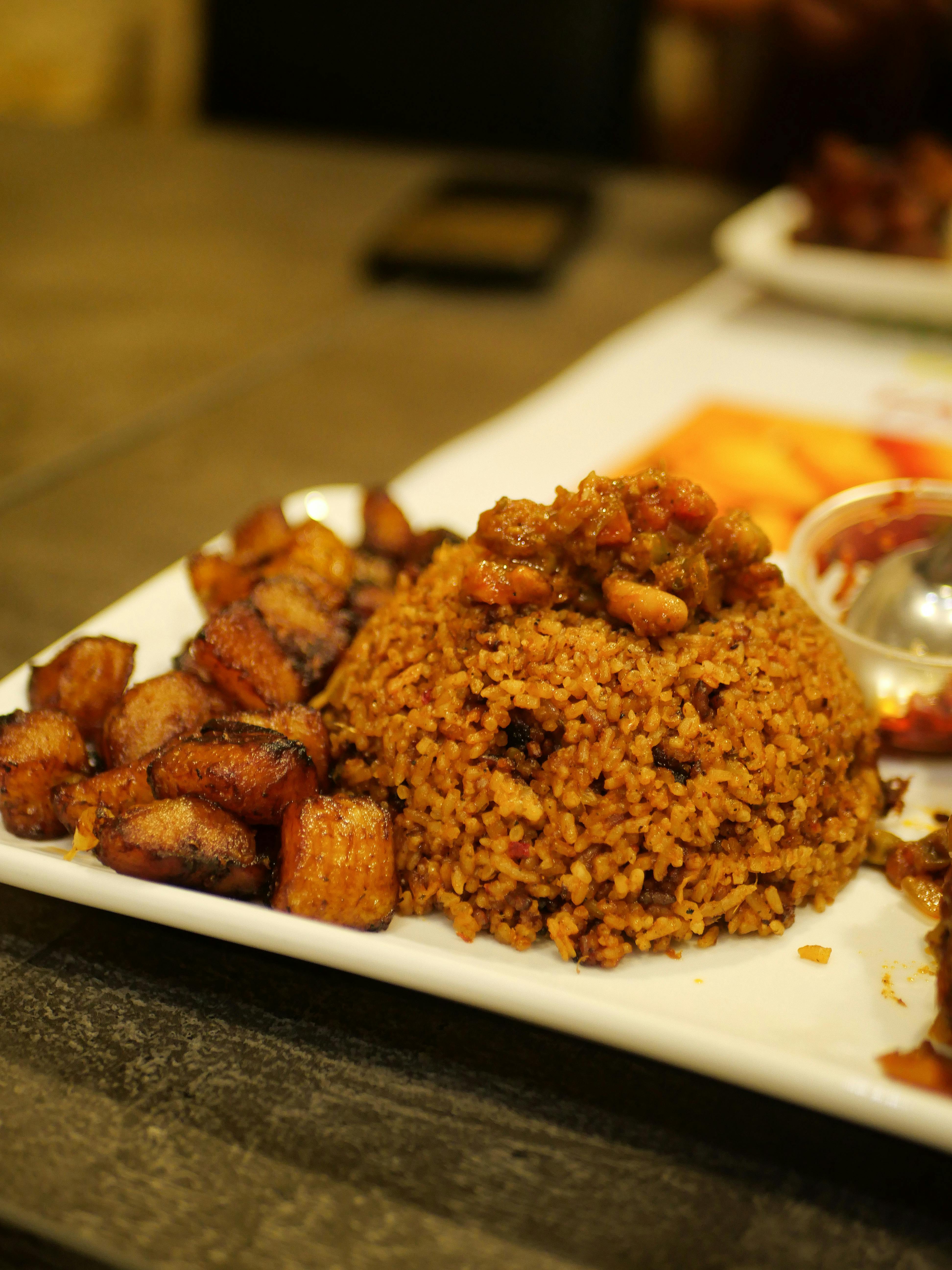
Photo: Studio Saiz / Pexels
Nigerian
Ofada Rice and Ayamase
The diets react (see scores below)
Common Ingredients
- ofada rice
- green bell peppers
- locust beans
- palm oil
- beef
- tripe
- boiled eggs
- onion
Specific recipes may vary.
Incompatible with 9 of 11 diets
Diet Ratings
Ofada Rice and Ayamase is fundamentally incompatible with a ketogenic diet due to the ofada rice base. Rice — including the unprocessed, locally grown ofada variety — is a high-carb grain containing approximately 45-50g of net carbs per 100g cooked. A standard serving easily exceeds the entire daily keto carb budget of 20-50g in one dish. The Ayamase stew component itself is actually quite keto-friendly: palm oil is an excellent high-fat keto ingredient, beef and tripe provide quality protein, boiled eggs add fat and protein, green bell peppers are relatively low-carb, locust beans (iru) are low-net-carb fermented legumes, and onion in moderate amounts is acceptable. However, the rice renders the complete dish a keto avoid. One could theoretically consume the stew alone without the rice, but as a combined dish it cannot be approved.
Ofada Rice and Ayamase contains multiple animal products that are strictly excluded from a vegan diet. The dish includes beef (red meat), tripe (animal organ/offal), and boiled eggs (animal product). These three ingredients alone make this dish entirely incompatible with veganism. The remaining ingredients — ofada rice, green bell peppers, locust beans, palm oil, and onion — are plant-based, but the presence of multiple animal-derived components overrides any plant-based elements. There is no meaningful debate within the vegan community about this verdict.
Ofada Rice and Ayamase is not paleo-compatible. The dish's foundation is ofada rice, a grain that is strictly excluded from the paleo diet regardless of its unprocessed, locally grown nature. Grains are one of the clearest exclusions in paleo due to their anti-nutrient content (lectins, phytates) and their association with the agricultural revolution. Additionally, locust beans (iru) are a fermented legume condiment, and legumes are also definitively excluded from paleo. The remaining ingredients — green bell peppers, palm oil, beef, tripe, boiled eggs, and onion — are all paleo-compliant. Palm oil is an accepted animal/plant fat in paleo. However, the two core non-compliant ingredients (rice and locust beans) are fundamental to the dish and cannot be omitted without fundamentally changing it.
Ofada Rice and Ayamase contains several elements that conflict with Mediterranean diet principles. Palm oil is the primary fat, replacing extra virgin olive oil — palm oil is high in saturated fat and is not part of the Mediterranean dietary tradition. Beef and tripe are red and organ meats, which the Mediterranean diet limits to a few times per month. The combination of multiple animal proteins (beef, tripe, eggs) in a single dish further pushes this toward excess. While ofada rice is an unpolished parboiled rice with some whole-grain qualities, and the inclusion of green bell peppers, onions, and locust beans (a fermented legume) provides some plant-forward elements, these positives are substantially outweighed by the palm oil base, red meat dominance, and overall incompatibility with Mediterranean fat and protein sourcing guidelines.
Ofada Rice and Ayamase is fundamentally incompatible with the carnivore diet. The dish is built on ofada rice, a plant-based grain that is entirely excluded from carnivore. The Ayamase stew, while containing carnivore-approved animal ingredients (beef, tripe, boiled eggs), is also loaded with multiple plant-based components: green bell peppers form the base of the sauce, locust beans (iru) are a fermented plant legume condiment, onion is a plant, and palm oil — while used by some carnivore practitioners — is a plant-derived oil excluded by strict carnivore standards. The ratio of plant to animal ingredients overwhelmingly disqualifies this dish. Even if one were to isolate the beef, tripe, and eggs, the preparation method involves deep integration with plant ingredients, making separation impractical.
Ofada rice is a grain (rice), which is explicitly excluded on the Whole30 program. Regardless of the other ingredients in this dish, the rice alone makes it non-compliant. Additionally, locust beans (iru/dawadawa) are fermented legumes, which fall under the excluded legume category. The other ingredients — green bell peppers, palm oil, beef, tripe, boiled eggs, and onion — are all Whole30-compatible, but the two excluded ingredients (rice and locust beans) disqualify this dish entirely.
Ofada Rice and Ayamase contains multiple high-FODMAP ingredients that make it unsuitable during the elimination phase. The most problematic ingredient is onion, which is high in fructans and should be strictly avoided. Locust beans (iru/dawadawa) are fermented African locust beans — a legume-derived condiment high in GOS and fructans, making them a significant FODMAP concern. These two ingredients alone are sufficient to classify this dish as high-FODMAP. Ofada rice itself is an unpolished Nigerian parboiled rice variety that is generally considered low-FODMAP (rice is low-FODMAP regardless of variety). Green bell peppers are low-FODMAP. Palm oil is fat-based and FODMAP-free. Beef, tripe, and boiled eggs are all protein sources with no FODMAPs. However, the combination of onion and locust beans creates an unavoidable high-FODMAP load that cannot be easily mitigated at standard serving sizes.
Monash University has not specifically tested locust beans (iru), creating some uncertainty about the precise FODMAP load from this ingredient specifically. Some clinical FODMAP practitioners may suggest that if onion and locust beans are omitted or replaced (e.g., garlic-infused oil instead of onion, omitting iru), a modified Ayamase could be tolerated — but the traditional dish as described cannot be considered low-FODMAP.
Ofada Rice and Ayamase presents multiple significant conflicts with DASH diet principles. The most critical concern is palm oil, a tropical oil high in saturated fat (approximately 50% saturated fat content), which DASH explicitly limits alongside coconut and palm kernel oils. The Ayamase stew is traditionally prepared with a generous quantity of palm oil — often 1–2 cups — making this a high saturated fat dish. Tripe (offal/organ meat) and red beef both fall under DASH's category of red and processed meats to limit. Locust beans (iru/dawadawa), while a fermented protein source with some nutritional merit, are extremely high in sodium due to the fermentation and salting process, potentially contributing hundreds of milligrams of sodium per serving — a direct conflict with DASH's sodium targets of 1,500–2,300mg/day. Boiled eggs add dietary cholesterol. On the positive side, ofada rice is an unpolished, relatively whole-grain rice with a lower glycemic index than processed white rice, and green bell peppers provide fiber, vitamins, and potassium. However, these positives are substantially outweighed by the palm oil volume, sodium from locust beans, and red/organ meat content. This dish as traditionally prepared cannot be considered DASH-compatible.
Some DASH-oriented nutritionists acknowledge that locust beans offer prebiotic fiber and plant-based protein, and that ofada rice's whole-grain properties align with DASH fiber goals; a modified preparation using significantly reduced palm oil (replaced partially with vegetable oil), lower locust bean quantities, and swapping beef/tripe for leaner protein (skinless poultry or fish) could bring this dish closer to DASH caution territory, though traditional preparation remains problematic.
Ofada Rice and Ayamase presents a mixed Zone Diet profile. On the positive side, the dish contains lean protein sources (beef, tripe, boiled eggs) and the Ayamase stew is rich in green bell peppers, which are low-glycemic, polyphenol-rich vegetables highly favorable in Zone terms. Locust beans (iru) add fermented plant protein and fiber. However, several factors challenge Zone compliance: (1) Ofada rice, while a less-processed, parboiled short-grain rice with a slightly lower GI than white rice, is still a grain-based carbohydrate that counts as an 'unfavorable' Zone carb — it can technically fit in 0-1 grain blocks per meal but not as the meal's primary carb base. (2) Palm oil is the principal fat source. It is high in saturated fat (palmitic acid), which Sears consistently flags as pro-inflammatory in his anti-inflammatory Zone framework. It is not a monounsaturated fat like olive oil or avocado. (3) The dish as traditionally served is rice-heavy, which would skew the 40/30/30 carb block ratio well past Zone targets. To zone-balance this meal, a practitioner would need to significantly reduce the rice portion, increase the protein (stew) proportion, and ideally modify or reduce the palm oil. With careful portioning — a small rice serving alongside a generous stew portion — this dish can approximate Zone ratios, earning it a 'caution' rather than 'avoid' rating.
Some Zone practitioners and later Sears writings (particularly 'The Mediterranean Zone') have softened the stance on saturated fats in the context of whole, traditional foods, acknowledging that palm oil in moderate amounts within a polyphenol-rich, anti-inflammatory stew context may be less harmful than industrial seed oils. Additionally, Ofada rice's lower GI relative to standard white rice (due to its parboiling and resistant starch content) leads some to treat it more favorably than typical 'unfavorable' Zone grains. From this perspective, the dish could score a 5-6 if portioned correctly.
Ofada Rice and Ayamase presents a mixed anti-inflammatory profile. On the positive side, ofada rice is an unprocessed local Nigerian parboiled rice variety with a lower glycemic index and more fiber than refined white rice, making it preferable. Green bell peppers are rich in vitamin C, antioxidants, and polyphenols. Locust beans (iru) are a fermented ingredient with probiotic potential and protein content. Onions contain quercetin, a notable anti-inflammatory flavonoid. Eggs provide choline and selenium with mixed but not strongly negative inflammatory signals. However, the significant concerns center on palm oil and the protein choices. Palm oil is high in saturated fat (palmitic acid), which at the quantities typically used in Ayamase stew — where it is the dominant fat and used heavily — can promote inflammatory pathways and elevate LDL. Unlike extra virgin olive oil or avocado oil, palm oil lacks the polyphenol density that offsets its saturated fat content in anti-inflammatory frameworks. Beef is a red meat recommended to be limited, and tripe (organ offal) is high in cholesterol and saturated fat, compounding the pro-inflammatory protein load. The combination of red meat, tripe, and palm oil in a single dish pushes the overall profile toward the moderate-to-concerning range. The dish is not entirely avoidable — it contains genuinely beneficial ingredients — but the saturated fat burden from palm oil and the protein choices place it squarely in the caution zone rather than approval.
Some traditional food researchers and African nutrition advocates note that unrefined red palm oil contains tocotrienols (a form of vitamin E) and beta-carotene that have antioxidant activity, distinguishing it from refined palm oil — Dr. Weil's framework does not explicitly condemn traditional unrefined palm oil in moderate cultural use. However, mainstream anti-inflammatory nutrition (including the IF Rating system) consistently flags palm oil's high saturated fat content as pro-inflammatory when consumed in the quantities typical of Ayamase stew preparation.
Ofada Rice and Ayamase is a traditional Nigerian dish that presents multiple significant concerns for GLP-1 patients. The Ayamase stew is prepared with a substantial amount of palm oil, which is high in saturated fat and is a known trigger for nausea, bloating, and reflux — side effects that GLP-1 medications already predispose patients to. Palm oil-heavy dishes are among the most problematic food categories for GLP-1 users due to slowed gastric emptying compounding the heaviness of high-fat meals. Locust beans (iru) add fermented flavor but also contribute to digestive load. The protein sources — beef and tripe — are moderate to high in saturated fat, which is less ideal than lean proteins. Boiled eggs are a positive protein contributor, but they do not offset the overall fat burden of the dish. Ofada rice is an unpolished parboiled rice with a slightly higher fiber and nutrient profile than white rice, which is a genuine positive, but it does not compensate for the high-fat stew it is served with. The combination of high saturated fat from palm oil, fatty cuts of beef and tripe, and the typically large serving size makes this dish very likely to worsen GLP-1 side effects. Overall nutrient density per calorie is poor relative to what a GLP-1 patient needs.
Some GLP-1-focused dietitians working with West African patient populations note that Ofada rice's unprocessed, fiber-retaining grain profile and the protein contribution of boiled eggs and tripe give it marginally more nutritional value than refined-grain, low-protein alternatives in the same cuisine category. A smaller portion of the rice with a reduced-palm-oil version of the stew might be tolerable for patients with lower GI sensitivity, though this would require significant recipe modification from the traditional preparation.
*See how scores were generated at our methodology page.
Nutritional profile
Six traits that cut across every diet.
Fiber & Plants
How much whole-plant food and fiber it delivers.
Healthy Fats
The quality of its fats (unsaturated, omega-3).
Whole / Unprocessed
How close it is to its natural, unprocessed form.
Gut Gentle
How easy it is on digestion (low FODMAP, few irritants).
Low Glycemic
How little it spikes your blood sugar.
Protein Density
How much protein it packs per calorie.
Controversy Index
Higher controversy = more disagreement between diets.
Diet-Specific Tips
 Zone — 4/10
View tips
- Palm oil is high in saturated fat — not a Zone-preferred monounsaturated fat source
- Ofada rice is an 'unfavorable' Zone carbohydrate; traditional serving sizes exceed 1 grain block
- Green bell peppers are excellent low-glycemic, polyphenol-rich Zone-favorable carbs
- Beef, tripe, and boiled eggs provide lean protein blocks, though portion and fat content of tripe/beef cut matter
- Locust beans (iru) contribute fermented plant protein and fiber, modestly favorable
- Dish is rice-heavy as traditionally served, skewing carb ratio far above 40% calories from carbs
- Palm oil's omega-6 to omega-3 ratio is unfavorable for Sears' anti-inflammatory Zone objectives
- Can be Zone-adapted by drastically reducing rice and increasing stew (protein + vegetable) proportion
 Anti-Inflammatory — 4/10
View tips
- Palm oil is high in saturated palmitic acid — pro-inflammatory when used heavily as in Ayamase
- Ofada rice is an unrefined, lower-GI whole grain alternative — anti-inflammatory positive
- Green bell peppers provide vitamin C, antioxidants, and polyphenols — anti-inflammatory
- Locust beans (iru) are fermented — potential probiotic and anti-inflammatory benefit
- Beef is a red meat — recommended to limit on anti-inflammatory diets
- Tripe is high in saturated fat and cholesterol — adds to pro-inflammatory load
- Onions contain quercetin — notable anti-inflammatory flavonoid
- Combined saturated fat burden (palm oil + red meat + tripe) is the primary concern