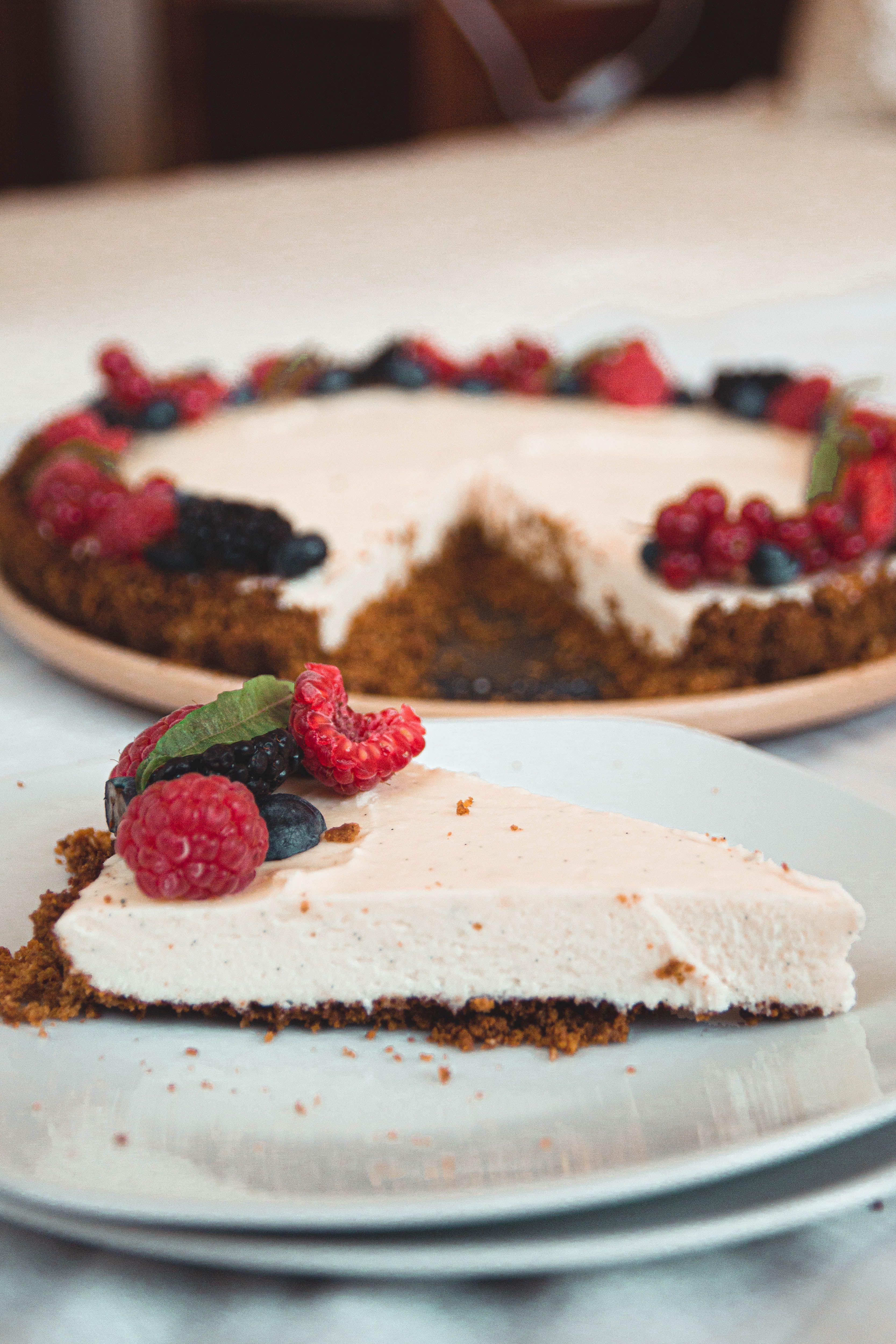
Photo: Regina Ferraz / Pexels
American
No-Bake Cheesecake
The diets react (see scores below)
Common Ingredients
- cream cheese
- whipped cream
- graham crackers
- butter
- sugar
- vanilla extract
- lemon juice
Specific recipes may vary.
Incompatible with 11 of 11 diets
Diet Ratings
Traditional no-bake cheesecake is fundamentally incompatible with ketogenic eating due to two major offenders: graham crackers (the crust) and added sugar. Graham crackers are made from whole wheat flour and are high in net carbs, while added sugar directly spikes blood glucose and halts ketosis. A standard serving would contain well over 30-40g of net carbs from these two ingredients alone, far exceeding safe keto thresholds. While the cream cheese and whipped cream base is actually keto-friendly in isolation, the crust and sugar make the dish as a whole a clear avoid. Keto-adapted versions exist (using almond flour crusts and erythritol/stevia), but the traditional recipe described here is not keto-compatible.
No-Bake Cheesecake contains multiple animal-derived ingredients that are categorically excluded from a vegan diet. Cream cheese is a dairy product made from cow's milk, and whipped cream is likewise a dairy product. Butter is an animal fat derived from cow's milk. These three ingredients alone make this dish entirely incompatible with veganism. There is no ambiguity here — all three are classic animal products with no meaningful debate within the vegan community. Vegan versions of this dish do exist using cashew cream, coconut cream, vegan cream cheese, and plant-based butter, but the standard recipe as described is definitively non-vegan.
No-Bake Cheesecake is fundamentally incompatible with the Paleo diet. The dish is built almost entirely on non-Paleo ingredients: cream cheese and whipped cream are dairy products explicitly excluded; graham crackers are a grain-based processed food containing wheat flour; and refined sugar is a prohibited additive. Butter is also dairy, and while ghee (clarified butter) is debated in the Paleo community, regular butter retains milk solids and is excluded. Vanilla extract and lemon juice are the only ingredients that pass Paleo scrutiny. This dish fails on multiple core Paleo pillars simultaneously — dairy, grains, and refined sugar — leaving no reasonable path to Paleo compliance without reconstructing it entirely.
No-Bake Cheesecake is fundamentally at odds with Mediterranean diet principles. It is built on cream cheese and whipped cream (high saturated fat dairy), a refined graham cracker crust bound with butter (more saturated fat), and significant added sugar. There are no whole grains, vegetables, legumes, or olive oil present. The dish is a heavily processed, high-sugar, high-saturated-fat dessert with no redeeming Mediterranean characteristics. Even as an occasional treat, its ingredient profile runs counter to nearly every core principle of the dietary pattern.
No-Bake Cheesecake is fundamentally incompatible with the carnivore diet. While cream cheese and whipped cream are dairy derivatives that some carnivore practitioners consume, the dish is dominated by multiple plant-based and processed ingredients that are strictly excluded: graham crackers (grain-based crust), sugar (processed sweetener), vanilla extract (plant-derived flavoring), lemon juice (fruit-derived), and butter used in a context that doesn't redeem the overall formulation. Even the most permissive 'animal-based' carnivore approach would reject this dish outright due to the grain crust and added sugar. This is essentially a dessert built on a grain foundation with sweeteners and plant additives — the antithesis of carnivore eating.
No-Bake Cheesecake contains multiple excluded ingredients that make it entirely incompatible with Whole30. Cream cheese and whipped cream are dairy products, which are explicitly excluded. Sugar is a direct excluded added sweetener. Graham crackers are made from wheat/grain, also explicitly excluded. Even setting aside individual ingredients, this dish is a classic junk food/dessert that falls squarely under the 'no recreating baked goods/junk food' rule — cheesecake is precisely the kind of indulgent treat the Whole30 program aims to eliminate. There is no compliant version of this dish possible while retaining its fundamental character.
No-Bake Cheesecake contains multiple high-FODMAP ingredients that make it unsuitable during the elimination phase. Cream cheese is high in lactose and is high-FODMAP at typical serving sizes used in cheesecake (though small amounts like 2 tbsp are considered low-FODMAP, the quantity in a cheesecake slice far exceeds this). Whipped cream (heavy cream) is low-FODMAP in small amounts but is often used in large quantities here. Graham crackers are the most problematic ingredient — they are made from wheat flour and contain fructans, making them high-FODMAP. Butter and sugar are low-FODMAP. Vanilla extract and lemon juice are low-FODMAP in typical amounts. The combination of lactose-heavy cream cheese at cheesecake-slice portions and the wheat-based graham cracker crust creates a dish that is clearly high-FODMAP. There is no realistic serving size of a standard cheesecake slice that would be low-FODMAP.
No-Bake Cheesecake is fundamentally incompatible with the DASH diet. Cream cheese is a full-fat dairy product high in saturated fat, directly contradicting DASH's emphasis on fat-free or low-fat dairy. Whipped cream adds additional saturated fat and calories. The butter-graham cracker crust contributes more saturated fat and refined carbohydrates. Sugar is an added sweetener that DASH explicitly limits. None of the primary ingredients align with DASH priorities — there are no meaningful sources of potassium, magnesium, fiber, or lean protein. The dish is essentially a combination of full-fat dairy, added sugars, refined grains, and butter — four categories DASH dietary guidelines specifically discourage.
No-Bake Cheesecake is extremely difficult to fit into the Zone Diet framework. The macronutrient profile is nearly the inverse of what Zone targets: it is dominated by saturated fat (cream cheese, butter, whipped cream) and high-glycemic, nutritionally empty carbohydrates (sugar, graham crackers), with virtually no lean protein and no favorable carbohydrates (vegetables or low-glycemic fruits). Added sugar is a primary ingredient, driving a high glycemic load and an insulin spike — the exact hormonal disruption the Zone Diet is designed to prevent. The fat sources are saturated rather than monounsaturated, conflicting with the Zone's anti-inflammatory fat priorities. The crust (graham crackers + butter) provides refined carbohydrates and saturated fat simultaneously, with no fiber or micronutrient value. While theoretically any food can be consumed in a tiny portion within a Zone block system, the macro ratios here are so skewed — overwhelmingly fat and high-GI carbs, minimal usable lean protein — that even a small serving would require extensive compensatory adjustments in the rest of the meal. This is not a practical Zone snack under any reasonable interpretation of Dr. Sears' guidelines.
No-Bake Cheesecake is dominated by pro-inflammatory ingredients with virtually no redeeming anti-inflammatory properties. Cream cheese and whipped cream are high-fat dairy products rich in saturated fat, which anti-inflammatory guidelines consistently flag as problematic — saturated fat promotes production of pro-inflammatory cytokines and is explicitly limited or avoided in all major anti-inflammatory frameworks. Butter in the graham cracker crust adds further saturated fat load. Graham crackers represent refined carbohydrates with added sugar, and the dish as a whole carries a significant added sugar burden. Sugar directly promotes inflammation by spiking blood glucose, increasing advanced glycation end products (AGEs), and elevating CRP. The lemon juice and vanilla extract offer negligible anti-inflammatory benefit at these quantities. There are no omega-3 fatty acids, no meaningful antioxidants or polyphenols, no fiber, and no colorful produce. This dish sits squarely in the 'limit to avoid' category across the anti-inflammatory spectrum — high saturated fat + refined carbohydrates + added sugar is the prototypical inflammatory dietary pattern.
No-bake cheesecake is a poor fit for GLP-1 patients across nearly every dietary priority. The primary ingredients — cream cheese, whipped cream, and butter — are all high in saturated fat, which worsens GLP-1 side effects including nausea, bloating, and reflux. Gastric emptying is already slowed by the medication, making high-fat, heavy foods sit in the stomach uncomfortably longer. The dish is high in sugar (added sugar plus graham cracker carbohydrates) with negligible fiber, and while cream cheese contains some protein, the quantity per realistic serving is minimal relative to the calorie load — making this a poor use of reduced appetite. The graham cracker crust adds refined carbohydrates and additional butter-derived saturated fat with no meaningful nutritional payoff. This is effectively a high-fat, high-sugar, low-protein, low-fiber dessert that conflicts with GLP-1 dietary priorities in nearly every dimension.
*See how scores were generated at our methodology page.
Nutritional profile
Six traits that cut across every diet.
Fiber & Plants
How much whole-plant food and fiber it delivers.
Healthy Fats
The quality of its fats (unsaturated, omega-3).
Whole / Unprocessed
How close it is to its natural, unprocessed form.
Gut Gentle
How easy it is on digestion (low FODMAP, few irritants).
Low Glycemic
How little it spikes your blood sugar.
Protein Density
How much protein it packs per calorie.
Controversy Index
Higher controversy = more disagreement between diets.