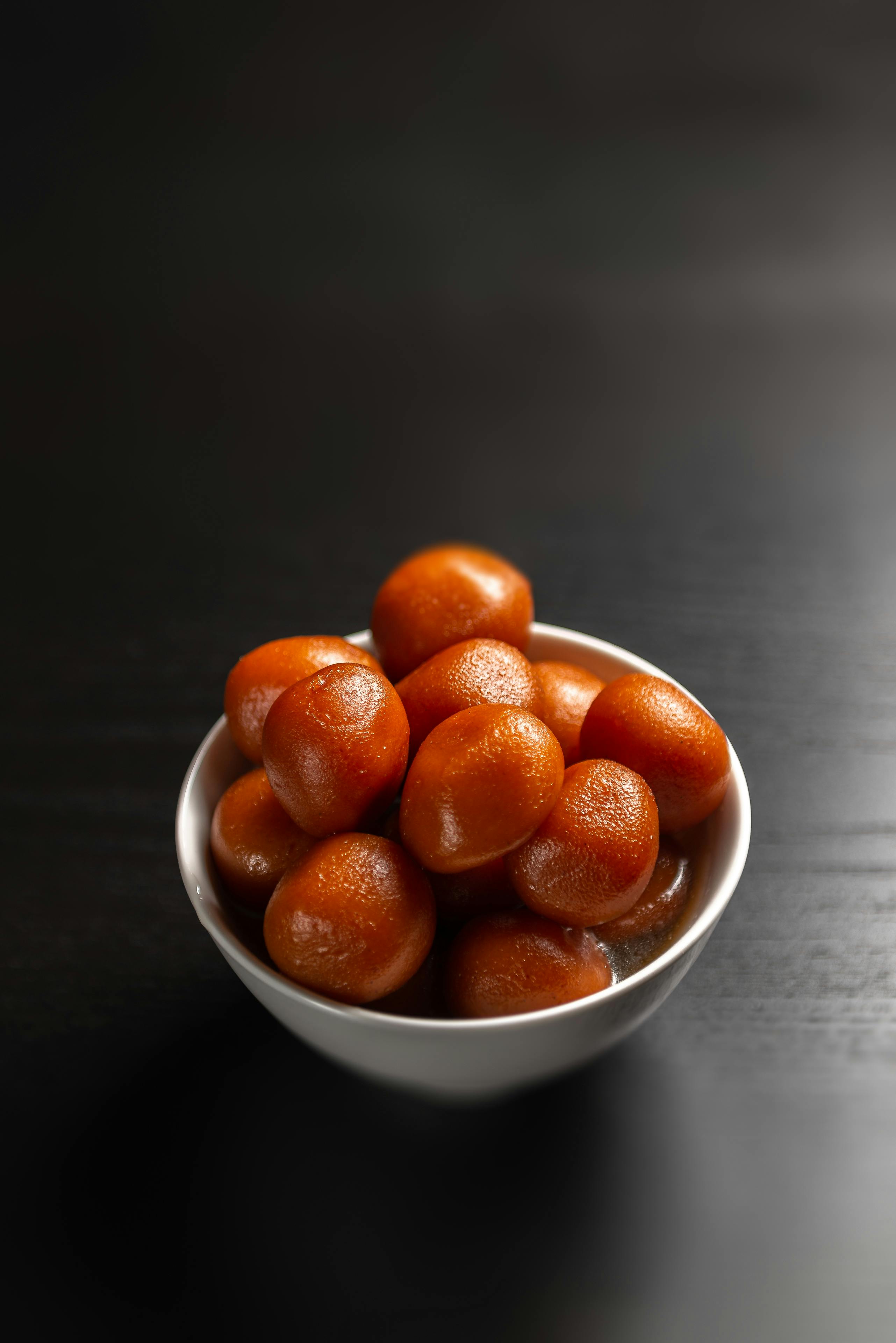
Photo: Nishess Shakya / Pexels
The diets react (see scores below)
Common Ingredients
- milk powder
- flour
- ghee
- sugar
- cardamom
- rose water
- milk
- baking soda
Specific recipes may vary.
Incompatible with 11 of 11 diets
Diet Ratings
Gulab Jamun is a quintessential high-sugar, high-carb Indian dessert that is completely incompatible with a ketogenic diet. It contains multiple major keto violations: white flour (refined grain), milk powder (lactose-heavy), and an enormous quantity of sugar both in the dough and in the sugar syrup it is soaked in. A single piece can contain 15-25g of net carbs, making even one serving capable of breaking ketosis. The ghee and cardamom are keto-friendly, but they are overwhelmed by the carbohydrate-dense and sugar-laden ingredients that define this dish.
Gulab Jamun contains multiple animal-derived ingredients that make it clearly incompatible with a vegan diet. Milk powder and milk are dairy products derived from animals, and ghee is clarified butter — also an animal-derived fat. These are not trace or incidental ingredients; they are primary structural and flavoring components of the dish. The remaining ingredients (flour, sugar, cardamom, rose water, baking soda) are plant-based, but the presence of three distinct animal-derived ingredients places this firmly in the 'avoid' category. There is no meaningful debate within the vegan community about dairy or ghee — both are unambiguously excluded. Vegan versions of Gulab Jamun can be made by substituting plant-based milk, dairy-free milk powder (e.g., coconut milk powder), and vegan butter or coconut oil for ghee.
Gulab Jamun is fundamentally incompatible with the paleo diet. The dish contains multiple strictly excluded ingredients: milk powder and milk (dairy), flour (grain-based), and refined sugar — all of which are core violations of paleo principles. Baking soda, while not a grain or dairy product, is a processed additive. The only paleo-friendly components are ghee (debated but often accepted), cardamom, and rose water. With the majority of the dish built on dairy, grains, and refined sugar, this is an unambiguous avoid.
Gulab Jamun is a deep-fried Indian dessert made primarily from milk powder and refined flour, soaked in a heavy sugar syrup. It contradicts Mediterranean diet principles on multiple fronts: it contains high amounts of added sugar (the syrup is the dominant component), refined/processed grains (flour), and ghee (saturated animal fat) rather than olive oil. It has no vegetables, legumes, whole grains, or other plant-forward components. Processed sweets and desserts high in refined sugars and saturated fats are explicitly discouraged in the Mediterranean dietary pattern.
Gulab Jamun is a heavily processed Indian sweet that is fundamentally incompatible with the carnivore diet. The dish is composed almost entirely of plant-derived and processed ingredients: flour (grain-based), sugar, cardamom (plant spice), rose water (plant-derived), and baking soda. While milk powder, ghee, and milk are animal-derived dairy components, they are minor elements in a recipe that is dominated by disqualifying ingredients. The primary structure of the dish is a fried dough ball soaked in sugar syrup — there is no meaningful animal protein source, and the macronutrient profile (high carbohydrate, sugar-laden) is the opposite of what carnivore aims for. Even the most lenient 'animal-based' practitioners who include dairy and honey would not approve a sugar-and-flour-based confection. This is a clear and unanimous avoid across all carnivore tiers.
Gulab Jamun contains multiple excluded ingredients. Sugar is explicitly prohibited on Whole30 as an added sweetener. Flour (wheat-based) is a grain and therefore excluded. Milk powder and milk are dairy products, which are excluded (ghee and clarified butter are the only dairy exceptions). Additionally, even if all ingredients were somehow made compliant, Gulab Jamun is a deep-fried dough ball dessert — a classic example of a junk food/sweet treat that would violate the 'no recreating baked goods/junk food' rule. This dish fails on multiple counts.
Gulab Jamun contains multiple high-FODMAP ingredients that make it unsuitable during the elimination phase. Milk powder (khoya/mawa base) is high in lactose, which is a key FODMAP disaccharide. The flour used is typically wheat flour or all-purpose flour, which is high in fructans. The sugar syrup is made with large amounts of sucrose, and while sucrose itself is not a FODMAP, the overall high sugar load combined with the large serving portions typical of this dessert creates problems. Milk adds additional lactose. The combination of lactose from milk powder and milk, plus fructans from wheat flour, makes this dish clearly high-FODMAP at any standard serving size (typically 2-3 pieces). Cardamom, rose water, ghee, and baking soda are low-FODMAP and not concerning.
Gulab Jamun is a deep-fried Indian dessert soaked in sugar syrup, making it fundamentally incompatible with DASH diet principles. It contains ghee (a clarified butter high in saturated fat), full-fat milk powder, refined white flour, and is saturated in a heavy sugar syrup flavored with cardamom and rose water. This combination delivers high levels of added sugar, saturated fat, refined carbohydrates, and calories with minimal nutritional benefit. DASH explicitly limits sweets, added sugars, saturated fats, and refined grains. There is no meaningful potassium, magnesium, fiber, or other DASH-valued nutrients. It represents the type of indulgent sweet that DASH guidelines recommend consuming rarely and in very small portions — ideally no more than 5 servings per week of any sweets, and those sweets should be low in fat. Gulab Jamun fails on multiple DASH criteria simultaneously.
Gulab Jamun is a deep-fried Indian dessert made primarily from milk powder and flour, soaked in a heavy sugar syrup. It is an extremely high-glycemic, high-sugar food with virtually no protein, negligible fiber, and fat from ghee (saturated). The macronutrient profile is the antithesis of Zone balance: nearly all calories come from rapidly absorbed simple carbohydrates and saturated fat, with essentially zero lean protein contribution. There is no practical portion size that would allow this food to fit into a Zone-balanced meal or snack without catastrophically distorting the 40/30/30 ratio. The sugar syrup alone would constitute multiple unfavorable carb blocks with a very high glycemic load. Even in the Zone's flexible, ratio-based framework — which rarely categorically excludes foods — Gulab Jamun offers no macronutrient lever to balance against: there is no protein to pair it with that would rescue the ratio, and the saturated fat from ghee adds additional anti-Zone concerns. This is firmly in the same category as candy or syrup-soaked pastry.
Gulab Jamun is a deep-fried Indian dessert soaked in sugar syrup, and its ingredient profile is largely pro-inflammatory by anti-inflammatory diet standards. The dish is centered on refined flour, milk powder, and ghee (saturated fat), with a heavy sugar syrup component that introduces a significant glycemic load. Refined carbohydrates and added sugars are well-established drivers of inflammatory markers including CRP and IL-6. Ghee, while it has some defenders in certain wellness circles, is a concentrated saturated fat that the anti-inflammatory framework advises limiting. The deep-frying process (even in ghee) further degrades fat quality and adds oxidized lipids. The only mildly redeeming ingredients are cardamom and rose water, which carry trace antioxidant and anti-inflammatory properties, but these are present in negligible amounts relative to the overall dish and cannot offset the strongly pro-inflammatory base. This is essentially a dessert built around three ingredients — refined starch, saturated fat, and sugar — that anti-inflammatory nutrition consistently flags. Occasional consumption in a broadly healthy diet is not catastrophic, but Gulab Jamun cannot be considered compatible with anti-inflammatory eating principles.
Gulab Jamun is a deep-fried Indian dessert soaked in sugar syrup, making it a poor fit for GLP-1 patients on virtually every criterion. It is extremely high in sugar (both from the dough and the syrup soak), contains significant saturated fat from ghee, offers negligible protein, and provides essentially no fiber. The combination of high sugar load and high fat content is likely to worsen common GLP-1 side effects including nausea, bloating, and reflux. Calorie density is very high relative to nutritional value, representing exactly the kind of empty-calorie food that is counterproductive when appetite is suppressed and every calorie needs to count. There is no meaningful pathway to making this food GLP-1-friendly in a standard serving.
*See how scores were generated at our methodology page.
Nutritional profile
Six traits that cut across every diet.
Fiber & Plants
How much whole-plant food and fiber it delivers.
Healthy Fats
The quality of its fats (unsaturated, omega-3).
Whole / Unprocessed
How close it is to its natural, unprocessed form.
Gut Gentle
How easy it is on digestion (low FODMAP, few irritants).
Low Glycemic
How little it spikes your blood sugar.
Protein Density
How much protein it packs per calorie.
Controversy Index
Higher controversy = more disagreement between diets.