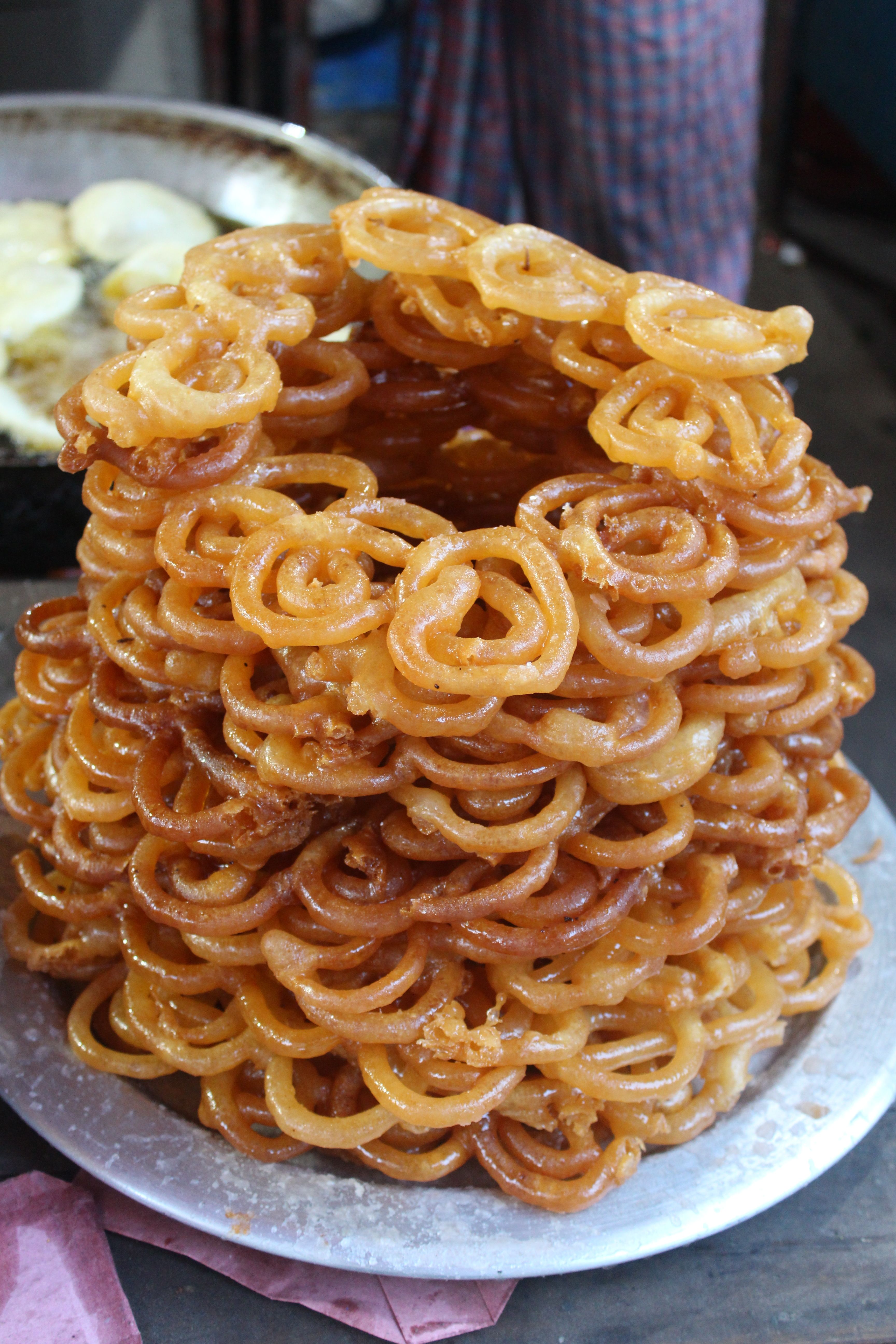
Photo: Abdus Salam / Pexels
The diets react (see scores below)
Common Ingredients
- flour
- yogurt
- sugar
- saffron
- cardamom
- ghee
- baking soda
- water
Specific recipes may vary.
Incompatible with 11 of 11 diets
Diet Ratings
Jalebi is one of the most keto-incompatible foods imaginable. It is made from refined wheat flour (high-carb grain) and is deep-fried then soaked in a sugar syrup, making it essentially pure carbohydrate and sugar. A single serving of jalebi (around 100g) contains approximately 50-60g of net carbs, almost entirely from refined flour and added sugar. This single serving alone would exceed or completely exhaust the entire daily carb allowance on a ketogenic diet. While ghee is a keto-friendly fat, it represents a negligible positive factor given the overwhelming carbohydrate load from flour and sugar syrup.
Jalebi as traditionally prepared contains two clear animal-derived ingredients: yogurt (a dairy product made from animal milk) and ghee (clarified butter, also a dairy product). Both are definitively non-vegan under any mainstream vegan framework. The remaining ingredients — flour, sugar, saffron, cardamom, baking soda, and water — are all plant-based. However, the presence of yogurt and ghee is disqualifying. Vegan versions of jalebi can be made by substituting plant-based yogurt (soy, coconut) and a neutral vegetable oil or vegan butter for the ghee, but the dish as listed with these ingredients cannot be considered vegan-compliant.
Jalebi is fundamentally incompatible with the paleo diet. Its base ingredient is wheat flour (a grain), which is one of the most clearly excluded foods in all paleo frameworks. It also contains yogurt (dairy) and refined sugar — two more core exclusions. Baking soda is a processed additive, and the overall dish is a deep-fried, highly processed confection. While saffron, cardamom, and ghee have some paleo standing, they cannot redeem a recipe built on three major paleo violations. There is no version of this dish that could be considered paleo-compatible without fundamentally reconstructing it.
Jalebi is a deep-fried sweet made primarily from refined white flour (maida), soaked in sugar syrup, and fried in ghee. It combines three elements that strongly contradict Mediterranean diet principles: refined grains (white flour with no fiber), high added sugar (sugar syrup soak), and saturated fat (ghee used for frying). The yogurt and spices (saffron, cardamom) are minor components that do not offset the dominant nutritional negatives. This snack is essentially the opposite of the plant-forward, whole-food, low-sugar, olive-oil-based ethos of the Mediterranean diet.
Jalebi is a deep-fried Indian sweet made almost entirely from plant-based and processed ingredients. Flour (wheat) is a grain and strictly excluded on carnivore. Sugar is a processed plant-derived sweetener with no place on carnivore. Saffron and cardamom are plant-based spices. Baking soda, while not plant-derived, is a processed additive. The only marginally carnivore-adjacent ingredient is yogurt (dairy) and ghee, but they are entirely overshadowed by the dominant plant-based, high-carbohydrate, high-sugar base. This dish has no meaningful animal protein, is carbohydrate-dense, and violates nearly every foundational rule of the carnivore diet. There is no version of this dish that could be adapted for carnivore without being completely reconstructed.
Jalebi contains multiple excluded ingredients that make it incompatible with the Whole30 program. Flour (wheat-based grain) is explicitly excluded, yogurt (dairy) is excluded, and sugar (added sugar) is excluded. Even setting aside the excluded ingredients, Jalebi is a deep-fried sweet snack that falls squarely into the 'no recreating junk food/baked goods' rule — it is a fried batter dessert similar in spirit to a donut or funnel cake. There is no compliant version of this dish possible, as its core identity depends on excluded ingredients.
Jalebi is made primarily from wheat flour (maida), which is high in fructans — a major FODMAP that must be avoided during the elimination phase. Wheat is one of the most significant fructan sources and is clearly categorized as high-FODMAP by Monash University. Additionally, yogurt contains lactose, which is a disaccharide FODMAP. While some ingredients are low-FODMAP (ghee, sugar, saffron, cardamom, baking soda, water), the two primary structural ingredients — wheat flour and yogurt — are both high-FODMAP at the quantities used in a standard serving of jalebi. Ghee is fine as it is a clarified fat with negligible lactose. Sugar (sucrose) is low-FODMAP in normal quantities. However, the wheat flour base alone disqualifies this dish during the elimination phase.
Jalebi is a deep-fried Indian sweet made primarily from refined white flour (maida), then soaked in a sugar syrup, making it extremely high in added sugars and refined carbohydrates — both of which DASH explicitly limits. It is fried in ghee, a clarified butter that is high in saturated fat, another nutrient DASH restricts. The dish offers virtually no fiber, potassium, calcium, or magnesium — the key nutrients DASH emphasizes. It provides essentially empty calories with high glycemic impact. There is no meaningful protein, no whole grain content, and no vegetables or fruit. This places Jalebi firmly in the 'avoid' category under DASH guidelines, which specifically limit sweets, added sugars, saturated fats, and refined grains.
Jalebi is a deep-fried Indian sweet made primarily from refined white flour batter, soaked in sugar syrup, and fried in ghee. It is essentially pure high-glycemic carbohydrate (refined flour + sugar syrup) combined with saturated fat (ghee), with virtually no protein and no fiber. This is the opposite of a Zone-favorable food: it spikes blood sugar rapidly, provides no lean protein to balance the macro ratio, and offers no monounsaturated fat or anti-inflammatory benefit. The 40/30/30 ratio cannot be approached even with creative portioning — you would need to add substantial lean protein and monounsaturated fat externally, and even then the glycemic impact of the sugar syrup alone makes this a poor Zone choice. Refined flour and sugar are both explicitly listed as 'unfavorable' or 'avoid' carbohydrates in Dr. Sears' Zone framework. Ghee (saturated fat) adds further concern from an anti-inflammatory standpoint. This is one of the clearer 'avoid' cases in Zone methodology.
Jalebi is a deep-fried Indian sweet made primarily from refined white flour (maida) and saturated in a heavy sugar syrup, with ghee used for frying. From an anti-inflammatory standpoint, this dish is problematic on multiple fronts. Refined flour (maida) is a refined carbohydrate that drives rapid blood sugar spikes, promoting glycation and the release of pro-inflammatory cytokines. The high sugar load compounds this effect — jalebi is essentially sugar syrup absorbed into fried dough. Deep-frying in ghee adds saturated fat, which in the quantities typical of fried foods is on the 'limit' end of anti-inflammatory guidance. The combination of refined carbs + high sugar + fried saturated fat is a textbook pro-inflammatory pattern associated with elevated CRP and IL-6 markers in research. The small amounts of saffron and cardamom do offer trace antioxidant and anti-inflammatory compounds (crocin in saffron, cineole in cardamom), and fermented yogurt in the batter adds minimal probiotic value — but these contributions are negligible against the dominant inflammatory drivers. The yogurt fermentation step is modest and the final product retains none of the probiotic benefit after frying. Occasional consumption as a treat in an otherwise anti-inflammatory diet may be acceptable, but the food itself is not compatible with anti-inflammatory principles.
Jalebi is a deep-fried Indian sweet made from refined flour batter, soaked in sugar syrup, and fried in ghee. It is essentially the opposite of what GLP-1 patients need: high in refined simple sugars, fried in saturated fat (ghee), made from low-nutrient refined flour, and contains virtually no protein or fiber. The combination of frying and high sugar content is likely to worsen GLP-1 side effects including nausea, bloating, and reflux. Because GLP-1 medications slow gastric emptying, high-fat fried foods sit in the stomach even longer than usual, amplifying discomfort. The high glycemic load also directly counters blood sugar stabilization goals. With near-zero protein and fiber, it provides empty calories at a time when every calorie needs to count nutritionally. There is no meaningful serving size that makes this appropriate for GLP-1 patients.
*See how scores were generated at our methodology page.
Nutritional profile
Six traits that cut across every diet.
Fiber & Plants
How much whole-plant food and fiber it delivers.
Healthy Fats
The quality of its fats (unsaturated, omega-3).
Whole / Unprocessed
How close it is to its natural, unprocessed form.
Gut Gentle
How easy it is on digestion (low FODMAP, few irritants).
Low Glycemic
How little it spikes your blood sugar.
Protein Density
How much protein it packs per calorie.
Controversy Index
Higher controversy = more disagreement between diets.