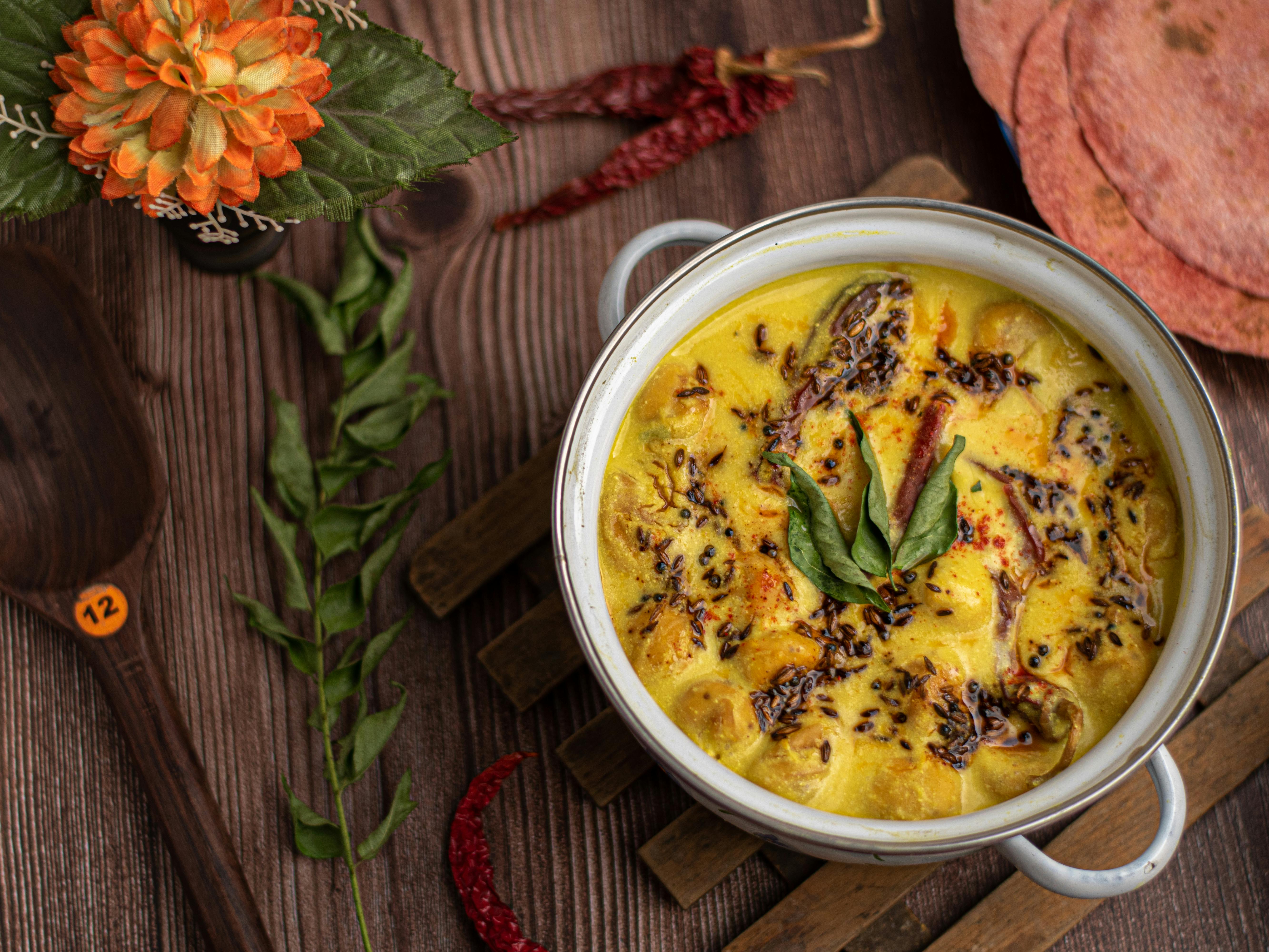
Photo: Pranjall Kumar / Pexels
The diets react (see scores below)
Common Ingredients
- yogurt
- gram flour
- onion
- turmeric
- cumin
- fenugreek
- curry leaves
- dried chiles
Specific recipes may vary.
Incompatible with 6 of 11 diets
Diet Ratings
Kadhi Pakora is fundamentally incompatible with ketogenic eating. The dish has two major high-carb components: (1) gram flour (besan), which is made from chickpeas and contains roughly 50-55g net carbs per 100g — it's used in significant quantities both in the yogurt-based gravy and as the pakora batter; and (2) yogurt, which contributes additional carbohydrates from lactose. Together, even a modest serving would deliver far more than the 20-50g daily net carb threshold. The pakoras are also deep-fried battered fritters, meaning gram flour is a structural, non-optional ingredient rather than a minor flavoring. Spices like turmeric, cumin, fenugreek, and curry leaves are keto-friendly in typical cooking amounts, but they cannot offset the carb load from the primary ingredients. There is no realistic portion size that makes this dish keto-compatible.
Kadhi Pakora is built on a yogurt-based sauce, and yogurt is a dairy product derived from cow's or buffalo's milk. This is a clear animal-derived ingredient that disqualifies the dish from vegan compliance. The pakora fritters themselves (gram flour, onion, spices) are entirely plant-based, but the defining kadhi base cannot be made without dairy yogurt in its traditional form. Vegan versions can be made by substituting plant-based yogurt (soy, coconut, or cashew-based), but the dish as listed with conventional yogurt is not vegan.
Kadhi Pakora contains two major non-paleo ingredients that are hard dealbreakers: yogurt (dairy) and gram flour (chickpea/legume flour). Yogurt is excluded under paleo rules as a dairy product, and gram flour is made from ground chickpeas, which are legumes — both explicitly off-limits. These are not minor or debated exclusions; they are foundational violations of paleo principles. The spices (turmeric, cumin, fenugreek, curry leaves, dried chiles) and onion are all paleo-compatible, but they cannot redeem a dish whose two primary structural components are both non-paleo.
Kadhi Pakora is a yogurt-based dish thickened with gram flour (chickpea flour), featuring anti-inflammatory spices and legume-based ingredients. Yogurt is an accepted dairy component in the Mediterranean diet, and gram flour (from legumes) is plant-forward and nutritious. The spice profile—turmeric, cumin, fenugreek—aligns well with anti-inflammatory principles. However, the pakora component involves deep-frying gram flour fritters in oil, which adds significant calories and typically uses non-olive oils, diverging from Mediterranean fat principles. Yogurt is acceptable in moderation rather than as a dietary staple. The dish is not traditional to Mediterranean cuisine but its core ingredients are compatible; the frying method and dairy-heavy base place it in the 'caution' zone rather than a full approve.
Some Mediterranean diet interpretations, particularly those emphasizing the broader 'traditional diet' framework, would view gram flour and yogurt favorably as legume and fermented dairy sources, and might score this higher if prepared with olive oil or baked rather than fried. Traditional Mediterranean cuisines do include yogurt-based dishes (e.g., Greek tzatziki, Turkish cacık) as regular components, lending some credibility to the yogurt base.
Kadhi Pakora is almost entirely plant-based and incompatible with the carnivore diet. The dish is built on gram flour (chickpea flour, a legume), yogurt (the only animal-derived ingredient, but it plays a minor supporting role in a sea of plant foods), onion, and a heavy array of plant spices and aromatics including turmeric, cumin, fenugreek, curry leaves, and dried chiles. The pakora fritters themselves are made from gram flour and onion — pure plant matter. Even setting aside the dominant plant ingredients, virtually every component violates carnivore principles. The yogurt alone does not redeem this dish.
Kadhi Pakora contains two major Whole30-excluded ingredients: yogurt (dairy) and gram flour (chickpea/besan flour, which is a legume-based product). Yogurt is explicitly excluded as a dairy product, and gram flour is made from ground chickpeas, which are legumes — also explicitly excluded. The pakora component (fritters made from gram flour batter) compounds the violation. The remaining ingredients — onion, turmeric, cumin, fenugreek, curry leaves, and dried chiles — are all Whole30-compliant spices and aromatics, but they cannot redeem a dish built on two fundamentally excluded ingredients.
Kadhi Pakora contains multiple high-FODMAP ingredients that make it unsuitable during the elimination phase. Yogurt (lactose) is high-FODMAP at standard serving sizes used in kadhi, which is yogurt-based at its core. Gram flour (chickpea/besan flour) is made from chickpeas and is high in GOS (galacto-oligosaccharides), a major FODMAP — it forms the base of both the pakoras and thickens the kadhi. Onion is one of the highest-fructan foods and is a staple ingredient in this dish. Together, these three ingredients alone — yogurt, gram flour, and onion — create a triple FODMAP hit (lactose, GOS, and fructans) that makes this dish clearly high-FODMAP at any standard serving. Fenugreek seeds also contain GOS in meaningful amounts. The remaining ingredients (turmeric, cumin, curry leaves, dried chiles) are generally low-FODMAP at culinary quantities and are not the concern here.
Kadhi Pakora is a yogurt-based curry with gram flour (chickpea flour) fritters. The base ingredients are largely DASH-compatible: yogurt provides calcium and protein, gram flour offers fiber, protein, and magnesium, and the spices (turmeric, cumin, fenugreek, curry leaves) are sodium-free and anti-inflammatory. However, the pakoras (fritters) are deep-fried, significantly increasing total fat and calorie content. Traditional recipes often use full-fat yogurt, which conflicts with DASH's preference for low-fat dairy. Sodium content depends heavily on preparation — home-cooked versions without added salt can be moderate, but restaurant versions often have high sodium. The deep-frying adds saturated and/or unsaturated fat that warrants portion control. With low-fat yogurt, baked or air-fried pakoras, and minimal added salt, this dish can approach DASH-approval; as commonly prepared with deep-frying and full-fat dairy, it falls in the caution range.
NIH DASH guidelines specify low-fat dairy and limit added fats including those from frying. However, updated clinical interpretations note that gram flour's high fiber and low glycemic profile, combined with anti-inflammatory spices and yogurt's probiotics, offer cardiovascular benefits — some DASH-oriented dietitians would approve a modified version with low-fat yogurt and baked pakoras as a nutrient-dense legume-and-dairy dish.
Kadhi Pakora is a yogurt-based curry with gram flour (besan) fritters. The yogurt base provides some protein and beneficial probiotics, and the anti-inflammatory spices (turmeric, cumin, fenugreek, curry leaves) are highly Zone-favorable from a polyphenol and omega-3/anti-inflammatory perspective. However, the gram flour pakoras are deep-fried, introducing significant fat (likely omega-6-heavy seed oils in traditional preparation) and raising the glycemic load considerably. Gram flour itself is moderate-GI, and while onion is a Zone-favorable vegetable, the overall carbohydrate content from the fried fritters skews the macronutrient ratio away from Zone balance. The dish also lacks a substantial lean protein source — yogurt provides some, but not a full Zone protein block equivalent for a main course. As a Zone meal component, it can work in careful small portions alongside a lean protein and lower-carb vegetables, but it is difficult to center a balanced Zone meal around it. The frying oil is the main concern, as Sears explicitly discourages omega-6-heavy oils. If made with olive oil or minimal oil, and paired with lean protein, it becomes more workable.
Some Zone practitioners would note that gram flour (chickpea flour) is actually a relatively low-glycemic legume-based carbohydrate with meaningful protein content compared to refined flour, and yogurt (especially low-fat) is a favorable Zone protein/carb source. In Sears' later anti-inflammatory writings, polyphenol-rich spices like turmeric and fenugreek are actively encouraged. A Zone-adapted version baked rather than fried, using low-fat yogurt and olive oil, could approach a more favorable score of 6-7.
Kadhi Pakora has a genuinely mixed anti-inflammatory profile. On the positive side, it features several potent anti-inflammatory spices: turmeric (curcumin), cumin, fenugreek (shown to reduce inflammatory markers), curry leaves (rich in antioxidants and alkaloids), and dried chiles (capsaicin). Gram flour (besan) is made from chickpeas, a legume that is encouraged in anti-inflammatory frameworks for its fiber and protein content. Onion contributes quercetin, a well-researched anti-inflammatory flavonoid. The limiting factors are the yogurt base (low-fat dairy is considered acceptable in moderation under most anti-inflammatory guidelines, but full-fat yogurt edges toward caution) and the pakora preparation, which involves deep-frying the gram flour fritters — typically in refined vegetable oils high in omega-6, which anti-inflammatory protocols flag as pro-inflammatory. The frying method significantly undermines what would otherwise be a moderately beneficial dish. If prepared with minimal or no deep-frying (baked pakoras) and low-fat yogurt, the score would rise. As traditionally prepared with deep-fried pakoras, the dish sits at the upper edge of caution.
Mainstream anti-inflammatory nutrition researchers who view refined seed oils as acceptable (per AHA guidance) would rate this dish more favorably, given the strong spice profile and legume base — potentially pushing it into the low 'approve' range. Conversely, autoimmune protocol (AIP) practitioners would rate it lower, flagging yogurt (dairy), nightshade-adjacent dried chiles, and gram flour lectins as potentially triggering for sensitive individuals.
Kadhi Pakora is a yogurt- and gram flour-based curry with deep-fried gram flour dumplings (pakoras). The yogurt base provides modest protein and probiotics, and gram flour (besan) adds some plant-based protein and fiber. Spices like turmeric, cumin, and fenugreek are gut-supportive and anti-inflammatory. However, the dish has two significant drawbacks for GLP-1 patients: (1) the pakoras are deep-fried, which increases fat content, worsens nausea and reflux risk, and slows digestion further on top of GLP-1-induced delayed gastric emptying; and (2) protein density is low relative to calorie load — this is not a high-protein dish. The dried chiles may also aggravate GI sensitivity in some patients. The yogurt base version without pakoras would score higher; the full traditional dish with fried pakoras lands in caution territory. Portion size matters significantly — a small serving of the kadhi broth with minimal pakoras is more tolerable than a full portion.
Some GLP-1-focused dietitians may allow kadhi in small portions as a culturally familiar, warm, easily digestible broth-like dish with modest protein from yogurt and gram flour, accepting that the fried pakoras can be minimized or omitted. Others would flag even the spice blend (dried chiles, fenugreek in quantity) as a potential nausea trigger for patients in early GLP-1 titration who have heightened GI sensitivity.
*See how scores were generated at our methodology page.
Nutritional profile
Six traits that cut across every diet.
Fiber & Plants
How much whole-plant food and fiber it delivers.
Healthy Fats
The quality of its fats (unsaturated, omega-3).
Whole / Unprocessed
How close it is to its natural, unprocessed form.
Gut Gentle
How easy it is on digestion (low FODMAP, few irritants).
Low Glycemic
How little it spikes your blood sugar.
Protein Density
How much protein it packs per calorie.
Controversy Index
Higher controversy = more disagreement between diets.
Diet-Specific Tips
 Mediterranean — 5/10
View tips
- Yogurt is accepted dairy in Mediterranean diet but in moderation
- Gram flour (chickpea flour) is a legume-based, plant-forward ingredient
- Pakora fritters are typically deep-fried, adding excess fat from non-olive oils
- Anti-inflammatory spices (turmeric, cumin, fenugreek) are a positive element
- No red meat, processed foods, or added sugars
- Not a traditional Mediterranean dish; cultural context differs
 DASH — 5/10
View tips
- Deep-frying of pakoras adds significant fat, reducing DASH compatibility
- Gram flour (chickpea flour) is a DASH-friendly legume source rich in fiber, protein, and magnesium
- Full-fat yogurt as commonly used conflicts with DASH low-fat dairy recommendation
- Spices contribute no sodium and may offer anti-inflammatory benefits
- Sodium content variable — home preparation can be low-sodium, restaurant versions typically high
- Low-fat yogurt and baked pakora modifications would substantially improve DASH score
 Zone — 5/10
View tips
- Deep-frying in omega-6 seed oils conflicts with Zone anti-inflammatory principles
- Gram flour fritters increase glycemic load significantly
- Yogurt provides moderate protein but insufficient for a full Zone protein block as a main
- No dedicated lean protein source listed — Zone main courses need ~25g protein
- Turmeric, fenugreek, cumin, and curry leaves are highly Zone-favorable anti-inflammatory polyphenol sources
- Onion is a Zone-favorable low-glycemic vegetable
- Macro ratio skews carb-heavy and fat-heavy (from frying) relative to protein
- Portion control critical — small serving as a side dish is more Zone-compatible than as a main
 Anti-Inflammatory — 6/10
View tips
- Turmeric (curcumin) — strong anti-inflammatory evidence
- Fenugreek and cumin — anti-inflammatory and gut-supportive
- Curry leaves — rich in antioxidants and anti-inflammatory alkaloids
- Dried chiles — capsaicin with anti-inflammatory properties
- Gram flour (chickpea) — legume base, fiber-rich, anti-inflammatory aligned
- Onion — quercetin content supports anti-inflammatory profile
- Deep-frying in refined oil — pro-inflammatory omega-6 concern undermines dish
- Yogurt — acceptable in moderation; full-fat versions are a mild concern
 GLP-1 Friendly — 4/10
View tips
- Pakoras are deep-fried — increases fat load and worsens GLP-1 GI side effects including nausea, bloating, and reflux
- Low protein density for a main dish — does not meet the 15-30g per meal protein target without significant supplementation
- Yogurt and gram flour provide modest protein and some fiber — partial positives
- Dried chiles may worsen reflux or nausea, particularly during early GLP-1 titration
- Turmeric, cumin, and fenugreek are generally well-tolerated and may support digestion
- Dish is portion-sensitive — kadhi broth alone is more GLP-1 friendly than the full pakora version
- Culturally significant dish; modification (baked or air-fried pakoras, reduced chiles) may improve suitability