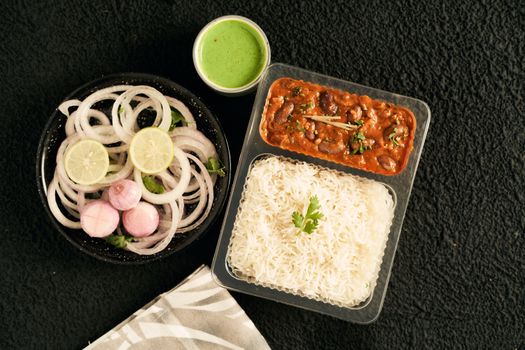
Photo: dhiraj jain / Pexels
Indian
Rajma Chawal
The diets react (see scores below)
Common Ingredients
- kidney beans
- rice
- onion
- tomatoes
- ginger
- garlic
- garam masala
- cumin
Specific recipes may vary.
Incompatible with 5 of 11 diets
Diet Ratings
Rajma Chawal is fundamentally incompatible with ketogenic diet principles. Rice alone contains approximately 45g of net carbs per cup (cooked), which can single-handedly exceed the entire daily keto carb limit. Kidney beans add another 30-35g of net carbs per cup despite their fiber content. Together, a standard serving of this dish delivers well over 60-80g of net carbs, making ketosis impossible. Both rice (a grain) and kidney beans (a legume with high starch content) are explicitly excluded foods on any version of the ketogenic diet. The spices, onion, tomato, and aromatics are relatively low-carb, but they cannot offset the core carbohydrate load from the two primary ingredients.
Rajma Chawal is a classic North Indian dish consisting entirely of whole plant foods. Kidney beans provide excellent plant-based protein and fiber, rice is a staple whole grain, and the aromatics (onion, tomato, ginger, garlic) and spices (garam masala, cumin) are all 100% plant-derived. There are no animal products, animal-derived ingredients, or ambiguous components in this dish as described. It is also a nutritionally balanced, whole-food meal combining a legume with a grain, making it exemplary from both a vegan and whole-food plant-based perspective. The high protein and fiber content from kidney beans, combined with complementary amino acids from rice, makes this a nutritionally strong vegan choice.
Rajma Chawal is built on two foundational non-paleo ingredients: kidney beans (a legume) and rice (a grain). Both are explicitly excluded from the Paleolithic diet with near-universal consensus across all major paleo authorities. Kidney beans contain lectins, phytates, and other antinutrients that paleo proponents argue the human gut did not evolve to handle efficiently. Rice, as a grain, is similarly excluded under standard paleo principles. The aromatics and spices — onion, tomatoes, ginger, garlic, garam masala, and cumin — are all paleo-compliant, but they represent only a minor fraction of the dish. The core identity and caloric base of Rajma Chawal is entirely incompatible with the Paleolithic diet, making this a clear avoid with no meaningful paleo adaptation possible without fundamentally changing the dish.
Rajma Chawal is a wholesome, plant-based dish featuring kidney beans as the primary protein alongside vegetables and anti-inflammatory spices — all well-aligned with Mediterranean principles. Kidney beans are legumes, a cornerstone of the Mediterranean diet, and the aromatic base of onion, tomatoes, garlic, and ginger closely mirrors Mediterranean flavor profiles. The main concern is the white rice, a refined grain that modern Mediterranean diet guidelines discourage in favor of whole grains like farro, barley, or brown rice. The dish contains no red meat, processed ingredients, or added sugars, and the spice blend is beneficial. If prepared with olive oil and served with whole-grain or limited rice portions, this dish would score higher.
Traditional Mediterranean cuisines — particularly from regions like Egypt, Turkey, and the Levant — do incorporate white rice regularly as a staple grain, and some nutritionists argue that white rice in a legume-heavy meal is acceptable given the overall fiber and nutrient balance. However, modern clinical Mediterranean diet frameworks (e.g., PREDIMED guidelines) consistently emphasize whole grains over refined ones.
Rajma Chawal is entirely plant-based and incompatible with the carnivore diet. Every single ingredient — kidney beans, rice, onion, tomatoes, ginger, garlic, garam masala, and cumin — is a plant-derived food that is explicitly excluded from the carnivore framework. Kidney beans are legumes (high in anti-nutrients like lectins and phytates, which carnivore communities specifically warn against), rice is a grain, and the remaining ingredients are vegetables, roots, and plant-based spices. There is no animal product whatsoever in this dish. This is as far from carnivore-compatible as a meal can get.
Rajma Chawal contains two Whole30-excluded ingredients: kidney beans (legumes) and rice (grains). Both are explicitly prohibited on the Whole30 program. Kidney beans are legumes, a fully excluded food category, and rice is a grain, also fully excluded. There are no exceptions for either of these ingredients. The dish cannot be made compliant by substitution without fundamentally changing its identity.
Rajma Chawal is fundamentally incompatible with the low-FODMAP elimination phase due to multiple high-FODMAP ingredients. Kidney beans are very high in GOS (galacto-oligosaccharides) and are explicitly listed as high-FODMAP by Monash University at any reasonable serving size — they are the primary protein and bulk of this dish, making substitution impossible while retaining the dish's identity. Garlic is one of the highest-FODMAP foods tested by Monash, rich in fructans, and is a core flavoring ingredient here. Onion is similarly high in fructans and is another foundational aromatic. While rice is low-FODMAP and safe, tomatoes are low-FODMAP at standard servings, ginger is low-FODMAP, cumin is low-FODMAP in culinary amounts, and garam masala is generally low-FODMAP in small spice quantities, none of these safe ingredients can offset the three major high-FODMAP components (kidney beans, garlic, onion). This dish cannot be made low-FODMAP in its traditional form without fundamentally altering the recipe.
Rajma Chawal is a well-aligned DASH meal. Kidney beans are a DASH star food — rich in plant-based protein, fiber, potassium, magnesium, and low in saturated fat. The vegetable base (onion, tomatoes, ginger, garlic) adds potassium, antioxidants, and phytonutrients. Spices like garam masala and cumin add flavor without sodium, supporting DASH's strategy of using herbs and spices to reduce salt dependency. The main area of caution is the white rice, which is refined and lower in fiber than brown rice or other whole grains DASH emphasizes. If prepared with white rice (as is traditional), the glycemic load is higher and fiber content lower than ideal. With brown rice, this dish would score a 9. Sodium is typically low in home-prepared versions, though canned kidney beans can add significant sodium — rinsing canned beans reduces sodium by ~40%. Overall, this is a strong DASH-compatible meal, particularly for plant-protein and legume servings.
NIH DASH guidelines strongly endorse legumes like kidney beans and recommend 4-5 servings/week, making this dish a natural fit. However, some DASH-oriented clinicians note that white rice — the traditional base — is a refined grain that DASH discourages, and suggest substituting brown rice or limiting portion size to avoid displacing more nutrient-dense whole grains from the daily plan.
Rajma Chawal presents a significant Zone challenge primarily due to its carbohydrate profile and the absence of meaningful fat or lean protein sources. Kidney beans are a dual protein-carb source: while they provide plant protein, their carb load is substantial (~40g net carbs per cup), requiring careful block counting. Rice — especially white rice, the traditional pairing — is a high-glycemic, unfavorable Zone carb that Sears explicitly discourages. The combination of two high-carbohydrate staples (beans + rice) makes hitting the 40/30/30 ratio extremely difficult. The dish's carb-to-protein ratio skews heavily toward carbs: beans provide roughly 15g protein and 35-40g net carbs per cup, while rice adds another 40-45g net carbs with minimal protein. Fat is almost entirely absent from this dish as traditionally prepared, requiring significant supplementation (olive oil, avocado) to reach Zone targets. The spices (garam masala, cumin, ginger, garlic) are Zone-positive for their anti-inflammatory polyphenol content. To Zone-ify this dish, one would need to dramatically reduce rice (or eliminate it), reduce bean portion, add a lean protein source, and add monounsaturated fat — essentially reconstructing the dish. As served in traditional proportions, the macro ratio is far outside Zone targets.
Rajma Chawal is a well-aligned anti-inflammatory dish. Kidney beans are an anti-inflammatory staple — high in fiber, plant protein, polyphenols, and folate, with research linking legume consumption to reduced CRP and IL-6 levels. Tomatoes contribute lycopene (especially when cooked), and onions provide quercetin, both potent antioxidants. Ginger, garlic, and cumin are well-documented anti-inflammatory spices, and garam masala typically includes turmeric, coriander, cloves, and cardamom — all with anti-inflammatory profiles. Rice (typically white in this dish) is the one neutral element: it's a refined carbohydrate with a higher glycemic index, offering little anti-inflammatory benefit, but it's not actively pro-inflammatory in moderate portions and is a lower-inflammatory choice compared to refined wheat. Brown rice would improve the profile further. Overall, the dish is predominantly plant-based, legume-forward, and spice-rich — a strong fit for anti-inflammatory eating.
Rajma Chawal is a nutritionally solid Indian staple with genuine strengths for GLP-1 patients, but the white rice component and portion dynamics introduce enough concern to land it in caution territory. Kidney beans are an excellent plant-based protein and fiber source — a standard serving (~1 cup cooked) delivers roughly 13-15g protein and 11-13g fiber, supporting both the #1 and #2 GLP-1 priorities simultaneously. The dish is low in fat, easy to digest when well-cooked, and the spice profile (garam masala, cumin, ginger, garlic) is moderate rather than aggressively hot, making it unlikely to worsen reflux or nausea for most patients. Tomatoes and onion add micronutrients and water content. The primary concern is the white rice: refined, low in fiber, moderate glycemic index, and nutritionally thin per calorie — a poor fit for the nutrient density priority. It also displaces more protein-rich or fiber-rich foods in an already small-appetite meal. The dish can be optimized by reducing rice portion, substituting brown or basmati rice, or increasing the rajma-to-rice ratio. As a combined dish, the bean-forward version scores well; a rice-heavy plate scores lower. Rated as typically served, with a standard 1:1 ratio of beans to rice.
Some GLP-1-focused dietitians consider legume-based dishes like rajma to be near-ideal plant protein sources and would rate this higher, accepting the white rice as a reasonable energy substrate in small portions given the strong overall fiber and protein contribution from the beans. Others flag the cumulative carbohydrate load — beans plus white rice — as a concern for patients with insulin resistance or type 2 diabetes on GLP-1 therapy, where glycemic control is a co-primary goal, and would recommend portion reduction or rice substitution before approving.
*See how scores were generated at our methodology page.
Nutritional profile
Six traits that cut across every diet.
Fiber & Plants
How much whole-plant food and fiber it delivers.
Healthy Fats
The quality of its fats (unsaturated, omega-3).
Whole / Unprocessed
How close it is to its natural, unprocessed form.
Gut Gentle
How easy it is on digestion (low FODMAP, few irritants).
Low Glycemic
How little it spikes your blood sugar.
Protein Density
How much protein it packs per calorie.
Controversy Index
Higher controversy = more disagreement between diets.
Diet-Specific Tips
 Vegan — 9/10
View tips
- Kidney beans are a whole-food plant-based protein source — fully vegan
- Rice is a plant staple with no animal involvement
- All aromatics (onion, tomato, ginger, garlic) are unambiguously plant-based
- Spices (garam masala, cumin) are plant-derived with no animal components
- No dairy, ghee, or cream used — traditional home versions sometimes add these, but the listed ingredients contain none
- Whole-food profile earns a high score within the approve range
 Mediterranean — 6/10
View tips
- Kidney beans are a Mediterranean diet staple — high in fiber, protein, and nutrients
- White rice is a refined grain, inconsistent with modern Mediterranean whole-grain emphasis
- All-plant ingredients with no red meat, processed foods, or added sugars
- Tomatoes, onion, garlic are core Mediterranean vegetables
- Spices like cumin and garam masala are not traditional Mediterranean but are not harmful
- Dish would improve with brown rice, whole grain substitute, or reduced rice portion
- No olive oil specified — traditional Mediterranean preparation would use it as primary fat
 DASH — 8/10
View tips
- Kidney beans are a DASH-recommended legume: high fiber, potassium, magnesium, plant protein
- No saturated fat or cholesterol from animal sources
- Spice-based flavoring supports sodium reduction strategy
- White rice is a refined grain — DASH prefers whole grains like brown rice
- Tomatoes and onions add potassium and micronutrients
- Canned kidney beans may add sodium — rinsing recommended; dried beans are ideal
- Portion control on rice important to manage glycemic load and calorie density
 Zone — 4/10
View tips
- White rice is a high-glycemic, Zone-unfavorable carbohydrate explicitly discouraged by Dr. Sears
- Double carbohydrate load from both rice and kidney beans makes 40/30/30 ratio very difficult to achieve
- Kidney beans are a favorable Zone protein-carb block but their net carb content is still significant (~7g net carbs per 1/4 cup cooked)
- Dish is nearly fat-free as prepared — monounsaturated fat must be added externally to meet Zone fat block requirements
- Protein content from kidney beans alone is insufficient for a Zone meal (~7g per 1/4 cup) and no lean animal protein is present
- Spices (ginger, garlic, garam masala, cumin) are Zone-positive for anti-inflammatory polyphenol and micronutrient content
- Traditional serving portions are far too carbohydrate-heavy for Zone compliance without significant modification
 Anti-Inflammatory — 8/10
View tips
- Kidney beans: high-fiber legume with polyphenols and plant protein — strongly anti-inflammatory
- Ginger and garlic: well-supported anti-inflammatory spices with COX-inhibiting compounds
- Garam masala and cumin: spice blend likely containing turmeric, cloves, and coriander — antioxidant-rich
- Cooked tomatoes: lycopene bioavailability increases with heat — anti-inflammatory antioxidant
- Onion: quercetin content supports anti-inflammatory profile
- White rice: higher glycemic index, nutritionally neutral — minor drag on score; brown rice preferred
 GLP-1 Friendly — 6/10
View tips
- Kidney beans provide strong dual protein and fiber benefit aligned with GLP-1 priorities #1 and #2
- White rice is refined, low-fiber, and nutritionally thin per calorie — conflicts with nutrient density priority
- Low fat content is a clear positive for GLP-1 tolerability
- Moderate spice profile unlikely to worsen nausea or reflux for most patients
- Dish is portion-sensitive: bean-heavy ratio improves the score; rice-heavy ratio worsens it
- Cumulative carbohydrate load (beans + rice) is a consideration for patients with comorbid insulin resistance
- Easily optimized: brown rice or reduced rice portion meaningfully improves GLP-1 suitability