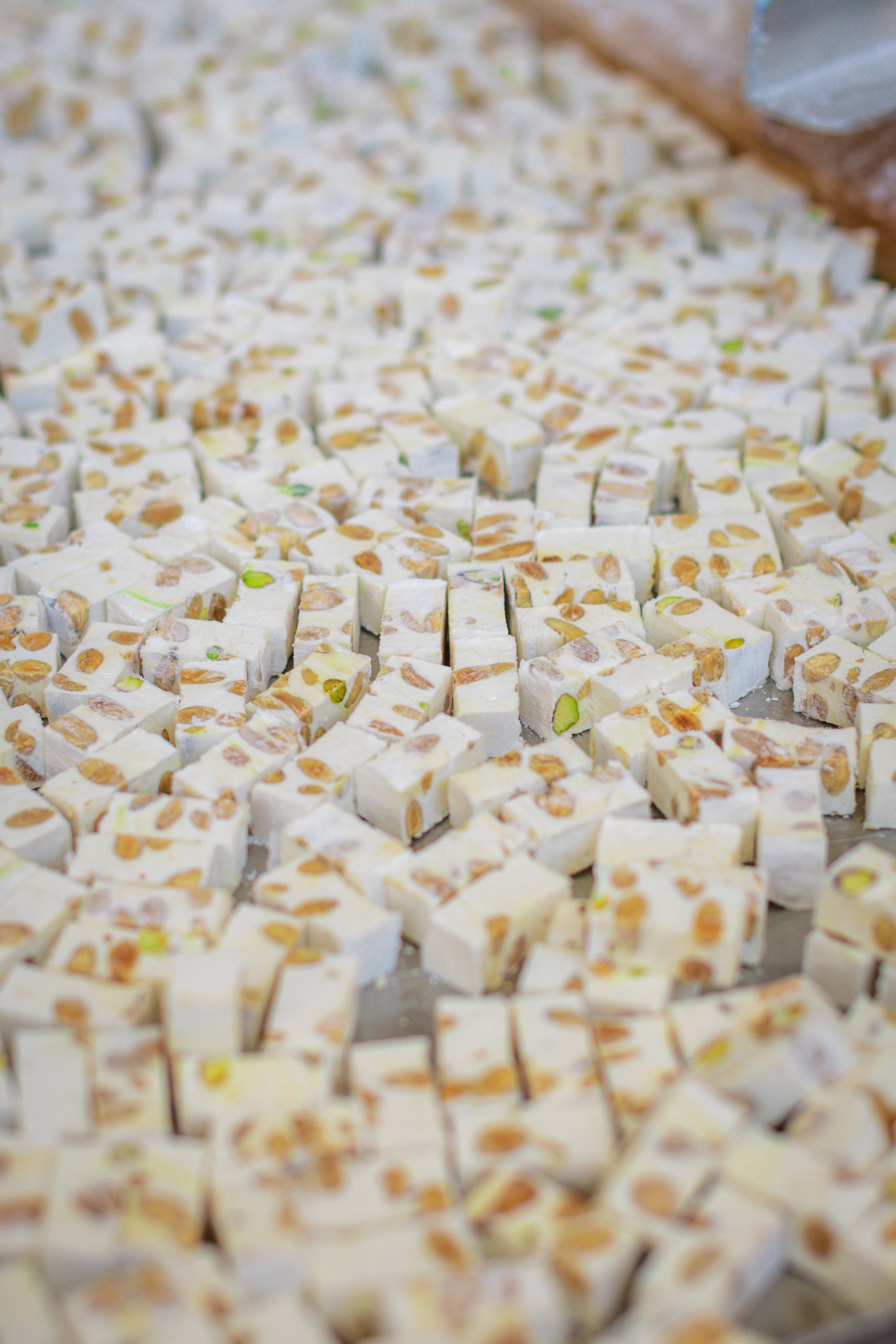
Photo: Nougat Diane de Poytiers / Pexels
The diets react (see scores below)
Common Ingredients
- egg whites
- honey
- almonds
- pistachios
- powdered sugar
- cornstarch
- wafer sheets
- vanilla
Specific recipes may vary.
Incompatible with 9 of 11 diets
Diet Ratings
French nougat is fundamentally incompatible with a ketogenic diet. The primary ingredients — honey, powdered sugar, and cornstarch — are pure or near-pure sources of fast-digesting carbohydrates and sugar. A single small serving of nougat can easily contain 20-40g of net carbs, which alone could exceed or entirely consume the entire daily keto carb allowance. Wafer sheets add additional starch-based carbs. While almonds and pistachios are keto-friendly nuts, and egg whites provide acceptable protein, they are present in insufficient quantities to offset the massive carbohydrate load from the sweeteners and starch. This is essentially a confection built on sugar and honey, making it one of the clearest 'avoid' foods on a ketogenic diet.
French nougat contains two clear animal-derived ingredients: egg whites and honey. Egg whites are an animal product (excluded by all vegan standards), and honey is excluded by the vast majority of vegan organizations including the Vegan Society and PETA. Either ingredient alone would disqualify this dish; together, they make it unambiguously non-vegan. The remaining ingredients (almonds, pistachios, powdered sugar, cornstarch, wafer sheets, vanilla) are plant-based, but they cannot offset the animal products present.
French nougat contains multiple non-paleo ingredients that disqualify it entirely. Powdered sugar is refined sugar, which is strictly excluded from all paleo frameworks. Cornstarch is a grain-derived processed starch, also excluded. Wafer sheets are made from wheat flour, a grain that is one of the clearest avoid items in any paleo interpretation. While egg whites, honey, almonds, and pistachios are individually paleo-compatible (honey being a caution-level natural sweetener), the presence of three hard-exclude ingredients — refined sugar, cornstarch, and wheat-based wafers — makes this dish firmly non-paleo. No reasonable paleo interpretation would accommodate this confection.
Nougat is a confection built around powdered sugar and honey as its structural base, making it primarily a high-sugar sweet treat. While it contains Mediterranean-friendly ingredients like almonds, pistachios, egg whites, and honey, the dominant caloric profile comes from added sugars (powdered sugar plus honey used in confectionery quantities). Cornstarch and wafer sheets add refined carbohydrates. The Mediterranean diet minimizes added sugars and sweets, treating them as rare indulgences rather than regular snacks. This dish falls into the 'sweets and desserts' category that Mediterranean diet guidelines explicitly recommend limiting to occasional consumption.
Some traditionalists note that honey-and-nut confections have a long history in Mediterranean cultures (including Middle Eastern and Southern European traditions), and the presence of almonds, pistachios, and egg whites gives this more nutritional value than modern candy. A small occasional portion could fit a culturally authentic Mediterranean lifestyle where homemade sweets with natural ingredients are considered preferable to industrially processed alternatives.
Nougat is fundamentally incompatible with the carnivore diet. While egg whites and honey have tenuous connections to animal products, the dish is overwhelmingly plant-based and sugar-laden. Almonds, pistachios, powdered sugar, cornstarch, wafer sheets, and vanilla are all strictly excluded plant-derived ingredients. Powdered sugar and cornstarch are processed carbohydrates, almonds and pistachios are nuts (explicitly excluded), and wafer sheets are grain-based. Even the honey — the only debatable ingredient — is present in a confection context alongside wholly incompatible ingredients. This dish represents the antithesis of carnivore eating: a sugar-and-nut candy with only trace animal input.
French nougat contains multiple excluded ingredients. Powdered sugar is an added sugar, which is explicitly excluded on Whole30. Cornstarch is also explicitly named as an excluded ingredient on Whole30. Wafer sheets are typically made from wheat flour, making them a grain-based product that is excluded. Additionally, even setting aside those individual ingredients, nougat is a confection — a candy — that clearly falls into the 'junk food' category that Whole30 prohibits recreating even with compliant ingredients. This dish fails on multiple fronts simultaneously.
French nougat contains two significant high-FODMAP ingredients that make it problematic during the elimination phase. Honey is high in excess fructose and is explicitly listed as high-FODMAP by Monash University — it is a primary ingredient in traditional nougat and cannot be avoided in this dish. Pistachios are high in GOS and fructans; even a small serving (around 15 pistachios or 28g) is rated high-FODMAP by Monash. Almonds are low-FODMAP at 10 almonds (approx. 12g) but become high-FODMAP beyond that serving due to GOS — in a confection like nougat, portion control over almond quantity is difficult. Egg whites, powdered sugar (plain sucrose), cornstarch, wafer sheets (typically rice-based), and vanilla are generally low-FODMAP. However, the combination of honey as a primary sweetener and pistachios as a featured nut makes this dish high-FODMAP at any realistic serving size. There is no straightforward substitution that preserves the character of the dish while making it FODMAP-safe.
Monash University does not specifically test nougat as a composite food, and some clinical FODMAP dietitians suggest that in very small tasting portions the total FODMAP load from honey and pistachios might remain below threshold; however, most elimination-phase practitioners would advise avoiding nougat entirely given honey's clear high-FODMAP status and the difficulty of controlling pistachio intake in a confection format.
French nougat contains a mix of DASH-friendly and DASH-problematic ingredients. On the positive side, it includes egg whites (lean protein, no saturated fat or cholesterol), honey (a natural sweetener, though still a sugar), almonds and pistachios (DASH-approved nuts rich in potassium, magnesium, and healthy fats), and vanilla. However, the dominant nutritional concern is the high added sugar content from powdered sugar and honey — DASH explicitly limits sweets and added sugars. Nougat is fundamentally a confection where sugar is the primary structural component, making it a high-sugar food regardless of its wholesome sub-ingredients. The nuts provide redeeming nutritional value (fiber, magnesium, potassium), and sodium is negligible, which prevents this from scoring in the 'avoid' range. However, the caloric density and added sugar load make it incompatible with regular DASH consumption. Small portions as an occasional treat are more acceptable than habitual snacking.
NIH DASH guidelines explicitly limit sweets to ≤5 servings per week (small portions), which technically allows occasional consumption of foods like nougat in very small amounts. Some DASH-oriented nutritionists might note that nougat's nut content and low sodium distinguish it favorably from candy bars or processed sweets, and that the glycemic impact of honey-based sweets may differ from refined sugar — though mainstream DASH interpretation treats all high-added-sugar foods with caution regardless of sugar source.
French nougat is fundamentally a confection built around high-glycemic, nutritionally empty carbohydrates. Honey and powdered sugar are the dominant carbohydrate sources — both are high-glycemic, rapidly absorbed sugars that spike blood glucose and trigger the insulin response Zone Diet is specifically designed to prevent. Cornstarch adds additional refined starch. While the dish does contain some Zone-favorable ingredients — egg whites (lean protein), almonds and pistachios (monounsaturated fats and some protein) — these are present in minor quantities relative to the sugar load, and the overall macro ratio is wildly skewed toward high-glycemic carbohydrates. The 40/30/30 ratio cannot be achieved here without consuming negligible portions that provide no nutritional value. This is essentially candy: the sugar-to-everything-else ratio makes it structurally incompatible with Zone block math. Unlike a food that is merely 'unfavorable' but usable in small amounts, nougat provides no practical Zone building block function — it is a dessert confection where the primary caloric contribution is pure sugar. Dr. Sears explicitly identifies refined sugars and high-glycemic sweets as foods that drive eicosanoid imbalance and chronic inflammation, the exact outcomes the Zone Diet seeks to prevent.
French nougat presents a mixed anti-inflammatory profile. On the positive side, almonds provide vitamin E, healthy monounsaturated fats, and some anti-inflammatory polyphenols; pistachios offer similar benefits plus antioxidants; honey contains small amounts of flavonoids and antimicrobial compounds and is a less-processed sweetener than refined sugar; egg whites are a clean protein source with minimal pro-inflammatory properties; vanilla adds minor antioxidant compounds. However, the dominant ingredient by caloric contribution is powdered sugar (refined sugar), which is a well-established pro-inflammatory driver that raises blood glucose, promotes insulin spikes, and increases inflammatory markers like CRP and IL-6. Cornstarch is a refined carbohydrate with no nutritional benefit and a high glycemic impact. Wafer sheets add additional refined starch. The overall dish is essentially a confection — a candy — where the beneficial nut content is outweighed by a significant refined sugar load. It is not a food that can be recommended on an anti-inflammatory basis as a regular snack, though the nut content prevents it from being a clear 'avoid.' Occasional consumption is acceptable, especially compared to more additive-laden confections, but it cannot be considered a dietary positive.
French nougat is essentially a confection built around sugar and honey, with egg whites serving as a structural component rather than a meaningful protein source. A standard serving (30g) delivers roughly 1-2g of protein alongside 20-25g of sugar and 100-120 calories that are almost entirely from simple carbohydrates. While almonds and pistachios contribute small amounts of healthy unsaturated fats and a trace of protein, their quantity in a typical nougat serving is too small to redeem the nutritional profile. This is a high-sugar, low-protein, low-fiber food that represents exactly the kind of empty-calorie snack GLP-1 patients should avoid — it spikes blood sugar rapidly, provides no satiety benefit, wastes precious reduced appetite on nutritionally vacant calories, and the high sugar content can worsen nausea and GI discomfort already common on GLP-1 medications. The powdered sugar and cornstarch add further refined carbohydrate load with zero nutritional value. Despite the egg white base, this cannot be categorized as a protein food in any practical sense.
*See how scores were generated at our methodology page.
Nutritional profile
Six traits that cut across every diet.
Fiber & Plants
How much whole-plant food and fiber it delivers.
Healthy Fats
The quality of its fats (unsaturated, omega-3).
Whole / Unprocessed
How close it is to its natural, unprocessed form.
Gut Gentle
How easy it is on digestion (low FODMAP, few irritants).
Low Glycemic
How little it spikes your blood sugar.
Protein Density
How much protein it packs per calorie.
Controversy Index
Higher controversy = more disagreement between diets.
Diet-Specific Tips
 DASH — 4/10
View tips
- High added sugar content from powdered sugar and honey — primary DASH concern
- DASH guidelines limit sweets to ≤5 small servings per week
- Almonds and pistachios are DASH-approved nuts with beneficial magnesium and potassium
- Egg whites are lean protein with no saturated fat or cholesterol
- Negligible sodium — no concern on DASH sodium limits
- High caloric density limits portion-controlled DASH compatibility
- No saturated fat or tropical oils — avoids one major DASH exclusion category
 Anti-Inflammatory — 4/10
View tips
- High refined sugar content (powdered sugar as primary sweetener) is pro-inflammatory — raises CRP and IL-6
- Almonds and pistachios provide anti-inflammatory vitamin E, monounsaturated fats, and polyphenols
- Honey is a less-processed sweetener with trace flavonoids, but still a significant sugar source
- Egg whites are a neutral, clean protein
- Cornstarch and wafer sheets add refined carbohydrate load with high glycemic impact
- Overall caloric profile dominated by sugar and starch — classifies this as a confection, not a health-supportive snack