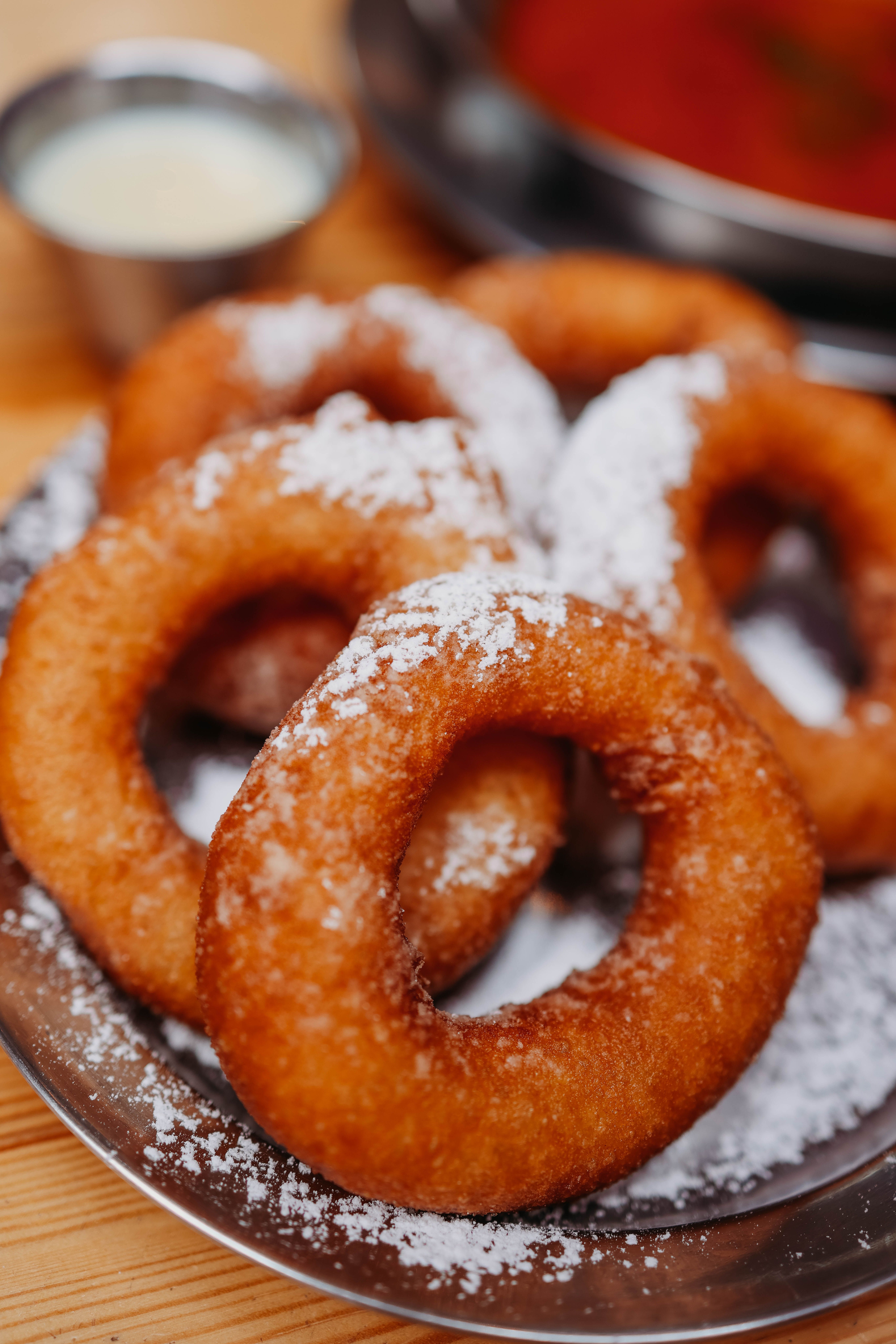
Photo: Valeria Boltneva / Pexels
American
Old-Fashioned Donut
The diets react (see scores below)
Common Ingredients
- flour
- sugar
- eggs
- buttermilk
- butter
- baking powder
- salt
- vanilla
- nutmeg
Specific recipes may vary.
Incompatible with 11 of 11 diets
Diet Ratings
An old-fashioned donut is fundamentally incompatible with a ketogenic diet. Its two primary ingredients — refined wheat flour and sugar — are the exact foods keto eliminates. A single old-fashioned donut typically contains 30-45g of net carbs, which alone can exceed or entirely consume the daily keto carb budget of 20-50g. There is no redeeming nutritional profile here: the fat content comes largely from frying oil rather than quality fat sources, the carbohydrate load is massive, and the sugar content will immediately disrupt ketosis. No portion size makes this food keto-compatible.
The Old-Fashioned Donut contains multiple animal-derived ingredients that disqualify it from vegan compliance. Eggs and buttermilk are direct animal products (from hens and cows respectively), and butter is a dairy fat. All three are explicitly excluded under any definition of veganism. There is no ambiguity here — this is a classic non-vegan baked good. Vegan versions can be made by substituting flax eggs or aquafaba for eggs, plant-based milk with vinegar for buttermilk, and vegan butter or coconut oil for butter, but as described, this recipe is not vegan.
An Old-Fashioned Donut is fundamentally incompatible with the paleo diet. The primary ingredient is wheat flour, a grain explicitly excluded from paleo. It also contains refined sugar, buttermilk (dairy), and added salt — all non-paleo. Butter and eggs are the only ingredients with any paleo relevance, but they are minor components in an otherwise entirely non-paleo food. This dish represents the archetypal processed, grain-based, dairy-containing baked good that the paleo diet was designed to exclude.
An old-fashioned donut fundamentally contradicts Mediterranean diet principles on multiple fronts. It is made with refined white flour (a refined grain), significant added sugar, and butter as the primary fat — none of which align with the diet's emphasis on whole grains, plant-based foods, and olive oil as the dominant fat. Donuts are a quintessential processed, high-sugar, high-saturated-fat snack with no meaningful nutritional contribution in the Mediterranean framework. There are no redeeming plant-forward or whole-food elements present.
An old-fashioned donut is almost entirely plant-derived and processed, making it completely incompatible with the carnivore diet. The primary ingredients — flour (grain), sugar (plant-derived/processed), buttermilk (dairy, but a minor component), butter (dairy, minor component), baking powder (plant-based leavening), vanilla (plant extract), and nutmeg (plant spice) — are overwhelmingly excluded on carnivore. Even the two animal-derived ingredients (eggs, butter, buttermilk) are minor players in what is fundamentally a grain-and-sugar-based food. This is a processed baked good with no place on any tier of the carnivore diet.
An old-fashioned donut violates Whole30 on multiple levels. It contains flour (a grain, excluded), sugar (excluded added sugar), buttermilk (dairy, excluded), and butter (dairy, excluded). Beyond the individual excluded ingredients, donuts are explicitly named in the spirit-of-the-program rule against recreating baked goods and junk food — even if somehow made with compliant ingredients, a donut would still be off-limits. This dish is unambiguously incompatible with Whole30.
Old-Fashioned Donuts are a clear avoid during the FODMAP elimination phase due to two primary high-FODMAP ingredients. First, regular wheat flour is the main structural ingredient and is high in fructans — one of the most problematic FODMAP groups. A standard donut contains a substantial amount of flour, far exceeding any safe fructan threshold. Second, buttermilk is high in lactose, another key FODMAP that must be restricted during elimination. The remaining ingredients — eggs, butter, baking powder, salt, vanilla extract, nutmeg, and sugar — are individually low-FODMAP and not concerning. However, the combination of wheat flour and buttermilk makes this food incompatible with the elimination phase at any realistic serving size. There is no practical way to consume a standard old-fashioned donut within safe FODMAP limits without reformulating the recipe.
An old-fashioned donut is fundamentally incompatible with the DASH eating plan. It is made primarily from refined white flour (not a whole grain), high in added sugar, and contains butter (saturated fat). When fried — as is typical for this style — it adds significant amounts of fat, often including trans or saturated fats from frying oils. Even in a baked version, it remains a refined-carbohydrate, high-sugar, high-saturated-fat food with negligible fiber, potassium, magnesium, or calcium. DASH guidelines explicitly limit sweets and foods high in added sugar and saturated fat. This food offers little nutritional value aligned with DASH priorities and should be avoided or treated as a very rare indulgence.
An old-fashioned donut is a near-perfect storm of Zone Diet unfavorable characteristics. Its macro profile is dominated by refined white flour (high-glycemic carbohydrate) and sugar — both explicitly categorized as 'unfavorable' and insulin-spiking carbohydrates that Sears warns against. The fat content comes primarily from butter (saturated fat) and potentially frying oil (often omega-6-heavy or trans fat-containing), neither of which aligns with the Zone's preference for monounsaturated fats. There is virtually no lean protein to speak of — eggs and buttermilk contribute marginally, but not nearly enough to approach a 30% protein ratio. The carbohydrate load is high-glycemic and calorie-dense, making it extremely difficult to incorporate into any Zone-balanced block structure without massively overshooting carbohydrate blocks. The overall macro ratio is something like 55-60% carbs, 5-8% protein, 35-40% fat — nearly the inverse of what Zone targets. While Zone is ratio-based rather than exclusionary, this food's macro profile is so far from 40/30/30 and its carbohydrate sources so unfavorable (refined flour + sugar) that it merits an 'avoid' classification. It offers no practical Zone building block value.
The old-fashioned donut is a highly processed baked good built on a foundation of refined white flour and added sugar — two of the most well-established drivers of inflammatory response. Refined carbohydrates rapidly spike blood glucose, promoting insulin release and downstream production of pro-inflammatory cytokines (CRP, IL-6). Butter contributes saturated fat, which in this context compounds the inflammatory load rather than offsetting it (as it might in small amounts in a nutrient-dense meal). The absence of any meaningful anti-inflammatory contributors — no omega-3s, no polyphenols, no fiber, no antioxidant-rich vegetables or fruits — means there is nothing to counterbalance the pro-inflammatory profile. Nutmeg and vanilla offer trace anti-inflammatory compounds but are present in quantities too small to matter nutritionally. Eggs and buttermilk provide some protein and micronutrients, but these modest benefits are overwhelmed by the overall composition. This dish is essentially a delivery vehicle for refined carbohydrates, sugar, and saturated fat — exactly the combination anti-inflammatory nutrition guidelines consistently identify as inflammatory.
An old-fashioned donut is a poor fit for GLP-1 patients on virtually every priority axis. It is composed almost entirely of refined flour and sugar — offering negligible protein, minimal fiber, and a high calorie load from butter and sugar with little nutritional return. The high sugar content causes rapid blood glucose spikes, counterproductive to the metabolic goals of GLP-1 therapy. The butter contributes saturated fat, and the dense, heavy texture is problematic given slowed gastric emptying — increasing the risk of nausea, bloating, and reflux. Even a single donut (~250-300 calories) delivers almost no protein or fiber, making it an especially poor use of the reduced caloric budget GLP-1 patients have. Every bite needs to count nutritionally, and this food fails that test decisively.
*See how scores were generated at our methodology page.
Nutritional profile
Six traits that cut across every diet.
Fiber & Plants
How much whole-plant food and fiber it delivers.
Healthy Fats
The quality of its fats (unsaturated, omega-3).
Whole / Unprocessed
How close it is to its natural, unprocessed form.
Gut Gentle
How easy it is on digestion (low FODMAP, few irritants).
Low Glycemic
How little it spikes your blood sugar.
Protein Density
How much protein it packs per calorie.
Controversy Index
Higher controversy = more disagreement between diets.