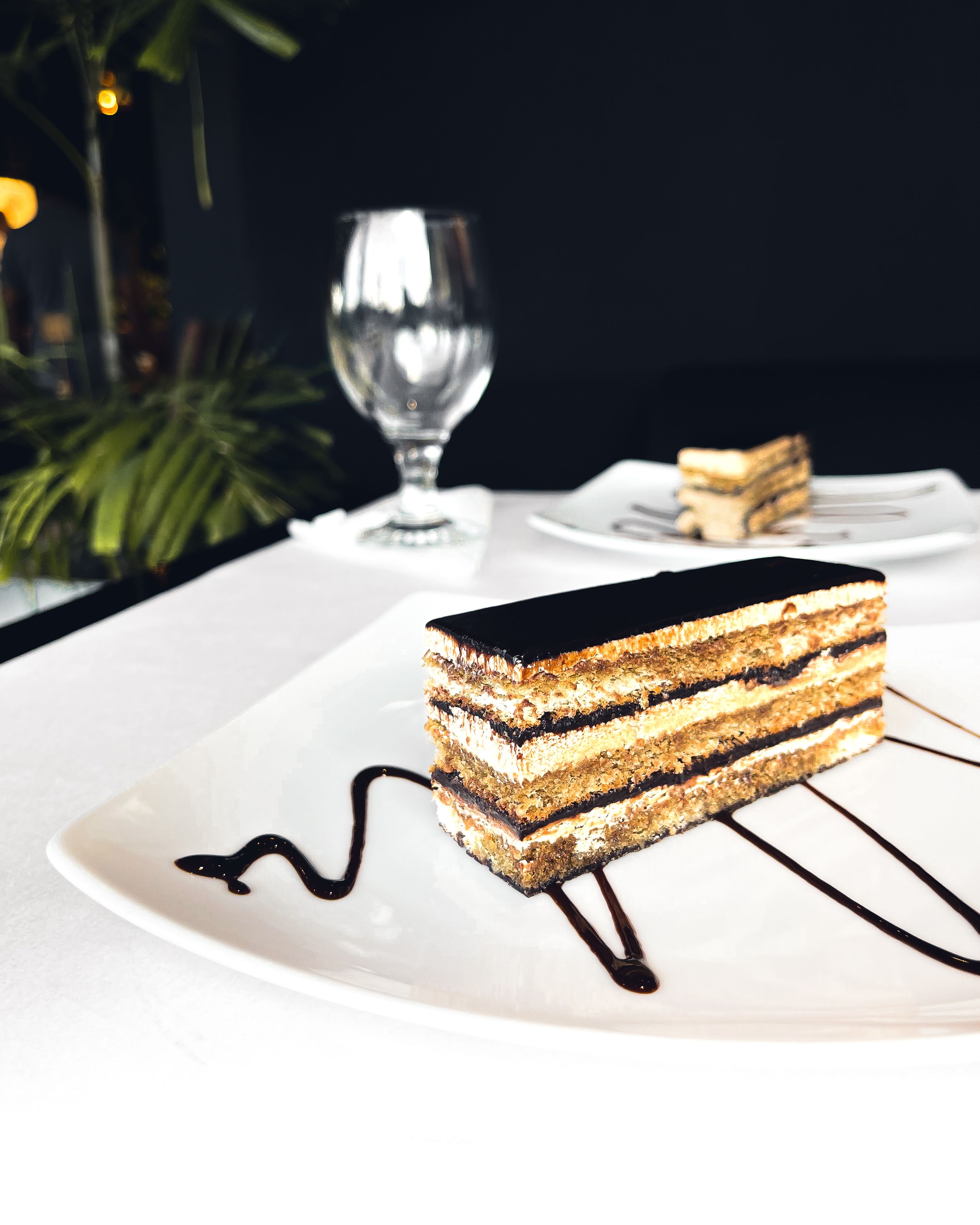
Photo: Shafky Zubair / Pexels
The diets react (see scores below)
Common Ingredients
- almond flour
- eggs
- sugar
- butter
- coffee
- cocoa powder
- dark chocolate
- heavy cream
- vanilla extract
Specific recipes may vary.
Incompatible with 10 of 11 diets
Diet Ratings
Opera Cake is a classic French layered dessert built around sugar as a primary structural ingredient. Despite the presence of keto-friendly components like almond flour, eggs, butter, heavy cream, and dark chocolate, the large quantity of added sugar used throughout the sponge layers, buttercream, and ganache makes this fundamentally incompatible with ketosis. A standard serving of Opera Cake contains roughly 40-60g of net carbs, nearly exceeding or blowing through the entire daily keto carb budget in one snack. The almond flour base does not redeem the dish because sugar is not a minor additive here — it is a core ingredient in every layer. This is not a borderline case; this is a confection.
Opera Cake contains multiple animal-derived ingredients that categorically disqualify it from a vegan diet. Eggs are a direct animal product, butter is a dairy fat, and heavy cream is a dairy product. All three are non-negotiable animal ingredients under any standard vegan definition. While some of the other ingredients (almond flour, coffee, cocoa powder, dark chocolate, sugar, vanilla extract) can be vegan, the presence of eggs, butter, and heavy cream makes this dish fundamentally incompatible with veganism. There is no meaningful debate within the vegan community about any of these ingredients.
Opera Cake contains multiple paleo-excluded ingredients that make it fundamentally incompatible with the Paleolithic diet. Sugar (refined) is a clear avoid, as is heavy cream (dairy). Butter is debated in the paleo community but generally discouraged, especially by strict Cordain-school paleo. While almond flour, eggs, coffee, cocoa powder, dark chocolate, and vanilla extract occupy gray areas or are conditionally acceptable, the combination of refined sugar and heavy cream alone disqualifies this dish outright. This is a heavily processed French dessert whose construction — multiple layered, refined components — contradicts paleo philosophy even beyond the individual ingredients.
Opera Cake is a classic French patisserie that fundamentally contradicts Mediterranean diet principles. It is a heavily processed dessert built around added sugars, butter (saturated fat rather than olive oil), heavy cream, and refined ingredients. While almond flour and dark chocolate have some redeeming nutritional qualities, they are overwhelmed by the high sugar content, saturated fat from butter and heavy cream, and the overall processed, indulgent nature of the dish. The Mediterranean diet minimizes added sugars and refined sweets, reserving them for rare, occasional treats. As a snack, this is particularly misaligned — Mediterranean snacking emphasizes whole foods like nuts, fruit, vegetables, and legumes.
Opera Cake is fundamentally incompatible with the carnivore diet. While it contains a few animal-derived ingredients (eggs, butter, heavy cream), the dish is dominated by plant-based and processed components: almond flour (plant), sugar (processed plant), coffee (plant), cocoa powder (plant), dark chocolate (plant-based processed food), and vanilla extract (plant). This is a French pastry — a dessert built on carbohydrates, plant flours, and sugar — which violates virtually every core carnivore principle. The presence of some animal ingredients does not redeem a dish that is structurally a plant-based confection with added sugar.
Opera Cake is excluded on multiple grounds. First and most directly, sugar is a listed excluded ingredient — it appears explicitly in this recipe. Second, butter (non-clarified) is a dairy product excluded by Whole30 rules; only ghee or clarified butter is permitted. Third, and independently disqualifying, Opera Cake is a classic layered sponge cake — a baked good that falls squarely into the category of items explicitly prohibited under Rule 4 (no recreating baked goods, breads, cakes, or desserts, even with otherwise compliant ingredients). This dish fails on at least three separate Whole30 criteria simultaneously.
Opera Cake's ingredient list is largely low-FODMAP in isolation, but several dose-dependent concerns arise at realistic serving sizes. Almond flour is low-FODMAP at up to 24g per serve (Monash-tested), but Opera Cake layers are typically dense with almond flour, making it easy to exceed this threshold and trigger GOS/fructan intake. Dark chocolate is low-FODMAP at 30g per serve but high-FODMAP at larger amounts due to excess fructose. Heavy cream is low-FODMAP (fat-based, minimal lactose). Eggs, butter, sugar, coffee, cocoa powder, and vanilla extract are all low-FODMAP at standard amounts. The primary risk lies in cumulative almond flour quantity across multiple layers and dark chocolate load in ganache. A small, controlled slice could be within limits, but a standard restaurant or bakery portion very likely pushes almond flour and dark chocolate into high-FODMAP territory.
Monash University rates almond flour as low-FODMAP at ≤24g, and dark chocolate at ≤30g, but clinical FODMAP practitioners often caution that multi-component desserts with stacked almond-based layers make portion control unreliable in practice. Many practitioners recommend avoiding almond flour-heavy desserts during the strict elimination phase due to cumulative GOS risk.
Opera Cake is a classic French pastry that is fundamentally incompatible with DASH diet principles. It is loaded with saturated fat from butter, heavy cream, and dark chocolate, and contains high amounts of added sugar. These are precisely the foods DASH explicitly limits. The combination of butter and heavy cream contributes substantial saturated fat, directly opposing DASH's cardiovascular-protective goals. While individual ingredients like almond flour and dark chocolate have some nutritional merits in isolation, the overall nutritional profile of this dessert — calorie-dense, high in saturated fat, and high in added sugar — places it firmly in the 'avoid' category. DASH guidelines are explicit about limiting sweets, full-fat dairy products, and high saturated fat foods, all of which are core components of Opera Cake.
Opera Cake is a classic French dessert that is fundamentally incompatible with Zone Diet principles. It is built almost entirely around high-glycemic, high-sugar ingredients (sugar, chocolate, heavy cream, butter) with negligible lean protein and no low-glycemic carbohydrates. The macronutrient profile is dominated by fat and simple carbohydrates, with the fat coming primarily from saturated sources (butter, heavy cream, dark chocolate). While almond flour provides a small amount of monounsaturated fat and eggs contribute some protein, these are overwhelmed by the overall composition. There is essentially no way to portion Opera Cake into a Zone-balanced snack — it lacks lean protein entirely, its carbohydrate load is high-glycemic and sugar-driven, and its fat profile skews heavily saturated. Even a tiny portion would fail to approximate the 40/30/30 ratio without pairing it with substantial lean protein and fiber sources, at which point it ceases to function as a meaningful component of the snack. This is one of the rare cases where the food's composition makes Zone compliance practically impossible in any realistic serving size.
Opera Cake presents a genuinely mixed anti-inflammatory profile. On the positive side, it contains several beneficial ingredients: dark chocolate (>70% cacao ideally) provides flavanols and polyphenols that reduce inflammatory markers; almond flour contributes vitamin E, healthy monounsaturated fats, and fiber compared to refined wheat flour; coffee delivers anti-inflammatory polyphenols and is associated with reduced CRP in population studies; cocoa powder adds additional flavanoids. However, the dish is also high in sugar, which is the most significant pro-inflammatory concern — excess added sugar drives glycation, raises triglycerides, and elevates inflammatory cytokines. Heavy cream is a full-fat dairy product high in saturated fat, which anti-inflammatory guidelines recommend limiting. Butter similarly adds saturated fat load. The overall dish is a dessert with a substantial sugar and saturated fat burden that partially offsets the genuinely beneficial components. Portion size matters significantly here: a small serving occasionally would be far less concerning than regular consumption. The use of almond flour rather than refined flour is a meaningful positive distinction from conventional cakes, but does not overcome the sugar and cream content. This sits comfortably in the 'caution' zone — not something to feature regularly in an anti-inflammatory diet, but not in the same category as a processed snack cake laden with seed oils, HFCS, and trans fats.
Some anti-inflammatory practitioners (including those aligned with Dr. Weil's more permissive framework) would argue that small amounts of quality desserts featuring dark chocolate, nuts, and coffee are consistent with an anti-inflammatory lifestyle, given the real polyphenol contributions of those ingredients — placing this closer to a 5-6. Conversely, stricter anti-inflammatory and autoimmune protocols (AIP, elimination diets) would score this lower (2-3) given the significant added sugar, butter, heavy cream, and eggs, viewing the inflammatory load of these as outweighing the antioxidant benefits of the chocolate and coffee.
Opera Cake is a classic French patisserie dessert built almost entirely from high-fat, high-sugar, low-fiber, low-protein ingredients. Butter, heavy cream, and dark chocolate drive a very high saturated fat load per serving, which directly worsens the nausea, bloating, and reflux that GLP-1 medications already predispose patients to. Sugar is the primary energy source, offering empty calories with no meaningful fiber or protein to justify the caloric cost. Eggs and almond flour contribute minimal protein relative to the overall macronutrient profile. Coffee is present but as a flavoring agent, not a meaningful stimulant dose. As a snack category item eaten during a period of severely reduced appetite, this dish displaces the protein and fiber that every meal and snack opportunity must prioritize on a GLP-1 regimen. There is no realistic portion size that rehabilitates this food for GLP-1 patients.
*See how scores were generated at our methodology page.
Nutritional profile
Six traits that cut across every diet.
Fiber & Plants
How much whole-plant food and fiber it delivers.
Healthy Fats
The quality of its fats (unsaturated, omega-3).
Whole / Unprocessed
How close it is to its natural, unprocessed form.
Gut Gentle
How easy it is on digestion (low FODMAP, few irritants).
Low Glycemic
How little it spikes your blood sugar.
Protein Density
How much protein it packs per calorie.
Controversy Index
Higher controversy = more disagreement between diets.
Diet-Specific Tips
 Anti-Inflammatory — 4/10
View tips
- Dark chocolate and cocoa powder provide anti-inflammatory flavanols and polyphenols
- Almond flour preferred over refined wheat flour — contributes vitamin E and fiber
- Coffee adds anti-inflammatory polyphenols associated with reduced CRP
- High added sugar content is the primary pro-inflammatory concern — drives glycation and cytokine production
- Heavy cream and butter contribute significant saturated fat, which anti-inflammatory guidelines recommend limiting
- No omega-3 sources present
- Portion size is critical — occasional small serving vs. regular consumption changes the risk profile substantially