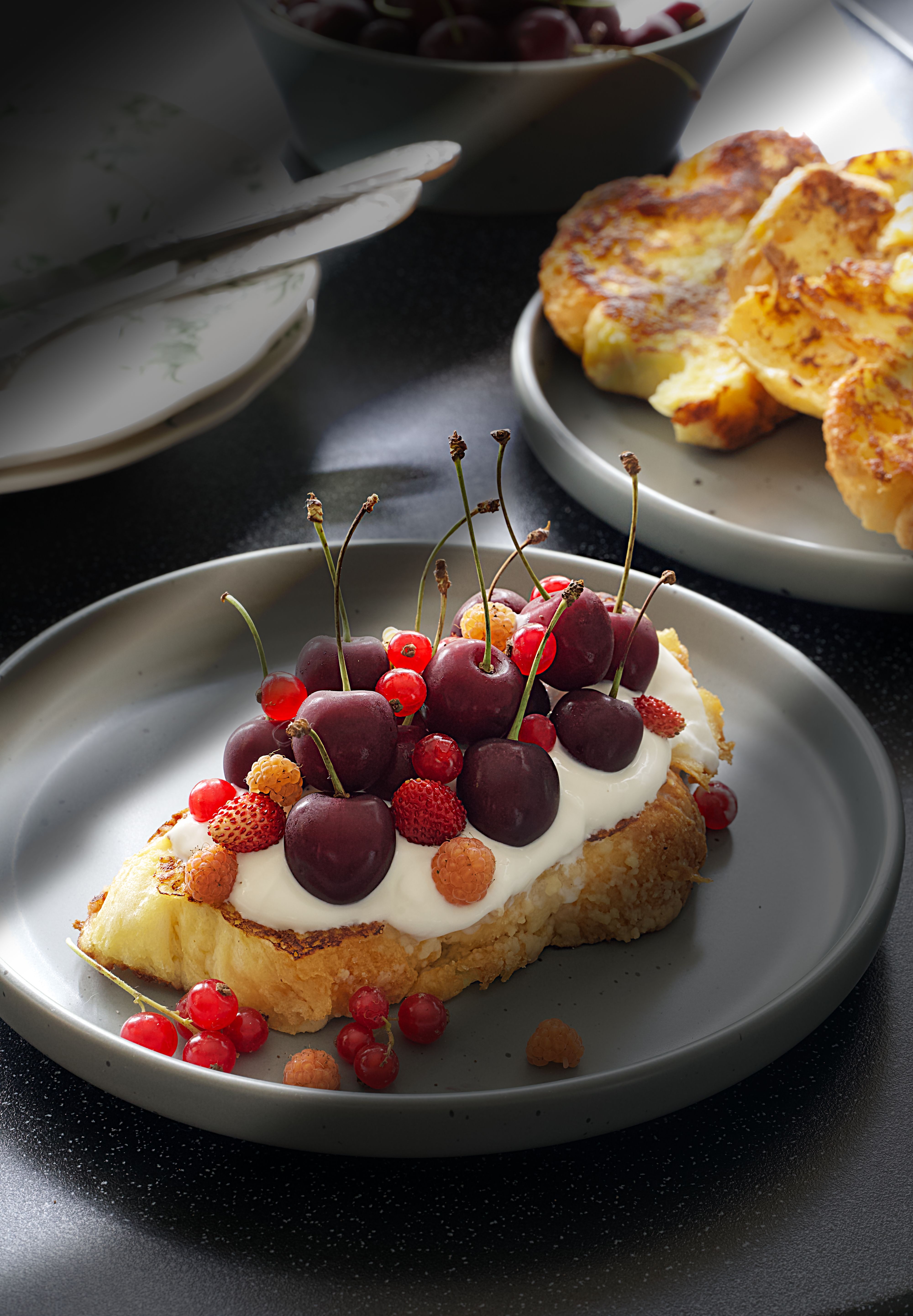
Photo: Sylwester Ficek / Pexels
The diets react (see scores below)
Common Ingredients
- bread
- eggs
- milk
- butter
- sugar
- cinnamon
Specific recipes may vary.
Incompatible with 8 of 11 diets
Diet Ratings
Pain Perdu (French toast) is fundamentally incompatible with a ketogenic diet. The primary ingredient is bread, a grain-based product with extremely high net carbs (roughly 12-15g per slice). Combined with added sugar and milk (which adds lactose/carbs), a standard serving easily delivers 40-60g of net carbs — potentially exceeding the entire daily keto carb allowance in one snack. There are no redeeming high-fat or low-carb elements that could offset the bread and sugar content. This dish is essentially designed around high-carbohydrate ingredients and would immediately disrupt ketosis.
Pain Perdu (French toast) is fundamentally incompatible with a vegan diet. The dish contains multiple animal-derived ingredients: eggs and milk form the custard batter the bread is soaked in, and butter is used for cooking. These are core, non-optional components of the dish — without them, it would be a different recipe entirely. All three ingredients are unambiguously animal-derived and excluded under any definition of veganism.
Pain Perdu (French toast) is fundamentally incompatible with the Paleo diet. The dish's base ingredient is bread, a grain-based product that is strictly excluded from Paleo. Milk is dairy, also excluded. Refined sugar is a processed ingredient with no place in Paleo. Butter is a dairy product discouraged in strict Paleo. While eggs and cinnamon are Paleo-approved, they are minor components that cannot redeem a dish built on multiple core Paleo violations. This is about as far from a hunter-gatherer meal as a dish can get.
Pain Perdu (French toast) combines several ingredients that conflict with Mediterranean diet principles. Bread is typically white/refined in this preparation, butter replaces the canonical olive oil as the cooking fat, and added sugar makes this a sweet treat. The combination of refined carbohydrates, saturated fat from butter, and added sugar places this firmly outside Mediterranean dietary patterns. Eggs and milk are acceptable in moderation, but they are supporting a dish that is otherwise nutritionally misaligned.
Some Mediterranean diet interpreters note that stale bread repurposed with eggs and milk reflects traditional frugal Mediterranean cooking philosophy (cucina povera). If made with whole-grain bread, minimal sugar, and olive oil instead of butter, a modified version could approach 'caution' territory.
Pain Perdu (French toast) is fundamentally incompatible with the carnivore diet. The primary ingredient is bread, a grain-based product that is strictly excluded from all tiers of carnivore eating. Additional violations include sugar (processed plant-derived sweetener) and cinnamon (plant-based spice). While eggs, milk, and butter are animal-derived and would be acceptable on various carnivore tiers, they are minor components that cannot redeem a dish built on a grain foundation. This dish is essentially a carbohydrate-forward snack with no meaningful animal protein base.
Pain Perdu (French toast) contains multiple excluded ingredients: bread (grains/wheat), milk (dairy), butter (dairy — only ghee/clarified butter is allowed), and sugar (added sugar). Even setting aside the excluded ingredients, Pain Perdu is explicitly the kind of baked-goods/junk-food recreation that Whole30 prohibits by name — it is essentially a sweet bread-based dish. There is no compliant version of this dish possible, as its defining ingredients are all excluded.
Pain Perdu (French toast) contains multiple high-FODMAP ingredients that make it problematic during the elimination phase. The primary concern is standard wheat bread, which is high in fructans and is a major FODMAP source. Cow's milk contributes lactose, another significant FODMAP. While eggs, butter, sugar, and cinnamon are individually low-FODMAP, the combination of wheat bread and milk creates a high-FODMAP dish at any standard serving size. The dish could theoretically be modified using gluten-free or sourdough spelt bread and lactose-free milk, but as traditionally prepared, it should be avoided.
Monash University has tested certain sourdough breads (particularly long-fermented spelt sourdough) and found them low-FODMAP at 2 slices — and lactose-free milk is widely available — meaning a modified version of Pain Perdu could be low-FODMAP. However, as traditionally prepared with regular wheat bread and cow's milk, most clinical FODMAP practitioners would advise avoiding this dish entirely during the elimination phase without these substitutions.
Pain Perdu (French toast) is a mixed dish from a DASH perspective. It combines several ingredients that individually range from acceptable to problematic. White bread (most common form) is a refined grain rather than the whole grain DASH emphasizes. Eggs are acceptable in moderation under modern DASH interpretations. Milk aligns with DASH's low-fat dairy emphasis if skim or low-fat is used. Butter adds saturated fat, which DASH limits. Added sugar conflicts with DASH's guidance to limit sweets. Cinnamon is beneficial and sodium-free. The overall dish is moderate-to-high in saturated fat (butter), refined carbohydrates (white bread), and added sugar, while lacking the fiber and micronutrient density DASH prioritizes. It is not explicitly forbidden but is far from a core DASH food. Modifications using whole grain bread, skim milk, minimal butter, and reduced sugar would improve its DASH compatibility meaningfully.
NIH DASH guidelines would flag this dish for its refined grains, added sugar, and saturated fat from butter. However, some updated clinical interpretations note that a portion-controlled serving using whole grain bread, egg whites or whole eggs in moderation, low-fat milk, and a small amount of butter can fit within weekly DASH discretionary allowances, particularly for individuals who are not severely sodium- or calorie-restricted.
Pain Perdu (French toast) is a challenging dish for the Zone Diet. The base is bread — typically white or brioche — which is a high-glycemic, unfavorable carbohydrate in Zone terminology. Added sugar compounds the glycemic load further. Butter is a saturated fat, which Zone discourages in favor of monounsaturated fats. The eggs do provide some lean protein and are a favorable Zone ingredient, and milk adds a modest protein contribution. Cinnamon is actually polyphenol-rich and anti-inflammatory, a genuine Zone positive. However, the overall macro profile skews heavily toward high-glycemic carbohydrates and saturated fat, with inadequate lean protein for a Zone block meal. As a snack, it fails to hit the 40/30/30 ratio — carbs dominate, protein is minimal relative to carb load, and fat is saturated rather than monounsaturated. It scores low-caution rather than outright avoid because eggs provide some redeeming protein value and the dish is technically modifiable (whole grain bread, less sugar, olive oil substitute), but as traditionally prepared it is poorly suited to Zone principles.
Some Zone practitioners would argue that a small, carefully portioned serving made with whole-grain bread and reduced sugar could fit as a partial carb-protein block combination, with the eggs providing the protein block and bread providing the carb block. Sears' later writings also slightly softened the strict anti-saturated-fat stance, which could rehabilitate the butter marginally. However, the high-glycemic index of even whole-grain French toast and the added sugar make this difficult to defend as a Zone-friendly choice in any realistic preparation.
Pain Perdu (French toast) is a dish with a mixed anti-inflammatory profile. On the positive side, eggs provide choline and some selenium, and cinnamon is a well-regarded anti-inflammatory spice with polyphenols. However, the overall dish skews toward the pro-inflammatory end due to several factors: white bread (typically refined carbohydrates with high glycemic index) drives blood sugar spikes and increases inflammatory markers; butter is a saturated fat that should be limited; added sugar contributes to glycemic load and inflammatory signaling; and milk is a moderate dairy food, acceptable in small amounts but not particularly anti-inflammatory. The combination of refined starch, added sugar, butter, and a cooking method (pan-frying in butter) creates a high-glycemic, saturated-fat-heavy meal. It falls into the 'caution' category — not acutely harmful, but not a dish that supports anti-inflammatory goals when consumed regularly. Modifications like using whole grain bread, reducing sugar, substituting olive oil, and adding berries would significantly improve its profile.
Pain perdu (French toast) is made primarily from white bread, eggs, milk, butter, and sugar — a combination that is poorly suited for GLP-1 patients. The dish is dominated by refined carbohydrates and added sugar with minimal protein per serving, cooked in butter adding significant saturated fat. Gastric emptying is already slowed by GLP-1 medications, making a high-fat, high-sugar, low-fiber meal like this more likely to cause nausea, bloating, and blood sugar spikes. Nutrient density per calorie is low — this is largely empty calories from refined grain and sugar. As a snack category item, it provides almost no protein to contribute toward the 100-120g daily target, and essentially zero fiber. The butter and sugar content together place this firmly in the avoid category, not just caution.
*See how scores were generated at our methodology page.
Nutritional profile
Six traits that cut across every diet.
Fiber & Plants
How much whole-plant food and fiber it delivers.
Healthy Fats
The quality of its fats (unsaturated, omega-3).
Whole / Unprocessed
How close it is to its natural, unprocessed form.
Gut Gentle
How easy it is on digestion (low FODMAP, few irritants).
Low Glycemic
How little it spikes your blood sugar.
Protein Density
How much protein it packs per calorie.
Controversy Index
Higher controversy = more disagreement between diets.
Diet-Specific Tips
 DASH — 4/10
View tips
- Refined white bread is not a DASH-preferred whole grain
- Butter contributes saturated fat, which DASH limits
- Added sugar conflicts with DASH guidance on limiting sweets
- Eggs are acceptable in moderation under modern DASH interpretations
- Milk supports DASH if low-fat or skim version is used
- Cinnamon is DASH-neutral and adds flavor without sodium
- Dish can be modified (whole grain bread, skim milk, less butter/sugar) to improve DASH compatibility
- Low fiber and micronutrient density relative to DASH ideals
 Zone — 5/10
View tips
- White or brioche bread is a high-glycemic, unfavorable carbohydrate in Zone terminology
- Added sugar further spikes glycemic load, worsening the carb block quality
- Butter is a saturated fat — Zone strongly prefers monounsaturated fats like olive oil or avocado
- Eggs are a favorable Zone protein source and partially redeem the dish
- Milk contributes minor protein but also adds lactose (sugar)
- Cinnamon is a polyphenol-rich, anti-inflammatory spice — a genuine Zone positive
- Overall macro ratio skews toward carbs and saturated fat with insufficient lean protein
- As a snack category item, Zone snacks should still hit 40/30/30 — this dish fails that ratio significantly
 Anti-Inflammatory — 4/10
View tips
- Refined white bread: high glycemic index, drives blood sugar spikes linked to inflammation
- Added sugar: contributes to glycemic load and pro-inflammatory signaling
- Butter: saturated fat, should be limited on anti-inflammatory diets
- Cinnamon: genuine anti-inflammatory spice (cinnamaldehyde, polyphenols) — a positive element
- Eggs: moderate; provide choline and selenium but contain arachidonic acid
- Pan-frying in butter increases saturated fat content
- No omega-3s, antioxidants, or fiber-rich components to offset pro-inflammatory elements