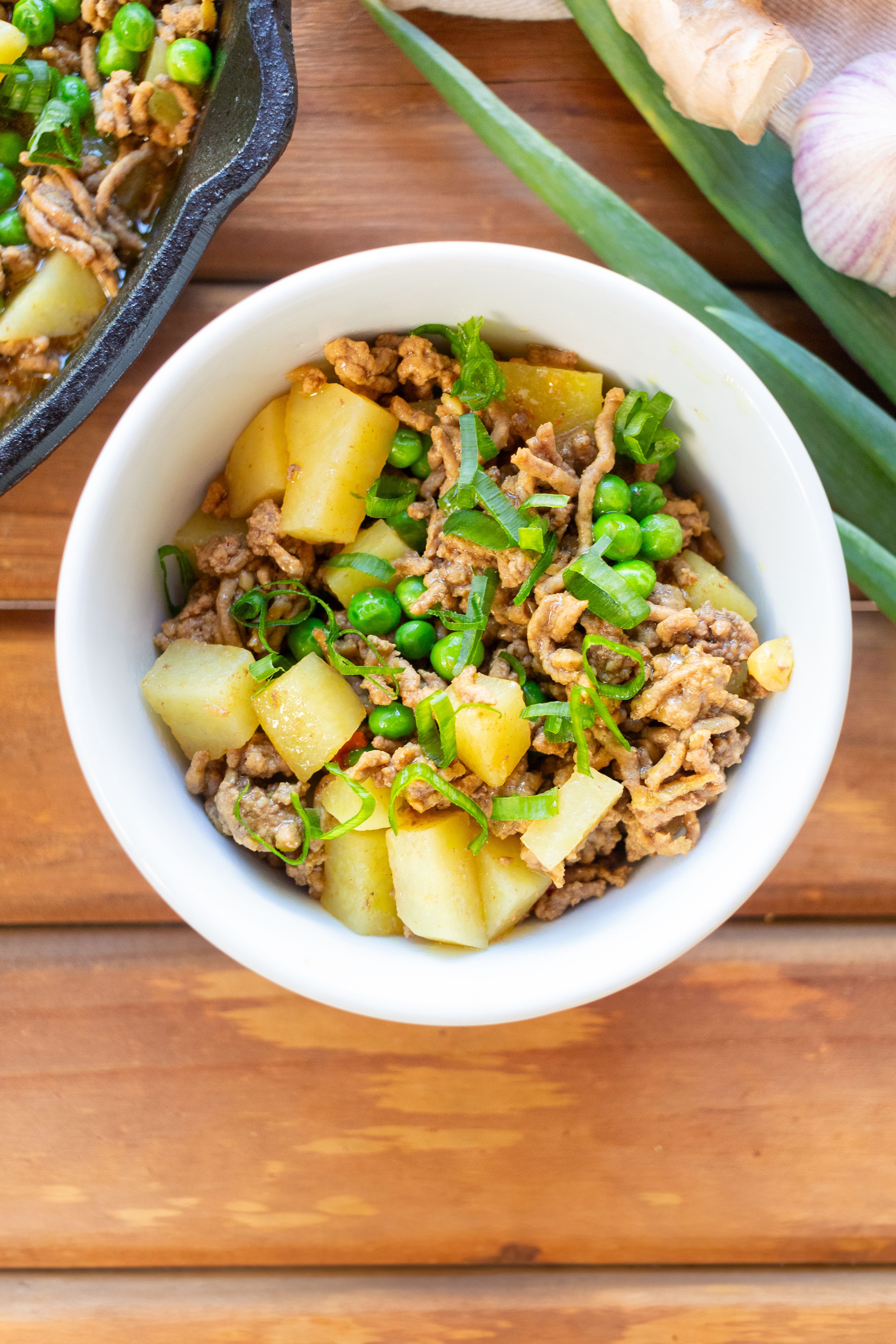
Photo: Laura oliveira / Pexels
Pakistani
Aloo Keema
The diets react (see scores below)
Common Ingredients
- ground beef
- potatoes
- tomato
- onion
- ginger
- garlic
- garam masala
- turmeric
- green peas
- cilantro
Specific recipes may vary.
Incompatible with 6 of 11 diets
Diet Ratings
Aloo Keema is fundamentally incompatible with a ketogenic diet due to its two primary carbohydrate-heavy ingredients: potatoes (aloo) and green peas. Potatoes are a starchy vegetable with approximately 15-17g net carbs per 100g, and a typical serving of this dish would contain enough potato to easily exceed the entire daily keto carb limit on its own. Green peas add an additional 9-12g net carbs per 100g. Together, these two ingredients make a standard serving of Aloo Keema contain well over 30-50g of net carbs, instantly breaking ketosis. The ground beef and spices are keto-friendly, but the dish's defining starchy components cannot be portioned down without fundamentally changing the dish itself.
Aloo Keema contains ground beef as its primary protein, which is an animal product and strictly excluded from a vegan diet. There is no ambiguity here — beef is slaughtered animal flesh. The remaining ingredients (potatoes, tomatoes, onion, ginger, garlic, garam masala, turmeric, green peas, cilantro) are all fully plant-based, but the presence of ground beef makes this dish entirely incompatible with veganism.
Aloo Keema contains two non-paleo ingredients that are clear violations: green peas (a legume) and potatoes (a debated-to-discouraged tuber). Green peas are legumes and excluded from paleo with high consensus. Potatoes are debated — discouraged by strict Cordain-school paleo and The Paleo Diet's official guide, though some modern practitioners accept them. The combination of both problematic ingredients pushes this dish firmly into 'avoid' territory. The remaining ingredients — ground beef, tomato, onion, ginger, garlic, garam masala, turmeric, and cilantro — are all paleo-compliant. However, the dish as traditionally prepared cannot be made paleo-compatible without removing or substituting the peas and potatoes, which would fundamentally alter its character.
Some modern paleo practitioners (Mark Sisson, Whole30) permit white potatoes, and a strict paleo version of this dish could be attempted by omitting the green peas and keeping the potatoes — though The Paleo Diet's official guide discourages potatoes entirely, and green peas remain a near-universal exclusion across all paleo frameworks.
Aloo Keema is centered on ground beef as its primary protein, which directly conflicts with Mediterranean diet principles. Red meat is restricted to only a few times per month, and ground beef — especially as the dominant ingredient — represents a significant source of saturated fat. While the dish does include several Mediterranean-friendly components (tomatoes, onions, garlic, ginger, green peas, and aromatic spices), these supporting ingredients are insufficient to offset the problematic primary protein. There is no olive oil, no whole grains, and the dish is not plant-forward. The spice profile is South Asian rather than Mediterranean, which is not itself a disqualifying factor, but the overall nutritional composition — high in red meat and saturated fat — clearly contradicts core Mediterranean dietary principles.
Aloo Keema is fundamentally incompatible with the carnivore diet. While it does contain ground beef as a primary protein — which is carnivore-approved — the dish is dominated by plant-based ingredients that are strictly excluded. Potatoes are a starchy carbohydrate vegetable, tomatoes and onions are plant foods, green peas are legumes, and cilantro is an herb. Ginger, garlic, garam masala, and turmeric are all plant-derived spices that strict carnivore excludes entirely. The dish is essentially a spiced meat-and-vegetable stew where the animal component is a minority ingredient surrounded by excluded foods. No meaningful modification could make this dish carnivore-compatible — it would cease to be Aloo Keema at that point.
Aloo Keema as described contains only Whole30-compliant ingredients. Ground beef is an approved protein, potatoes and tomatoes are allowed vegetables, onion, garlic, and ginger are compliant aromatics, garam masala and turmeric are permitted spices, cilantro is an allowed herb, and green peas are a standard Whole30-compliant vegetable. There are no excluded ingredients such as grains, legumes (beyond green peas which are allowed), dairy, added sugars, or other prohibited items. This is a straightforward whole-food dish that aligns well with the Whole30 program's spirit.
Aloo Keema as traditionally prepared contains multiple high-FODMAP ingredients that make it unsuitable during the elimination phase. Onion is one of the highest-FODMAP foods tested by Monash, containing significant fructans at any culinary quantity. Garlic is similarly high in fructans and is a major FODMAP offender even in small amounts. Green peas are high in GOS and fructans at standard serving sizes (low-FODMAP only at a very restricted 1/4 cup, but traditional recipes use much more). These three ingredients alone make the dish a clear 'avoid' during elimination. Ground beef, potatoes, tomatoes, ginger, turmeric, and cilantro are all low-FODMAP and unproblematic. Garam masala in small culinary quantities is generally considered low-FODMAP. However, the combination of onion, garlic, and green peas — all used in standard quantities in this dish — creates a high cumulative FODMAP load that cannot be mitigated by portion reduction of the overall dish.
Aloo Keema presents a mixed DASH profile. On the positive side, it contains several DASH-friendly ingredients: potatoes and green peas provide potassium and fiber; tomatoes, onion, ginger, and garlic are vegetables aligned with DASH principles; and spices like turmeric and garam masala add flavor without sodium. However, the primary protein is ground beef, which DASH guidelines explicitly limit due to its saturated fat content — DASH recommends lean meats and favors poultry and fish over red meat. Ground beef (especially 80/20) can contain 7-10g saturated fat per serving, well above DASH targets. The dish is not inherently high in sodium if prepared without added salt, which is a relative advantage. The verdict hinges heavily on the cut of beef used: extra-lean ground beef (96/4) would be more compatible, while regular ground beef pushes this dish toward 'avoid' territory. As commonly prepared, it warrants 'caution.'
NIH DASH guidelines categorize red meat as a food to limit, recommending no more than 6 oz of lean meat/poultry/fish per day and suggesting meat consumption be reduced overall. However, some updated DASH clinical interpretations note that if extra-lean ground beef is used and portion sizes are controlled (3-4 oz), the dish's overall nutrient profile — rich in potassium from vegetables and low in added sodium — may be acceptable within a DASH framework 1-2 times per week.
Aloo Keema presents two significant Zone challenges: potatoes and ground beef. Potatoes are explicitly listed as an 'unfavorable' high-glycemic carbohydrate in Dr. Sears' Zone framework — they spike insulin and are among the carb sources Sears specifically advises avoiding. Ground beef, unless very lean (90%+ lean), carries higher saturated fat than Zone's preferred lean proteins, making it harder to hit the 30% fat target without overshooting on saturated fat. The favorable elements are the tomatoes, onions, green peas, ginger, garlic, and cilantro — all Zone-friendly, low-glycemic, and polyphenol-rich. The spices (garam masala, turmeric) are anti-inflammatory and actively encouraged in Sears' later writings. However, the potato is the dominant carbohydrate source here, not a minor garnish, making it structurally difficult to Zone-balance this dish without recipe modification. A Zone adaptation would replace potatoes with cauliflower or additional peas and vegetables, and use very lean ground beef or substitute ground turkey/chicken. As prepared traditionally, this dish leans high-glycemic on the carb side and potentially high saturated fat on the protein side, earning a caution rating.
Aloo Keema is a mixed dish from an anti-inflammatory standpoint. On the positive side, it contains a strong lineup of anti-inflammatory spices — turmeric (curcumin), ginger, garlic, and garam masala (a blend typically including cinnamon, cloves, and cardamom, all with antioxidant properties). Tomatoes provide lycopene, onions supply quercetin, cilantro offers additional polyphenols, and green peas contribute fiber and plant-based nutrition. These ingredients collectively represent meaningful anti-inflammatory value. The primary liability is ground beef, which is a red meat high in saturated fat and arachidonic acid — both associated with increased inflammatory markers (CRP, IL-6) in research. The anti-inflammatory framework recommends limiting red meat, and ground beef is typically higher in fat than leaner cuts. Potatoes are nutritionally neutral to mildly positive (resistant starch, potassium, vitamin C), though they are a high-glycemic-index starch when not eaten with fiber-rich accompaniments. Overall, the dish's spice-forward profile and vegetable content partially offset the red meat concern, landing it firmly in 'caution' territory — acceptable occasionally but not a regular anti-inflammatory staple. Substituting ground turkey or lamb would improve the profile; using leaner ground beef (90%+ lean) also helps.
Most anti-inflammatory frameworks including Dr. Weil's pyramid would flag ground beef as a 'limit' food due to saturated fat and arachidonic acid content. However, some researchers argue that the inflammatory impact of red meat is overstated when consumed in modest portions alongside antioxidant-rich vegetables and spices, as is the case here — and that the turmeric and ginger in this dish may actively counteract some of the pro-inflammatory signaling from the meat.
Aloo Keema is a moderately nutritious dish with meaningful protein from ground beef and fiber from potatoes, peas, tomatoes, and onions. However, the primary concern for GLP-1 patients is the fat content: standard ground beef (80/20) is high in saturated fat, which can worsen nausea, bloating, and reflux — key GLP-1 side effects. The spice blend (garam masala, turmeric, ginger, garlic) is generally well-tolerated and anti-inflammatory, but the overall fat load from typical ground beef is the main drawback. Potatoes add digestible carbohydrates and some fiber but are relatively low in protein and nutrient density per calorie. Green peas contribute both protein and fiber, which is a positive. The dish can be made significantly more GLP-1-friendly by substituting lean ground beef (93/7 or leaner) or ground turkey/chicken, reducing oil used in cooking, and keeping portion sizes small.
Some GLP-1-focused dietitians would rate this dish more favorably if prepared with lean ground beef (93/7), noting that the combined protein from beef and peas, plus the fiber from vegetables, makes it a reasonably balanced small-portion meal. Others would rate it lower due to the saturated fat in typical ground beef and the relatively high glycemic load from potatoes, arguing that GLP-1 patients' reduced caloric intake leaves little room for these nutritional trade-offs.
*See how scores were generated at our methodology page.
Nutritional profile
Six traits that cut across every diet.
Fiber & Plants
How much whole-plant food and fiber it delivers.
Healthy Fats
The quality of its fats (unsaturated, omega-3).
Whole / Unprocessed
How close it is to its natural, unprocessed form.
Gut Gentle
How easy it is on digestion (low FODMAP, few irritants).
Low Glycemic
How little it spikes your blood sugar.
Protein Density
How much protein it packs per calorie.
Controversy Index
Higher controversy = more disagreement between diets.
Diet-Specific Tips
 Whole30 — 6/10
View tips
- Ground beef is a compliant Whole30 protein
- Potatoes are explicitly allowed on Whole30
- Green peas are a standard compliant vegetable
- Garam masala and turmeric are permitted spice blends — verify no anti-caking agents or fillers in packaged versions
- All other ingredients (tomato, onion, garlic, ginger, cilantro) are clearly compliant
- No grains, dairy, legumes, or added sugars present
 DASH — 4/10
View tips
- Ground beef is a red meat explicitly limited by DASH guidelines due to saturated fat
- Saturated fat content varies significantly by beef fat percentage (80/20 vs. 96/4 lean)
- Potatoes, green peas, and tomatoes contribute potassium and fiber — DASH-positive
- No inherently high-sodium ingredients; sodium level depends on added salt during cooking
- Spice-forward flavor profile reduces need for added sodium
- DASH recommends lean meats, poultry, and fish as preferred protein sources over red meat
- Portion control critical — a large serving of regular ground beef would exceed DASH saturated fat targets
 Zone — 4/10
View tips
- Potatoes are an explicitly 'unfavorable' high-glycemic carb in Zone methodology — Sears lists them alongside white bread and white rice as foods that spike insulin
- Ground beef's fat content depends heavily on lean percentage; standard ground beef (80/20) has excess saturated fat for Zone's 30% fat target
- Tomato, onion, green peas, ginger, garlic, and cilantro are all Zone-favorable low-glycemic vegetables with anti-inflammatory properties
- Turmeric and garam masala spices align with Sears' anti-inflammatory polyphenol recommendations
- No added oils are listed, which is favorable — the dish avoids pro-inflammatory seed oils
- Dish is structurally potato-centric, making it difficult to block correctly without significantly reducing or eliminating the potato component
- Could be Zone-adapted by substituting cauliflower for potatoes and using 93%+ lean ground beef or lean ground turkey
 Anti-Inflammatory — 5/10
View tips
- Ground beef (red meat) — pro-inflammatory: saturated fat and arachidonic acid raise CRP and IL-6
- Turmeric — strongly anti-inflammatory via curcumin
- Ginger and garlic — well-established anti-inflammatory properties
- Garam masala spice blend — antioxidant-rich (cinnamon, cloves, cardamom)
- Tomatoes — lycopene and vitamin C (antioxidant support)
- Green peas — fiber and plant nutrients
- Onion — quercetin (anti-inflammatory flavonoid)
- Potatoes — high glycemic index starch, nutritionally neutral
- Dish is spice-forward, which partially offsets the red meat liability
 GLP-1 Friendly — 5/10
View tips
- Standard ground beef is high in saturated fat, which worsens GLP-1 GI side effects (nausea, bloating, reflux)
- Protein content is moderate but dependent on beef fat percentage — lean ground beef significantly improves the rating
- Green peas and tomatoes contribute fiber and micronutrients, supporting the #2 fiber priority
- Potatoes add digestible carbs but lower the overall nutrient density per calorie
- Spice blend is generally well-tolerated and not excessively spicy for most patients
- Dish is portion-sensitive — a small serving is more appropriate than a standard full portion
- Substituting 93/7 lean beef or ground turkey/chicken would elevate this to an approve-level dish