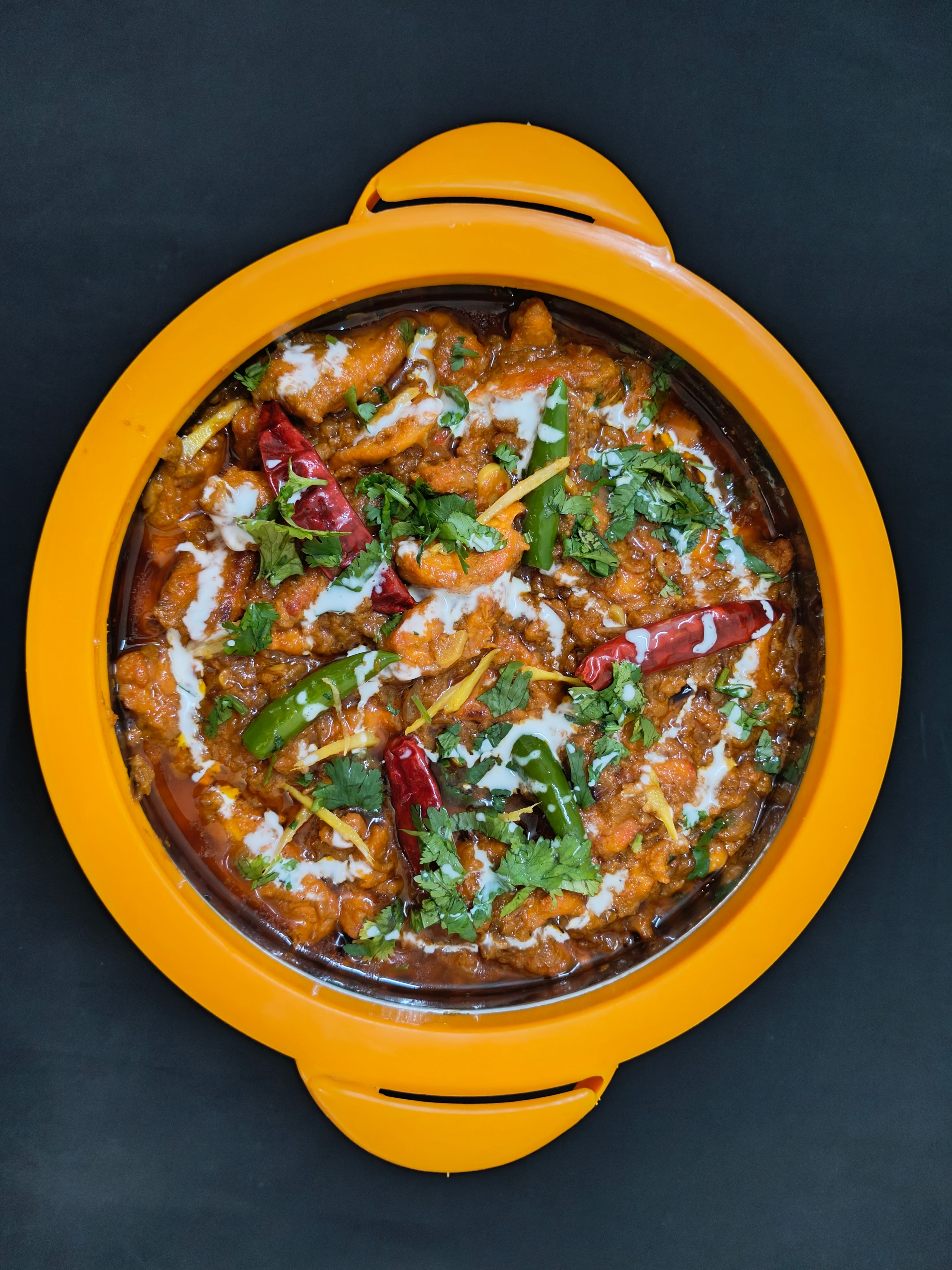
Photo: Kitchen Se Dil Tak by Anjum Ansari / Pexels
Pakistani
Karahi
The diets react (see scores below)
Common Ingredients
- chicken
- tomato
- ginger
- garlic
- green chiles
- ghee
- cumin
- coriander
- cilantro
Specific recipes may vary.
Incompatible with 3 of 11 diets
Diet Ratings
Karahi is a protein and fat-forward dish that aligns well with ketogenic principles. Chicken provides quality protein, ghee supplies healthy saturated fat, and the aromatics (garlic, ginger, green chiles, cumin, coriander, cilantro) are used in modest culinary quantities that add minimal net carbs. Tomatoes are the primary carb concern — a typical karahi serving uses roughly 150-200g of tomatoes per portion, contributing approximately 4-6g net carbs from tomatoes alone. Total net carbs for a standard serving likely land in the 6-10g range, which is manageable within a 20-50g daily budget. No grains, added sugars, or starchy vegetables are present. Ghee is an ideal keto cooking fat.
Some strict keto practitioners flag tomatoes as borderline due to their natural sugars and glycemic response, arguing that a tomato-heavy sauce accumulates carbs quickly if portions are generous or the dish is served with other moderate-carb items throughout the day. They recommend reducing tomato quantity or substituting with a smaller amount for a stricter macro profile.
Karahi contains two animal-derived ingredients that are categorically excluded from a vegan diet: chicken (poultry/meat) and ghee (clarified butter, a dairy product). There is no ambiguity here — both are direct animal products, making this dish entirely incompatible with veganism. A vegan adaptation would require substituting chicken with a plant protein (e.g., chickpeas, tofu, cauliflower) and replacing ghee with a neutral plant-based oil such as avocado or coconut oil.
Karahi is predominantly paleo-friendly: chicken, tomato, ginger, garlic, green chiles, cumin, coriander, and cilantro are all unambiguously approved paleo ingredients. The single point of debate is ghee. Strict Cordain-school paleo excludes all dairy derivatives, which would push this dish into caution territory. However, the majority of modern paleo practitioners accept ghee because the clarification process removes casein and lactose — the primary objections to dairy. If ghee is substituted with coconut oil or avocado oil, this dish would score a confident 8-9. As prepared with ghee, it sits at the high end of caution, leaning toward approval for most practical paleo adherents.
The Paleo Diet by Loren Cordain discourages ghee along with all other dairy derivatives, arguing that even clarified butter retains trace dairy compounds that can trigger inflammatory responses. Strict followers of Cordain's original framework would flag this dish solely on the ghee.
Karahi features chicken as the primary protein, which is acceptable in moderate amounts under Mediterranean diet guidelines (poultry is a 'caution' category food, suitable a few times per week). The dish is rich in Mediterranean-friendly ingredients: tomatoes, garlic, ginger, green chiles, cumin, coriander, and cilantro are all whole, plant-based foods that align well with the diet's emphasis on vegetables and aromatics. The main concern is ghee, which is clarified butter — a saturated animal fat that directly conflicts with the Mediterranean diet's cornerstone principle of using extra virgin olive oil as the primary fat. Ghee is not traditional to Mediterranean cuisine and carries a notably different lipid profile. If ghee were substituted with olive oil, this dish would score higher. As prepared, the chicken + ghee combination keeps this squarely in 'caution' territory.
Some broader interpretations of the Mediterranean diet acknowledge that traditional cuisines from Eastern Mediterranean regions (e.g., parts of Turkey, Lebanon) do use small amounts of butter or clarified fats occasionally, and a strict purist might argue ghee in modest quantities is no worse than occasional butter used in some Greek or Turkish cooking traditions. However, mainstream clinical guidelines (e.g., Willett/Oldways model) firmly identify olive oil — not butter or ghee — as the canonical fat source.
Karahi is heavily plant-forward despite containing chicken and ghee. The dish is built around tomatoes as a base sauce, with multiple plant-derived ingredients: tomato, ginger, garlic, green chiles, cumin, coriander, and cilantro. These plant components are not incidental garnishes — they are structural and flavor-defining elements of the dish. On the carnivore diet, all plant foods are excluded regardless of their role, so this dish fails on multiple counts simultaneously. The chicken and ghee are carnivore-compatible components, but they are minority ingredients in a dish dominated by plant matter. This is not a dish that can be easily modified to carnivore compliance without becoming an entirely different dish.
Karahi made with these ingredients is fully Whole30 compliant. Every component — chicken (animal protein), tomatoes (vegetable/fruit), ginger, garlic, and green chiles (fresh aromatics/vegetables), ghee (the one explicitly allowed dairy exception), cumin and coriander (spices), and cilantro (fresh herb) — is either explicitly permitted or falls squarely into the allowed categories of meat, vegetables, natural fats, herbs, and spices. There are no excluded ingredients such as grains, legumes, added sugars, alcohol, or disallowed dairy. Ghee is specifically called out as an exception to the dairy exclusion rule, making it a strong choice for cooking fat. This is a whole-food, minimally processed dish that aligns perfectly with the spirit of the Whole30 program.
Karahi contains two significant high-FODMAP ingredients: garlic and onion-family ingredients. Garlic is one of the highest-FODMAP foods tested by Monash University, containing high levels of fructans even in very small amounts (1/2 clove is considered high-FODMAP). While the other ingredients are largely low-FODMAP — chicken, ghee, cumin, coriander, cilantro, ginger, and tomato (at standard servings) are all low-FODMAP — garlic is a core, non-optional flavoring in karahi and cannot be omitted without fundamentally changing the dish. Green chiles are generally low-FODMAP at small servings. Tomato is low-FODMAP at up to 1 medium tomato. Ginger is low-FODMAP at standard cooking quantities. The dish as traditionally prepared with real garlic cloves must be rated avoid during the elimination phase. A modified version using garlic-infused oil instead of garlic cloves could render the dish low-FODMAP, as FODMAPs are water-soluble and do not transfer into oil.
Karahi contains several DASH-friendly ingredients — lean chicken, tomatoes, ginger, garlic, green chiles, and aromatic spices like cumin and coriander are all well-aligned with DASH principles, providing potassium, antioxidants, and lean protein with minimal sodium. The significant concern is ghee, a clarified butter that is high in saturated fat, which DASH explicitly limits. Traditional Karahi recipes can use a generous amount of ghee (2-4 tablespoons or more), which could contribute 5-10g+ of saturated fat per serving — approaching or exceeding DASH's saturated fat ceiling of roughly 6% of total calories. However, sodium is naturally low since no salt-heavy sauces or processed ingredients are listed, which is a meaningful DASH advantage. The dish earns a 'caution' rating: the base is excellent for DASH, but ghee quantity is the limiting factor. Substituting ghee with a small amount of olive or canola oil would push this solidly into 'approve' territory.
NIH DASH guidelines clearly limit saturated fat and specify vegetable oils over animal fats like ghee. However, some updated clinical interpretations note that ghee's impact depends heavily on portion size, and a modest amount (1 tsp) in an otherwise sodium-free, vegetable-rich dish may be acceptable within a well-balanced DASH day — particularly given emerging research questioning the blanket restriction of all saturated fat sources.
Karahi is a dish with a strong Zone-compatible foundation: chicken is a lean, favorable Zone protein, and tomatoes, ginger, garlic, green chiles, and cilantro are all low-glycemic, polyphenol-rich vegetables that Zone highly favors. The spice blend (cumin, coriander) adds anti-inflammatory value with negligible macro impact. The primary concern is ghee — a saturated animal fat rather than the monounsaturated fats Zone prefers (olive oil, avocado, almonds). Traditional Karahi uses a generous amount of ghee, which can tip the fat profile toward saturated fat and push the fat block count high, disrupting the 30/30/40 ratio balance. However, because the dish's carb base is tomatoes and aromatics (genuinely low-glycemic), the carbohydrate side is excellent. With portion control on ghee or substitution with olive oil, this dish could score 7-8. As traditionally prepared with significant ghee, it scores a 6 — usable in Zone with awareness.
Some Zone practitioners and Sears' later anti-inflammatory writings (notably 'The Zone' and 'Toxic Fat') acknowledge that not all saturated fats are equally harmful and that whole-food saturated fat sources like ghee, used in modest amounts, are more acceptable than processed seed oils. From this perspective, a small ghee portion in an otherwise polyphenol-rich, lean-protein dish could be rated more favorably. Additionally, traditional Pakistani Karahi is often made with bone-in chicken skin-on, which increases saturated fat further — the verdict depends heavily on preparation specifics.
Karahi is a spice-forward Pakistani dish with a genuinely mixed anti-inflammatory profile. On the positive side, it features a remarkable array of anti-inflammatory ingredients: ginger and garlic are among the most well-researched anti-inflammatory spices, with gingerols and allicin respectively shown to reduce inflammatory markers like CRP and IL-6. Green chiles provide capsaicin, a potent anti-inflammatory compound. Tomatoes deliver lycopene and vitamin C. Cumin and coriander contribute antioxidant polyphenols. Cilantro adds quercetin and other flavonoids. Chicken is a lean protein acceptable within anti-inflammatory guidelines. The combination of these spices in a tomato base is genuinely beneficial. The limiting factor is ghee (clarified butter), a saturated fat that the anti-inflammatory framework places in the 'limit' category. Ghee is used as the primary cooking fat here, and its saturated fat content is associated with some pro-inflammatory pathways when consumed in excess. That said, the amount per serving is moderate in traditional preparation, and some integrative nutrition practitioners view ghee more favorably than butter due to its butyrate content and removal of casein and whey. Overall, the exceptional spice profile partially offsets the ghee, landing this dish in the caution zone — leaning toward approve if ghee quantity is modest or substituted with extra virgin olive oil.
Some integrative and Ayurvedic nutrition frameworks (including certain interpretations followed by practitioners like Dr. Deepak Chopra) view ghee as therapeutically beneficial due to its short-chain fatty acid butyrate content, which supports gut lining integrity and may reduce intestinal inflammation — contrasting with mainstream anti-inflammatory guidance (Dr. Weil's pyramid) which places saturated fats like ghee in the 'limit' category. If ghee is viewed neutrally or positively, this dish would likely score in the approve range given its outstanding spice profile.
Chicken Karahi is built around a strong protein base (chicken) in a tomato-forward sauce with anti-inflammatory aromatics (ginger, garlic, cumin, coriander) — all positives for a GLP-1 patient. However, the dish is traditionally cooked with a meaningful amount of ghee (a saturated fat), which raises concerns: high-fat cooking fats slow gastric emptying further on top of the GLP-1 effect, increasing risk of nausea, bloating, and reflux. Green chiles are another flag — even in moderate amounts, spicy ingredients can worsen GLP-1-related GI side effects including reflux and nausea. The dish has no meaningful fiber source (tomato and aromatics contribute minimally), so it would need to be paired with a fiber-rich side (lentils, vegetables, whole grain roti) to meet fiber targets. Scored as caution rather than avoid because the protein foundation is solid and the dish can be meaningfully improved with preparation adjustments: reducing ghee quantity, substituting olive or avocado oil, and moderating chile heat. A restaurant-prepared version is more likely to use heavy ghee portions and is harder to control.
Some GLP-1-focused dietitians would rate a home-prepared, ghee-light Karahi higher (approaching 6-7), arguing that the protein density of chicken and the digestive benefits of ginger and cumin outweigh the fat concern when ghee is used sparingly. Others maintain a stricter limit on all saturated fats and spicy ingredients regardless of quantity, given how variable GI tolerance is among GLP-1 patients, particularly in the first several months of treatment.
*See how scores were generated at our methodology page.
Nutritional profile
Six traits that cut across every diet.
Fiber & Plants
How much whole-plant food and fiber it delivers.
Healthy Fats
The quality of its fats (unsaturated, omega-3).
Whole / Unprocessed
How close it is to its natural, unprocessed form.
Gut Gentle
How easy it is on digestion (low FODMAP, few irritants).
Low Glycemic
How little it spikes your blood sugar.
Protein Density
How much protein it packs per calorie.
Controversy Index
Higher controversy = more disagreement between diets.
Diet-Specific Tips
 Keto — 8/10
View tips
- Ghee as cooking fat is ideal for keto — high in saturated fat with zero carbs
- Chicken provides clean, moderate protein with no carb contribution
- Tomatoes are the main net-carb source; portion size matters (~4-6g net carbs per serving from tomatoes)
- No grains, added sugars, or starchy ingredients present
- Spices and aromatics (garlic, ginger, chiles) add negligible carbs at culinary quantities
- Total estimated net carbs per serving: 6-10g — fits within daily keto budget
 Paleo — 6/10
View tips
- Chicken is a fully approved paleo protein
- Tomato, ginger, garlic, green chiles, cilantro are all paleo-compliant vegetables and aromatics
- Cumin and coriander are approved paleo spices
- Ghee is the sole contested ingredient — accepted by most modern paleo practitioners but rejected by strict Cordain-school paleo
- No grains, legumes, seed oils, dairy milk, or refined sugar present
- Substituting ghee with coconut oil or avocado oil would make this dish fully approvable
 Mediterranean — 5/10
View tips
- Chicken is acceptable poultry protein — moderate consumption aligns with Mediterranean guidelines
- Ghee (clarified butter) is a saturated animal fat, not a Mediterranean staple — conflicts with olive oil-first principle
- Tomato, garlic, ginger, chiles, and spices are whole plant ingredients strongly aligned with Mediterranean values
- No refined grains, added sugars, or heavily processed components
- Dish is nutrient-dense and vegetable-forward despite the fat concern
- Substituting ghee with extra virgin olive oil would substantially improve compatibility
 Whole30 — 6/10
View tips
- Chicken is a compliant animal protein
- Ghee is explicitly allowed as the sole dairy exception on Whole30
- Tomatoes, green chiles, ginger, and garlic are all compliant whole vegetables/aromatics
- Cumin, coriander, and cilantro are compliant spices and herbs
- No grains, legumes, added sugars, or disallowed dairy present
- Dish is whole-food based and aligns with the spirit of Whole30
 DASH — 5/10
View tips
- Ghee is high in saturated fat, which DASH explicitly limits
- Chicken provides lean protein well-suited to DASH
- Tomatoes, garlic, ginger, and chiles contribute potassium and antioxidants with no sodium
- No processed or high-sodium ingredients listed — sodium profile is favorable
- Spices (cumin, coriander) are DASH-friendly flavor enhancers that reduce need for salt
- Substituting ghee with olive or canola oil would significantly improve DASH compatibility
- Portion size of ghee is critical — restaurant versions often use more than home preparation
 Zone — 6/10
View tips
- Chicken is a favorable Zone lean protein — excellent macronutrient building block
- Tomatoes, green chiles, ginger, garlic, and cilantro are low-glycemic, polyphenol-rich Zone-favorable carbohydrates
- Ghee is a saturated fat, not the monounsaturated fat Zone recommends as primary fat source
- Traditional Karahi uses substantial ghee quantities, potentially disrupting Zone fat ratios
- No high-glycemic carbohydrates present — no grains, starchy vegetables, or sugars in the dish itself
- Anti-inflammatory spice profile (cumin, coriander, ginger, garlic) aligns with Sears' anti-inflammatory Zone principles
- Dish is Zone-compatible with ghee reduction or olive oil substitution; fat portioning is the key control variable
 Anti-Inflammatory — 6/10
View tips
- Ginger and garlic are among the best-evidenced anti-inflammatory spices, reducing CRP and IL-6
- Green chiles provide capsaicin, a well-documented anti-inflammatory compound
- Tomatoes contribute lycopene and vitamin C — potent antioxidants
- Cumin, coriander, and cilantro add polyphenols and antioxidant diversity
- Ghee (clarified butter) is a saturated fat classified as 'limit' in anti-inflammatory frameworks
- Chicken is a lean protein acceptable under anti-inflammatory guidelines
- No refined carbohydrates, added sugars, trans fats, or processed additives
 GLP-1 Friendly — 5/10
View tips
- Good lean protein source (chicken) supports muscle preservation goal
- Ghee is a saturated fat that may worsen nausea, bloating, and reflux — amount used is critical
- Green chiles may trigger or worsen GLP-1-related reflux and nausea in sensitive patients
- Tomato-based sauce is low-calorie and nutrient-dense — a positive
- Ginger may modestly support digestion and reduce nausea
- Dish is low in fiber — requires pairing with fiber-rich sides to meet daily targets
- Home preparation allows meaningful improvement (reduce ghee, control chile level); restaurant version is higher risk
- Small-portion friendly if served with appropriate accompaniments