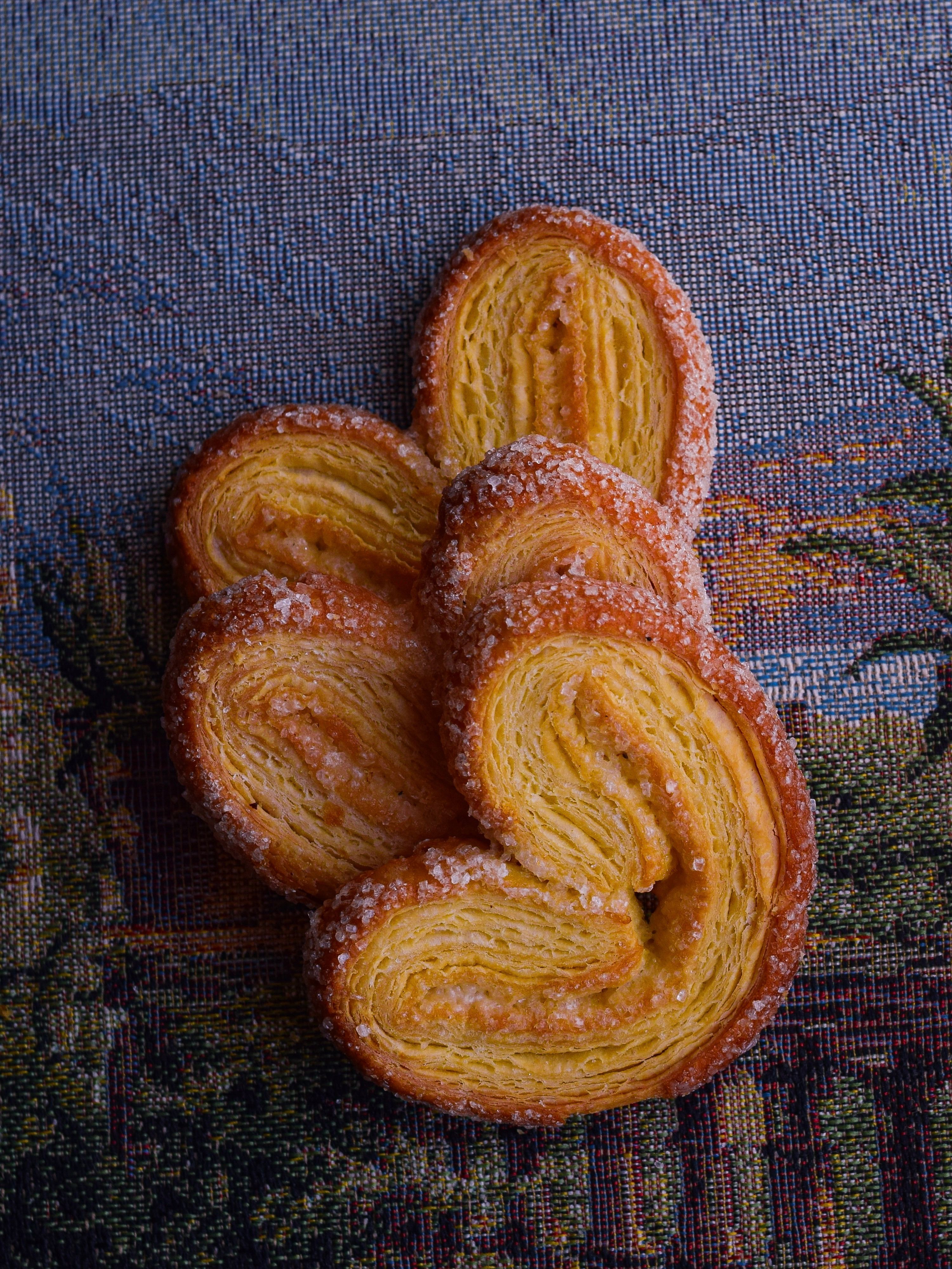
Photo: Aleksandr Sochnev / Pexels
The diets react (see scores below)
Common Ingredients
- puff pastry
- sugar
- butter
Specific recipes may vary.
Incompatible with 11 of 11 diets
Diet Ratings
Palmiers are made almost entirely from puff pastry and sugar — both of which are fundamentally incompatible with a ketogenic diet. Puff pastry is a grain-based dough (wheat flour) with an extremely high net carb content, and the generous coating of sugar adds direct simple carbohydrates. A single palmier can easily contain 15-20g of net carbs, making even one or two pieces capable of breaking ketosis. While butter is a keto-friendly fat, it does not redeem the dish given the dominant presence of flour and sugar.
Traditional palmiers contain butter, a dairy product derived from cow's milk, making them non-vegan. Puff pastry in its classic French form is made with large quantities of butter (feuilletage) laminated into the dough. Both the puff pastry and the listed butter ingredient confirm animal-derived dairy content. Vegan versions of palmiers do exist using plant-based butter and vegan puff pastry, but the default/traditional recipe as described here is not vegan-compliant.
A palmier is fundamentally incompatible with the paleo diet. Puff pastry is made from wheat flour, a grain that is strictly excluded from paleo. Sugar is a refined sweetener, also excluded. Butter is a dairy product, likewise excluded. Every single ingredient in this dish violates core paleo principles. There are no gray areas here — this is a grain-based, dairy-containing, refined-sugar-laden processed pastry that would have been entirely unavailable to Paleolithic humans.
Palmiers are made from puff pastry, sugar, and butter — a combination that directly contradicts Mediterranean diet principles on multiple fronts. Puff pastry is a refined grain product with no whole-grain nutritional value, butter is a saturated animal fat that displaces the preferred extra virgin olive oil, and added sugar provides empty calories. This is a highly processed pastry snack with no plant-forward, whole-food, or health-promoting qualities recognized by Mediterranean diet guidelines. It belongs firmly in the 'occasional treat' or 'avoid' category.
A Palmier is a classic French pastry made from puff pastry and sugar — both of which are strictly prohibited on the carnivore diet. Puff pastry is a grain-based product (wheat flour) with plant-derived fats, and sugar is a processed plant-derived sweetener. While butter is an animal-derived ingredient, it constitutes only a minor component and cannot redeem this dish. This food is almost entirely plant- and grain-based with no meaningful animal protein, making it completely incompatible with carnivore principles.
Palmiers are excluded on multiple grounds. Puff pastry is made with wheat flour (a grain), which is explicitly excluded on Whole30. Sugar is an excluded added sweetener. Butter (regular, not ghee/clarified) is also excluded as a dairy product. Additionally, even if compliant ingredients could theoretically be sourced, a palmier is a pastry/baked good that falls squarely under the 'no recreating baked goods/junk food' rule — it is a cookie/pastry by nature. This dish fails on virtually every ingredient and on the spirit of the program.
Palmiers are made primarily from puff pastry, which is wheat-based. Wheat is high in fructans and is one of the primary foods to avoid during the FODMAP elimination phase. Even a small serving of 1-2 palmiers would contain a meaningful amount of wheat flour, making this a high-FODMAP food. Sugar and butter are both low-FODMAP ingredients, but they cannot offset the fructan content of the wheat-based pastry. Some specialty puff pastry made with gluten-free flour exists, but traditional palmiers use wheat flour exclusively.
Monash University rates some wheat-containing products differently based on serving size — very small portions of some wheat foods may fall below the fructan threshold. However, clinical FODMAP practitioners universally advise avoiding wheat-based pastries during the elimination phase, as the fructan load in a realistic 2-3 palmier serving is almost certainly above safe limits, and gluten-free puff pastry alternatives would be required to make this dish elimination-phase safe.
Palmiers are made from puff pastry, sugar, and butter — a combination that is fundamentally at odds with DASH diet principles. Puff pastry is high in saturated fat and sodium, butter adds significant saturated fat, and sugar contributes empty calories with no nutritional benefit. DASH explicitly limits saturated fat, trans fat (often present in commercial puff pastry), added sugars, and refined grains. This snack provides none of the nutrients DASH emphasizes — no potassium, calcium, magnesium, or fiber — while delivering multiple nutrients DASH restricts. It offers no redeeming DASH-compatible nutritional profile.
Palmiers are essentially pure sugar and refined fat with zero redeeming Zone qualities. The three ingredients — puff pastry (refined white flour), sugar, and butter — represent exactly what the Zone Diet discourages: high-glycemic refined carbohydrates that spike insulin, saturated fat rather than monounsaturated fat, and zero protein, zero fiber, zero polyphenols. There is no protein block here whatsoever, making it impossible to build a Zone-balanced snack around this food without essentially eating an entirely separate snack alongside it. The refined flour and sugar combination produces a very high glycemic load, directly triggering the insulin cascade that the Zone is designed to prevent. Unlike most foods which can be portioned into Zone blocks, a palmier's macro profile (high carb, moderate saturated fat, zero protein) is structurally incompatible with the 40/30/30 framework regardless of portion size.
Palmiers are made almost exclusively from puff pastry, butter, and sugar — a trifecta of pro-inflammatory ingredients. Commercial puff pastry is typically made with refined white flour (a refined carbohydrate that spikes blood glucose and promotes inflammatory signaling) and substantial amounts of butter or partially hydrogenated fats (saturated and potentially trans fats). Added sugar directly promotes inflammatory pathways, elevates insulin, and has been associated with increased CRP and IL-6 in research. Butter, while not the worst offender in moderation, is a source of saturated fat that anti-inflammatory frameworks recommend limiting. There are no meaningful omega-3s, antioxidants, polyphenols, fiber, or other anti-inflammatory compounds present. This is essentially a refined carbohydrate-and-saturated-fat snack with no redeeming anti-inflammatory properties.
A palmier is made almost entirely of puff pastry (refined white flour, butter) and sugar — offering virtually no protein, no fiber, and high saturated fat with a significant sugar load. It is the definition of empty calories, which is especially counterproductive for GLP-1 patients who are eating far fewer total calories and need every bite to deliver nutritional value. The high butter content can worsen GLP-1 side effects including nausea, bloating, and reflux due to slowed gastric emptying combined with high fat intake. The refined pastry offers no digestive support and the sugar spike provides no satiety benefit. There is no meaningful redeeming nutritional quality for a GLP-1 patient.
*See how scores were generated at our methodology page.
Nutritional profile
Six traits that cut across every diet.
Fiber & Plants
How much whole-plant food and fiber it delivers.
Healthy Fats
The quality of its fats (unsaturated, omega-3).
Whole / Unprocessed
How close it is to its natural, unprocessed form.
Gut Gentle
How easy it is on digestion (low FODMAP, few irritants).
Low Glycemic
How little it spikes your blood sugar.
Protein Density
How much protein it packs per calorie.
Controversy Index
Higher controversy = more disagreement between diets.