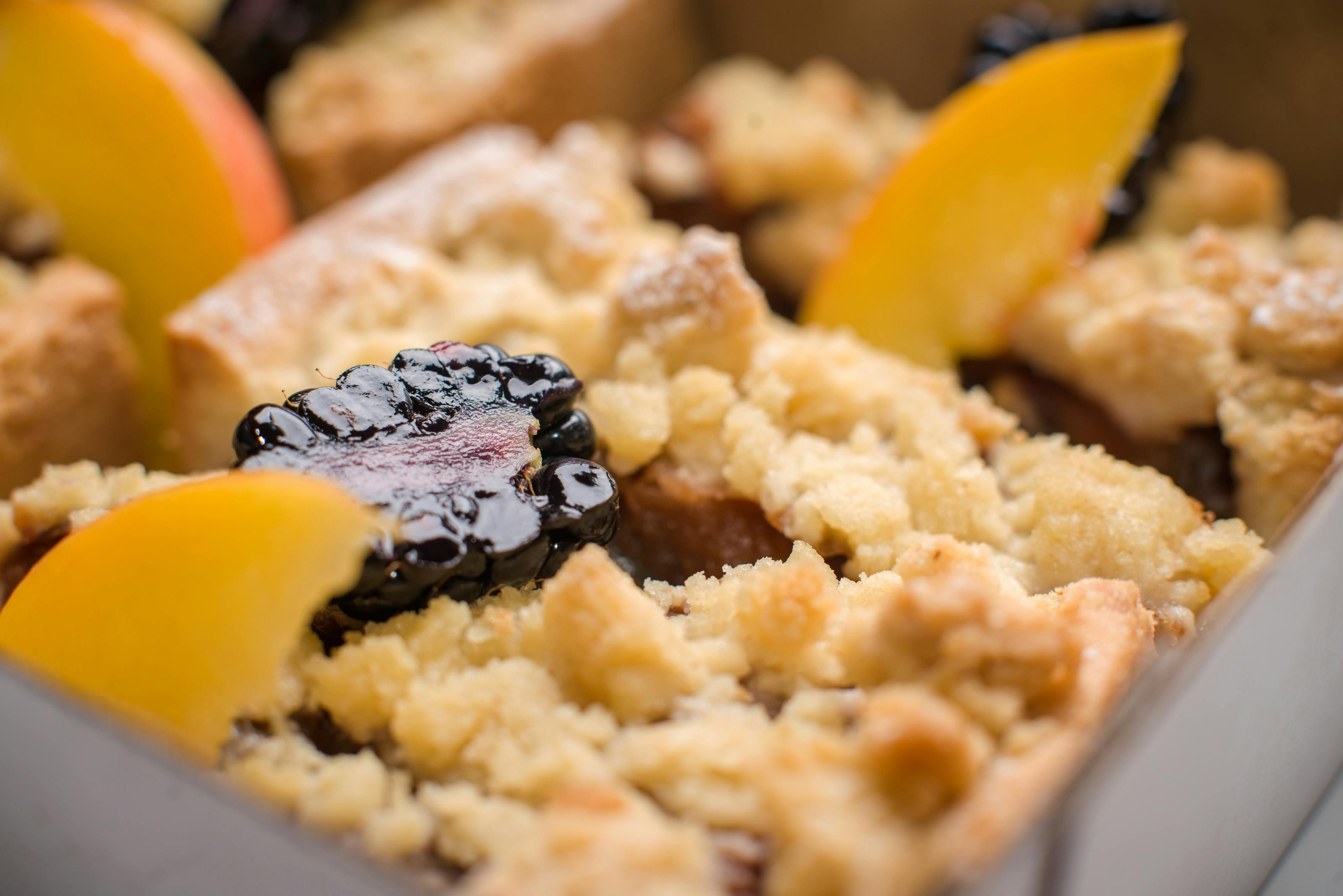
Photo: Novkov Visuals / Pexels
American
Peach Cobbler
The diets react (see scores below)
Common Ingredients
- peaches
- sugar
- butter
- flour
- baking powder
- salt
- milk
- cinnamon
- nutmeg
- vanilla extract
Specific recipes may vary.
Incompatible with 10 of 11 diets
Diet Ratings
Peach Cobbler is fundamentally incompatible with a ketogenic diet. It contains multiple high-carb, high-sugar ingredients that would obliterate a daily net carb budget in a single serving. Peaches are a moderate-to-high sugar fruit, added sugar is explicitly prohibited on keto, and flour is a grain-based ingredient that delivers dense net carbs. Combined with milk and baking powder, a standard serving easily delivers 50-70g of net carbs — exceeding or matching an entire day's keto allowance in one snack. There is no reasonable portion size that makes this dish keto-compatible without fundamentally reconstructing the recipe.
Peach Cobbler as listed contains two clear animal-derived ingredients: butter (dairy fat) and milk (dairy). Both are direct animal products excluded under all major vegan frameworks. The dish is otherwise plant-based — peaches, sugar, flour, baking powder, salt, cinnamon, nutmeg, and vanilla extract are all vegan-compliant. However, the presence of butter and milk makes this recipe non-vegan without substitution. Vegan versions are easily achievable by swapping butter for vegan margarine or coconut oil and milk for any plant-based milk (oat, almond, soy), which would elevate the score to approximately 7-8.
Peach Cobbler contains multiple non-paleo ingredients that are firmly excluded across all mainstream paleo frameworks. Flour (wheat) is a grain and a core paleo exclusion. Refined sugar is prohibited as a processed, modern food with no place in a hunter-gatherer diet. Milk is dairy, excluded under paleo principles. Butter, while debated, is also dairy. Baking powder typically contains cornstarch (a grain derivative) and is a processed additive. Added salt is discouraged. While peaches, cinnamon, nutmeg, and vanilla extract are paleo-compatible, they are minor components overwhelmed by the non-compliant majority of this dish. This is a classic processed baked good that contradicts both the ingredient list and the philosophy of the paleo diet.
Peach Cobbler is a classic American dessert that conflicts significantly with Mediterranean diet principles. While peaches themselves are a Mediterranean-friendly fruit, the dish is dominated by refined wheat flour, added sugar, butter (a saturated animal fat rather than olive oil), and milk. The topping is essentially a sweetened biscuit or cake made from refined grains. This combination of refined grains, added sugars, and saturated fat from butter represents exactly the type of highly processed, sugar-laden dessert the Mediterranean diet discourages. The fruit component is the only saving grace, but it is far outweighed by the problematic ingredients.
Peach Cobbler is entirely plant-based and grain-based with no animal protein as the primary component. It contains peaches (fruit), sugar (processed plant-derived sweetener), flour (grain), baking powder (plant-derived leavening), milk (the only marginally carnivore-adjacent ingredient, and even then in a minor role), cinnamon, nutmeg, and vanilla extract (plant spices/flavoring). This dish violates virtually every carnivore diet principle: it is loaded with fruit sugars, refined carbohydrates, and plant-derived ingredients. Even the most lenient 'animal-based' carnivore practitioners would exclude this dish due to the grain flour, refined sugar, and processed nature of the dessert. There is unanimous consensus across all carnivore diet approaches that this food is incompatible.
Peach Cobbler contains multiple excluded ingredients and violates core Whole30 rules. Sugar (added sweetener) is explicitly excluded. Butter (regular, not ghee) is excluded dairy. Flour is a grain and excluded. Milk is excluded dairy. Furthermore, even if all ingredients were made compliant, Whole30 Rule 4 explicitly prohibits recreating baked goods — cobbler is a classic baked dessert that falls squarely in this category. This dish fails on multiple independent grounds.
Peach Cobbler contains multiple high-FODMAP ingredients that make it unsuitable during the elimination phase. Peaches are high in polyols (sorbitol) and are rated high-FODMAP by Monash University at typical serving sizes (a standard serving of ~1 medium peach is high-FODMAP; only ~1 canned peach slice or about 30g fresh is considered low-FODMAP). All-purpose wheat flour is high in fructans and is a major FODMAP source in the cobbler topping. Standard cow's milk contains lactose, adding another FODMAP load. The combination of these three high-FODMAP ingredients — even at moderate serving sizes — makes this dish clearly problematic during elimination. Sugar, butter, baking powder, salt, cinnamon, nutmeg, and vanilla extract are low-FODMAP individually, but they cannot offset the high-FODMAP ingredients.
Peach cobbler contains fresh peaches, which are a DASH-approved fruit rich in potassium and fiber, but the dish as traditionally prepared is high in added sugar, refined white flour, and butter (saturated fat) — all of which DASH guidelines limit. The combination of significant added sugar and saturated fat from butter pushes this well beyond a DASH-friendly snack. However, it is not as categorically problematic as heavily processed or high-sodium foods. The peaches themselves are a positive DASH element, and moderate occasional consumption of dessert-type foods is not explicitly banned by DASH, which allows limited sweets. A modified version using less sugar, whole-wheat flour, and reduced butter or a plant-based oil substitute could score higher. As commonly prepared, this is a borderline caution item — acceptable as an infrequent treat but not a regular DASH snack.
NIH DASH guidelines explicitly limit added sugars and saturated fats, which peach cobbler contains in meaningful amounts, making it a poor routine snack choice. However, some DASH-oriented dietitians note that fruit-based desserts, when portion-controlled and prepared with modifications (e.g., less sugar, whole grains, minimal butter), can fit within the DASH framework's allowance for occasional sweets, particularly given the beneficial fruit component.
Peach cobbler is a poor fit for the Zone Diet across nearly every dimension. The dish is dominated by high-glycemic carbohydrates — refined white flour, added sugar, and milk — with peaches contributing natural sugars on top. There is no meaningful protein source (no protein block possible from this dish), making the 40/30/30 ratio impossible to achieve even with careful portioning of the cobbler itself. The fat content comes primarily from butter, a saturated fat that Zone discourages in favor of monounsaturated sources like olive oil. As a snack, Zone targets a 1-block mini-meal with balanced macros; peach cobbler provides essentially carbohydrates and saturated fat with negligible protein. The added sugar alone classifies this as an 'unfavorable' carb by Zone standards. While peaches themselves are a borderline-acceptable fruit in Zone (moderate glycemic index), the preparation transforms them into a high-glycemic dessert that cannot be meaningfully balanced without entirely reconstructing the recipe. This is one of the rare cases where the food's macro profile is so skewed — essentially zero protein, high saturated fat, very high glycemic carbs — that even careful portioning cannot bring it into Zone compliance as a standalone dish.
Peach cobbler is a classic American dessert that presents a mixed picture from an anti-inflammatory standpoint. The positives are limited: peaches provide antioxidants, vitamin C, and some polyphenols, while cinnamon and nutmeg have modest anti-inflammatory properties. However, the dish is fundamentally built around a high-sugar, refined-flour batter with butter, making it predominantly pro-inflammatory. Added sugar is one of the strongest drivers of inflammatory markers like CRP and IL-6. Refined white flour (high glycemic index) spikes blood glucose, promoting an insulin response linked to inflammation. Butter, while less problematic than trans fats, is a source of saturated fat that is classified as 'limit' under anti-inflammatory guidelines. The combination of substantial added sugar, refined carbohydrates, and saturated fat gives this dish a strongly pro-inflammatory profile overall. The anti-inflammatory benefits of peaches and spices are vastly outweighed by the other ingredients in typical serving portions. As an occasional treat it would score slightly higher, but as a rated dish in its standard form it warrants an 'avoid' verdict.
Peach cobbler is a high-sugar, refined-carbohydrate dessert with negligible protein and minimal fiber relative to its calorie load. The primary ingredients — sugar, butter, and white flour — represent exactly the empty-calorie, high-fat, high-glycemic profile that is counterproductive for GLP-1 patients. Butter contributes saturated fat, which can worsen nausea and GI discomfort due to slowed gastric emptying. The sugar load risks blood sugar spikes and provides no satiety benefit in the small portions GLP-1 patients eat. The peaches offer minimal redeeming fiber and micronutrient value once cooked down with sugar. As a snack category item, it occupies a meal slot that should be delivering 15-30g protein and meaningful fiber — this dish delivers neither. It scores a 2 rather than 1 only because peaches provide trace fiber and natural fruit sugars are marginally preferable to pure refined sugar alone.
*See how scores were generated at our methodology page.
Nutritional profile
Six traits that cut across every diet.
Fiber & Plants
How much whole-plant food and fiber it delivers.
Healthy Fats
The quality of its fats (unsaturated, omega-3).
Whole / Unprocessed
How close it is to its natural, unprocessed form.
Gut Gentle
How easy it is on digestion (low FODMAP, few irritants).
Low Glycemic
How little it spikes your blood sugar.
Protein Density
How much protein it packs per calorie.
Controversy Index
Higher controversy = more disagreement between diets.
Diet-Specific Tips
 DASH — 4/10
View tips
- Peaches are a DASH-approved fruit rich in potassium and fiber
- High added sugar content conflicts with DASH limits on sweets
- Butter contributes saturated fat, which DASH recommends limiting
- Refined white flour lacks the fiber of whole grains emphasized by DASH
- Moderate sodium from salt and baking powder, not a primary concern
- Small portion as an occasional treat is more compatible than regular snacking
- Modifications (less sugar, whole-wheat flour, less butter) would improve DASH compatibility