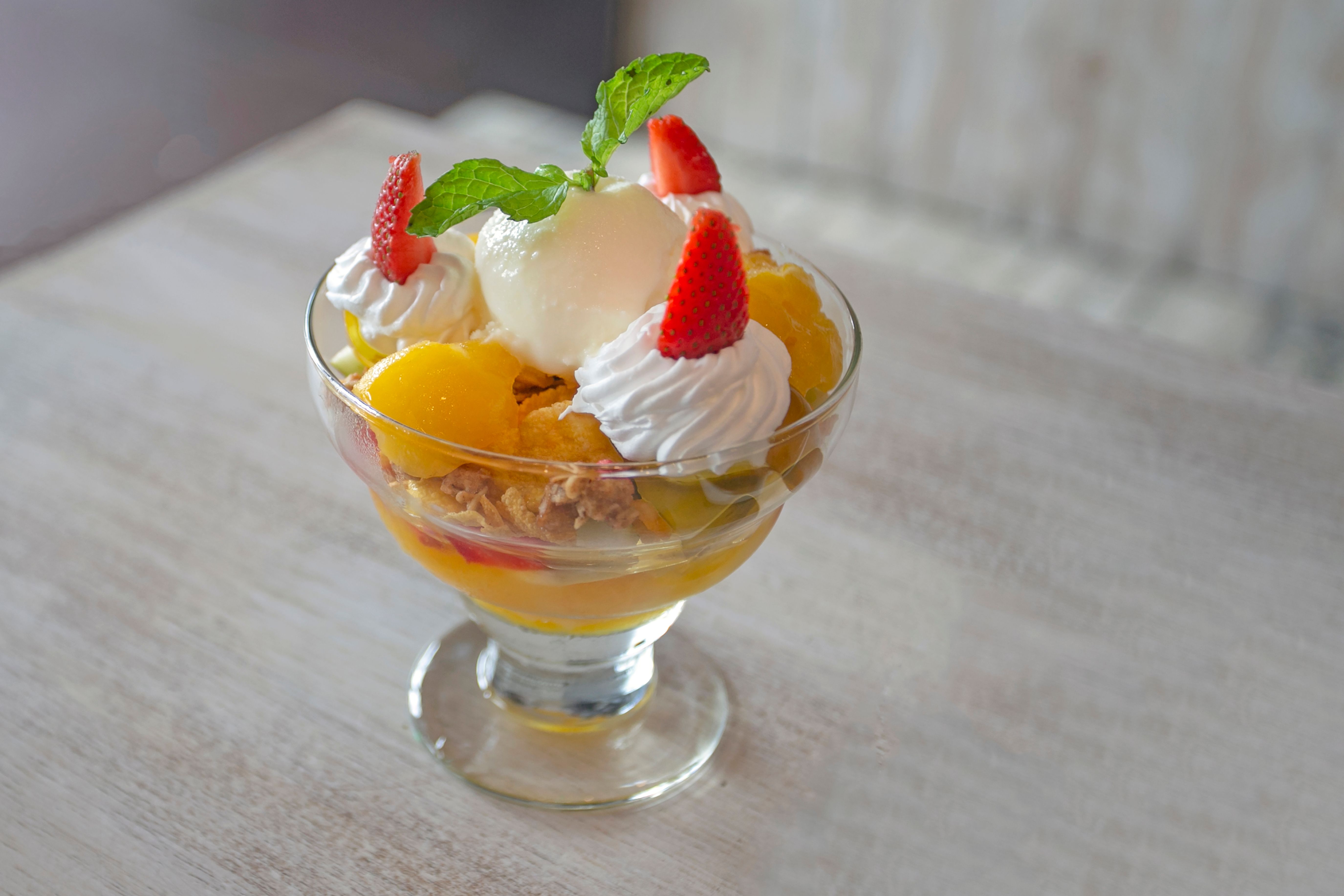
Photo: Jeffry Surianto / Pexels
The diets react (see scores below)
Common Ingredients
- peaches
- vanilla ice cream
- raspberries
- sugar
- water
- lemon juice
Specific recipes may vary.
Incompatible with 10 of 11 diets
Diet Ratings
Peach Melba is fundamentally incompatible with a ketogenic diet. It combines multiple high-carb, high-sugar ingredients: peaches are a sugary fruit (roughly 13g net carbs per 100g), vanilla ice cream contains significant sugar and starch, and the raspberry sauce is made with added sugar and water. A single standard serving easily delivers 50-80g of net carbs, which alone exceeds or matches the entire daily carb allowance for ketosis. There is no meaningful way to consume this dish in a traditional form while maintaining ketosis.
Peach Melba contains vanilla ice cream as a primary component, which is a dairy-based product made from milk and cream — clear animal-derived ingredients that disqualify it from any vegan diet. The remaining ingredients (peaches, raspberries, sugar, water, lemon juice) are all plant-based, but the ice cream alone renders the dish non-vegan. A vegan version could be made by substituting dairy ice cream with a plant-based alternative (coconut, almond, oat, or cashew-based), in which case the dish would be fully vegan-compliant.
Peach Melba contains multiple paleo-incompatible ingredients. Vanilla ice cream is a dairy product (cream, milk) and is explicitly excluded from the paleo diet. Refined sugar is added both in the raspberry coulis/sauce and likely in the ice cream itself, making it a processed, refined ingredient that paleolithic humans had no access to. While peaches, raspberries, and lemon juice are fully paleo-approved fruits, and water is neutral, the dish's foundation — dairy-based ice cream and refined sugar — renders it firmly in the 'avoid' category. The primary protein listed as dairy further confirms the dish's incompatibility. There is no meaningful way to make traditional Peach Melba paleo-compliant without fundamentally reconstructing the dish.
Peach Melba is a classic French dessert that conflicts with Mediterranean diet principles on multiple fronts. While the peaches and raspberries are whole fruits that would be approved, the dish is primarily defined by vanilla ice cream (high in saturated fat and added sugar) and a sugar-sweetened raspberry coulis (added sugar, water, lemon juice). Ice cream is a heavily processed dairy product with significant added sugar, far removed from the moderate, minimally processed dairy (yogurt, cheese) that the Mediterranean diet permits. The added sugar component further pushes this into 'avoid' territory. The Mediterranean diet does allow for occasional sweets, especially fruit-based ones, but this dessert is anchored by processed, high-sugar ingredients rather than being incidentally sweet.
Peach Melba is almost entirely plant-based and sugar-laden, making it wholly incompatible with the carnivore diet. The dish consists of peaches (fruit), raspberries (fruit), sugar (processed plant-derived sweetener), water, and lemon juice (fruit) — all strictly excluded on carnivore. The only animal-derived component is vanilla ice cream, which itself contains sugar, plant-based vanilla flavoring, and is a highly processed dairy product. Even setting aside the carnivore debate around dairy, this dessert is fundamentally a fruit and sugar dish with a token dairy element. There is no meaningful animal protein or fat content. This fails every tier of the carnivore diet, including the most lenient 'animal-based' approaches.
Peach Melba contains multiple Whole30-excluded ingredients. Vanilla ice cream is a dairy product (explicitly excluded), and sugar is an added sweetener (explicitly excluded). While peaches, raspberries, and lemon juice are compliant, the foundational components of this classic French dessert — ice cream and sugar — make it entirely incompatible with the Whole30 program.
Peach Melba contains multiple high-FODMAP ingredients that make it problematic during the elimination phase. Peaches are high in polyols (sorbitol) and are rated high-FODMAP at a standard serving (one medium peach); only a very small portion (~1 slice, 30g) is considered low-FODMAP. Vanilla ice cream is made with dairy and contains significant lactose, making it high-FODMAP at a standard dessert serving. Raspberries are low-FODMAP at up to 60g but the raspberry coulis (raspberries cooked with sugar and water) is often used generously. The combination of peaches and ice cream alone is enough to classify this dish as high-FODMAP for most people eating a standard portion. Sugar, water, and lemon juice are low-FODMAP, but they don't offset the problematic ingredients.
Monash University does rate very small portions of peach (30g) and raspberries (60g) as low-FODMAP, and lactose-free ice cream could substitute for regular ice cream to reduce lactose load. Some clinical FODMAP practitioners might suggest a heavily modified version with lactose-free ice cream, a controlled raspberry portion, and strict peach limitation could be tolerated — but this would barely resemble the classic dish and is not practical as a standard serving assessment.
Peach Melba is a classic French dessert that is largely incompatible with DASH diet principles. While the peaches and raspberries are DASH-friendly fruits rich in potassium, fiber, and antioxidants, the vanilla ice cream is full-fat dairy — directly contrary to the DASH guideline emphasizing fat-free or low-fat dairy. The added sugar (in both the ice cream and the raspberry coulis/sauce) contributes significant added sugars, which DASH explicitly limits. The combination results in a high-fat, high-sugar dessert with negligible sodium concern but substantial saturated fat and added sugar content. DASH allows sweets only in very limited quantities (≤5 servings/week of small portions), and Peach Melba as a dish exceeds what would constitute an occasional DASH-compliant treat. The dish is categorized as a snack, making it even more problematic since DASH snacks should ideally be nuts, seeds, fruits, or vegetables rather than ice cream-based desserts.
Peach Melba is a classic French dessert composed almost entirely of high-glycemic, sugar-dense ingredients that make it nearly impossible to incorporate into a Zone-balanced meal or snack. Vanilla ice cream is high in sugar and saturated fat with minimal protein relative to its carbohydrate load. Added sugar and water form a simple syrup — pure high-glycemic carbohydrate with zero nutritional value. While peaches and raspberries are individually Zone-acceptable fruits in controlled portions, here they are combined with large amounts of added sugar, negating their relatively modest glycemic benefit. The fat profile from ice cream is primarily saturated rather than monounsaturated. There is no meaningful lean protein source to anchor even a partial Zone block. The macronutrient ratio skews heavily toward carbohydrates and saturated fat, nearly the inverse of the Zone 40/30/30 ideal. Even with aggressive portioning (a very small serving), the presence of added sugar and the dessert's structural design make it impossible to achieve Zone balance without fundamentally deconstructing the dish. As a snack category item, it fails even more clearly, since Zone snacks are typically 1-block mini-meals requiring lean protein, low-GI carbs, and a small fat portion.
Peach Melba contains both anti-inflammatory and pro-inflammatory elements. On the positive side, peaches and raspberries are colorful fruits rich in antioxidants, polyphenols, vitamin C, and flavonoids — particularly raspberries, which contain ellagic acid and anthocyanins with documented anti-inflammatory properties. Lemon juice adds a modest vitamin C boost. However, the dish is anchored by vanilla ice cream (full-fat dairy, high in saturated fat) and added sugar, both of which are explicitly limited or avoided in anti-inflammatory frameworks. The raspberry coulis requires added sugar and water, amplifying the glycemic load. Full-fat dairy promotes arachidonic acid pathways and can elevate inflammatory markers like CRP when consumed regularly. The net effect is a dessert with meaningful antioxidant contributions from the fruit components that are largely offset by the sugar and saturated fat load from the ice cream. As an occasional indulgence rather than a dietary staple, it lands in 'caution' territory — the fruit components offer real benefit, but the overall composition does not support an anti-inflammatory eating pattern.
Peach Melba is a high-sugar, low-protein dessert that is poorly suited for GLP-1 patients. The dish centers on vanilla ice cream — a high-fat, high-sugar, low-nutrient-density food — combined with a sugar-syrup-poached fruit and a sweetened raspberry coulis. While peaches and raspberries contribute modest fiber and micronutrients, those benefits are overwhelmed by the sugar load and saturated fat from the ice cream. Protein content is negligible (roughly 2-3g per serving), which fails the 15-30g per meal protein target. The high sugar content risks blood glucose spikes, poor satiety, and empty calorie consumption in a patient population that must maximize nutritional value from reduced caloric intake. The fat and sugar combination may worsen GLP-1 side effects including nausea and reflux. As a snack category item, it provides almost no functional nutritional value for a GLP-1 patient.
*See how scores were generated at our methodology page.
Nutritional profile
Six traits that cut across every diet.
Fiber & Plants
How much whole-plant food and fiber it delivers.
Healthy Fats
The quality of its fats (unsaturated, omega-3).
Whole / Unprocessed
How close it is to its natural, unprocessed form.
Gut Gentle
How easy it is on digestion (low FODMAP, few irritants).
Low Glycemic
How little it spikes your blood sugar.
Protein Density
How much protein it packs per calorie.
Controversy Index
Higher controversy = more disagreement between diets.
Diet-Specific Tips
 Anti-Inflammatory — 4/10
View tips
- Raspberries are high in anthocyanins and ellagic acid — potent anti-inflammatory polyphenols
- Peaches provide carotenoids, vitamin C, and flavonoids with antioxidant properties
- Vanilla ice cream is full-fat dairy — high in saturated fat, which is limited in anti-inflammatory diets
- Added sugar in the coulis and ice cream elevates glycemic load and can promote inflammatory signaling
- No omega-3 sources, fiber-rich whole grains, or other core anti-inflammatory components present
- Dish is dessert-category — even within anti-inflammatory eating, occasional fruit-forward desserts are more acceptable than heavily processed sweets